









Search engine optimization (SEO) is defined as the process of improving your website’s visibility in search results so patients can find your practice before they find anyone else. The role of SEO in private practice goes well beyond ranking for keywords. It builds the kind of online trust that converts a search into a booked appointment. Google applies its E-E-A-T standard (Experience, Expertise, Authoritativeness, Trust) with extra scrutiny to medical websites, classifying them as YMYL (Your Money or Your Life) content. Practices that own their niche online with clear, authoritative messaging consistently outperform those relying on insurance directories or generic claims. In 2026, SEO also means showing up in AI-powered tools like ChatGPT and Perplexity, not just on Google.
How does SEO support private practice growth and patient acquisition?
SEO connects your practice to patients who are already searching for your services. A patient typing “anxiety therapist near me” or “pain management clinic in Dallas” has clear intent. If your website answers that intent better than anyone else in your area, you get the call.
Local SEO is the fastest path to new patients for most private practices. Your Google Business Profile, local directory listings, and proximity signals determine whether you appear in the map pack at the top of local search results. That map pack placement is often the first thing a prospective patient sees, before they ever scroll to organic results.
SEO also builds patient trust over time in a way paid advertising cannot replicate. When a patient finds your practice through an organic search, reads a detailed blog post you wrote, and sees 40 authentic reviews on your Google profile, they arrive at your contact form with a level of confidence that a paid ad rarely generates. That trust shortens the decision cycle and reduces no-shows.
The sustainability argument for SEO is real. Paid ads stop the moment you stop paying. Organic rankings, built through consistent content and technical improvements, continue delivering patient inquiries for months and years after the work is done. For private-pay practices especially, where patient lifetime value is high, SEO delivers a compounding return that paid advertising cannot match on its own.
- SEO targets patients with active search intent, not passive audiences
- Local SEO drives map pack visibility, the highest-click placement in local results
- Organic trust signals (content, reviews, credentials) improve conversion rates
- Long-term SEO investment compounds in value; paid ads do not
Pro Tip: Set up Google Search Console on day one. It shows you exactly which search queries are bringing patients to your site, so you can double down on what is already working.
What are the key components of effective SEO for private practices?
Effective SEO for private healthcare providers rests on four pillars: on-page content, local SEO, technical SEO, and off-site reputation. Each one affects your rankings differently, and weakness in any single area limits the others.
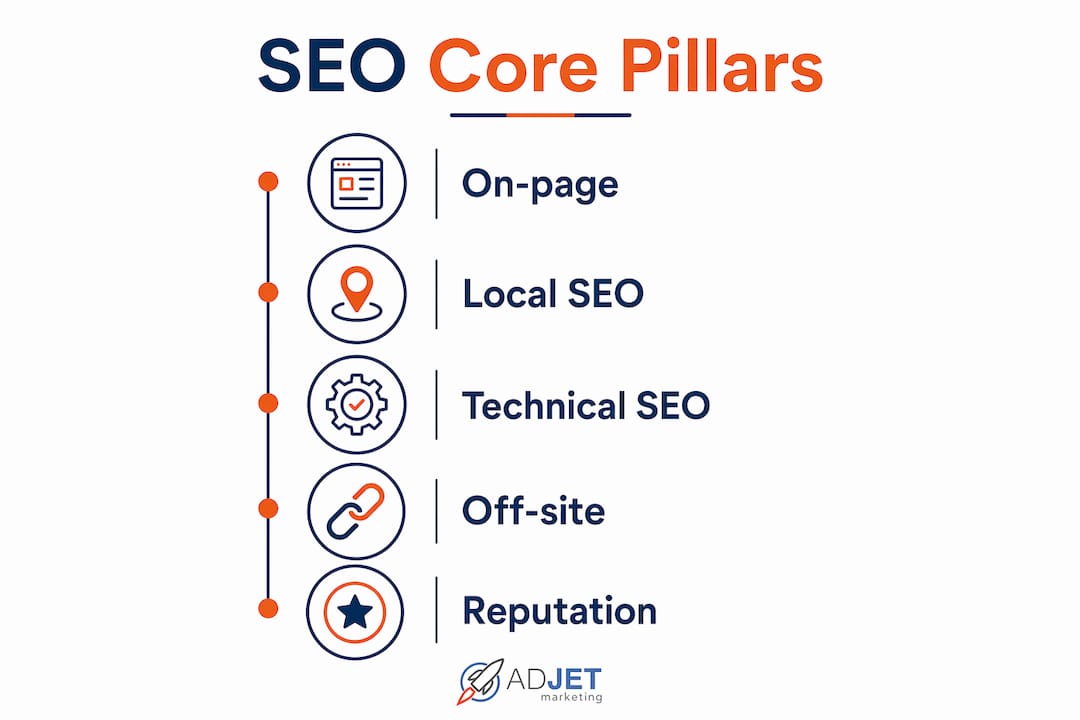
On-page content
On-page SEO means creating pages that directly answer the questions your patients are already asking. A therapist’s website should have individual service pages for each condition treated, not one generic “services” page. A pain clinic should explain each procedure in plain language, with the clinician’s credentials clearly visible. Google’s E-E-A-T standard requires medical content to demonstrate real experience and expertise, not just keyword density. The author’s name, credentials, and clinical background must appear on every content page.
Local SEO and Google Business Profile
Your Google Business Profile is the single highest-leverage asset in local search. Authentic patient reviews improve both your local ranking and the conversion rate of patients who find you. Keep your name, address, and phone number identical across every directory: Google, Yelp, Healthgrades, Psychology Today, and any specialty directories relevant to your field. Inconsistencies in your business information confuse Google’s local algorithm and suppress your map pack ranking.

Technical SEO
Technical SEO covers the infrastructure that allows Google to crawl, index, and rank your pages. The non-negotiables for a private practice website are:
- Page load speed under three seconds on mobile
- HTTPS security certificate (required for patient trust and Google ranking)
- Mobile-responsive design, since most health searches happen on smartphones
- Clean URL structure with no broken links or duplicate content
- Schema markup for medical practices, which helps Google understand your specialty and location
Off-site reputation
Backlinks from reputable health directories, local news sites, and professional associations signal authority to Google. A therapist quoted in a local news article, a physician listed on a hospital’s referring provider page, or a clinic featured in a regional health guide all generate the kind of off-site signals that trusted medical SEO requires. Quantity matters less than quality. One link from a respected medical association outweighs fifty links from unrelated directories.
| SEO component | Primary impact |
|---|---|
| On-page content | Matches patient search intent and demonstrates E-E-A-T |
| Google Business Profile | Drives map pack visibility and local patient calls |
| Technical SEO | Allows Google to crawl and rank your pages correctly |
| Off-site reputation | Builds domain authority through quality backlinks and reviews |
How is SEO evolving in 2026 with AI?
Private practice SEO now requires mastery of three distinct concepts: SEO for traditional search engines, AEO (Answer Engine Optimization) for AI answer tools, and GEO (Generative Engine Optimization) for AI-generated recommendations. Each one operates differently, and ignoring any of the three means leaving a patient acquisition channel uncovered.
AEO focuses on getting your content cited by AI tools like ChatGPT and Perplexity when patients ask health questions. GEO focuses on appearing in AI-generated summaries and recommendation lists. Both reward the same thing: clear, authoritative, well-structured content that directly answers specific questions.
Here is how to adjust your content strategy for AI-driven search in 2026:
- Write in direct question-and-answer format. AI platforms extract and cite structured FAQs more reliably than narrative paragraphs. Every service page should include a FAQ section with concise, factual answers.
- Publish one focused post per week for six months. Consistent, specific content builds topical authority faster than sporadic long-form posts. A therapist who publishes weekly on anxiety treatment becomes the recognized authority in that topic cluster.
- Add video content to your website and YouTube channel. Video is an authority signal that AI cannot replicate. A clinician explaining a treatment on camera builds the kind of human trust that AI-generated content cannot fake.
- Use your real name and credentials everywhere. AI tools prioritize named, credentialed sources over anonymous content. Your bio, your photo, and your license number should appear on every page you publish.
- Claim and verify your practice on AI business directories. Tools like Perplexity pull from structured data sources. Being listed accurately on Google, Bing Places, and Apple Maps increases the chance of appearing in AI-generated local recommendations.
Pro Tip: Before writing any new content, search your target question in ChatGPT and Perplexity. See what sources they cite. Then write content that is more specific, more credentialed, and more locally relevant than what is already being cited.
What practical steps can healthcare professionals take to implement SEO?
The most effective starting point is keyword research focused on patient intent, not industry jargon. Patients search for “help with panic attacks” not “cognitive behavioral therapy for anxiety disorders.” Tools like Google Search Console and Google’s autocomplete feature reveal exactly how patients phrase their searches in your area.
Your website structure matters as much as your content. Every private practice website needs these core pages, each optimized for a specific patient search:
- Home page: Establishes who you are, what you treat, and where you are located. Include your city name in the title tag and H1 heading.
- About page: Credentials, clinical philosophy, and a professional photo. This page directly supports E-E-A-T.
- Individual service pages: One page per condition or treatment. A single page titled “Services” cannot rank for multiple specific patient searches.
- Fees and insurance page: Patients search for cost information. A transparent fees page reduces friction and improves conversion.
- Contact page: Name, address, phone number, and an embedded Google Map. This page anchors your local SEO.
Encouraging authentic patient reviews is one of the highest-return activities in local search optimization. Ask satisfied patients directly, make the process easy with a direct review link, and respond to every review professionally. A practice with 50 recent, detailed reviews outranks a competitor with 200 older, generic ones.
Set realistic timelines. SEO for a new private practice website typically takes four to six months to show measurable ranking improvements. Practices in competitive urban markets may need nine to twelve months before organic traffic becomes a primary patient source. The work done in month one continues paying dividends in month eighteen.
Key takeaways
SEO is the most sustainable patient acquisition channel for private practices because it builds compounding visibility, trust, and authority that paid advertising cannot replicate over time.
| Point | Details |
|---|---|
| E-E-A-T is non-negotiable | Google scrutinizes medical content heavily; credentials and author bios must appear on every page. |
| Local SEO drives the fastest wins | Google Business Profile optimization and authentic reviews produce the quickest ranking gains. |
| AEO and GEO are now required | AI tools like ChatGPT and Perplexity are patient referral channels that need separate optimization. |
| Content consistency beats volume | Publishing one focused post per week for six months builds more authority than sporadic long posts. |
| Realistic timelines prevent abandonment | Expect four to six months for measurable results; commit to twelve months for full organic growth. |
Why most private practices are still leaving patients on the table
The clinics I see struggling with SEO share one pattern: they treat it as a one-time technical task rather than an ongoing communication strategy. They build a website, add a few service pages, and wait. When nothing happens after 90 days, they conclude that SEO does not work for their practice. That conclusion is wrong, but it is understandable.
What actually works is treating your website the way you treat your clinical reputation. You built that reputation by showing up consistently, being specific about what you do well, and earning trust one patient at a time. SEO works the same way. A therapist who publishes a clear, credentialed answer to “how do I know if I need therapy” every week for six months will rank for that question. A pain clinic that explains each procedure in plain language, with the physician’s name attached, will be cited by AI tools when patients ask about treatment options.
The AI shift makes this even more urgent. Practices that ignore ChatGPT and Perplexity as patient referral channels are making the same mistake clinics made in 2010 when they ignored Google entirely. The channel is different, but the principle is identical: be the most credible, specific, and accessible answer to your patient’s question, wherever they are asking it.
The other mistake I see is treating SEO and paid ads as competing choices. They are not. SEO builds the foundation. Google Ads fills the gaps while organic rankings develop. The practices that grow fastest use both, with SEO as the long-term asset and paid search as the short-term accelerator.
— Felix
How Adjetmarketing helps private practices grow through SEO
Adjetmarketing works with private healthcare providers, including mental health therapists, pain clinics, med spas, and imaging centers, to build SEO programs that produce real patient leads. As a Google Partner agency, Adjetmarketing combines technical SEO, patient-centered content, and Google Business Profile management into a single, measurable program. The team understands HIPAA compliance requirements and builds websites and content strategies that meet both Google’s E-E-A-T standards and healthcare privacy obligations. If you are ready to build a patient acquisition channel that compounds over time, explore Adjetmarketing’s healthcare digital marketing services or review the full SEO service offering to see what a structured program looks like for your practice type.
FAQ
What is the role of SEO in private practice?
SEO makes your practice discoverable to patients searching for your services online. It builds visibility, trust, and a sustainable patient acquisition channel that does not depend on paid advertising.
How long does SEO take to work for a private practice?
Most private practices see measurable ranking improvements within four to six months. Competitive urban markets may require nine to twelve months before organic traffic becomes a primary patient source.
Why does Google treat medical websites differently?
Google classifies medical websites as YMYL (Your Money or Your Life) content and applies the E-E-A-T standard more strictly. Clinician credentials, author bios, and accurate clinical information are required to rank well.
What is AEO and why does it matter for private practices?
AEO stands for Answer Engine Optimization. It focuses on structuring your content so AI tools like ChatGPT and Perplexity cite your practice when patients ask health-related questions, creating a referral channel beyond traditional Google search.
Is a Google Business Profile really that important?
Google Business Profile is the highest-leverage local SEO asset for private practices. It drives map pack visibility, collects patient reviews, and directly influences how many local patients call or contact your practice.
Recommended
- Private Practice Marketing Services: Your 2026 Growth Guide
- SEO Benefits For Aesthetics Practices: 2026 Guide
- SEO Best Practices 2026: What Marketers Must Know
- The Ultimate Guide To Dental SEO: Outranking Your Competitors – AdJet Digital Marketing & Google Partner Agency | SEO Development Google Ads Social