









SEO trends in 2026 for realtors are defined by one fundamental shift: Google and AI-powered search engines no longer just rank pages, they synthesize answers and cite sources. Realtors who understand this change will generate more qualified leads. Those who keep chasing keyword rankings alone will lose ground to agents with stronger content authority and better-structured websites. The core strategies now center on topical authority, structured data like FAQ Schema, Core Web Vitals compliance, and local SEO built around real neighborhood intelligence. This guide breaks down each trend with specific, practical steps you can act on today.
What are the major SEO trend shifts for realtors in 2026?
SEO in 2026 is defined more by presence in AI-generated answers and citations than by traditional rank positions. That means your goal is no longer just to rank on page one. Your goal is to be the source that Google’s AI Overview, Perplexity, or ChatGPT pulls from when a buyer asks “What are the best neighborhoods in Austin for families?”
This shift has a name: Answer Engine Optimization, or AEO. It sits alongside a related concept called Generative Engine Optimization (GEO). Both describe the practice of structuring content so AI systems can extract, trust, and cite it. For realtors, this means writing content that answers specific questions directly, not content that buries the answer in three paragraphs of background.

Entity-based SEO has replaced simple keyword density as the dominant ranking signal. Search engines now map relationships between named entities: your name, your brokerage, your city, specific neighborhoods, and local market data. Pages with clearly defined and linked named entities are 2.4x more likely to be cited in AI responses. That is a significant advantage for realtors who build content around real, verifiable local data.
Zero-click optimization is now a core strategy, not an afterthought. Using lists, tables, and short paragraphs improves your chances of winning featured snippets, People Also Ask boxes, and AI Overview citations. A buyer may never click your link, but they see your name and your answer. That brand impression compounds over time.
Pro Tip: Structure at least one section of every new page as a direct Q&A. Write the question as a heading, then answer it in two to three sentences. This format directly matches how AI Overviews extract content.
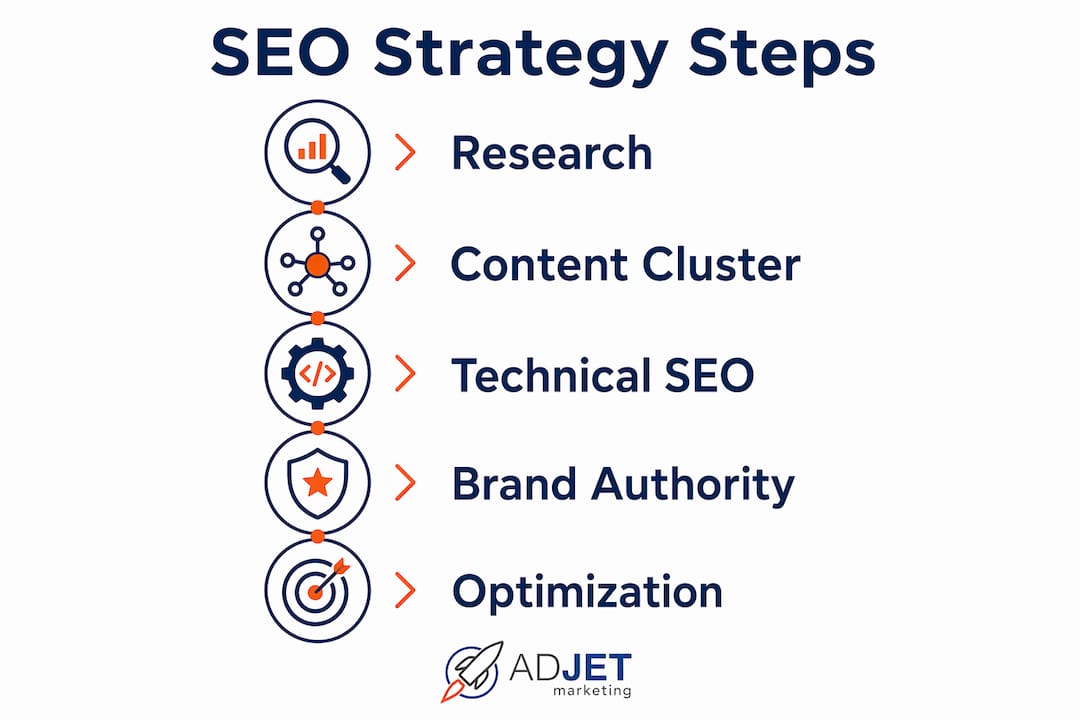
How can realtors build topical authority through content clusters and local SEO?
Topical authority has replaced simple keyword density as the primary ranking signal, and content clusters signal the expertise AI systems need to trust your site. A content cluster is a group of interlinked pages that cover one topic from multiple angles. For a realtor in Denver, that might mean a pillar page on “Denver real estate market 2026” supported by individual pages on each neighborhood, school district comparisons, price-to-rent ratios, and buyer guides.
Here is a practical framework for building a local content cluster:
- Create a pillar page. Write a comprehensive overview of your primary market. Include current median prices, inventory trends, and neighborhood breakdowns. This page becomes your hub.
- Build spoke pages for each neighborhood. Each spoke covers one area in depth: walkability scores, school ratings, average days on market, and local amenities. Link every spoke back to the pillar.
- Publish original market reports. Monthly or quarterly data updates with price-to-rent ratios and absorption rates give AI systems fresh, citable content. Answer-dense neighborhood guides with original data outperform generic listings for AI citations.
- Add hyper-local resource pages. Cover topics like “best coffee shops near Highlands Ranch” or “top-rated elementary schools in Plano ISD.” These pages capture long-tail searches and reinforce your local authority.
- Interlink consistently. Every new page should link to at least two existing pages on your site. Hub-to-spoke internal linking increases indexing speed by 38% in SEO-managed sites.
The real estate sites that struggle most are those with hundreds of MLS listing pages but no original local content. Those listings get indexed but rarely cited. AI systems need original, answer-dense content to pull from. A well-built content cluster strategy gives you that foundation.
Pro Tip: Add a “Neighborhood Snapshot” section to each area page with three to five bullet points of current data: median sale price, average days on market, and school rating. This format is easy for AI to extract and cite.
What technical SEO practices matter most for real estate websites in 2026?
Technical SEO remains non-negotiable, and the standards tightened in 2026. Google lowered its Core Web Vitals threshold in march 2026, and sites exceeding 2.0s LCP on mobile dropped an average of 4.3 ranking positions. For a realtor whose site loads slowly on a buyer’s phone, that drop directly translates to lost leads.
The table below shows the technical priorities that separate high-performing real estate sites from those losing ground in 2026.
| Technical Factor | Standard in 2026 | Impact if Ignored |
|---|---|---|
| Mobile LCP (Largest Contentful Paint) | Under 2.0 seconds | Average loss of 4.3 ranking positions |
| FAQ Schema implementation | Valid markup required | Risk of losing AI Overview citations |
| Title tags | Present on 99% of top sites | Reduced click-through from search results |
| Viewport meta tags | Present on 93% of top sites | Poor mobile rendering and user experience |
| HTTPS | Near-universal adoption | Trust signals and ranking factor |
FAQ Schema deserves special attention. 91% of pages gaining AI Overview citations in Q2 2026 had valid FAQ Schema implemented, while 67% of pages losing citations lacked valid schema. That correlation is too strong to ignore. Adding FAQ Schema to your neighborhood guides, buyer FAQ pages, and market reports is one of the highest-return technical tasks you can complete this year.
Technical SEO fundamentals like HTTPS, title tags, and viewport meta tags are now table stakes. The differentiator is how well your structured data communicates entity relationships to AI systems. Use schema markup to connect your name, your brokerage, your service area, and your content topics into a clear, machine-readable map.
How does brand authority influence realtors’ SEO success in AI-driven search?
Brand authority is now a measurable SEO signal, not just a marketing concept. AI Overviews favor well-known brands and reward increases in branded search volume with 20–35% higher citation rates. When buyers search for “Austin realtor reviews” and your name appears repeatedly across Google Business Profile, Zillow, Realtor.com, and local news sites, AI systems treat you as a trusted entity.
Building brand authority as a realtor requires consistent action across several channels:
- Publish first-person market commentary. Write monthly posts with your own analysis of local market conditions. AI systems weight author experience and verifiable expertise. Sign every piece with your full name and credentials.
- Earn citations from local sources. Get quoted in local news articles, neighborhood blogs, and community publications. Each citation reinforces your entity profile in Google’s knowledge graph.
- Collect and respond to reviews. Google Business Profile reviews directly influence local pack rankings and AI trust signals. Aim for consistent volume, not just a one-time burst.
- Build a recognizable content voice. Realtors who publish consistently on one platform, whether that is a blog, YouTube channel, or newsletter, build recall. Brand recall is now a KPI that feeds back into search visibility.
- Use lead magnets for realtors to capture branded traffic. Buyers who download your neighborhood guide or market report are more likely to search your name directly later.
Branded traffic converts at a higher rate than generic organic traffic. Even in a zero-click environment where buyers get answers without visiting your site, the brand impression from AI citations drives direct searches later. That is the compounding value of brand authority in 2026.
Key Takeaways
Realtors who combine topical authority, valid FAQ Schema, sub-2.0s mobile load times, and consistent brand-building will dominate AI-generated search results in 2026.
| Point | Details |
|---|---|
| AI citation over ranking | Structure content for AI Overview citations, not just page-one rankings. |
| Content clusters win | Build interlinked neighborhood guides and market reports around a single pillar page. |
| FAQ Schema is mandatory | 91% of pages gaining AI citations had valid FAQ Schema; implement it on every key page. |
| Mobile speed is critical | Sites exceeding 2.0s LCP on mobile lost an average of 4.3 ranking positions in 2026. |
| Brand authority compounds | Branded search volume increases of 20–35% directly improve AI citation rates. |
What I’ve learned watching realtors adapt to AI-driven SEO
The realtors who come to us frustrated with their SEO results share a common pattern. They published dozens of listing pages, added a few blog posts, and waited. Nothing moved. The problem is not effort. The problem is structure.
AI search systems do not reward volume. They reward clarity, specificity, and trust. A single neighborhood guide with original price data, school ratings, and a well-structured FAQ section will outperform ten generic “homes for sale in X” pages every time. I have seen this play out repeatedly with clients who shifted from quantity to depth.
The other mistake I see often is treating technical SEO as a one-time setup. Core Web Vitals thresholds change. Schema requirements evolve. A site that passed every technical check in 2024 may be losing ranking positions today because its mobile LCP crept above 2.0 seconds after a plugin update. Technical hygiene requires ongoing attention, not a single audit.
My honest recommendation: pair your organic SEO work with a modest Google Ads budget while your content cluster builds authority. Google Ads gives you immediate visibility for high-intent buyer searches while your organic presence matures. The two channels reinforce each other. Buyers who see your paid ad and later find your organic content trust you more. Patience matters in SEO, but you do not have to wait in silence.
— Felix
How Adjetmarketing helps realtors build SEO that performs in 2026
Adjetmarketing works with real estate professionals to build the content infrastructure, technical foundation, and brand authority that AI-driven search rewards. That means structured content clusters built around your specific market, FAQ Schema implementation, Core Web Vitals audits, and local SEO strategies tied to real neighborhood data. We do not hand you a generic keyword list. We build a system designed to get your name cited where buyers are already looking for answers. If you are ready to move beyond rankings and into AI-visible authority, our real estate SEO services are built for exactly that.
FAQ
What is Answer Engine Optimization for realtors?
Answer Engine Optimization (AEO) is the practice of structuring content so AI search tools like Google’s AI Overview can extract and cite it directly. Realtors apply AEO by writing direct Q&A sections, using FAQ Schema, and building answer-dense local content.
How does FAQ Schema help real estate websites rank in 2026?
FAQ Schema signals to AI systems that your page contains structured, trustworthy answers. Pages with valid FAQ Schema were present in 91% of AI Overview citations gained in Q2 2026, making it one of the highest-impact technical implementations for real estate sites.
What is a content cluster and why do realtors need one?
A content cluster is a group of interlinked pages covering one topic from multiple angles, anchored by a pillar page. Realtors need content clusters because topical authority, not individual keyword pages, is the primary signal AI systems use to evaluate expertise and trustworthiness.
How fast does a real estate website need to load on mobile in 2026?
Google’s updated Core Web Vitals standard requires a Largest Contentful Paint (LCP) under 2.0 seconds on mobile. Sites that exceed this threshold dropped an average of 4.3 ranking positions after Google’s march 2026 update.
Does brand authority actually affect SEO rankings for realtors?
Brand authority directly influences AI citation rates. Realtors who build consistent branded search volume through reviews, local citations, and original content see 20–35% higher rates of being cited in AI-generated answers, which drives both visibility and direct search traffic.
Recommended
- Real Estate SEO: Strategies For Agents To Boost Leads
- What Social Media Platforms Should Realtors Use? | The Top 5 That Actually Work – AdJet Digital Marketing & Google Partner Agency | SEO Development Google Ads Social
- SEO Terminology For Real Estate Agents: 2026 Guide
- SEO Benefits For Real Estate Agents: Drive More Leads