









A roofing marketing agency is a specialized service provider that builds and manages marketing systems designed to generate high-quality, exclusive roofing leads and convert them into booked jobs. Unlike general digital marketing firms, these agencies track revenue-linked metrics like cost per booked job, lead source attribution, and call recording quality rather than clicks or impressions. The best ones combine Google Local Services Ads, paid search, local SEO, and CRM automation into a single pipeline built around one goal: more closed jobs at a lower acquisition cost. If you are a roofing contractor evaluating your options, understanding how these agencies work will help you spend smarter and grow faster.
What marketing channels does a roofing marketing agency use?
Roofing marketing agencies increasingly rely on multi-channel systems combining SEO, paid ads, local SEO, reputation management, CRM automation, and lead response systems. No single channel wins alone. The agencies that produce consistent results for roofing contractors integrate all of them into a coordinated pipeline.
Here is how the main channels break down and what each one does for your business:
| Channel | Primary Role | Best For |
|---|---|---|
| Google Local Services Ads (LSA) | Pay-per-lead, Google-verified badge | Emergency repairs, high-urgency calls |
| Google Search Ads | Pay-per-click, keyword targeting | Replacement, insurance claims, broader intent |
| Local SEO | Organic Google Maps visibility | Long-term, low-cost lead volume |
| Website / Landing Pages | Convert traffic into calls and form fills | All traffic sources |
| Reputation Management | Build and protect review profile | Trust signals, LSA ranking |
LSA drives high-urgency calls for emergency repair scenarios, while Google Search Ads capture broader, higher-ticket searches like roof replacement and insurance restoration. Running both together covers the full spectrum of roofing search intent.
On the organic side, local SEO builds a compounding asset. A well-optimized Google Business Profile combined with location-specific service pages can generate leads at near-zero marginal cost over time. That is the core reason agencies recommend investing in SEO alongside paid ads rather than treating them as alternatives.
Conversion-optimized roofing websites built for mobile-first performance and fast load times can achieve 12 to 18% lead conversion rates, compared to 2 to 3% for unoptimized sites. That gap is not a minor improvement. It means the same ad spend produces six times more leads when the website is built correctly.
High-intent keywords like “roof repair near me” and “emergency roof leak repair” are the primary targets for paid campaigns. These terms signal immediate buying intent, which is exactly the traffic worth paying for.
How do roofing agencies improve lead-to-job conversion with speed-to-lead?
Generating leads is only half the job. The other half is converting them before a competitor does. Contacting inbound roofing leads within 5 minutes increases close rates by 18% compared to later contact. After 60 minutes, conversion drops roughly 80%. That is not a small margin. It is the difference between a profitable campaign and a frustrating one.
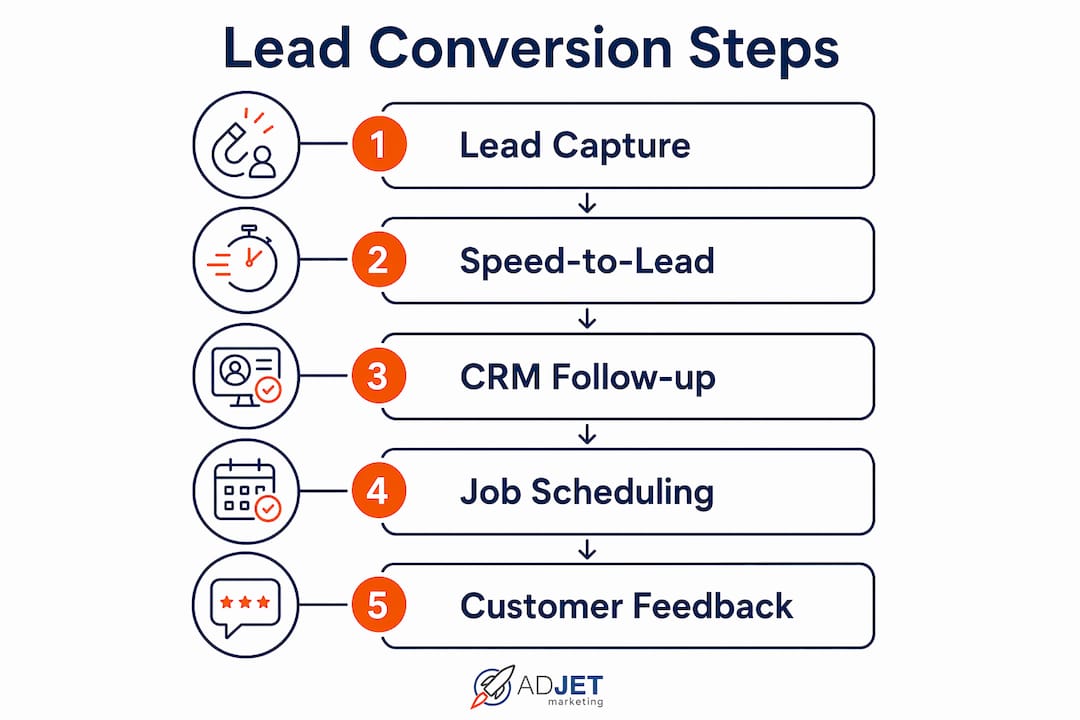
The agencies that understand this build operational systems around speed-to-lead, not just ad campaigns. Here is the process a well-structured roofing marketing agency implements:
- Instant lead notification. The moment a form is submitted or a call comes in, the system sends an SMS and email alert to the owner or sales rep. Tools like CallRail and Zapier handle this in real time.
- Automated first-touch SMS. An automated text goes to the lead within 60 seconds, confirming receipt and setting expectations. This keeps the lead warm while a human prepares to call back.
- Owner or rep call within 5 minutes. The human follow-up call happens immediately. CRMs like JobNimbus log the attempt and trigger the next step if there is no answer.
- Multi-attempt follow-up sequence. If the first call goes unanswered, the system triggers additional attempts at 10, 30, and 60 minutes, then again the next morning.
- After-hours coverage. Virtual receptionists or SMS automation handle leads that come in outside business hours, so no lead sits cold until morning.
Pro Tip: Set up a missed-call text-back in your CRM so that every unanswered call receives an automatic SMS within 30 seconds. Many contractors lose jobs simply because a lead called, got voicemail, and called the next roofer on the list.
Speed-to-lead is as much an operational process as a marketing optimization. An agency that only manages your ads but ignores your response infrastructure is leaving a significant portion of your ad spend on the floor.
What is the difference between exclusive and shared roofing leads?
Exclusive leads are generated specifically for your business and sent only to you. Shared leads are sold to multiple contractors simultaneously, meaning you are competing against two, three, or more roofers the moment the lead comes in.
The practical impact is significant. Switching to exclusive lead generation improved one contractor’s close rate from 22% to 38%. That improvement did not come from better salesmanship. It came from removing the competition at the point of first contact.
Here is what separates a genuine exclusive lead program from a marketing claim:
- Dedicated campaign assets. Your ads, landing pages, and phone numbers are built for your business only. No shared infrastructure.
- Call recording access. You can verify that every lead came from your campaign and was not routed from a shared pool.
- Real-time CRM attribution. Each lead is tagged with its source channel, campaign, and keyword so you can see exactly where it originated.
- No resale clauses. The agency contract explicitly prohibits selling your lead data to other contractors.
Claimed exclusive leads require proof through call recordings, real-time tracking, and source attribution. If an agency cannot show you this data, the exclusivity claim is unverified. Ask for it before signing any contract.
Shared lead platforms can work as a volume supplement, but they should not be your primary acquisition channel. The economics are unfavorable: you pay the same price as your competitors for a lead that all of you are chasing at the same time.
How to choose the right roofing marketing agency for your business
Most roofing contractors who come to agencies after a bad experience share a common story: the previous agency promised leads, delivered some volume, but could not explain where the leads came from or why the close rate was low. Choosing the right agency starts with asking the right questions before you commit.
Here is what to evaluate:
- Transparent reporting. The agency should provide a dashboard showing cost per lead, cost per booked appointment, and cost per closed job by channel. Fully attributed dashboards showing channel-level lead attribution are the standard for serious roofing agencies.
- Roofing-specific track record. Ask for examples from roofing clients in comparable markets. General contractor experience does not automatically translate to roofing.
- Channel mix rationale. A good agency explains why it recommends a specific mix for your market, service focus, and budget. If the recommendation is the same for every client, that is a red flag.
- Speed-to-lead infrastructure. Ask whether the agency helps set up CRM automation, call tracking, and missed-call follow-up. If they only manage ads, you are missing half the system.
- Lead exclusivity documentation. Request a written explanation of how leads are generated and distributed, plus access to call recordings.
Pro Tip: Before signing, ask the agency to show you a sample reporting dashboard from a current roofing client. If they cannot or will not, assume the reporting is not detailed enough to manage your budget effectively.
On budget and timeline: Google LSA cost per lead for roofing averages around $126.60 in 2026, with a typical range of $53 to $148 depending on market and competition. That means a $2,000 monthly LSA budget produces roughly 13 to 38 leads. Realistic expectations require knowing your close rate and average job value before deciding whether that math works for your business.
SEO takes three to six months to produce meaningful organic lead volume. Paid ads can generate leads within days of launch. Most contractors benefit from starting with paid acquisition while building SEO in parallel, then reducing paid spend as organic volume grows.
Key takeaways
A roofing marketing agency produces results only when it combines the right channel mix with operational systems that convert leads into booked jobs before competitors do.
| Point | Details |
|---|---|
| Multi-channel integration | Combining LSA, Google Ads, local SEO, and reputation management outperforms any single channel. |
| Speed-to-lead is operational | Responding within 5 minutes requires CRM automation, not just faster salespeople. |
| Exclusive leads close better | Verified exclusive leads improved one contractor’s close rate from 22% to 38%. |
| Demand transparent reporting | Cost per booked job and channel attribution are the metrics that matter, not clicks. |
| Budget and timeline are linked | Paid ads deliver leads quickly; SEO builds lower-cost volume over 3 to 6 months. |
Why most roofers are sold marketing but not systems
I have worked with contractors across home services long enough to see the same pattern repeat. A roofer hires an agency, the agency runs Google Ads, leads come in, and then the close rate is disappointing. The contractor blames the leads. The agency blames the sales process. Neither is entirely wrong, but both are missing the real issue.
The real issue is that marketing and operations were never connected. The ads generated interest. The website converted some of it. But no one built the system that turns a form submission at 7 PM on a Friday into a booked appointment by Saturday morning. That gap is where most roofing marketing budgets go to waste.
What I have seen work consistently is an integrated approach: paid acquisition feeds into a conversion-optimized landing page, which feeds into an automated CRM sequence, which triggers a human call within minutes. Measuring lead to appointment to closed job conversions is the only way to know whether the system is actually working. Volume metrics are noise without that chain.
The other thing I would tell any roofer evaluating agencies: be skeptical of any promise that does not come with a reporting framework. If an agency cannot show you cost per booked job within 60 days of launch, they are not measuring what matters. You deserve to see exactly where every dollar goes and what it produced.
— Felix
How Adjetmarketing helps roofing contractors build a predictable lead pipeline
Adjetmarketing is a Google Partner agency that builds performance-driven marketing systems for contractors who want measurable growth, not just ad spend. Our approach covers digital marketing strategy development from channel selection through CRM integration, so your pipeline works as a connected system rather than a collection of disconnected tools.
We manage Google Ads campaigns and Local Services Ads built around roofing-specific intent, paired with SEO strategies that build long-term organic lead volume. Every campaign includes transparent reporting at the job level, not just the click level. If you want to understand what your marketing is actually producing, we are ready to walk through your current setup and show you where the gaps are.
FAQ
What does a roofing marketing agency actually do?
A roofing marketing agency builds and manages lead generation systems for roofing contractors, including Google Ads, Local Services Ads, SEO, website optimization, and CRM automation. The goal is to produce exclusive, qualified leads and convert them into booked jobs at a measurable cost.
How much do roofing leads cost through Google LSA?
Google Local Services Ads cost per lead for roofing contractors averages around $126.60 in 2026, with a range of approximately $53 to $148 depending on market competition and campaign structure.
Why does response time matter so much for roofing leads?
Contacting a roofing lead within 5 minutes increases close rates by 18%, while waiting 60 minutes or longer causes conversion to drop by roughly 80%. Fast response requires automated CRM systems, not just attentive salespeople.
What is the difference between exclusive and shared roofing leads?
Exclusive leads are generated solely for your business and never sold to competing contractors. Shared leads go to multiple roofers at once, reducing your close rate and increasing the cost to acquire each job.
How long does roofing digital marketing take to produce results?
Google Ads and Local Services Ads can generate leads within days of launch. SEO typically requires three to six months to build meaningful organic lead volume, which is why most contractors benefit from running both channels simultaneously.
Recommended
- Google Ads For Contractors: Get More Leads In 2026
- Home Services Marketing Agency: 2026 Growth Guide
- Unlocking Industrial Success: A Guide To Choosing The Right Marketing Agency – AdJet Digital Marketing & Google Partner Agency | SEO Development Google Ads Social
- Mastering B2B Industrial Marketing: Secrets From Top Agencies – AdJet Digital Marketing & Google Partner Agency | SEO Development Google Ads Social