









Why landing pages are the conversion engine of healthcare marketing
The role of landing pages in healthcare is straightforward: they turn ad clicks and search traffic into booked appointments. A general clinic website introduces your practice. A landing page does one thing — it converts a specific visitor with a specific intent.
Healthcare landing pages convert around 3–4% of visitors on average, while deliberately optimized pages reach 8–10%. That gap does not come from more traffic. It comes from a better page.
What makes a healthcare landing page effective:
- Single, focused purpose: one treatment, one offer, one call to action
- Trust signals: patient testimonials, accreditations, and visible certifications
- Ad-to-page alignment: the page delivers exactly what the ad promised
- HIPAA-conscious design: no tracking pixels that capture protected health information without consent
- Fast load times and mobile-ready layout: Over 60% of healthcare website traffic comes from mobile devices.
- Clear next step: a specific, benefit-named CTA above the fold
Patients making health decisions need clarity and trust before they act. A landing page built around those two things is your most reliable patient acquisition asset.

How healthcare landing pages differ from general clinic websites
A clinic website is built for breadth. It introduces your team, lists your services, explains your philosophy, and links to your blog. That structure works well for brand awareness. It works poorly for converting paid traffic.
A landing page is built for depth on a single topic. When someone clicks a Google Ad for “knee pain injection therapy,” they expect to land on a page about exactly that treatment. Sending them to your homepage forces them to hunt for the information they already asked for. Most will not bother.

Key structural differences:
| Element | General website | Landing page |
|---|---|---|
| Navigation | Full menu with multiple links | Minimal or none |
| Content scope | All services and information | One treatment or offer |
| CTA | Multiple competing actions | Single, specific action |
| Goal | Inform and explore | Convert one visitor |
| Ad traffic suitability | Poor | High |
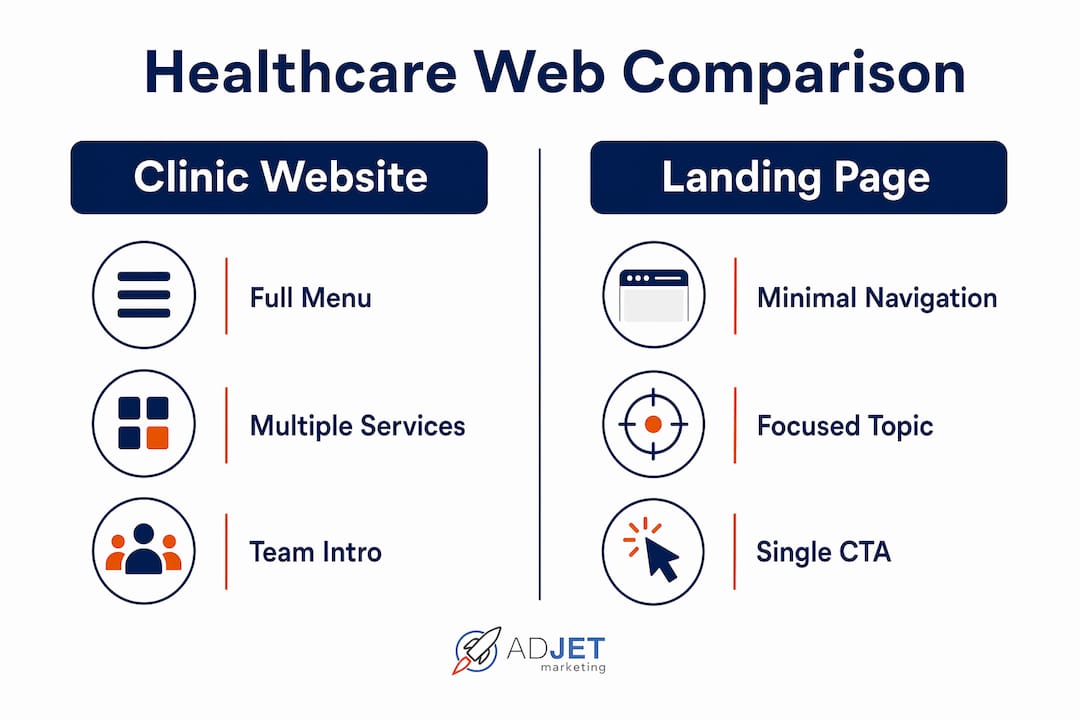
The most common mistake clinics make is routing all paid ad traffic to their homepage. Every additional link or menu option on a page is a decision point that pulls the patient away from booking. A landing page removes those distractions and keeps the path to conversion clear.
Why optimized landing pages directly drive patient conversions
Patients choosing a healthcare provider are not browsing casually. They are weighing a decision that affects their body or their health. That stakes level means trust is not a nice design touch — it is the primary conversion driver.
Treatment-specific pages consistently outperform general services pages because they match the patient’s exact search intent. A dedicated FUE hair transplant page answers the specific questions a patient researching that procedure actually has: recovery time, realistic results, cost range, and what the first appointment looks like. A general “hair restoration” page cannot do that well.
Key engagement and conversion drivers:
- Specificity: pages that name the treatment and address its unique patient concerns
- Speed: every additional second of load time costs 7% in conversions
- Mobile design: click-to-call buttons, short forms, and CTAs visible without scrolling
- HIPAA compliance: avoid embedding tracking tools that collect PHI without explicit patient consent
- Upfront eligibility information: clearly stating disqualifying criteria reduces drop-off and improves conversion efficiency
Pro Tip: Match your landing page headline word-for-word with your ad copy. If your ad says “Free Botox Consultation in Dallas,” your page headline should say the same thing. Any gap between the ad’s promise and the page’s content erodes trust immediately and raises your bounce rate.
Best practices for designing effective healthcare landing pages
The clinics that consistently generate appointments from their digital campaigns share a common pattern. Their pages are specific, fast, compliant, and built around what the patient needs to feel confident enough to book.
Core design principles:
- Write a headline that names the treatment and the benefit, not just the clinic name
- Place your primary CTA above the fold, visible without scrolling on mobile
- Keep forms short: name, phone number, and one qualifying question is usually enough
- Add trust signals — Google review scores, board certifications, before-and-after photos with consent — near the booking form, not buried at the bottom
- State eligibility criteria and what to expect at the first visit so patients arrive prepared
Pro Tip: Compliance messaging and conversion copy are not in conflict. A sentence like “All consultations are confidential and HIPAA-compliant” placed near your form does two things at once: it satisfies a regulatory expectation and it removes a patient’s hesitation about sharing personal information.
| Page element | Weak version | Strong version |
|---|---|---|
| Headline | “Welcome to Our Clinic” | “Book Your Free Knee Pain Consultation” |
| CTA | “Contact Us” | “Schedule My Consultation Today” |
| Trust signal | Logo row at footer | Google reviews + certification badge near form |
| Form length | 8+ fields | 3 fields maximum |
| Compliance | No mention | “HIPAA-compliant. Your information stays private.” |
Google Ads policies require healthcare landing pages to avoid misleading claims and stay within FDA and FTC guidelines. That means no guaranteed results, no unsupported efficacy claims, and no language that overstates what a treatment can do. Building your page around honest, specific information protects you legally and builds the patient trust that actually converts.
Each treatment-specific page also functions as an independent SEO asset, ranking for its own keyword set and capturing patients further along in their decision process without competing with your homepage.
How well-designed landing pages improve patient engagement and conversion rates
Conversion data indicates that average healthcare landing pages convert a modest share of visitors, while top performers achieve significantly better results through deliberate optimization. Clinics exceeding typical conversion benchmarks are generally considered ahead of most practices.
Personalized, treatment-specific CTAs tend to convert better than generic ones like “Contact Us.” Naming the specific action and treatment helps reduce hesitation and encourages booking.
Performance drivers worth tracking:
- CTA specificity: “Book Your Free Lip Filler Consultation” vs. “Get in Touch”
- Mobile conversion gap: mobile conversion rates run 8% lower than desktop, largely due to poor form design and buried CTAs
- Load speed: a 5-second load time loses a measurable share of patients before they read a single word
- A/B testing: experiment with information order, social proof placement, and CTA wording using tools like Google Optimize or VWO
- Tracking: use Google Analytics 4 with conversion events, and ensure your tracking setup is HIPAA-compliant before capturing any form submissions
For crafting CTAs that convert, the principle is the same across healthcare specialties: name the action, name the treatment, and remove every reason to hesitate.
Expert insights on healthcare landing pages from Adjetmarketing
At Adjetmarketing, we work with medical clinics, med spas, pain management centers, and mental health practices across the United States. The pattern we see most often is this: a clinic is running Google Ads, spending a real budget, and getting poor lead quality. When we audit the campaign, the ads are usually fine. The landing page is the problem.
The most common failure is a mismatch between the ad and the page. An ad promises a free consultation for a specific treatment, and the page it links to is a general homepage with no mention of that treatment. Patients leave immediately. The budget is wasted.
Felix Shaye, who leads strategy at Adjetmarketing, puts it directly: the page has to earn the click. If the ad created an expectation, the page has to fulfill it within the first three seconds. Anything less and the patient is already looking at another clinic.
Key principles from our agency work:
- Build one landing page per ad group, not one page for all campaigns
- Keep compliance messaging visible but brief — it builds confidence without slowing the read
- Test continuously: A/B testing on information order, social proof placement, and CTA wording produces measurable gains over time
- Integrate your landing page form with your CRM so leads are followed up within minutes, not hours
- Set realistic expectations: a well-built page improves conversion rates, but it works best when the ad targeting is also precise
Pro Tip: Never treat a landing page as finished. Run one test at a time, measure for at least two weeks, and document what changed. Clinics that iterate consistently outperform those that launch and leave.
Building trust online is a process, not a one-time design decision. The clinics that win patient confidence consistently are the ones that treat every page element, from the headline to the privacy notice, as a trust signal.
What high-performing healthcare landing pages actually look like
The best-performing healthcare landing pages share a structure that is easy to recognize once you know what to look for. They are not the most visually elaborate pages. They are the clearest ones.
Characteristics of high-converting clinic pages:
A fertility clinic landing page built around a single service, such as IVF consultations, typically opens with a headline that names the treatment and a benefit (“Start Your IVF Journey with a Free Consultation”), followed immediately by a short form and a visible phone number. Trust signals, including board certifications, patient success rates disclosed responsibly, and a brief physician bio, appear within the first scroll. The CTA is repeated at the bottom for patients who read the full page.
A pain management clinic page for nerve block injections works differently. Patients searching for that treatment often have chronic pain and are skeptical after trying other options. High-performing pages in this category lead with empathy in the headline, address the most common patient concern early (“No surgery required”), and use a short FAQ section to answer eligibility questions before the form. This approach, addressing patient concerns upfront, reduces abandonment and improves the quality of leads.
A dental clinic page for Invisalign consultations typically performs best when it includes before-and-after photos with consent, a clear price range or financing option, and a CTA that names the next step precisely: “See If You Qualify for Invisalign.” You can see how Adjetmarketing applies these principles in practice through our dental landing page guide.
The common thread across all three: one treatment, one CTA, trust signals near the form, and no navigation links pulling the patient away from the page.
How landing pages connect with your CRM and patient management systems
A landing page that captures a lead but does not route it correctly is only half a system. The follow-up speed matters as much as the conversion itself. Patients who submit a form and do not hear back within a short window often book with another clinic.
Integration points that matter:
- CRM connection: connect your form directly to a CRM like HubSpot, Salesforce Health Cloud, or a healthcare-specific platform so every lead is logged, tagged by treatment, and assigned for follow-up automatically
- Email and SMS automation: trigger an immediate confirmation message when a form is submitted, confirming the appointment request and setting expectations for next steps
- Call tracking: use a tool like CallRail to assign unique phone numbers to each landing page, so you know exactly which page and which campaign generated each call
- EHR integration: for practices using electronic health record systems, some CRM platforms offer direct integration so a new patient inquiry can flow into the intake process without manual data entry
- HIPAA-compliant data handling: any system that touches patient-submitted information must meet HIPAA standards. Standard marketing CRMs are not automatically compliant. Confirm your vendor’s Business Associate Agreement (BAA) before connecting form data to any third-party tool
The SEO and paid traffic strategies that drive patients to your landing pages only deliver full value when the back-end systems capture, route, and follow up on every lead without gaps. A well-integrated landing page is not just a conversion tool. It is the entry point to your entire patient acquisition workflow.
Key Takeaways
Healthcare landing pages convert more patients than general websites because they match specific intent, build trust quickly, and remove friction from the booking process.
| Point | Details |
|---|---|
| Conversion rate gap | 3–4%; optimized pages reach 8–10% |
| CTA specificity matters | Treatment-specific CTAs convert better than generic alternatives like “Contact Us.” |
| Mobile is the priority | A majority of clinic traffic comes from mobile devices, although mobile conversion rates are generally lower than those on desktop. |
| Compliance builds trust | HIPAA-compliant messaging near your form reduces patient hesitation and meets regulatory standards. |
| CRM integration closes the loop | Connecting your form to a compliant CRM and triggering immediate follow-up prevents leads from going cold. |
Ready to turn your clinic’s traffic into booked appointments?
If your clinic is running Google Ads or investing in SEO and the appointment volume is not reflecting it, the page is usually where the breakdown happens. Adjetmarketing builds and manages high-converting landing pages for medical clinics, med spas, pain management centers, and mental health practices across the United States. We handle the design, the compliance review, the CRM integration, and the ongoing testing so your pages keep improving. If you want to see what a properly built patient acquisition system looks like for your specific practice, our Google Ads team is a good place to start.