









Reputation management for med spas is defined as the ongoing process of generating, monitoring, and responding to patient reviews to build trust and improve online visibility. This is not a passive activity. Over 90% of potential patients research online reviews before booking, and practices with 4 or 5-star ratings rank an average of 9% higher in local search results than lower-rated competitors. That gap in rankings translates directly into appointment volume. Understanding what is reputation management for medspas, and how to execute it consistently, is one of the highest-return activities a practice owner can invest in.
What is reputation management for med spas?
Reputation management for med spas is the structured practice of controlling how your practice appears across Google, Yelp, RealSelf, and other review platforms through active review generation, real-time monitoring, and professional response protocols. The industry term used by healthcare marketers is online reputation management, or ORM. Both terms describe the same core activity: shaping patient perception before, during, and after their visit.
ORM for med spas differs from general business reputation work because of two factors: HIPAA compliance and the emotional sensitivity of aesthetic treatments. You cannot publicly confirm that someone is a patient. You cannot discuss treatment details in a response. Every public reply must be crafted to protect patient privacy while still addressing the concern. That constraint makes med spa ORM more technical than it is for a restaurant or retail store.

The business case is direct. Med spas with 200+ reviews at 4.7 stars convert website visitors at 2 to 3 times the rate of practices with fewer, lower-rated reviews. Review volume signals authority to Google’s local search algorithm, and review content gives prospective patients the social proof they need to book a treatment they may find intimidating. A well-managed online reputation for medspas is not a vanity metric. It is a patient acquisition channel.
How do med spas generate and manage patient reviews effectively?
Review generation is the most controllable part of ORM, and the method you use matters as much as the timing. The channel, the message, and the sender all affect whether a patient actually leaves a review.
1. Choose SMS over email. SMS open rates average 98% compared to 20–28% for email. That gap alone makes SMS the default channel for review requests in any active practice. Patients read texts. They archive emails.
2. Send the request within 24 hours. Positive sentiment peaks immediately after a treatment. Waiting 48 hours or longer allows that enthusiasm to fade. Sending within 2 hours post-treatment captures patients when their experience is freshest and their motivation to share is highest.
3. Personalize the message. Generic automated messages underperform. Provider-personalized review requests convert at 3 times the rate of generic automated messages. A text that reads “Hi Sarah, this is Dr. Nguyen. I hope your Botox appointment went well today. If you have a moment, I’d love your feedback” will outperform any template.
4. Make the action frictionless. Include a direct link to your Google Business Profile review form. Every additional step a patient must take reduces the chance they complete the request.
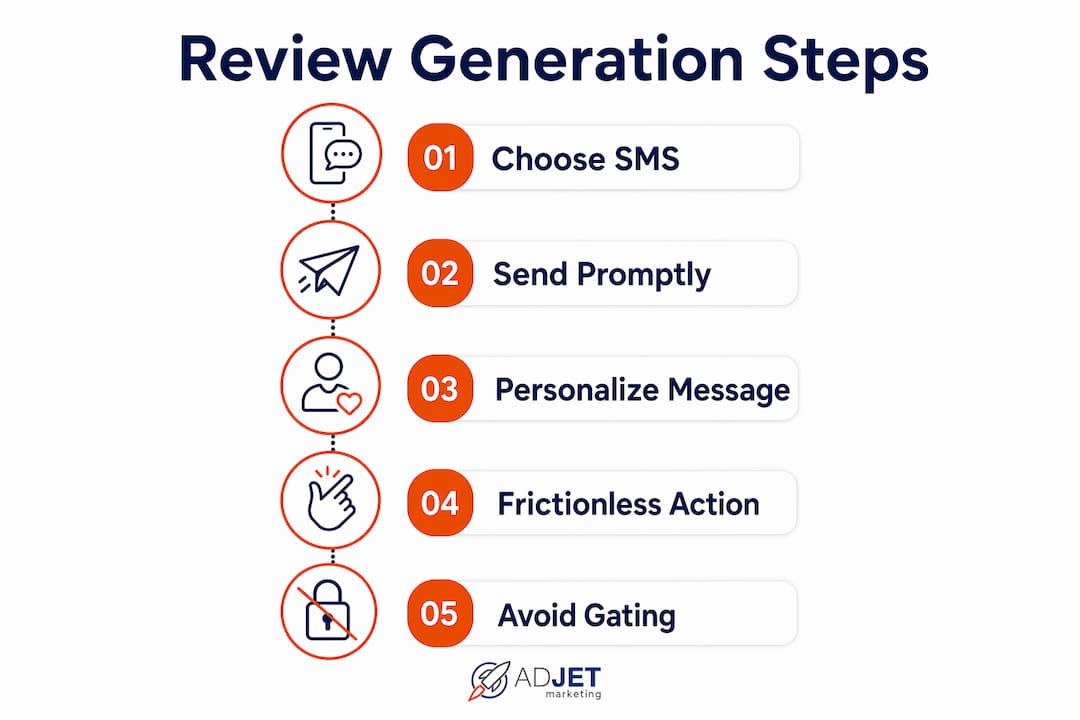
5. Avoid review gating. Review gating means selectively asking only satisfied patients for reviews. This practice violates Google’s policies and risks suspension of your Google Business Profile. Ask all patients, not just the ones you expect to rate you highly.
Pro Tip: Set up your review request as a triggered automation tied to appointment completion in your practice management software. This removes the human memory requirement and keeps your review volume growing consistently without adding staff workload.
Med spas using consistent, automated review management report 2 to 3 times better patient acquisition results compared to practices relying on word-of-mouth alone. Automation is not a shortcut. It is the only way to maintain volume at scale.
Why is monitoring and responding to reviews critical for med spa reputation?
Generating reviews is only half the work. How you monitor and respond to them determines whether your reputation grows or erodes over time.
Effective monitoring means you know about every new review within hours, not days. A centralized dashboard that aggregates reviews from Google, Yelp, RealSelf, and Facebook into one view is the standard approach for practices with moderate to high appointment volume. Without that visibility, negative reviews can sit unanswered for weeks, which signals to prospective patients that the practice does not care.
Responding to reviews, both positive and negative, builds trust. Responding to a positive review takes 30 seconds and shows the next reader that your team is engaged. Responding to a negative review is more complex, but the 3 R method gives you a repeatable framework:
- Recognize: Acknowledge the patient’s experience without confirming they are a patient or admitting fault. “We’re sorry to hear your visit did not meet your expectations.”
- Respond: Address the concern at a general level. Keep it brief and professional.
- Redirect: Move the conversation offline. “Please contact our patient care team directly at [phone number] so we can make this right.”
This method keeps you HIPAA-compliant while demonstrating accountability to everyone reading the exchange. A balanced review profile, one that includes occasional constructive feedback alongside strong ratings, actually increases credibility. Patients distrust a practice with 500 five-star reviews and zero criticism.
Pro Tip: Create a HIPAA-compliant response template library with 5 to 8 pre-approved responses for common negative review scenarios. Your front desk team can then respond quickly without legal risk or inconsistency.
How does reputation management influence med spa local SEO and patient acquisition?
Your review profile is a direct input into Google’s local search ranking algorithm. This is not a theory. Practices with 4 to 5-star ratings rank 9% higher in local search results on average. That ranking advantage compounds over time as more reviews accumulate and your Google Business Profile gains authority.
The table below shows how reputation factors connect to specific business outcomes:
| Reputation factor | Business outcome |
|---|---|
| Higher average star rating | Improved local search ranking and click-through rate |
| Higher review volume | Stronger authority signal to Google’s algorithm |
| Reviews mentioning providers by name | Increased trust and bookings for specific providers |
| Fast response to negative reviews | Reduced churn and improved patient retention |
| Consistent review generation | Sustained ranking gains over time |
Reviews also reduce the perceived risk of booking an aesthetic treatment. Botox, laser resurfacing, and body contouring are not impulse purchases. Patients research extensively before committing. A strong review profile answers the questions they are asking before they ever contact your practice. That is why local SEO for med spas and reputation management are inseparable strategies, not separate ones.
Reviews that mention individual providers by name add another layer of trust. A patient reading “Dr. Kim was thorough and made me feel completely comfortable” is more likely to book with Dr. Kim specifically. That provider-level trust increases both conversion rates and patient loyalty.
What are the best practices and pitfalls to avoid in med spa reputation management?
Executing ORM well requires both the right systems and the right habits. The following practices separate high-performing med spas from those that plateau.
- Automate at scale. Manual reputation management is unsustainable for practices handling 80 to 120 appointments weekly. Automation is not optional at that volume. It is operationally necessary.
- Use satisfaction-first routing. A private Net Promoter Score (NPS) survey sent immediately post-visit lets you identify dissatisfied patients before they post publicly. Patients scoring 0–6 receive direct outreach from a manager. Patients scoring 9–10 are routed to your public review request. This approach protects your public rating while surfacing real clinical feedback internally.
- Never gate reviews. Asking only happy patients for public reviews is review gating. It violates Google’s terms of service and can result in your Google Business Profile being suspended. Ask all patients consistently.
- Protect patient privacy in every response. Never confirm someone is a patient in a public reply. Never reference treatment details. Keep all responses general and redirect sensitive conversations to a private channel.
- Integrate ORM into your standard operating procedures. Reputation management that depends on one staff member remembering to send requests will fail. Build it into your appointment workflow so it runs automatically regardless of who is working that day.
The practices that build the strongest reputations treat ORM as a clinical process, not a marketing task. It runs on a schedule, follows a protocol, and gets measured like any other performance metric.
Key takeaways
Reputation management for med spas requires a combination of automated review generation, HIPAA-compliant response protocols, and consistent monitoring to drive both patient trust and local search rankings.
| Point | Details |
|---|---|
| SMS outperforms email | SMS open rates average 98%, making it the most effective review request channel. |
| Timing drives conversion | Sending review requests within 24 hours of treatment captures peak patient sentiment. |
| Personalization multiplies results | Provider-personalized requests convert at 3 times the rate of generic messages. |
| Reviews affect local rankings | Practices with 4 to 5-star ratings rank 9% higher in local search results on average. |
| Automation is required at scale | Manual follow-up fails operationally beyond 30 to 40 appointments per week. |
What I’ve learned from watching med spas manage their reputations
Most med spa owners I work with understand that reviews matter. What surprises them is how much the process matters more than the platform. I’ve seen practices with excellent clinical outcomes struggle to break 50 reviews because their request system was inconsistent. I’ve also seen average practices with 300+ reviews dominate their local market simply because they automated the ask.
The mistake I see most often is treating reputation management as something you do when you have time. You send a few review requests after a good week, respond to a negative review when you notice it, and call it done. That approach produces a flat review profile that slowly loses ground to competitors who are running a system.
The other pattern worth naming: many clinic owners are afraid to ask for reviews because they fear negative feedback. That fear is understandable but counterproductive. A practice that asks everyone for reviews will receive some criticism. That criticism, handled well using the 3 R method, actually builds more trust than a spotless record. Patients are not looking for perfection. They are looking for a practice that takes their experience seriously.
The most effective approach I’ve seen combines automated SMS requests, a private NPS survey for internal feedback, and a response protocol that any trained staff member can execute. That combination does not require a large marketing budget. It requires consistency and the right setup. Reputation management is a hybrid of technology and human engagement. Neither alone is enough.
— Felix
How Adjetmarketing helps med spas build lasting online reputations
Adjetmarketing works with med spas and aesthetic practices to build the systems that make reputation management consistent and measurable. That includes setting up automated review generation workflows, building HIPAA-compliant response protocols, and connecting your review performance to your broader healthcare marketing strategy. We also integrate reputation data into local SEO campaigns so your review growth directly supports your search rankings. If your practice is generating strong clinical outcomes but your online profile does not reflect that, the gap is almost always a process problem. We fix the process. You can also review common healthcare marketing mistakes that hold practices back from the growth their reputation deserves.
FAQ
What is online reputation management for med spas?
Online reputation management for med spas is the process of generating, monitoring, and responding to patient reviews across platforms like Google and Yelp to build trust and improve local search visibility.
How often should a med spa request reviews from patients?
Request a review after every appointment, ideally within 24 hours via SMS. Consistent volume matters more than occasional bursts of activity.
Does responding to negative reviews help or hurt a med spa’s reputation?
Responding professionally to negative reviews builds trust with prospective patients. Use the 3 R method: Recognize, Respond, and Redirect to a private channel while staying HIPAA-compliant.
How many reviews does a med spa need to rank well locally?
There is no fixed number, but practices with higher review volume and ratings above 4.0 consistently outperform lower-rated competitors in local search rankings. Volume and recency both matter.
Is review gating allowed for med spas?
No. Review gating violates Google’s policies and risks suspension of your Google Business Profile. All patients should receive review requests, regardless of their expected satisfaction level.
Recommended
- Building A Strong Online Reputation For Your MedSpa – AdJet Digital Marketing & Google Partner Agency | SEO Development Google Ads Social
- Best Practices For MedSpa Online Reviews And Testimonials – AdJet Digital Marketing & Google Partner Agency | SEO Development Google Ads Social
- Creating Engaging Social Media Campaigns For MedSpas – AdJet Digital Marketing & Google Partner Agency | SEO Development Google Ads Social
- An Ultimate Guide To Effective Medical Spa Marketing