









Paid advertising for real estate sounds simple until you’re three months in with a drained budget and a CRM full of unqualified leads. Real estate PPC management, or pay-per-click campaign management as it’s formally known in search engine marketing, is the practice of building, optimizing, and measuring paid ads that target home buyers, sellers, and renters at the right moment. Done well, it generates consistent, high-intent leads. Done poorly, it bleeds money fast. This guide covers the structure, targeting, compliance, and tracking systems you need to run PPC campaigns for real estate that actually produce closings.
Table of Contents
- Key Takeaways
- Real estate PPC management: campaign types and budgeting
- Writing ads and landing pages that convert
- Tracking, measurement, and offline conversions
- Compliance and legal risk in real estate advertising
- Optimizing and scaling your campaigns over time
- My honest take on what actually moves the needle
- Take your real estate advertising further with expert management
- FAQ
Key Takeaways
| Point | Details |
|---|---|
| Start with Search Ads and LSAs | Solo agents should run Google Search Ads and Local Services Ads before testing Performance Max or Display. |
| Budget to collect data | A monthly spend of $900 to $2,000 gives enough volume for Google’s algorithm to optimize bids meaningfully. |
| Compliance is non-negotiable | Fair Housing Act rules apply directly to PPC ad copy, and violations can result in account suspensions or legal exposure. |
| Track offline conversions | Capturing the Google Click ID through your CRM allows you to attribute closed deals back to specific ads and improve Smart Bidding. |
| Speed matters for LSAs | Responding to leads within five minutes improves both conversion rates and your ad placement in Local Services Ads. |
Real estate PPC management: campaign types and budgeting
Before you write a single ad, you need to understand what type of campaign you’re actually running. Not all paid real estate advertising works the same way, and mixing them up leads to wasted spend and misread performance data.
Google Search Ads vs. Local Services Ads
Google Search Ads are what most agents think of first. You bid on keywords, pay per click, and send traffic to a landing page. Local Services Ads (LSAs) operate differently. They sit above Search Ads in results, display a “Google Screened” badge, and charge you per valid lead, not per click. That distinction matters more than most agents realize.
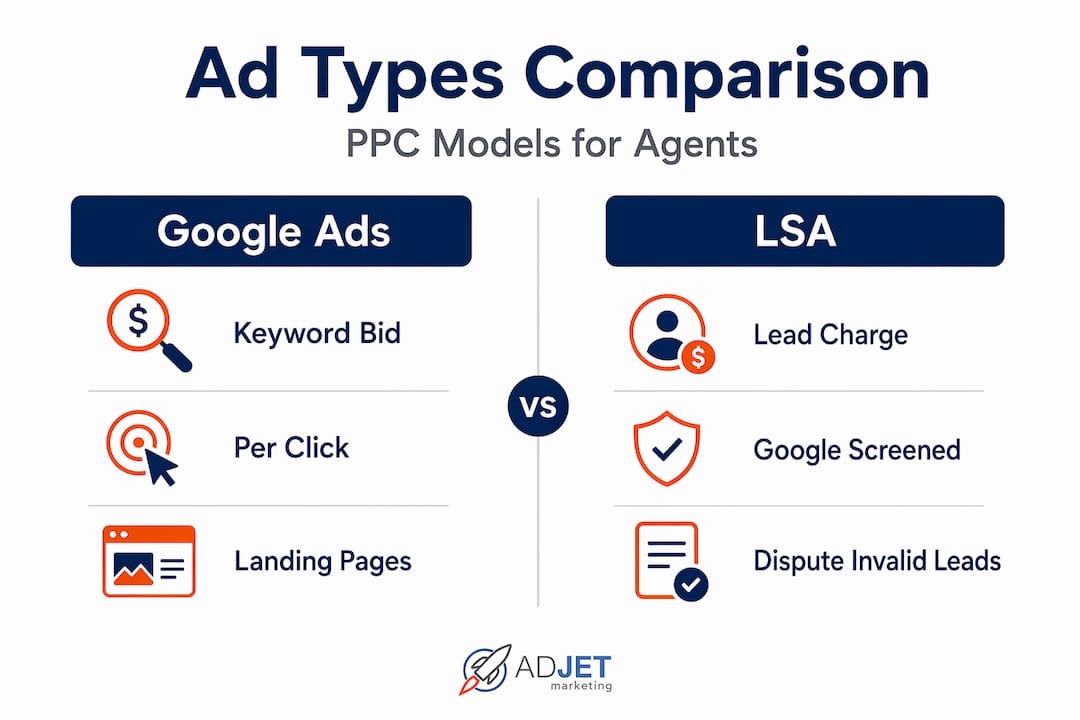
Here’s how the two models compare:
| Feature | Google Search Ads | Local Services Ads |
|---|---|---|
| Charge model | Pay per click | Pay per lead |
| Average cost | ~$70.11 per lead | ~$60 per lead |
| Ad rank factors | Quality Score, bid, CTR | Lead responsiveness, profile completeness |
| Appears above | Organic results | Search Ads |
| Best for | High control, custom targeting | Local trust building, lower CPL |
LSAs also let you dispute invalid leads, which gives you some cost protection. Search Ads give you more control over keywords and landing pages. Start with both before you consider Performance Max or Display.
Targeting and budget strategy
Geo-targeting is one of the highest-impact decisions in real estate online advertising. Tight geographic targeting by city, zip code, or radius reduces your cost per click and focuses your budget on areas you actually serve. Targeting an entire state is rarely a good idea for an individual agent or small team.

For keywords, separate your buyer-intent terms from your seller-intent terms. Someone searching “homes for sale in Austin under 400k” is in a very different mindset than someone searching “how much is my home worth in Austin.” Build separate ad groups or campaigns for each, because the follow-up process, landing page, and conversion definition are all different.
On budget, solo agents typically need $900 to $2,000 per month to generate a steady lead flow and give Google’s algorithm enough data to optimize. Teams in competitive markets often need more. Underfunding a campaign is one of the most common mistakes we see. You cannot optimize what you cannot measure, and you cannot measure what doesn’t have enough clicks.
Pro Tip: Set a 90-day minimum commitment before judging campaign performance. Real estate has long sales cycles, and leads from month one often close in month three or four.
Writing ads and landing pages that convert
Getting clicks is the easy part. Converting those clicks into qualified leads is where most real estate digital marketing strategies fall short.
Ad copy that works and stays compliant
Your ad copy needs to do two things at once: attract motivated buyers or sellers and stay within Fair Housing Act guidelines. The Fair Housing Act, under 42 U.S.C. § 3604©, prohibits any advertising language that indicates a preference or limitation based on protected characteristics. This applies directly to your PPC ads, not just listing descriptions.
Phrases to avoid include:
- “Family-friendly neighborhood”
- “Perfect for empty nesters”
- “Adult building” or “quiet community”
- “Great for young professionals”
- “Walking distance to churches”
Any phrase that signals preferred resident demographics rather than property features creates legal exposure, regardless of your intent. Focus your copy on square footage, price points, location, and service features like “free home valuation” or “exclusive off-market listings.”
“Liability can attach to ad text signaling preference even without discriminatory intent.” — Fair Housing Act compliance standard, as outlined in Montaic’s 2026 listing guide.
Keyword research and negative keywords
Use long-tail, location-specific keywords that signal clear intent. “Buy a 3-bedroom home in Denver” converts far better than “real estate Denver” because the searcher has already narrowed their decision. Build out your keyword lists around buyer stage, not just topic.
Negative keywords are equally important. Without them, your ads show for irrelevant searches like “real estate school,” “real estate jobs,” or “Zillow reviews.” Build your negative list before you launch, not after you’ve spent money on garbage clicks.
Landing page fundamentals
Never send paid traffic to your homepage or a third-party profile. Build dedicated landing pages with a single purpose: capturing lead information. A high-converting real estate landing page includes a clear headline matching the ad’s promise, a short lead form (name, email, phone, and one qualifying question), a reason to give you their contact info such as a free valuation or buyer guide, and social proof like reviews or transaction counts.
Pro Tip: Match your ad headline to your landing page headline exactly. This “message match” reduces bounce rate and improves your Quality Score, which lowers your cost per click over time.
Tracking, measurement, and offline conversions
Most agents track form fills and call clicks. That’s a start, but it misses the most valuable data point in all of real estate search engine marketing: the closed deal.
Why offline conversion tracking matters
When someone clicks your ad, Google assigns them a unique identifier called a Google Click ID, or GCLID. Capturing and persisting the GCLID through your landing page and into your CRM allows you to upload that conversion back to Google Ads when a deal closes months later. This is how Google’s Smart Bidding learns which keywords and audiences actually produce revenue, not just leads.
Here’s how to set it up:
- Confirm your landing page captures the GCLID as a hidden form field and stores it in your CRM alongside the lead record.
- When a deal closes, export a file containing the GCLID, conversion name, and conversion date from your CRM.
- Upload the file manually in Google Ads under “Conversions” or connect via API for automatic syncing.
- Set a conversion window long enough to capture your typical sales cycle, often 90 to 180 days.
- Monitor match rates in the upload report. A rate below 50% usually means the GCLID is not being stored correctly in your CRM.
Automating uploads via API removes the manual step and keeps Smart Bidding fed with timely data. Manual uploads work but introduce delays that limit how quickly the algorithm can respond.
Pro Tip: If your CRM cannot store the GCLID natively, use a hidden field on your landing page form that auto-populates via URL parameter. Most form builders support this with a simple configuration.
Compliance and legal risk in real estate advertising
Legal compliance in PPC is not just about avoiding bad press. It directly affects your account health, your budget, and your exposure to litigation.
The Fair Housing Act applies to every stage of your advertising, including your PPC ad copy, landing page text, images, and even the way you target audiences in Google Ads. Google has its own housing advertising policies layered on top of federal law. Violating either can result in ad disapprovals, account suspensions, or both.
Key compliance practices to build into your workflow:
- Review every ad before it goes live for language that describes the type of resident rather than the property.
- Audit landing pages quarterly to catch any language that may have slipped through during updates.
- Avoid demographic-based audience targeting in housing campaigns. Google restricts the use of age, gender, and zip-code-based targeting for housing ads specifically.
- Document your review process so you can demonstrate due diligence if a complaint is ever filed.
- Use compliance-check software to scan ad copy and listing descriptions before publishing.
The most common mistake we see is agents copying successful ad templates from non-housing industries. What works for a hotel or a gym may contain language that violates Fair Housing rules in a real estate context. Write your own copy from scratch, focused entirely on property features and service benefits.
“Advertising language that even indirectly indicates preference violates Fair Housing, so PPC ad copy must use precise, neutral descriptions focused on property.” — Fair Housing compliance insight, 2026.
Optimizing and scaling your campaigns over time
Launching a campaign is the beginning, not the finish line. Consistent performance improvement in PPC campaigns for real estate requires structured ongoing management.
- Review performance weekly for the first 90 days. Look at click-through rate, cost per click, conversion rate, and cost per lead. Identify any keywords with high spend and zero conversions.
- Add negative keywords after each review. Every week you’ll find new irrelevant search terms triggering your ads. Blocking them is free optimization.
- Test one ad copy variant at a time. Change one element, such as the headline or the call to action, and run it for at least two weeks before drawing conclusions.
- Adjust bids by location. If certain zip codes are producing leads at half the cost, increase budget allocation there. Pull back from areas with high cost and low conversion.
- Switch to Smart Bidding after 30 to 50 conversions. Before that threshold, the algorithm doesn’t have enough data to bid intelligently. Manual CPC or Maximize Clicks works better in the early phase.
- Scale budget gradually, not all at once. Increasing spend by more than 20% in a week can disrupt campaign learning and inflate your cost per lead temporarily.
LSAs require a slightly different approach. High response speed to incoming leads directly influences your ad placement. Responding within five minutes improves both your rank and your close rate, so build a process for fast follow-up before you scale your LSA spend.
My honest take on what actually moves the needle
I’ve worked with real estate agents at different stages, from solo agents running their first Google Ads campaign to teams spending $10,000 a month on paid search. The agents who get the most from their PPC investment consistently have one thing in common: they obsess over what happens after the click, not just before it.
I’ve seen agents spend months refining ad headlines and barely glance at their lead follow-up process. Meanwhile, a competitor with average ads and a 10-minute callback system is closing more deals. In my experience, fixing the follow-up system often produces better ROI than fixing the ads.
Compliance is the other area I find consistently underestimated. Many agents treat it as an afterthought rather than a foundational part of ad creation. One account suspension can set a campaign back by weeks. Building compliance checks into your ad review process from day one is far less painful than dealing with the fallout later.
My broader take: PPC is one of the most predictable lead generation tools available to real estate professionals when it’s managed with data discipline. Patience matters. You’re not going to see optimized performance in the first 30 days. The agents who stick with it, track everything, and make incremental improvements are the ones who eventually have a lead pipeline that runs with consistency.
For a broader view of how paid search fits into a full marketing approach, the paid search management frameworks we use for other regulated industries translate well to real estate. The principles around tracking, compliance, and conversion optimization are the same.
— Felix
Take your real estate advertising further with expert management
Managing PPC campaigns for real estate takes time, technical knowledge, and ongoing attention to detail. Many agents come to Adjetmarketing after months of running campaigns that generated clicks but not closings. The issues are usually the same: no offline conversion tracking, untested landing pages, and ad copy that was never checked for Fair Housing compliance.
Adjetmarketing’s Google Ads management services include keyword research tailored to your market, compliant ad copy review, offline conversion setup with CRM integration, and structured weekly optimization. You get a team that understands the specific rules and dynamics of real estate online advertising, without having to build that expertise yourself. If you want a lead pipeline that’s actually trackable and scalable, explore lead generation strategies built specifically for realtors or reach out to discuss your campaign goals directly.
FAQ
What is real estate PPC management?
Real estate PPC management is the process of creating, monitoring, and optimizing paid search campaigns targeting buyers, sellers, and renters. It includes keyword strategy, ad copy, landing pages, budget allocation, and conversion tracking.
How much should a real estate agent spend on Google Ads?
Solo agents typically need between $900 and $2,000 per month to generate consistent leads and give Google’s algorithm enough data to optimize bids effectively. Competitive markets may require more.
What are Google Local Services Ads for real estate?
LSAs are a pay-per-lead ad format that appears above standard Search Ads and includes a “Google Screened” badge. They charge around $60 per valid lead on average and prioritize lead response speed over traditional Quality Score metrics.
Does the Fair Housing Act apply to PPC ads?
Yes. Under 42 U.S.C. § 3604©, any advertising that signals a preference or limitation based on protected characteristics is prohibited, including PPC ad copy and landing page text.
What is offline conversion tracking in real estate PPC?
Offline conversion tracking involves capturing the Google Click ID from an ad click, storing it in your CRM, and uploading it back to Google Ads when a lead closes. This tells Google which ads produce actual sales, improving Smart Bidding accuracy over time.