









PPC advertising for agents is defined as a paid digital marketing model where you pay only when a prospect clicks your ad, giving you direct control over budget, targeting, and measurable results. The industry term is pay-per-click (PPC) advertising, and it runs primarily through platforms like Google Ads. For agents in real estate and other service industries, PPC delivers immediate visibility to high-intent prospects searching for exactly what you offer. Unlike organic search, which builds over months, a well-structured PPC campaign can generate qualified inquiries on day one. This guide explains how PPC works for agents, what strategies produce quality leads, and where most campaigns go wrong.
What is PPC advertising for agents, and how does it work?
PPC advertising is a system where you bid on keywords, and your ad appears when someone searches those terms. You pay only when a user clicks your ad, not when it appears. That distinction matters because it means every dollar you spend reflects genuine interest, not passive exposure.
Google Ads runs on an auction model. When someone types “real estate agent near me” or “sell my home fast,” Google evaluates every advertiser bidding on that query. Your ad rank depends on your bid amount, your Quality Score (a measure of ad relevance and landing page experience), and your expected click-through rate. The highest-ranked ads appear at the top of the search results page, above all organic listings.
For agents, three ad types are most relevant:
- Search ads appear when prospects actively search for agent services. These capture the highest intent because the person is already looking.
- Local Service Ads (LSAs) show your business name, rating, and phone number at the very top of Google results. You pay per lead, not per click, and Google verifies your credentials before showing your ad.
- Display ads place image-based ads across websites in Google’s network. These work well for remarketing to people who visited your site but did not convert.
The funnel for agent PPC has three distinct stages: inquiry, qualified lead, and sales-ready opportunity. An inquiry is a form fill or phone call. A qualified lead has confirmed timeline, budget, and need. A sales-ready opportunity has booked an appointment or requested a valuation. Structuring your campaigns around these stages changes everything about how you measure success.
Pro Tip: Set up conversion tracking in Google Ads before you spend a single dollar. Without it, you are flying blind. Track calls, form fills, and, ideally, CRM events like booked appointments.
What are the key benefits of PPC advertising for agents?
PPC offers agents a set of advantages that most other marketing channels cannot match at the same speed or precision.
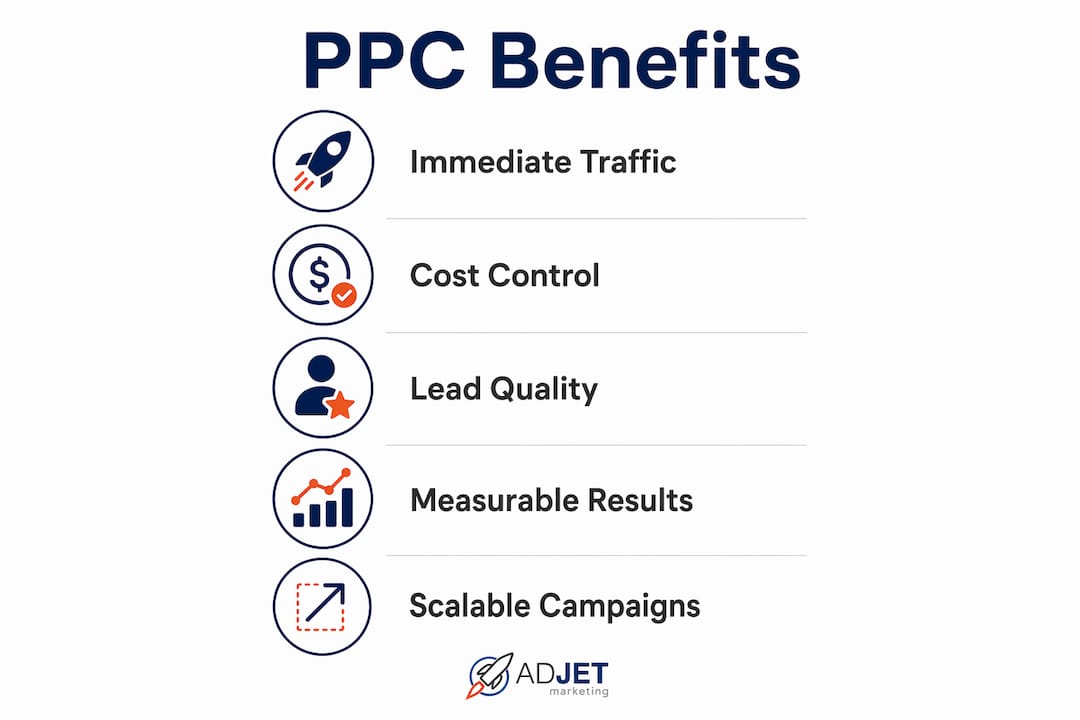
- Immediate traffic. SEO takes months to build. A Google Ads campaign can put you in front of buyers and sellers within hours of launch. For agents entering a new market or promoting a time-sensitive listing, that speed is critical.
- Precise targeting. PPC lets you pick who sees your ad by keywords, location, device, time of day, and audience behavior. An agent in Dallas can target only people searching within a specific zip code, filtering out irrelevant traffic entirely.
- Budget control. PPC platforms operate on a daily budget system, and you can start with a modest spend. There is no minimum commitment. You scale up when results justify it and pull back when they do not.
- Measurable ROI. Every click, call, and form fill is tracked. You can calculate cost per lead, cost per appointment, and, with CRM integration, cost per closed deal. That level of accountability is rare in marketing.
- Hyper-local reach. Real estate PPC is hyper-local by nature, and agents can use neighborhood-specific keywords, local imagery, and geo-targeting to attract motivated buyers without competing on national platforms.
- Brand defense. Bidding on your own name prevents competitors from capturing traffic from people searching specifically for you. It is a low-cost, high-return tactic most agents overlook.
The honest comparison with SEO is this: SEO builds compounding, long-term visibility at a lower cost per click over time. PPC delivers speed and control but requires ongoing spend to maintain results. The strongest agent marketing programs use both, with PPC covering immediate lead flow while SEO builds the foundation. You can read more about SEO vs. PPC tradeoffs to decide how to weight each channel for your situation.
What PPC strategies work best for agents to maximize lead quality?
The most common mistake agents make is optimizing for lead volume. More leads sound better, but optimizing for volume without offline conversion tracking consistently produces unqualified leads rather than closed transactions. The fix is to build your campaign backwards from the outcome you actually want.

Start by defining what a sales-ready opportunity looks like for your business. Is it a booked consultation? A signed listing agreement? Once you know that, set up your conversion tracking to report that event, not just a form fill. Feeding closed-deal data back into Google Ads tells the algorithm what a real client looks like, shifting its bidding focus from cheap clicks to high-value prospects.
| Strategy | What it does | When to use it |
|---|---|---|
| CRM-fed offline conversions | Sends closed deal data to Google Ads to train the algorithm | Always, once you have 30+ conversions per month |
| Remarketing audiences | Re-engages site visitors who did not convert | Ongoing, especially for high-consideration services |
| Hyper-local keyword targeting | Focuses spend on neighborhood or city-level queries | From campaign launch |
| Audience signal layering | Adds demographic and in-market filters to search campaigns | When budget allows refinement |
Channel selection also matters. Start with Google Search for high-intent buyer and seller queries. Add Meta Ads only if you can qualify leads quickly and follow up within minutes. Meta generates interest-based leads, which require faster and more persistent follow-up than search-intent leads.
On budget, base your spend on capacity and unit economics, not on what competitors appear to be spending. If your average commission is $8,000 and you close one in ten qualified leads, you can afford a meaningful cost per lead. Work backwards from that number to set a realistic daily budget.
Pro Tip: Performance Max campaigns can reach large audiences, but without CRM data and human oversight, they default to the cheapest, least qualified traffic. Always feed audience signals and conversion data before scaling Performance Max.
Marketing funnel alignment is what separates campaigns that produce revenue from those that produce reports full of clicks. When your campaign structure mirrors your funnel stages, every optimization decision has a clear business rationale.
Common pitfalls agents face with PPC and how to avoid them
Most PPC campaigns for agents fail for predictable reasons. Recognizing them early saves significant budget.
- Chasing cheap clicks. Low cost-per-click sounds efficient until you realize those clicks come from unqualified prospects. Cheap traffic from broad keywords like “real estate” produces inquiries from people researching the industry, not hiring an agent.
- Ignoring offline data. Form fills are not revenue. Without connecting your CRM to Google Ads, the algorithm has no idea which leads actually became clients. It keeps optimizing for the wrong signal.
- Skipping funnel tracking. If you only track top-of-funnel events, you cannot tell which campaigns produce sales-ready opportunities. You end up cutting campaigns that work and scaling ones that do not.
- Mismatched landing pages. An ad for “sell my home in Austin” should land on a page specifically about selling homes in Austin, not your general homepage. Mismatched intent kills conversion rates and raises your cost per click by lowering Quality Score.
- Over-relying on automation. Automated platforms prioritize cheapest leads without proper guardrails. Human oversight, negative keyword lists, and audience exclusions are not optional. They are the difference between a campaign that scales and one that drains budget.
The pattern we see most often is agents who ran PPC, got flooded with low-quality leads, and concluded that PPC does not work. In almost every case, the campaign lacked conversion tracking, CRM integration, or both. The channel works. The setup was the problem. For a parallel view of how these principles apply across service industries, the PPC strategies for dentists guide shows the same framework in a different professional context.
Key Takeaways
PPC advertising for agents produces quality leads when campaigns are built around funnel stages, CRM-fed conversion data, and precise targeting rather than raw click volume.
| Point | Details |
|---|---|
| Pay only for clicks | PPC charges only when a prospect clicks your ad, making every dollar traceable to real interest. |
| Build around funnel stages | Structure campaigns around inquiry, qualified lead, and sales-ready opportunity to measure what matters. |
| Feed CRM data to Google Ads | Sending closed-deal data back to the platform trains the algorithm to find real clients, not just form fills. |
| Control budget from day one | Daily budgets require no minimum spend, so you can test, learn, and scale based on actual results. |
| Human oversight is non-negotiable | Automated tools like Performance Max need audience signals and regular review to avoid wasting spend on low-quality leads. |
Why I think most agents are measuring PPC wrong
After working with agents and service businesses across multiple industries, the single biggest gap I see is not the ad creative or the keyword list. It is the measurement layer. Agents often judge a PPC campaign by the number of leads it generates in the first 30 days. That is the wrong metric.
The right question is: how many of those leads became clients, and what did each client cost to acquire? Without CRM integration and offline conversion tracking, you cannot answer that question. And if you cannot answer it, you cannot improve the campaign in any meaningful way.
The second thing I see consistently is agents who scale budget before the algorithm has enough data to optimize. Google’s machine learning needs a meaningful volume of conversion events before it can shift from volume-based bidding to value-based bidding. Scaling too early, before that data exists, amplifies the wrong patterns. Patience in the first 60–90 days is not passive. It is the work.
My honest advice: treat the first three months of a PPC campaign as a data collection phase. Set conservative budgets, track everything you can, and resist the urge to make major changes every week. The online advertising trends for 2026 confirm that disciplined, data-fed campaigns consistently outperform those chasing short-term volume. The agents who win with PPC are the ones who commit to the full measurement stack, not just the ad spend.
— Felix
How Adjetmarketing helps agents build PPC campaigns that convert
Adjetmarketing works with agents and service businesses to build Google Ads campaigns grounded in funnel strategy, CRM integration, and conversion tracking that reflects real business outcomes. The focus is always on lead quality over lead volume, with campaign structures that mirror the inquiry-to-close process specific to your market. If you are ready to build a paid search program that produces sales-ready opportunities rather than a pile of unqualified form fills, the Google Ads management services at Adjetmarketing are built for exactly that. You can also review the broader digital marketing strategy development offering to see how PPC fits into a full-channel growth plan.
FAQ
What is PPC advertising for agents in simple terms?
PPC advertising for agents is a paid digital model where you pay only when someone clicks your ad. It gives agents immediate visibility on Google for high-intent searches like “real estate agent near me.”
How much does PPC advertising cost for agents?
PPC platforms use a daily budget system with no required minimum. Your actual cost depends on keyword competition, targeting, and campaign structure, so costs vary widely by market and service type.
How does PPC differ from SEO for agents?
PPC delivers immediate traffic through paid placements, while SEO builds organic visibility over months. PPC requires ongoing spend to maintain results; SEO compounds over time at a lower long-term cost per click.
What makes a PPC lead “qualified” for agents?
A qualified lead has confirmed timeline, budget, and need. A sales-ready opportunity has taken a concrete next step, such as booking an appointment or requesting a property valuation.
Why do PPC campaigns for agents often produce poor-quality leads?
The most common cause is optimizing for lead volume without offline conversion tracking. Without CRM data feeding back into Google Ads, the algorithm targets the cheapest traffic rather than the most valuable prospects.