









Plumbing SEO services are specialized local search marketing strategies designed to place your business in front of customers actively searching for a plumber in your area. For plumbing businesses, visibility in Google’s Map Pack and organic results directly determines call volume. This article breaks down the core components of effective local SEO for plumbers, explains how multi-location expansion works, and introduces AI search optimization as the next competitive frontier. You will also find practical guidance on which tactics deliver the fastest return and how to measure results in terms that actually matter to your business.
What are the essential components of plumbing SEO services?
Plumbing SEO services combine several distinct tactics that work together to improve your position in local search results. No single element is sufficient on its own. The strongest results come from treating these components as a system rather than a checklist.
Google Business Profile optimization is the foundation. Your profile controls whether you appear in the Map Pack, which captures the majority of clicks for local searches. Proximity to the searcher accounts for roughly 55% of Map Pack ranking influence, which means your physical location matters enormously. Beyond location, your profile needs accurate business categories, service descriptions, photos of your team and work, and an active Q&A section. A plumber with 80 reviews and a 4.6 average typically outranks a competitor with fewer reviews, even if that competitor’s average rating is slightly higher. Review volume signals trust and activity to Google.
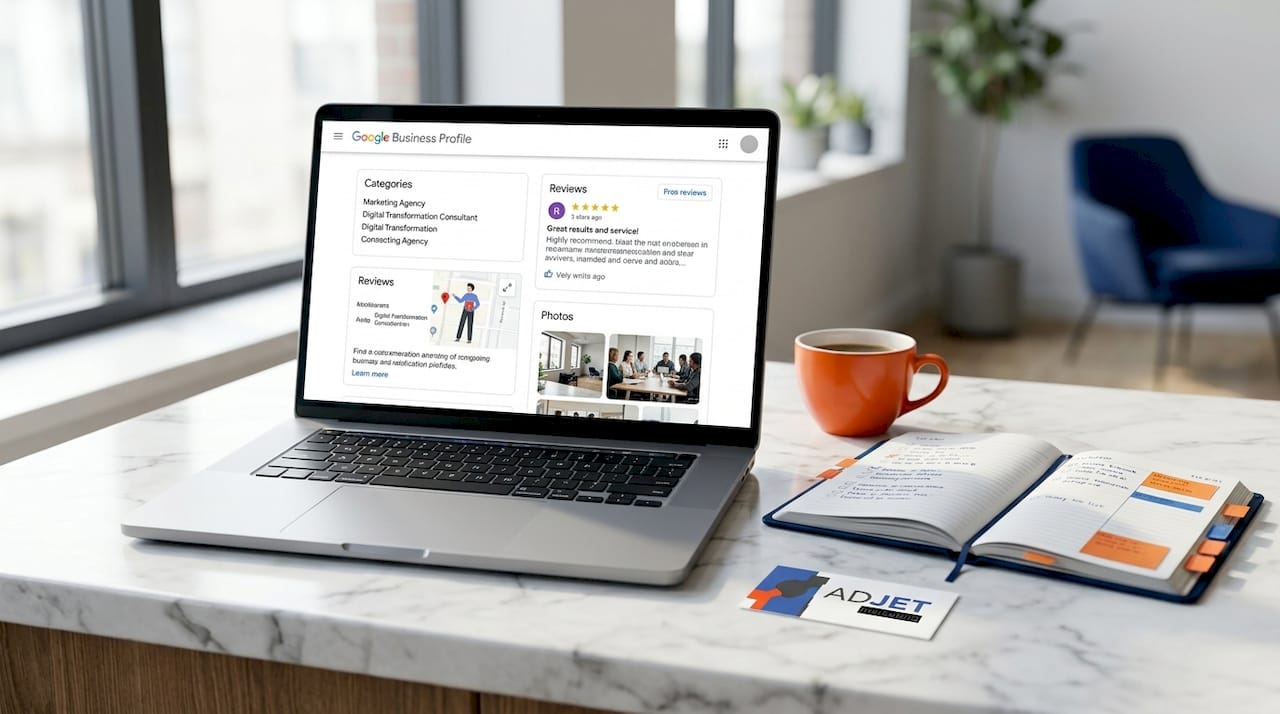
NAP consistency is the next critical layer. NAP stands for name, address, and phone number. Even minor inconsistencies like “St” versus “Street” across your website, Google Business Profile, Yelp, Angi, and other directories create conflicting signals that suppress your rankings. Auditing and correcting these discrepancies across all platforms is one of the highest-return tasks in plumbing business online marketing.
The remaining components of a strong local SEO program include:
- Service and location pages: Each core service (drain cleaning, water heater installation, emergency plumbing) deserves its own page with unique content targeting specific keywords and your city or region.
- On-page SEO: Title tags, meta descriptions, header structure, and internal links all need to reflect the plumbing services and locations you target.
- Structured data markup: Adding LocalBusiness schema to your website helps Google display your business information accurately in search results and increases eligibility for rich results.
- Local backlinks: Links from local news sites, chambers of commerce, and home services directories signal community relevance to Google.
Pro Tip: When building service pages, write at least 400 words of unique content per page. Pages that simply list services without context rank poorly because they offer no value to the reader or to Google’s quality assessment.
How does multi-location SEO work for plumbing companies?
Multi-location SEO is the practice of building search visibility across several cities or service areas from a single website. For plumbing companies expanding their territory, this is where SEO delivers its most significant cost-per-lead advantage over paid advertising.
The hub-and-spoke architecture is the proven structure for this approach. Your main domain acts as the authority hub, and individual city pages function as spokes that inherit authority through internal linking. Here is how to build it effectively:
- Create a dedicated city page for each service area. Each page must contain unique content. Generic pages that swap out only the city name are treated as duplicate content and rank poorly.
- Include local landmarks, neighborhoods, and project references. A page for “plumber in Austin” that mentions specific neighborhoods like South Congress or Barton Hills signals genuine local relevance.
- Link city pages to relevant service pages and back to the homepage. Internal linking is the mechanism through which authority flows from your hub to your spokes.
- Build 3 to 5 local backlinks per city. City-specific local backlinks from regional directories, local news outlets, or community organizations significantly improve rankings in secondary service areas.
- Set up a separate Google Business Profile for each physical location. If you operate from multiple addresses, each location qualifies for its own profile. Service-area businesses without a storefront can still rank locally, but a verified address provides a stronger signal.
Comparing multi-location SEO vs. paid ads for expansion:
| Factor | Multi-location SEO | Google Ads |
|---|---|---|
| Time to results | 3 to 6 months per city | Immediate |
| Cost per lead over time | Decreases as rankings build | Stays constant or rises |
| Visibility type | Organic and Map Pack | Paid listings only |
| Scalability | High once content is built | Requires ongoing budget |
| Risk if budget stops | Rankings persist | Traffic stops immediately |
The URL structure debate (subfolders vs. subdomains vs. separate domains) matters far less than the quality of your content and the strength of your internal linking. Focus your energy on those two factors first.
Pro Tip: Add photos of actual jobs completed in each city to the corresponding location page. Real project photos from a recognizable neighborhood are more persuasive to both visitors and Google than stock images.
What role does AI search optimization play in plumbing SEO?
AI Search Optimization, commonly called AEO (Answer Engine Optimization), is the practice of structuring your content so that AI-powered platforms like ChatGPT, Google Gemini, and Google AI Overviews select your business as the direct answer to a user’s question. This differs from traditional SEO, which focuses on ranking links. AEO focuses on being cited as the answer itself.
Businesses structured for conversational AI queries increase their visibility as AI platforms prioritize direct, authoritative responses over ranked lists of links. Most plumbers are entirely absent from AI results because their websites lack the conversational, FAQ-style content that these platforms prefer. This is a significant gap and a real opportunity.
“AI-powered search platforms prefer FAQ-style direct answer content for citation. Most plumbers are absent from AI results due to lacking conversational-style content.” — AEO Program Targets HVAC, Roofing & Plumbing Contractors
To position your plumbing business for AI citation, focus on these steps:
- Add FAQ sections to every service page. Write questions the way a homeowner would ask them: “How much does it cost to replace a water heater in Dallas?” or “What should I do if my pipe bursts at night?”
- Use structured data for FAQs. FAQ schema markup signals to Google and AI crawlers that your content contains direct answers.
- Keep your NAP data consistent everywhere. AI platforms cross-reference multiple sources to verify credibility. Inconsistent data reduces the likelihood of being cited.
- Write in plain, direct language. AI systems favor content that answers a question in the first sentence of a paragraph, not content that builds to an answer over several paragraphs.
- Claim and optimize your presence on data aggregators. Platforms like Yelp, Angi, and HomeAdvisor feed data into AI systems. A complete, accurate profile on these platforms increases your citation probability.
The shift toward AI-driven search answers does not replace traditional local SEO. It adds a layer on top of it. Plumbers who build strong foundational SEO and then layer in AEO content will hold a measurable advantage over competitors who ignore this shift.
Which SEO strategies deliver the fastest results for plumbing lead generation?
Speed and sustainability are not always the same thing in SEO. The tactics below are ranked by how quickly they produce measurable business outcomes, not just ranking movement.
- Google Business Profile optimization: This is the single fastest lever. Completing your profile, adding photos, selecting accurate categories, and responding to reviews can improve Map Pack visibility within weeks, not months.
- Review generation: Ask every satisfied customer for a Google review immediately after the job. A consistent review velocity signals active business operations to Google and builds the trust that converts searchers into callers.
- Emergency and high-intent keyword targeting: Phrases like “24 hour plumber” and “water leak repair” carry the highest conversion rates because customers searching under stress are ready to call. Build dedicated pages around these terms.
- Citation cleanup: Fixing NAP inconsistencies across Yelp, Angi, Houzz, and the major data aggregators (Neustar Localeze, Data Axle, Foursquare) removes ranking suppression that may have been holding you back for months.
- Content depth over content volume: One well-researched, 600-word service page outperforms five thin pages. Write for the customer’s actual questions, not just for keyword density.
- Tracking by business outcomes: Measuring calls and contact form submissions from Google Business Profile Insights and your website analytics gives you a direct line between SEO activity and revenue. Rankings and traffic are secondary signals.
Pro Tip: Run Google Ads on your highest-value keywords while your organic SEO builds. This gives you immediate lead flow and also generates data on which keywords convert best, which you can then prioritize in your organic content strategy.
Balancing paid and organic channels is a practical approach for most plumbing businesses. SEO builds a durable asset over time. Google Ads fills the gap while that asset matures. The two strategies reinforce each other when managed together.
Key takeaways
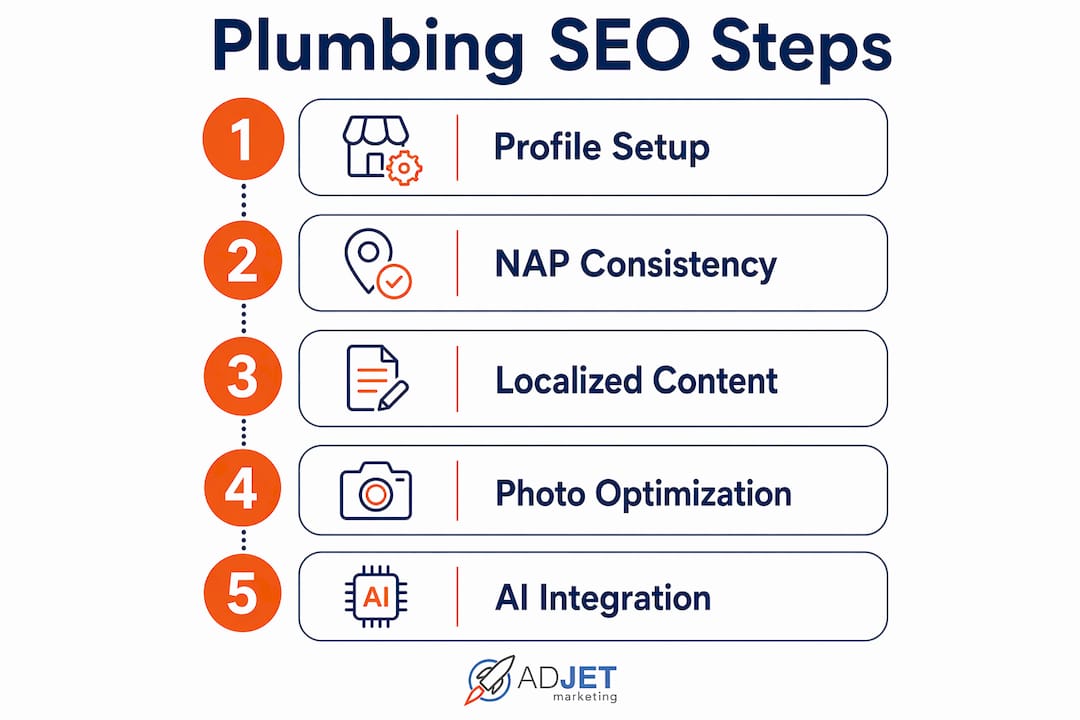
Plumbing SEO services require Google Business Profile optimization, consistent NAP data, localized content, and AI-ready formatting to generate sustainable local leads.
| Point | Details |
|---|---|
| Google Business Profile is the top priority | Optimize categories, photos, and reviews before any other tactic. |
| NAP consistency prevents ranking suppression | Audit all directories and correct even minor address discrepancies. |
| Multi-location SEO reduces cost per lead | Hub-and-spoke architecture with unique city pages outperforms paid ads over time. |
| AEO content captures AI search citations | Add FAQ sections with direct answers to every service page. |
| Track calls and form submissions, not just rankings | Business Insights data connects SEO activity directly to revenue outcomes. |
Why most plumbing SEO programs stall in the first six months
I have worked with enough home services businesses to recognize a pattern. The plumbing companies that come to us frustrated with their SEO results almost always made the same mistakes early on. They either hired a generalist agency that treated their Google Business Profile as an afterthought, or they invested in content without first fixing their citation data. Both approaches produce the same outcome: slow rankings and no measurable increase in calls.
The other issue I see consistently is unrealistic timeline expectations. Organic SEO for a competitive plumbing market in a mid-sized city takes four to six months to show meaningful results. That is not a flaw in the strategy. It is the nature of building a durable digital asset. Businesses that abandon SEO at month three and shift entirely to paid ads end up paying for every lead indefinitely, while their competitors who stayed the course start receiving free organic calls.
What actually works is a focused, sequential approach. Fix your NAP data first. Optimize your Google Business Profile second. Build service and location pages third. Then layer in review generation and AEO content as ongoing activities. This sequence is not glamorous, but it produces results that compound over time. The plumbing businesses I have seen scale most effectively are the ones that treated their local SEO strategy as a long-term investment, not a short-term campaign.
— Felix
How Adjetmarketing helps plumbing businesses grow through SEO
Adjetmarketing is a Google Partner digital marketing agency with direct experience building local search programs for home services businesses. If you are looking to increase plumbing leads through organic search, we build and manage the full program: Google Business Profile optimization, service and location page content, citation cleanup, and AI search optimization. Our SEO services are built around measurable outcomes, specifically calls and form submissions, not vanity metrics. For businesses that want immediate visibility while SEO builds, we also manage Google Ads campaigns that complement your organic strategy. Reach out to discuss what a realistic SEO program looks like for your market and service area.
FAQ
What is the most important factor in local plumbing SEO?
Proximity to the searcher is the single largest ranking factor for Google Map Pack visibility, accounting for roughly 55% of ranking influence. After proximity, Google Business Profile completeness and review volume are the next most significant signals.
How long does plumbing SEO take to produce results?
Most plumbing businesses see measurable improvement in calls and Map Pack visibility within three to six months of consistent SEO work. Competitive markets may take longer, which is why combining SEO with Google Ads during the buildup period is a practical approach.
What is AEO and why does it matter for plumbers?
AEO (Answer Engine Optimization) is the practice of formatting content so AI platforms like ChatGPT and Google Gemini cite your business as a direct answer. Most plumbers are absent from AI results because they lack FAQ-style content, making this an open competitive opportunity.
How many Google Business Profile reviews do I need to rank?
There is no fixed number, but a profile with 80 or more reviews and a 4.6 average star rating typically outranks competitors with fewer reviews. Consistent review velocity, meaning new reviews arriving regularly, signals active business operations to Google.
Does my plumbing website need separate pages for each city I serve?
Yes. Each service area should have a dedicated page with unique content referencing local neighborhoods, landmarks, and completed projects. Generic pages that only swap out the city name are treated as duplicate content and rank poorly.
Recommended
- Local SEO For Home Services: Your 90-Day Growth Plan
- Real Estate Agent SEO – AdJet Digital Marketing & Google Partner Agency | SEO Development Google Ads Social
- Unlock The Secret To Attracting More Clients: The Power Of Medical Spa SEO Services
- Local SEO Tips To Dominate The MedSpa Market – AdJet Digital Marketing & Google Partner Agency | SEO Development Google Ads Social