








The single highest-leverage move in plastic surgery content marketing right now is publishing procedure-specific pages built around real patient questions, formatted for AI answer engines (GEO), and backed by conversion-ready landing pages with properly consented before/after galleries. Everything else, social cadence, review generation, ad spend, supports that core engine. Skip it and you’re spending money on traffic that never converts.
Here’s the priority order for the next 90 days:
Days 1 to 30 (SEO and content triage):
- Audit your top 5 procedure pages against competitors ranking in your metro
- Rewrite the weakest 2 pages with direct-answer openings and FAQ schema
- Draft 6 patient-question FAQs pulled from your front desk’s actual call logs
Days 31 to 60 (paid and gallery foundation):
- Launch one tightly scoped Google Ads campaign for your highest-margin procedure
- Run a gallery consent audit and standardize your intake form language
- Build or fix the landing page that campaign sends traffic to
Days 61 to 90 (measurement and scale):
- Connect CRM source fields to your ad platform for real attribution
- Expand to procedure page 3 through 5
- Layer in short-form video tied to the procedures already ranking
Your office manager or marketing coordinator can own the FAQ drafting and consent audit. Hire outside help for the technical SEO fixes, schema markup, and ad campaign structure. That’s where most in-house attempts stall.
Key Takeaways
Plastic surgery content marketing works when procedure-specific pages, GEO-formatted answers, and consented galleries feed directly into conversion-focused landing pages with clean CRM attribution.
| Point | Details |
|---|---|
| Start with procedure pages | Build direct-answer, schema-marked pages for your top 3 to 5 procedures before expanding into blog content. |
| Format for GEO | Open every FAQ and page section with a complete, standalone answer to improve AI citation odds. |
| Fix consent before scaling galleries | Standardize photography and get channel-specific written consent before publishing any before/after image. |
| Track server-side, not client-side | Use conversion APIs and CRM source fields to protect PHI and get accurate ad attribution. |
| Consider agency support for execution | Adjetmarketing runs SEO, Google Ads, landing pages, and compliance as one coordinated system for practices without in-house bandwidth. |
Table of Contents
- Why Plastic Surgery Content Marketing Needs a Coordinated Framework
- What Content Should You Publish First for Plastic Surgery SEO?
- How Should You Build a Compliant Before/After Gallery?
- What Makes a Plastic Surgery Google Ads Campaign Profitable?
- Which Social and Video Formats Actually Drive Consults?
- How Do You Use RealSelf and Reviews to Build Trust?
- How Do You Measure Which Marketing Channel Actually Drives Procedures?
- How Should a Practice Staff Content Production?
- What Compliance Rules Should Never Be Skipped?
- What Does an Agency-Executed Version of This Playbook Look Like?
- Why GEO and Compliance-Safe Galleries Matter More Than Most Practices Realize
- How Can Adjetmarketing Help You Execute This Playbook?
- Sources
Why Plastic Surgery Content Marketing Needs a Coordinated Framework
Most practices treat content marketing as a checklist: post on Instagram, write a blog, maybe run some ads. That approach fails because each channel is solving a different problem in the patient’s decision path, and none of them compound if they’re built in isolation.
Think of the funnel in four stages. Discovery happens on social feeds and increasingly inside AI search results, where a prospective patient asks a chatbot “what’s the recovery like for a breast augmentation” and gets a direct answer pulled from somebody’s website. Trust building happens through your content, your gallery, and your reviews once they land on your site. Consult conversion happens on your landing page and through your ad copy. Procedure conversion happens through nurture sequences and CRM follow-up after the consult is booked but before the surgery date. A practice that nails discovery but has a weak landing page is paying for traffic that evaporates. A practice with gorgeous galleries but no GEO-formatted content never shows up in the AI-driven searches that are replacing traditional Google results.
Generative Engine Optimization deserves special attention here because it’s genuinely new ground, not just SEO with a rebrand. When ChatGPT or Perplexity answers a question about rhinoplasty recovery, it’s pulling from pages that answer the question in the first sentence and support it with structured data. That means:
- Open every procedure page and FAQ with a direct, complete answer, no throat clearing
- Add FAQ schema markup so search engines and AI crawlers can parse the Q&A structure
- Keep answers self-contained; don’t assume the reader scrolled past context above
Pro Tip: Write your FAQ answers as if they’ll be read aloud by a voice assistant with zero surrounding context. If the sentence doesn’t make sense standing alone, rewrite it.
Budget allocation follows practice stage. A newer solo practice building its first digital presence should weight spend toward organic content and technical SEO since those assets compound over years, while running a modest paid pilot to generate near-term consults. An established multi-surgeon practice with a content backlog already in place can shift more budget toward paid media and gallery production, since the organic foundation is already earning traffic. Neither approach works well without the other eventually in place.
What Content Should You Publish First for Plastic Surgery SEO?
Start with procedure pages, not blog posts. A blog post about “5 things to know before rhinoplasty” ranks for almost nothing valuable. A dedicated rhinoplasty page built around real search intent ranks for the terms that actually convert.
Every procedure page needs these sections, in roughly this order:
- A direct-answer opening paragraph stating what the procedure is and who it’s for
- Candidacy criteria (who is and isn’t a good fit)
- Recovery timeline broken into concrete phases (week 1, week 2 to 4, month 2 to 6)
- Cost range with the variables that move price (revision vs primary, implant type, combined procedures)
- Before/after gallery specific to that procedure
- A short surgeon bio reinforcing credentials
- FAQ block answering the 5 to 8 questions patients actually ask on the phone
Keyword selection splits into two buckets. Transactional terms (“rhinoplasty surgeon [city],” “breast augmentation cost”) belong on your procedure pages and should map one keyword cluster per page, never split across multiple thin pages. Informational, long-tail patient questions (“how long does swelling last after rhinoplasty,” “can I combine a tummy tuck with liposuction”) belong in your FAQ sections and supporting blog content, and these are exactly what AI answer engines pull from when a prospective patient asks a conversational question instead of typing a search term.
The American Society of Plastic Surgeons publishes annual procedure-volume data that’s genuinely useful here: it tells you which procedures in your category have enough search volume to justify a dedicated page versus which ones can live as a section on a broader page. If a procedure represents a small fraction of national volume, building five pages around it is often wasted effort, one strong page will do.
On the technical side, three things move the needle more than anything cosmetic: page load speed under 2.5 seconds on mobile, structured data using MedicalBusiness and Physician schema so search engines understand who you are and what you do, and a mobile experience where the phone number and booking form are reachable without scrolling past a wall of text. A technical SEO audit will surface most of these gaps in a single pass.
How Should You Build a Compliant Before/After Gallery?
Your gallery is likely your single highest-converting asset, more persuasive than any paragraph of copy, but only if it’s built with consistent photography and airtight consent documentation.
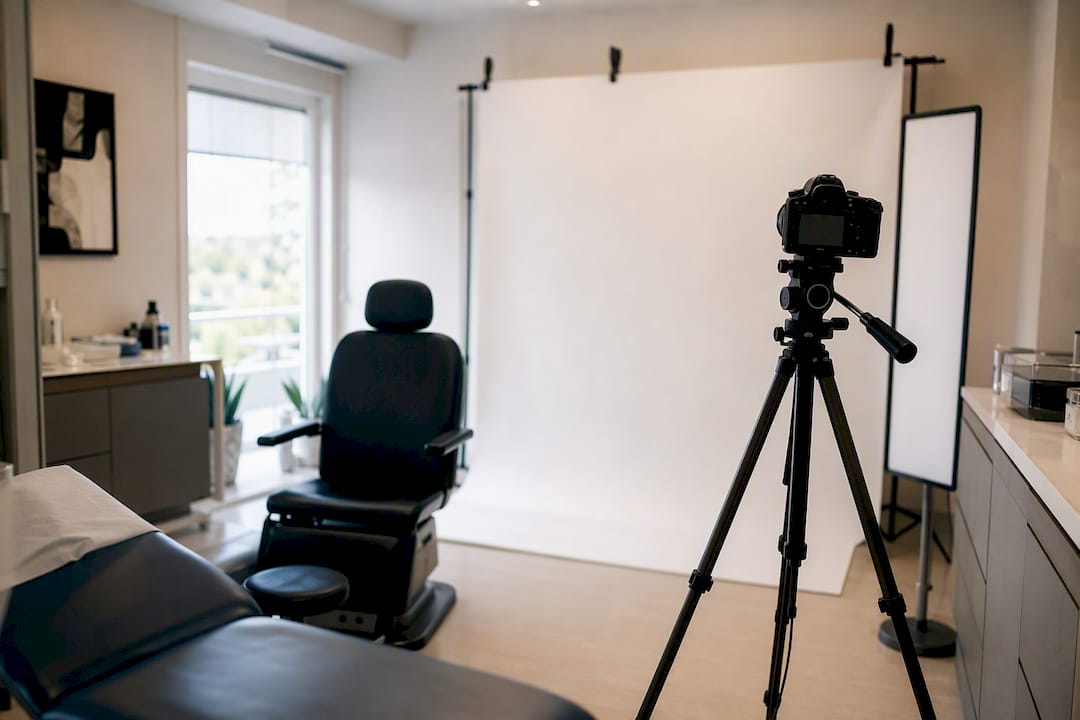
Photography standards matter more than most practices realize. Inconsistent lighting or angles between “before” and “after” shots undermines credibility even when the result is excellent. Invest in a dedicated shooting space with controlled lighting, a neutral backdrop, and a fixed camera position marked on the floor so every patient is photographed from the identical distance and angle. This is a one-time setup cost that pays back on every patient photographed afterward.
Follow this workflow to keep the gallery both useful and defensible:
- Standardize your capture protocol (same lighting, backdrop, angles, and camera settings for every patient, every time)
- Tag every image by procedure, technique or implant type if relevant, and time point (6 weeks, 3 months, 1 year)
- Build filterable gallery pages so a prospective patient researching a specific procedure sees only relevant results
- Get written consent before the first photo is taken, not after
- Store consent forms in your CRM or EHR with the patient’s file, not in a shared folder
Your consent form should specify exactly which channels the photos can appear on (website, Instagram, print materials), how long consent lasts, and how a patient can revoke it later. Vague “marketing purposes” language is not sufficient and creates real exposure if a patient asks you to take images down years later.
Well-tagged galleries do double duty: they’re the centerpiece of your procedure landing pages, and they’re what you’d pull from for paid ad creative, since image ads built from real results consistently outperform stock photography in this category.
Pro Tip: Ask patients for consent renewal every two years, not just once. It’s a small administrative step that closes a real liability gap most practices never think about until something goes wrong.
What Makes a Plastic Surgery Google Ads Campaign Profitable?
The mistake we see most often: one broad campaign covering every procedure, with no negative keywords, sending traffic to a generic homepage instead of a procedure-specific landing page. That structure burns budget on clicks that never convert.
The fix is straightforward but requires discipline. Run one campaign per procedure, not per practice. Structure ad groups by intent inside each campaign, separating “cost” searches from “recovery” searches from “best surgeon” searches, since each deserves different ad copy. Build a negative keyword list early and maintain it monthly; terms like “free,” “DIY,” and “at home” waste spend fast in this category. In competitive metro markets, expect to need a meaningful daily budget just to gather enough data for the algorithm to optimize. Underfunded campaigns in competitive markets often just don’t generate the volume needed to learn.
Your landing page needs to do the closing. That means:
- A hero section with real gallery images above the fold, not a stock photo of a smiling model
- A short surgeon bio establishing credentials in two or three sentences
- A visible price range so unqualified leads self-select out before they call
- Trust signals: board certification, years in practice, patient count
- A short booking form or date picker, never a long intake questionnaire at this stage
Tracking is where most practices lose the thread entirely. Browser-based pixels are increasingly blocked or degraded by privacy defaults, and on any page touching protected health information they carry real compliance risk. A server-side conversion API paired with CRM integration solves both problems: it tracks conversions reliably and keeps patient data off the ad platform’s servers. If your CRM shows leads your ad platform never recorded, that’s the first thing to check.
Set expectations early with clients: cost-per-click and cost-per-acquisition vary enormously by market and procedure, and consult-to-procedure rates depend heavily on how qualified your landing page makes the lead before they ever pick up the phone.
Which Social and Video Formats Actually Drive Consults?
Four video formats consistently outperform generic “day in the life” content: surgeon explainer videos answering one specific question, patient point-of-view recovery journeys (with consent), before/after progression reveals, and candid Q&A sessions pulling from real patient questions.
A systematic review of digital marketing in plastic surgery found that effective social strategy depends on matching content type to platform rather than posting the same clip everywhere, and recommends age-specific guidance since different platforms skew toward different patient demographics. That matters practically: a recovery-journey series aimed at a younger rhinoplasty audience belongs on TikTok and Instagram Reels, while a longer surgeon explainer about mommy makeover candidacy often performs better as YouTube content, where an older, more research-driven audience spends more time per session.
Cadence beats perfection. A small team can realistically sustain several short-form posts per week if they batch production, shooting several patient interviews or explainer segments in a single afternoon rather than scheduling separate shoots for each piece.
The repurposing workflow that scales best: shoot one longer conversation with a patient or surgeon, cut a 5 to 10 minute version for YouTube, pull two or three 30 to 60 second segments for Reels and TikTok, then extract still-frame quotes or short clips for feed posts. One shoot, five to six pieces of content.
Given how much time people spend daily on social platforms, Statista’s usage data makes clear why short-form discovery content still matters even for a high-consideration purchase like plastic surgery. The real measurement question is whether social is generating qualified consults, which means tagging consult bookings by referral source in your CRM rather than just tracking likes and follower growth.
How Do You Use RealSelf and Reviews to Build Trust?
RealSelf and similar review platforms occupy the mid-funnel: a patient who found you through social or a Google search often checks RealSelf next to validate what they saw. A thin or outdated profile undermines the trust you just built elsewhere.
Complete the basics first: full photo gallery uploaded, procedure pricing ranges filled in, and an active presence answering the Q&A section, since patient questions there function as long-tail content that other prospective patients search directly.
- Ask for reviews 4 to 6 weeks post-op, once a patient can see real results and swelling has resolved
- Keep the ask message simple and never reference specific procedure details in a way that could expose protected health information if the message is forwarded or screenshotted
- Respond to every review, positive or negative, within a few business days
- Route RealSelf leads into your CRM the same way as website leads, tagged by source, since they typically arrive more pre-qualified than cold ad traffic but convert differently and deserve separate tracking
How Do You Measure Which Marketing Channel Actually Drives Procedures?
Consult volume alone tells you almost nothing. The KPI that matters is consult-to-procedure rate by channel, because a channel generating cheap consults that never convert to surgery is worse than a more expensive channel with a strong close rate.
Track these core numbers monthly: cost per consult by channel, consult-to-procedure conversion rate, cost per acquisition against average procedure revenue, and return on ad spend. Attribution mechanics matter as much as the metrics themselves. Server-side conversion tracking, clean CRM source fields on every lead, consistent UTM tagging on every campaign link, and call tracking on your phone number are the four pillars that make the rest of this data trustworthy.
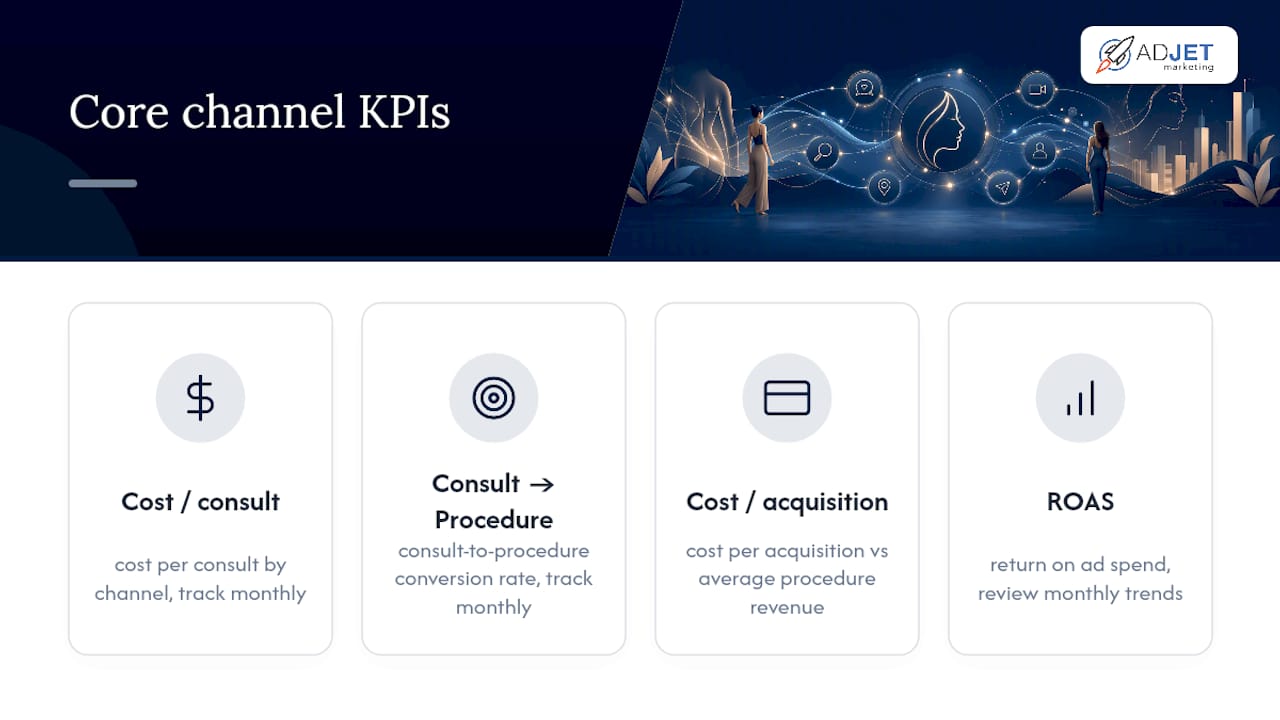
Build a weekly dashboard with lead volume by source, consult bookings by source, and procedure bookings by source, then review monthly trends against the same fields with cost layered in.
Pro Tip: Duplicate leads are the most common measurement error we see, the same patient submitting a form, then calling, then messaging on Instagram, and getting counted three times. Deduplicate by phone number and email in your CRM before you trust any channel-level ROI number.
The other frequent gap: offline bookings that never make it back into the tracking system, a patient who called after seeing an ad but whose front desk staff logged the booking without noting the source. Fixing that requires a simple intake script asking “how did you hear about us” and a CRM field that’s actually mandatory, not optional.
How Should a Practice Staff Content Production?
Most practices need three roles covered, though rarely three full-time people: a content coordinator managing the calendar and drafting FAQs and blog copy, a photographer or videographer for gallery and video capture, and technical SEO oversight, usually outsourced, for schema, site speed, and page structure.
A realistic starter calendar for the first 90 days:
- Month 1: Publish 2 procedure pages and 6 FAQs pulled from real patient questions; shoot the first batch of gallery images with standardized protocol
- Month 2: Publish 2 more procedure pages; produce first video batch (one surgeon explainer, one recovery journey segment); launch the first paid campaign
- Month 3: Publish remaining priority procedure pages; begin RealSelf review push for early Q1 patients; build the measurement dashboard
Templates speed this up considerably: a one-page blog brief template, a video script skeleton for surgeon explainers, and a gallery consent checklist covering every consent element in one document.
The decision between hiring an agency and building in-house usually comes down to bandwidth and technical depth. Practices with a coordinator who can write and shoot but lacks SEO or ad platform expertise typically do best pairing that person with an outside specialist for the technical layers, rather than trying to build both skill sets internally from scratch.
What Compliance Rules Should Never Be Skipped?
The single biggest risk in plastic surgery digital marketing is client-side tracking pixels sitting on pages that contain protected health information. Facebook’s pixel and standard Google Analytics tags, when placed on a consult confirmation page or patient portal, can transmit PHI to third parties without proper authorization, and enforcement actions have followed exactly this pattern. Server-side conversion APIs that strip identifying data before transmission solve this without sacrificing your ability to measure ad performance.
A short operational checklist keeps you safe:
- Never place client-side pixels on any page displaying patient names, procedure specifics, or appointment confirmations
- Get explicit, channel-specific consent before publishing any patient photo or testimonial
- Keep consent records in your CRM or EHR, not a shared drive
- Review ad copy against platform health-content policies before launch; several platforms restrict specific cosmetic procedure claims
- Have one person responsible for a final compliance check before anything publishes, especially patient stories or before/after content
These aren’t optional best practices. A single enforcement action or platform ad account suspension costs far more than the time it takes to build this checklist into your publishing workflow.
What Does an Agency-Executed Version of This Playbook Look Like?
Everything above is executable in-house, but it takes real bandwidth to run well across SEO, paid media, galleries, and compliance simultaneously. Adjetmarketing is a Google Partner agency built specifically around medical and aesthetic practice marketing, which means the schema markup, server-side tracking, and ad policy nuances covered here are baseline, not a learning curve.
Practices working with agencies in this category typically come in after a previous attempt generated plenty of clicks but few qualified consults, usually traced back to a landing page mismatch or untracked conversions rather than an ad targeting problem. A properly structured procedure campaign paired with a gallery-driven landing page and clean CRM attribution tends to close that gap.
For teams that want to build this in-house, Adjetmarketing’s plastic surgeon marketing playbooks walk through the same framework in more operational detail.
Why GEO and Compliance-Safe Galleries Matter More Than Most Practices Realize
The conventional advice in this space still treats social media as the centerpiece and everything else as supporting content. That’s backward. Social builds awareness, but the systematic review on plastic surgery digital marketing makes clear that platform-content mismatch is a common failure point, and awareness without a conversion path is just expensive attention.
What’s genuinely underrated is GEO. Most practices are still writing content for a Google search results page from five years ago, long paragraphs, keyword density, no direct answers up front. AI answer engines reward the opposite: a clear question, a direct answer, structured data behind it. The practices that adapt their FAQ and procedure page formatting now will have a meaningful head start once patient search behavior shifts further toward conversational AI tools, and that shift is already underway.
The other place conventional advice falls short is treating galleries as a nice-to-have visual add-on instead of the conversion asset they actually are. A gallery without consistent photography and airtight consent documentation is a liability wearing the costume of a marketing asset.
If you do only one thing differently this year, fix your procedure pages first. Everything else, ads, social, reviews, works better once there’s a page built to actually close the patient once they arrive.
— Felix
How Can Adjetmarketing Help You Execute This Playbook?
Adjetmarketing is the alternative to piecing this together across three or four freelancers or letting it sit on your internal team’s already-full plate. We handle SEO, Google Ads structure, landing page design, and gallery and compliance workflows as one coordinated system rather than disconnected vendors who don’t talk to each other, which is the pattern we see most often when practices come to us who are frustrated with inconsistent lead quality.
The engagement model is straightforward: we start with an audit of your current site, ad accounts, and tracking setup, move into a focused pilot on one or two priority procedures, then expand into an ongoing retainer once the pilot shows real consult data. Most practices see meaningful directional data within the first full quarter, though full SEO gains build over a longer runway.
If you’re ready to see where your current setup is leaking leads, start with a medical marketing consultation to review your specific practice and priorities.
Sources
The systematic review on plastic surgery digital marketing grounds the social and GEO strategy in peer-reviewed evidence. The ASPS statistics report helps size procedure demand for budget planning. Adjetmarketing’s plastic surgery SEO playbook expands on the technical checklist covered above.
- The New Era of Marketing in Plastic Surgery: A Systematic Review and Algorithm of Social Media and Digital Marketing
- Plastic Surgery Statistics report (American Society of Plastic Surgeons)
- Daily social media usage worldwide (Statista)