








The keywords that drive bookings fall into three buckets: high-intent treatment keywords (“Botox injections,” “HydraFacial treatment”), local modifiers (“med spa near me,” city and neighborhood terms), and specific long-tail phrases that signal someone is ready to book. Map these to your Google Business Profile, homepage, and service pages, and you can see clicks within weeks, though stronger organic rankings for competitive terms usually take longer.
TL;DR:
- Focus on local keywords with “near me” and neighborhood terms, as they drive the majority of booking conversions through Google Business Profile.
- Prioritize high-intent service keywords like “Botox injections” and support them with FAQ pages to improve ranking and patient reassurance.
- Build service pages around one primary commercial keyword with natural long-tail and question-based support to match patient search intent.
- Regularly update and optimize your Google Business Profile, including categories, NAP consistency, and reviews, to maintain local relevance and prominence.
- Concentrate efforts on the top few treatments and local modifiers, as a small set of pages or keywords typically generates most of your traffic and bookings.
Table of Contents
- How to run med spa keyword research that actually works
- Structuring service pages that rank and convert
- Local keywords and Google Business Profile: the fastest lever you have
- Content that meets patients while they’re still researching
- Why specificity wins: long-tail and comparison keywords
- Measuring and prioritizing: where to actually spend your time
- What agency experience tells us about med spa SEO
- Common mistakes we see and how to fix them fast
- How we can help you turn keywords into booked consultations
- FAQ
- Sources
How to run med spa keyword research that actually works
Start with your services list, not a keyword tool. Every treatment you offer (Botox, dermal fillers, laser hair removal, microneedling) is a seed keyword. From there, expand using Google Autocomplete, Google Keyword Planner, and an SEO platform like Ahrefs or Semrush to surface variations, search volumes, and related questions.
Once you have a raw list, sort it into four buckets: commercial or service keywords (“CoolSculpting cost”), local or near-me keywords (“med spa near me”), consideration or comparison keywords (“microneedling vs chemical peel”), and question keywords (“how long does Botox last”). A comprehensive med-spa keyword reference groups searches this same way and shows local terms driving the bulk of actual bookings.
Score each keyword by volume, intent, and a conversion proxy like CPC or how aggressively competitors bid on it. High CPC usually means real commercial value, even when volume looks modest.
- Group related keywords into clusters that can live on one page instead of spreading thin.
- Build a short sitemap: homepage for broad brand and category terms, service pages for single-treatment keywords, blog posts for long-tail and question queries.
- Export your prioritized list into a spreadsheet so you can track which pages still need coverage.
Pro Tip: Run your top 10 keywords through Google’s autocomplete on both desktop and mobile. The suggestions often differ, and mobile patterns usually reveal more local intent.
Structuring service pages that rank and convert
Each service page should target one primary commercial keyword, something like “lip filler injections,” with a handful of supporting long tails and FAQ questions woven in naturally rather than stuffed.
- Put the primary keyword in the title tag and H1, phrased the way a patient would search rather than internal jargon.
- Place your booking CTA above the fold and repeat it after the FAQ section.
- Add trust signals near the CTA: provider credentials, licensing details, and before-and-after photos where compliant.
- Aim for 1,000 to 1,500 words on high-intent service pages, long enough to answer real questions without padding.
- Build an FAQ section from the question keywords you found in research; this is where “how long does Botox last” earns its place.
- Use canonical tags and internal links to prevent two pages from competing for the same keyword.
A page built this way does double duty: it satisfies search intent and gives a hesitant visitor the reassurance to book.
Local keywords and Google Business Profile: the fastest lever you have
For most med spas, local search is where bookings actually come from. Google ranks local results primarily on relevance, distance, and prominence, which means your Business Profile details carry real weight, not just your website copy.
- Verify your primary category as Medical Spa, then add four to seven accurate secondary categories (Skin Care Clinic, Laser Hair Removal Service, and similar).
- Keep your name, address, and phone number identical across your website, GBP, and every directory listing.
- Fill out the service list field with the exact treatments you offer, using the same phrasing patients search for.
- Use “near me” and neighborhood language in GBP posts and service descriptions, not just on your website.
Review velocity matters more than a single burst of five-star reviews. A steady, ongoing flow of service-specific mentions, “my lip filler results looked natural,” tells Google and prospective patients more than a review spike ever will. Single-location clinics rarely need separate location pages; multi-location practices do, one per address, each optimized around its own neighborhood terms. We break this down further in our local SEO guide for med spas.
Pro Tip: Ask for reviews within 24 hours of an appointment, while the results are still fresh and visible.
Content that meets patients while they’re still researching
Not every visitor is ready to book today. Many clinics come to us after years of blogging about general wellness topics that never converted, because the content never answered the questions a patient actually has before choosing a provider.
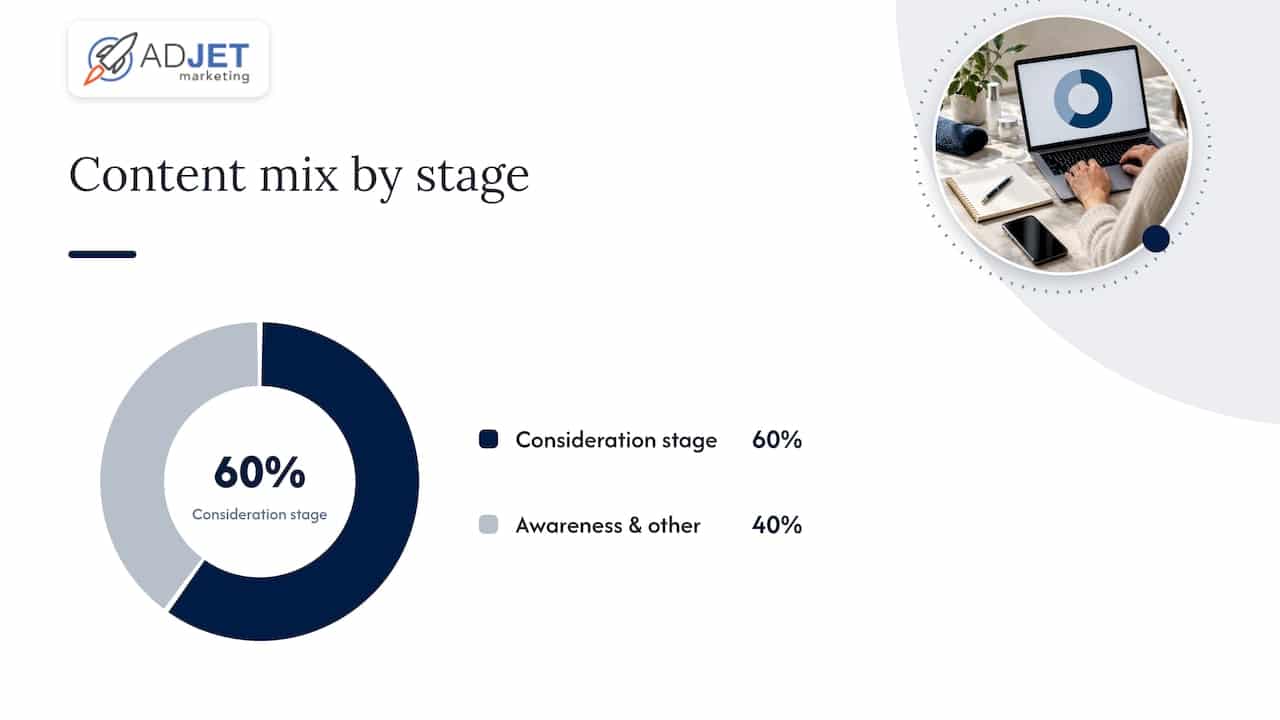
Industry guidance suggests weighting roughly 60% of content toward consideration-stage topics, the comparisons and questions people search while deciding, rather than broad awareness pieces.
- Publish comparison posts like “microneedling vs chemical peel” that route readers to the matching service page.
- Answer specific questions (“does CoolSculpting hurt”) in dedicated posts with FAQ schema markup to improve visibility in search results.
- Plan seasonal content around predictable spikes: wedding season facials, holiday party prep, summer body treatments.
- Link every blog post back to a relevant service page with a clear, low-pressure CTA.
Treat your blog as a patient-acquisition tool, not a traffic exercise. Our guide to med spa blog SEO covers the structure that tends to convert best.
Why specificity wins: long-tail and comparison keywords
A patient searching “best med spa for acne scars downtown” is closer to booking than one searching “med spa.” The specificity itself signals intent, and these long tails typically face less competition.
- Cluster long tails under the relevant service page rather than building a separate page for each variation.
- Use comparison pages for “vs” searches (“Botox vs Dysport”) and internally link to the matching service page with a direct CTA.
- Niche phrases like “non-surgical nose job cost” deserve their own FAQ entry or subsection rather than a whole new page.
Track consultation requests and conversion rate by keyword cluster, not just traffic. A cluster that brings ten visitors and three bookings beats one that brings a hundred visitors and none.
Measuring and prioritizing: where to actually spend your time
Build a simple prioritization matrix: score each keyword on search intent, volume, difficulty, and estimated conversion value, then rank your content calendar by that composite score rather than volume alone.
- Use CPC as a rough proxy for commercial value. A 217-keyword med spa reference recommends testing high-CPC terms with a small paid campaign before investing heavily in organic content.
- Expect GBP and on-page changes to move clicks within weeks; competitive organic rankings typically take three to nine months.
- Track GBP views and clicks, organic traffic to money pages, consultation requests, and booking rate as your core KPIs.
Local searches convert fast: the same med spa keyword data shows many bookings happen soon after a “near me” search, which is why local keywords deserve priority over broader, slower-moving terms. If you have the time and a reasonable budget, DIY keyword work and GBP management are achievable; once you’re managing multiple locations or competing in a crowded market, that’s usually when agency support pays for itself.
What agency experience tells us about med spa SEO
We build HIPAA-aware WordPress sites and manage keyword strategy for clinics that need compliant, patient-acquisition-focused content.
- Keep a keyword-to-page map so every service page, blog post, and GBP field has a defined target.
- Set up a GBP checklist before launch: categories, NAP consistency, service list, and photo cadence.
- Build service-page templates once, then replicate them across treatments to save time and keep quality consistent.
Clinics running multiple locations or several ad campaigns tend to benefit most from outside help; a single-location spa with time to spare can often handle the basics in-house. For practice management resources tailored to owners, see For Owners Only – OsteoStrong.
Common mistakes we see and how to fix them fast
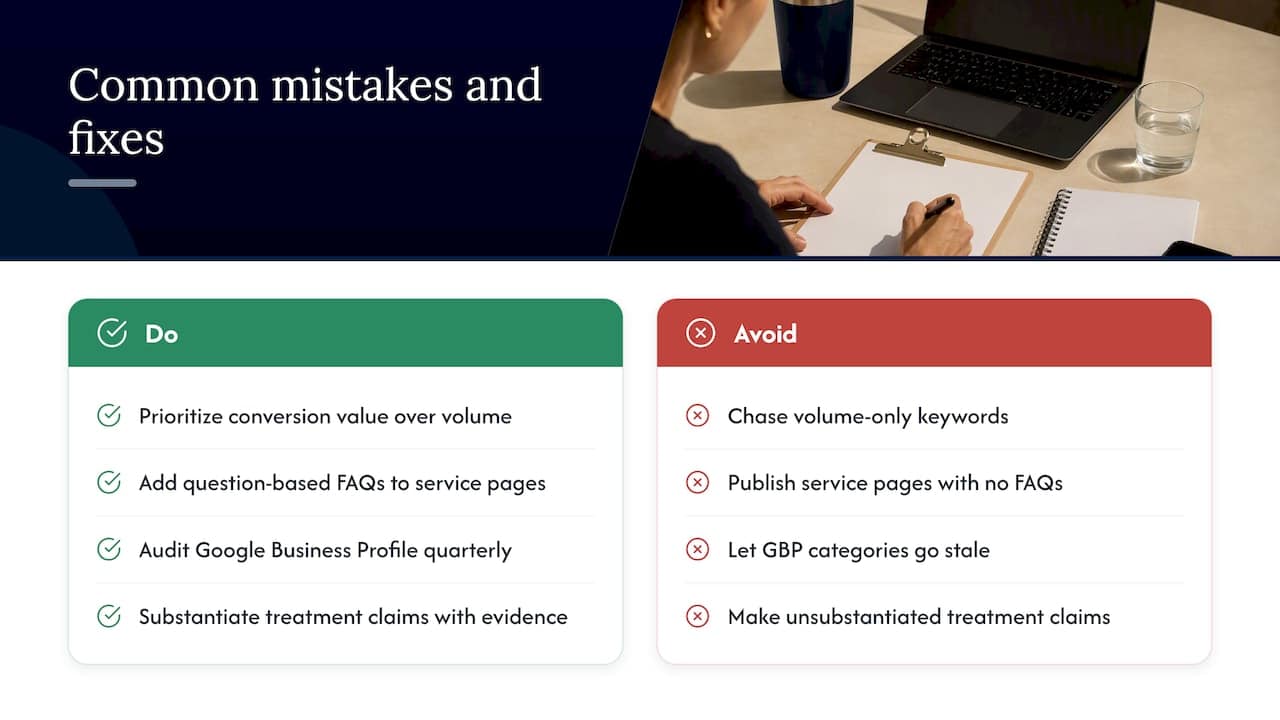
Three mistakes show up constantly: chasing high-volume keywords with no booking intent, writing service pages with no FAQ section, and letting GBP categories go stale after a service change. Fix them by reprioritizing around conversion value over raw volume, adding question-based FAQs to every service page, and auditing GBP quarterly.
Chasing volume alone fills your funnel with the wrong visitors; chasing conversion keeps your calendar full. One more thing: keep treatment claims factual and substantiated. FTC guidance on medical marketing warns against unsupported efficacy claims, and that caution applies directly to how you write about results.
— Felix
How we can help you turn keywords into booked consultations
If building and maintaining this keyword structure sounds like more than your team has time for, that’s exactly where we come in. Our SEO services handle keyword research, service-page builds, and ongoing GBP management for medical and aesthetic practices.
- Service pages can be built mapped to high-intent and local keywords potential patients search.
- Google Business Profile optimization, review strategy, and local pack visibility can be managed.
- We design landing pages through our med spa marketing services built to convert search traffic into booked consultations.
If you want a clear picture of where your current site stands, request an audit and we’ll walk you through what’s working and what isn’t.
FAQ
What are some good SEO keywords for a med spa?
The strongest keywords combine a specific treatment with intent or location, such as “Botox injections near me” or “HydraFacial cost.” These outperform broad terms like “med spa” because they match what someone searches right before booking.
What are the current trends in the med spa industry for SEO?
Local search and Google Business Profile optimization continue to drive the most bookings, since relevance, distance, and prominence determine who shows up in the local pack. Consideration-stage content, like treatment comparisons, is also gaining weight as patients research more before choosing a provider.
What is the 80/20 rule in SEO?
A small share of your pages or keywords typically drive most of your traffic and conversions, so focus your effort on the service pages and local terms that already show traction rather than spreading thin across every possible phrase. For med spas, that usually means your top three or four treatments and your local modifiers.
What are some good SEO keywords for therapists?
While this article focuses on med spas, the same intent-based approach applies: pair the specific service with a location or outcome, such as “anxiety therapist near me” or “couples counseling cost.” Question keywords like “how does therapy help with anxiety” work well for blog content aimed at patients still researching.
Sources
- Tips to improve your local ranking on Google – Google Business Profile Help
- 217 SEO Keywords for Medical Spas (2026 Data)
- Medspa marketing strategies — Sciton