









The fastest, compliant way to grow referrals this week is to run two tracks at once: reach out to your top referring physicians while turning on a low-friction, non-monetary patient referral flow. You don’t need new software or a big budget to start. You need a target list, one email, one automated message, and a place to log what comes in.
Here’s what to do in the next seven days:
- Day 1 to 2: The practice manager pulls the last 12 months of referral sources and emails your top five referring physicians directly, thanking them and offering a quick call.
- Day 3 to 4: Front desk sets up a 48 to 72 hour post-visit SMS or email with a unique referral link for patients, timed to what the Zocdoc referral primer describes as the key moment for referral ask.
- Day 5 to 7: The clinician or office manager adds referral source and referrer name as required fields in your EMR or CRM intake form.
None of this requires new tools. It requires someone owning each task.
Key Takeaways
Patient referral marketing works best when physician outreach and a compliant, non-monetary patient referral flow run together, tracked from day one.
| Point | Details |
|---|---|
| Start with two tracks | Combine physician outreach with a low-friction patient referral flow in the same week. |
| Time the patient ask | Send referral requests 48 to 72 hours post-care, when satisfaction peaks. |
| Choose bilateral rewards | Use service credits or priority booking instead of cash, especially if you bill federal payers. |
| Track the right fields | Log referrer ID, referral date, revenue attribution, and payer mix in your EMR or CRM. |
| Get expert setup support | Adjetmarketing builds the landing pages, tracking, and pilot campaigns that make referral programs measurable. |
Table of Contents
- Why Patient Referral Marketing Deserves Priority in Your Growth Plan
- Physician Referrals vs Patient Referrals: What’s the Difference?
- How Do You Build a Physician Referral Outreach Program?
- How Do You Start a Patient Referral Program the Right Way?
- What Digital Tools Support Physician and Patient Referrals?
- Which KPIs Actually Show If Your Referral Program Is Working?
- What Are the Legal Limits on Referral Incentives?
- How Do You Train Staff to Ask for Referrals Consistently?
- How Adjetmarketing Helps Practices Build Referral Programs That Convert
- Frequently Asked Questions
- Sources
Why Patient Referral Marketing Deserves Priority in Your Growth Plan
Referred patients tend to convert at a higher rate, stay longer, and cost less to acquire than patients from most paid channels. That’s not a guess. It’s the pattern that shows up across word-of-mouth research in healthcare, which found referred patients often carry higher lifetime value and re-refer at higher rates than patients from cold acquisition.
The benefits compound in ways paid ads don’t:
- Lower acquisition cost per patient over time
- Higher treatment acceptance, since trust is already established
- Better retention, because referred patients arrive pre-sold on your care
- A snowball effect, where each satisfied referral creates the next one
Referrals matter most in specialties with repeat visits, long decision cycles, or outcomes patients want to talk about, think orthopedics, pain management, or dermatology, more than in one-off transactional visits.
Physician Referrals vs Patient Referrals: What’s the Difference?
Physician referral marketing and patient referral marketing solve different problems, and they need different playbooks.
- Physician-to-provider referrals run on relationships and clinical trust. A referring doctor sends patients because they believe in your outcomes, not because of a reward.
- Patient-to-patient referrals run on satisfaction and timing. A patient refers a friend because their experience was good and you asked at the right moment.
- Digital referral mechanisms, codes, unique links, e-referral portals, sit underneath both and make either type trackable.
Orthopedics and specialty surgery lean on physician referrals almost exclusively. Med spas and aesthetic practices lean on patient referrals and digital codes. Each type carries different legal exposure, which we’ll get to shortly.
How Do You Build a Physician Referral Outreach Program?
Physician referral marketing is a relationship business first and a marketing function second. Skip the pitch deck and start with a list.
- Identify target referrers. Rank local providers by referral volume potential and clinical fit, not just proximity.
- Map referral pathways. Document how a referral currently reaches you, fax, EMR e-referral, phone call, and remove friction at each step.
- Craft outreach messaging. Lead with clinical value: outcomes data, wait times, or a specific care gap you fill. Skip sales language entirely.
- Assign an owner and timeline. Someone, usually the practice manager or a physician liaison, owns the relationship on a recurring cadence.
A realistic outreach cadence looks like: initial contact in week one, a value-add follow-up (case outcomes, referral feedback loop) around week three, an in-person or virtual meeting by week six, and an educational offering, a short CME session or lunch-and-learn, on the calendar within the first quarter. The word-of-mouth referral analysis backs this up: value-first outreach, feedback loops, and clear care pathways outperform anything that feels transactional.
Budget for staff time above all else, typically a few hours a week from a practice manager or liaison, plus modest costs for an occasional lunch or educational event. Track every referral in your EMR or CRM with referrer name, practice, reason for referral, and patient consent captured at intake.
Pro Tip: Assign one person to own physician relationships full time, even part-time. A referral program with no single owner quietly dies within two quarters.
How Do You Start a Patient Referral Program the Right Way?
A patient referral program works when it feels like a natural extension of good care, not a transaction. Start with the timing.
- Identify your “happy moments,” the point right after a successful procedure, a resolved pain issue, or a satisfying consult.
- Send the ask 48 to 72 hours post-care, when satisfaction is highest and the experience is still fresh, a window Pabau’s referral guidance points to directly.
- Choose a reward structure that leans non-monetary: priority booking, a service credit, or a small gift rather than cash.
- Document the rules in writing and script what staff say, so the ask never sounds like a sales pitch.
A front desk script might sound like: “We’re really glad your visit went well. If you know anyone who could use care like this, we have a simple way for you to send them our way, no pressure at all.” A clinician script during a good outcome conversation: “I’m glad this worked out for you. If a friend or family member ever needs this kind of care, feel free to mention us.”
The strongest patient referral programs are structured, actively managed, and cheap to run. What separates the ones that scale from the ones that fizzle is documentation, not budget.
Administration matters as much as messaging: assign tracking codes at intake, confirm referrals automatically, and send a genuine thank-you when a referral books.
Pro Tip: Never offer cash for referrals if you bill federal payers. Run any incentive plan past healthcare counsel before you launch it.
What Digital Tools Support Physician and Patient Referrals?
Digital infrastructure is what turns a referral program from a good idea into something you can measure. Unique referral links, QR codes, and referral codes carry metadata into your CRM or EMR automatically, which is exactly what Spokk’s referral platform research points to when it comes to reducing admin overhead and improving retention tracking.
A few practical builds worth prioritizing:
- A referral landing page with one-click booking and a clear message about who should be referred
- An automated SMS or email sequence timed to the 48 to 72 hour window
- Paid ads used sparingly, mainly to amplify referrer-facing educational content, not to chase cold traffic
- Clinician profile pages and local SEO work that make it easy for a referred patient to find and confirm you once they’ve been told to look
Our patient lead generation playbook covers how these pieces fit into a broader acquisition mix beyond referrals alone.
Which KPIs Actually Show If Your Referral Program Is Working?
Track referral conversion rate, cost per referred acquisition, and lifetime value of referred versus non-referred patients side by side. Referral velocity, how fast a referral turns into a booked visit, and a ranked list of your top referrers round out the core set.
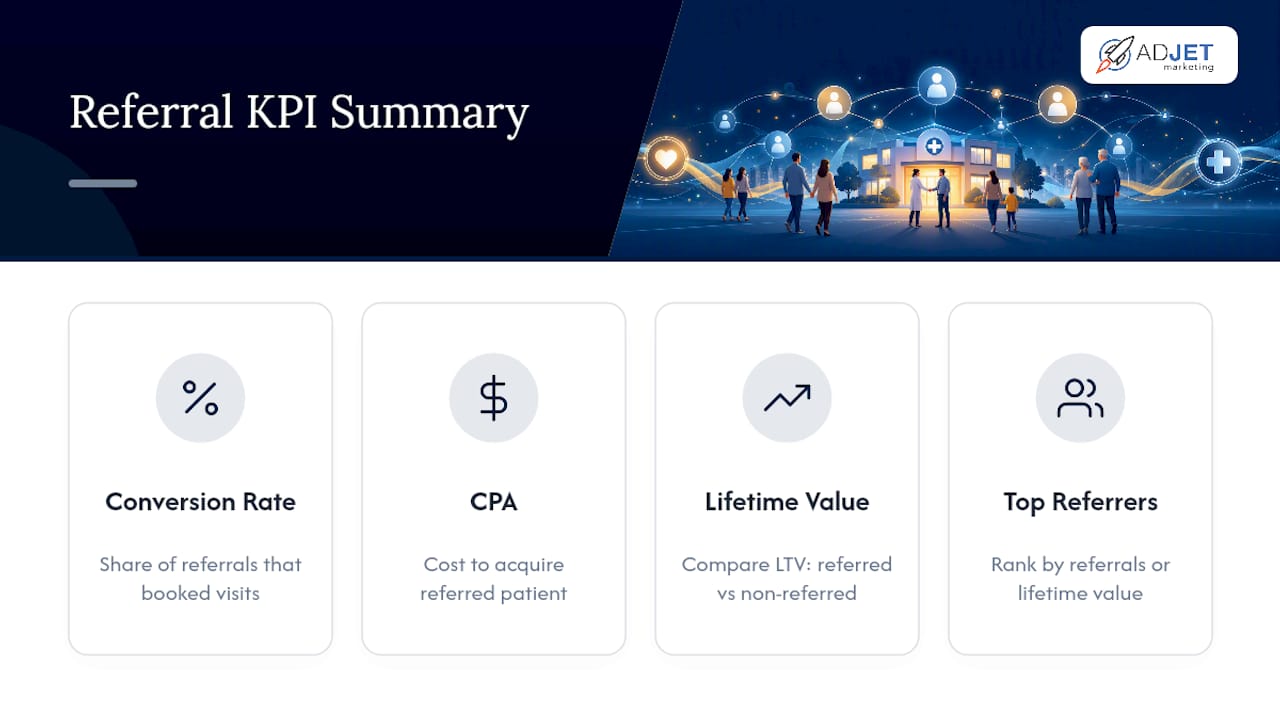
Your dashboard should capture referrer ID, referral date, first-visit outcome, revenue attribution, payer mix, and follow-up retention. Attribution windows for referrals often need to be longer than most paid channels, according to Improvado’s healthcare attribution guide, because physician referrals frequently carry a better payer mix that justifies a higher cost per acquisition than for a paid ad channel.
Once you have a few months of data, A/B test your ask messaging, adjust reward types if conversion stalls, and shift outreach cadence toward whichever referrers show the strongest lifetime value.
What Are the Legal Limits on Referral Incentives?
Before you attach any reward to a referral, confirm whether you bill federal payers like Medicare or Medicaid. That single fact determines how much risk you’re carrying.
- Consult healthcare counsel before finalizing any incentive structure, not after you’ve announced it
- Document program terms in writing and record patient consent where personal health information changes hands
- Check the AMA Code of Medical Ethics on patient incentives, Anti-Kickback Statute exposure, Stark Law if physicians are involved, and your state medical or dental board rules
- Watch for red flags: cash-for-referral language, undisclosed fee-splitting with third parties, rewards that resemble commissions, or incentive values that exceed de minimis thresholds
Financial or valuable incentives for patients who recruit other patients are restricted under AMA ethical guidance in physician-supervised practices. Bilateral, value-based rewards, service credits, priority booking, are the safer default.
Safe alternatives that hold up under scrutiny: service credits, priority scheduling, loyalty points, or a donation to a community cause in the referring patient’s name.
How Do You Train Staff to Ask for Referrals Consistently?
A referral program only works if front-desk staff and clinicians actually ask, consistently, not occasionally.
- Give clinicians and hygienists a one-line script tied to a good outcome moment, delivered naturally in conversation, not read off a card.
- Train front desk to capture referral codes or referrer names at check-in and tag them immediately in the EMR.
- Review referral metrics weekly as a standing agenda item, five minutes is enough, and recognize the staff member who generated the most referral asks that week.
Small internal incentives, a gift card, public recognition at a team meeting, keep the habit alive long after the initial launch enthusiasm fades.
Agency Perspective: What Actually Slows Referral Programs Down
Most practices under-track referrals for months before they realize it, then expect results in weeks once they fix it. Meaningful lift usually takes a full quarter. If you invest in one thing first, invest in the tracking field, not the reward.
How Adjetmarketing Helps Practices Build Referral Programs That Convert
Adjetmarketing gives you a faster path to a working referral system than building one alone through trial and error. You get the landing pages, EMR or CRM tagging, and tracking infrastructure set up correctly the first time, without months of guessing which fields matter.

We typically start with an audit of your current referral sources and intake fields, then build a pilot: a referral landing page, an automated SMS sequence timed to the 48 to 72 hour window, and paid ads to support referrer-facing education where it makes sense. From there, we scale whatever the data shows is converting. Clients usually see cleaner attribution within the first month and a measurable lift in booked referral visits by the second quarter.
If you want a practice built to capture and convert referrals correctly, start with our medical marketing services overview to see what an audit and pilot typically involve.
Frequently Asked Questions
What is patient referral marketing?
Patient referral marketing is the practice of systematically encouraging existing patients and referring physicians to send new patients to your clinic, then tracking and optimizing that flow with tools like unique codes, timed outreach, and EMR tagging.
How do I increase patient referrals without violating Anti-Kickback rules?
Favor non-monetary or bilateral rewards, service credits, priority booking, small gifts, rather than cash, and confirm your reward structure with healthcare counsel if you bill Medicare, Medicaid, or other federal payers.
How long does it take to see results from a referral program?
Most practices see measurable attribution improve within the first month once tracking is in place, with meaningful volume growth typically showing up over a full quarter or two, not days.
What’s the difference between physician referral marketing and patient referral marketing?
Physician referral marketing focuses on relationship building with other providers through value-first outreach and education, while patient referral marketing focuses on timing, low-friction sharing tools, and non-monetary incentives for existing patients.
What KPIs matter most for tracking referrals?
Referral conversion rate, cost per referred acquisition, lifetime value of referred versus non-referred patients, and a ranked list of top referrers give you the clearest picture of program health.
This article is general information, not a substitute for advice from a qualified lawyer. Consult a qualified legal professional about your own circumstances before acting on anything here.