









The three highest-impact moves to start generating patient leads right now are: optimize your Google Business Profile and local SEO, systematize referrals and reviews, and fix your intake speed and tracking. Do these three things before spending a dollar on paid ads and you will likely see more new patients within 30–60 days than a poorly structured Google Ads campaign would deliver in three months.
Start here this week:
- Google Business Profile (GBP): Claim and fully complete your profile, add service categories, upload 10+ photos, and post weekly. Aim for 50+ reviews at 4.5 stars or above. A fully optimized GBP at that review threshold typically generates 40–60 new appointment requests per month for a single-location practice in a mid-size market.
- Referrals and reviews: Map every existing referral source (physicians, past patients, community partners). Set up a simple, automated post-visit review request via text or email. Most practices have referral relationships that are never formally tracked or nurtured.
- Intake speed and tracking: Add UTM parameters to every marketing link. Install call tracking. Set a goal to answer or return every new patient inquiry within five minutes during business hours. Speed to contact is the single biggest driver of healthcare lead conversion at materially higher rates than slower callbacks (https://improvado.io/blog/healthcare-lead-generation-strategies-for-hospitals-and-medical-practices), and most clinics are losing leads to voicemail and slow callbacks.
Pro Tip: Sequence matters. Fix GBP and intake first because they cost almost nothing and produce measurable results within weeks. Add paid search only after your phone answer rate and booking conversion are solid, otherwise you are paying to fill a leaky bucket.
Key Takeaways
Effective patient lead generation is a governed operational system, not a series of one-off campaigns. The practices that grow consistently are the ones that fix intake and attribution first, then scale paid channels on a solid foundation.
| Point | Details |
|---|---|
| Start with zero-cost channels | GBP, referrals, and directories produce the best ROI before any paid spend is added. |
| Fix intake before scaling ads | A 90%+ phone answer rate and sub-5-minute response time are prerequisites for paid channel ROI. |
| Attribution drives CPA improvement | Closed-loop tracking from ad click to booked patient typically cuts cost-per-acquisition by 40–60% in the first quarter. |
| PAC-to-LTV sets your budget ceiling | Primary care LTV runs $1,500; specialty LTV $5,000. Keep PAC at 10% of LTV. |
| Adjetmarketing builds the full system | From GBP and Google Ads to HIPAA-aware CRM integration, Adjetmarketing provides a structured path from audit to booked patients. |
Table of Contents
- How to define and segment your ideal patient before you market to anyone
- Which digital channels actually produce booked patients for your practice
- How to convert traffic into booked appointments: website, forms, and phone handling
- HIPAA and privacy essentials for patient lead generation: what you must not do
- How to measure success: KPIs, budgets, and realistic timelines
- What tools and workflows you need to capture and nurture patient leads
- What most practices get wrong and how to fix it
- When to hire a specialist agency vs. run the program in-house
- Building referral networks and offline channels that actually produce patients
- What we see in practice: patterns, anecdotes, and what actually moves the needle
- How Adjetmarketing approaches patient lead generation for clinics
- Sources
How to define and segment your ideal patient before you market to anyone
Spending money on patient acquisition marketing without a clear patient persona is one of the fastest ways to generate high volume and low quality at the same time. Many clinics come to us after months of Google Ads traffic that produced inquiries from out-of-network patients, wrong geographies, or services they do not even offer. Segmentation fixes that before it costs you.
The core idea is simple: when your messaging, channel selection, and keywords match a specific patient’s situation, your cost per acquisition drops and your booking rate rises. Combining firmographic and intent-based filters improves targeting and lead quality for healthcare-focused outreach, and the same logic applies at the practice level when you map service lines to patient intent.
Persona template fields to capture
For each patient segment you want to attract, document:
- Demographics: Age range, gender, location radius, insurance type (commercial, Medicare, Medicaid, self-pay)
- Clinical need: Primary condition or service sought, urgency level (acute vs. elective), and whether they are a new or returning patient
- Search intent: What they type into Google (“back pain specialist near me” vs. “lumbar fusion recovery time”)
- Referral source: Primary care physician, specialist, friend/family, online search, social media
- Objections: Cost concerns, wait time fears, insurance uncertainty, stigma (especially relevant for mental health)
- Decision timeline: Immediate (urgent care, pain) vs. weeks or months (elective aesthetics, bariatric)
Three example patient personas
-
Primary care new patient (Maria, 34, commercial insurance): Searching “family doctor accepting new patients [city]” on Google. Finds you via GBP or insurance directory. Converts quickly if your website shows availability and accepts her plan. Best channels: GBP, insurance directories, local SEO service pages.
-
Elective aesthetics patient (Jordan, 42, self-pay): Researching “best medspa for laser skin resurfacing [city]” over several weeks. Compares before/after photos, reads reviews, and checks pricing. Converts via social proof and a clear consultation CTA. Best channels: Instagram/Meta ads, GBP, before/after gallery pages, and specialty-specific paid search.
-
Referral-driven specialty patient (David, 58, Medicare + supplement): Referred by his cardiologist. Does not search independently but does verify your credentials and location online before calling. Converts via a professional website, clear physician bio, and a smooth phone intake. Best channels: physician referral network, GBP, and a credibility-focused website.
Map each persona to your service lines and the intent keywords they use. A pain management clinic targeting David needs different landing pages and different ad copy than a medspa targeting Jordan. Treating them the same wastes budget on both.
Which digital channels actually produce booked patients for your practice
Not every channel deserves equal attention, and the right sequence depends on your specialty, market size, and how much staff bandwidth you have. The goal of digital marketing for clinics is not to be everywhere at once. It is to be dominant in the two or three channels your ideal patient actually uses.
Channel priority and cost benchmarks
Practice owners consistently achieve the best ROI by maximizing zero-cost channels first before scaling paid media. Here is how the channels stack up by cost per new patient and implementation priority:
| Channel | Typical cost per new patient | Best for | Priority order |
|---|---|---|---|
| GBP / local SEO | $0 | All specialties | 1 (immediate) |
| Physician directories | $0–$30 | Primary care, specialists | 1 (immediate) |
| Organic service pages | $50–$150 | All specialties | 2 (weeks 4–12) |
| Google Search (paid) | $100 | High-intent, urgent needs | 3 (after intake is fixed) |
| Paid social (Meta/Instagram) | $80 | Elective, aesthetics, mental health | 3 (parallel with paid search) |
| Email/SMS reactivation | $5–$30 | Existing patient base | 2 (quick win) |
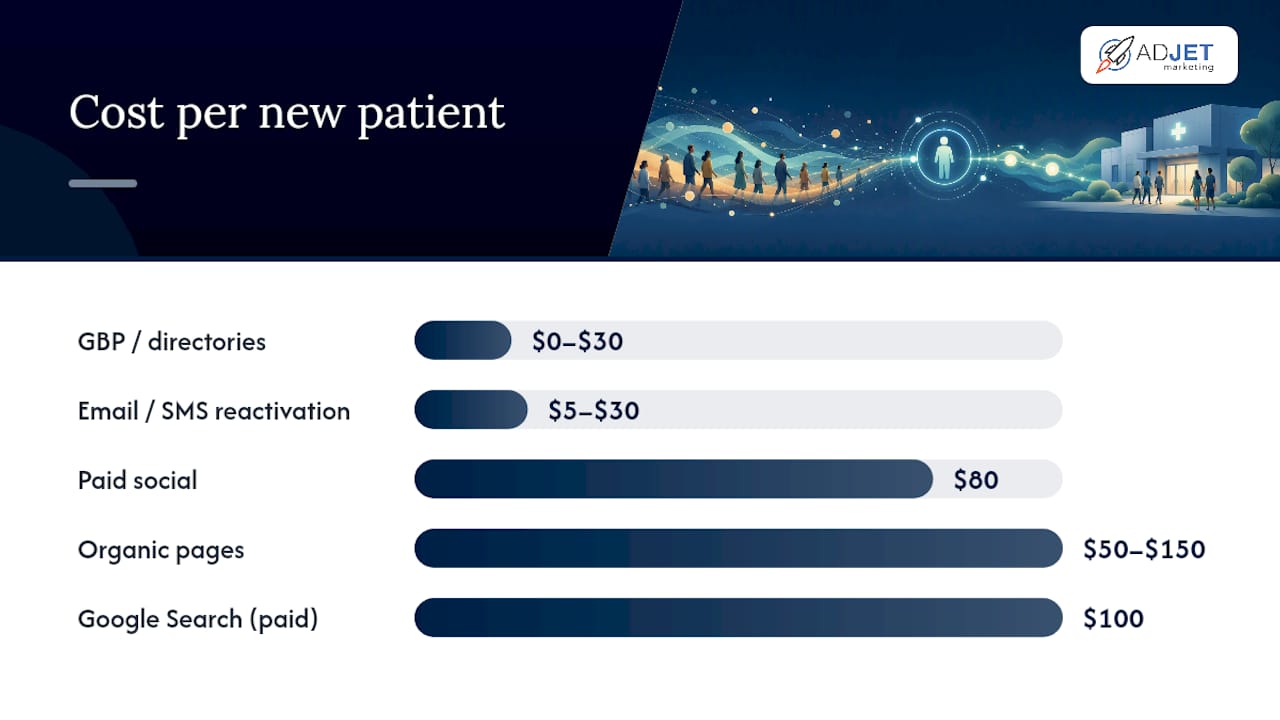
Cost ranges sourced from FrontDesk’s healthcare marketing guide.
What to implement for each channel
GBP and local SEO:
- Complete every GBP field: hours, services, attributes, Q&A, and photos
- Post at least once per week (service updates, health tips, team spotlights)
- Build consistent NAP (name, address, phone) citations across Yelp, Healthgrades, Zocdoc, and WebMD
- Publish location-specific service pages on your website (e.g., “knee pain treatment in [city]”)
Google Ads:
- Start with exact and phrase match keywords for your highest-margin service
- Use dedicated landing pages, not your homepage, for every ad group
- Set location radius tightly (5–15 miles for most practices)
- Install conversion tracking before the campaign goes live
Paid social:
- Meta and Instagram work best for elective services where patients are not yet searching
- Use lead form ads for consultation requests; retarget website visitors with testimonial content
- Aesthetics and mental health practices often see strong results here; primary care less so
Email and SMS reactivation:
- Pull a list of patients not seen in 12+ months and send a re-engagement sequence
- Keep messages general (appointment reminders, wellness tips) to avoid PHI exposure in marketing tools
Pro Tip: For search intent mapping by specialty, the healthcare search intent guide is worth bookmarking before you build your service pages or ad campaigns.
How to convert traffic into booked appointments: website, forms, and phone handling
Traffic without conversion is just an expense. Fixing funnel leaks — answer rate, booking conversion, and no-shows — often produces a 25–40% lift in patients from existing marketing before you need to increase spend. That is the most underused lever in most practices.
Website and landing page conversion checklist
- Page load time under three seconds on mobile (test with Google PageSpeed Insights)
- Click-to-call button visible above the fold on every page
- Online booking link or form on every service page, not just the homepage
- Trust signals: provider photos, credentials, years in practice, and patient review count
- Clear service descriptions that match the patient’s search intent (not clinical jargon)
- Structured data markup (LocalBusiness, MedicalClinic schema) for search visibility
Form design: what to ask and what to avoid
| Form field | Include? | Reason |
|---|---|---|
| First name, last name | Yes | Basic identification |
| Phone number | Yes | Primary follow-up channel |
| Email address | Yes | Nurture and confirmation |
| Service of interest | Yes | Routes to correct staff |
| Insurance type | Optional | Helps triage, not PHI |
| Specific symptoms or diagnosis | No | PHI — use intake forms instead |
| Date of birth | No | PHI in marketing context |
| Referral source (dropdown) | Yes | Attribution data |
Keep forms to five fields or fewer for initial contact. Detailed clinical information belongs in your EHR intake process, not your marketing form. Capturing referral source via a dropdown (“Google search,” “physician referral,” “friend/family,” “insurance directory”) takes 30 seconds to add and gives you attribution data that most practices never collect.
Phone and chat handling
88% of healthcare prospects prefer calling directly from search results, which means your phone system is your primary conversion tool. Every missed call during business hours is a lead that likely called your competitor next.
- Install call tracking (CallRail or a HIPAA-compliant equivalent) with dynamic number insertion so you can attribute calls to their source channel
- Set up IVR routing that gets new patient callers to a live person within two rings, not a four-menu maze
- Record calls (with proper consent disclosure) and review weekly for missed booking opportunities
- Add UTM parameters to every marketing link so web-to-form conversions carry source data through to your CRM
HIPAA and privacy essentials for patient lead generation: what you must not do
The compliance bottom line for marketing channels is this: any system that captures, stores, or transmits information that could identify a patient in connection with their health condition is handling Protected Health Information (PHI) and requires a Business Associate Agreement (BAA) with every vendor involved. Most standard marketing tools — Google Analytics 4, Meta Pixel, HubSpot’s free tier, and most chatbots — are not HIPAA-compliant out of the box.
Compliance checklist for your marketing stack
- Sign a BAA with every vendor that touches patient data: CRM, call tracking, email platform, scheduling software, and any chatbot
- Use HIPAA-compliant form processors (not standard Google Forms or Typeform without a BAA)
- Store form submissions in an encrypted, access-controlled system, not a shared spreadsheet
- Include consent language on every intake form: “By submitting this form, you consent to being contacted by [Practice Name] regarding your inquiry.”
- Do not use Meta Pixel or Google Ads conversion tags on pages where patients enter clinical information
- Disable browser autofill on fields that could capture PHI
- Train front desk staff on what can and cannot be discussed in follow-up texts and emails
BAA fields to request from every vendor
Before integrating any tool into your patient acquisition workflow, verify these items in writing:
- Encryption at rest and in transit (AES-256 minimum)
- Audit logging with user-level access records
- Data retention and deletion policies
- Breach notification timeline (HIPAA requires 60 days; faster is better)
- Subcontractor BAA coverage (does their BAA extend to their own vendors?)
- Geographic data storage (US-based servers preferred)
Common pitfalls and one-line fixes
- Chatbot capturing clinical details: Use chatbots only for scheduling and general questions; disable free-text input fields that could collect symptoms.
- Unsecured CRM fields: Audit every custom field in your CRM and remove or restrict any that store diagnosis, treatment, or medication data.
- Retargeting with PHI: Never build retargeting audiences from patient lists unless you have explicit authorization and a compliant data transfer method.
- Call recordings stored in non-compliant tools: Move call recordings to a HIPAA-covered storage environment immediately after capture.
The practical rule for compliant patient marketing: If a vendor will not sign a BAA, do not connect them to any system that touches patient inquiries. There is no marketing ROI worth an HHS audit or a breach notification letter to your patients.
How to measure success: KPIs, budgets, and realistic timelines
Primary KPIs to track
| KPI | What it measures | Target benchmark |
|---|---|---|
| New patients by source | Which channels produce booked patients | Track monthly by channel |
| Cost per new patient (CPA) | Marketing spend divided by new patients acquired | Varies by specialty (see below) |
| Call answer rate | % of inbound calls answered live | 90%+ during business hours |
| Booking conversion rate | % of inquiries that become scheduled appointments | 40–60% for well-run practices |
| No-show rate | % of scheduled appointments not kept | Under 10% with reminders |
| Lead-to-appointment time | Days from first inquiry to first appointment | Under 5 days for most specialties |
Budget ranges and expected lead volume
Organizations that close the loop between ad spend and patient revenue typically see 40–60% improvement in cost-per-acquisition within the first quarter of implementation. That improvement comes from attribution, not just more spend.
- Low spend ($500–$1,500/month): Focus on GBP, local SEO, and directory optimization. Expect 10–25 new patient inquiries per month within 60–90 days, primarily from organic and referral sources.
- Medium spend ($1,500–$4,000/month): Add Google Ads for one or two high-margin service lines. Expect 30–60 inquiries per month by month three, with paid channels contributing 40–60%.
- High spend ($4,000–$10,000+/month): Full-channel approach: paid search, paid social, content, and CRO. Expect 60–150+ inquiries per month, with CPA varying significantly by specialty and market competition.
Timeline expectations by channel
- Month 1: GBP fully optimized, call tracking live, citation cleanup underway. Referral outreach initiated. Paid search campaigns in learning phase.
- Month 3: Local SEO showing early ranking movement. Paid search CPA stabilizing. Referral volume measurably up if outreach was systematic.
- Month 6: Organic service pages ranking for local intent keywords. Review count growing. Attribution data clean enough to make channel budget decisions with confidence.
- Month 12: Full picture of PAC by channel. SEO producing consistent organic leads. Paid channels optimized to target CPA.
Healthcare acquisition cycles commonly run over a year and up to two years, and qualified leads frequently go quiet during budget or insurance review periods before reengaging. Build your nurture sequences for the long game.
Calculating PAC-to-LTV
Primary care patient lifetime value typically runs in the low thousands; specialty patient lifetime value is often several thousands or more. For a specialty practice with a $10,000 LTV, a $500–$1,000 PAC is defensible. For a primary care practice with a $2,000 LTV, keep PAC under $200–$400. These thresholds tell you how aggressively you can bid in paid search without eroding margin.
For a deeper look at channel sequencing and budget allocation by clinic type, the digital marketing guide for healthcare clinics walks through the math in more detail.
What tools and workflows you need to capture and nurture patient leads
CRM and call tracking: what to look for
Before selecting any tool, verify it meets these criteria:
- HIPAA compliance: BAA available, encryption at rest and in transit, audit logs
- EHR connector or Zapier integration: Allows closed-loop attribution from lead to patient record
- Call tracking integration: Dynamic number insertion, call recording, source attribution
- Lead routing rules: Automatic assignment by service line, location, or insurance type
- Nurture automation: Triggered sequences for unbooked leads, no-shows, and reactivation
HIPAA-compliant CRM options include platforms like Salesforce Health Cloud, Keap (with a BAA), and specialty-built tools like PatientPop or Klara. Standard marketing CRMs without a BAA are not appropriate for storing patient inquiry data.
Sample lead workflow with timing SLAs
- Lead capture (0 minutes): Form submission or inbound call triggers an automatic confirmation to the patient and an internal alert to the front desk or intake coordinator.
- Instant routing (0–2 minutes): CRM assigns the lead to the correct staff member based on service line. Call tracking logs the source channel and call outcome.
- First contact attempt (under 5 minutes): Staff calls or texts the lead. Speed here is critical. Contacting leads within five minutes converts at materially higher rates than delays of hours or days.
- Intake follow-up (same day): If no answer, send a HIPAA-safe text (“Hi, this is [Practice Name]. We received your inquiry and would love to help. Please call us at [number] or reply to schedule.”). Do not include clinical details in the message.
- Nurture sequence (days 2–14): Automated, compliant follow-up sequence for leads that have not booked.
- Appointment confirmation (48 hours before): Automated reminder via text and email to reduce no-shows.
Sample 4-step nurture sequence for inbound leads
- Day 0 (immediate): Auto-confirmation text/email acknowledging the inquiry and providing your phone number and booking link.
- Day 1: Personal follow-up call or text from intake staff. If voicemail, leave a brief, non-clinical message.
- Day 3: Email with a brief overview of what to expect at the first appointment, insurance information, and a direct booking link.
- Day 7: Final follow-up text or email. Keep it simple: “We still have availability if you would like to schedule. No pressure, just want to make sure you get the care you need.”
Integration priorities for closed-loop attribution
Connect your tools in this order: call tracking feeds into your CRM, your CRM connects to your EHR or billing system, and your ad platforms pull conversion data from the CRM. This chain lets you see which Google Ads keyword or which referral source produced a patient who completed treatment and generated revenue, not just a form fill.

What most practices get wrong and how to fix it
The most common mistakes, ranked by impact
- Ignoring Google Business Profile: GBP is the single highest-ROI free asset most practices under-maintain. An incomplete or unmonitored profile loses patients to competitors with 50+ reviews and weekly posts.
- No formal referral system: Most practices receive referrals passively. A structured outreach program to referring physicians, with regular updates and easy fax/portal referral submission, can double specialist referral volume within a quarter.
- Slow follow-up: A lead that waits 24 hours for a callback has already called two other practices. This is the most fixable problem and the one with the fastest ROI.
- Broken attribution: Running Google Ads without call tracking and UTM parameters means you cannot tell which campaigns produce patients. You end up cutting the wrong budget lines.
- Over-indexing on low-quality channels: Some practices spend heavily on broad social media awareness campaigns that generate clicks but not bookings. Awareness is not a patient lead.
Optimization checklist with prioritized fixes
- Answer the phone: set a 90% answer rate goal and measure it weekly
- Add a booking link to your GBP, website header, and every service page
- Automate review requests via text within 24 hours of a completed appointment
- Clean your directory citations (consistent NAP across Healthgrades, Zocdoc, Yelp, WebMD)
- Add UTM parameters to every paid and organic link before the next campaign launches
- Set up call tracking with at least one HIPAA-compliant provider before spending on ads
Testing and iteration
Before A/B testing ad creative or landing page copy, you need at least 30–50 conversions per variant to draw statistically meaningful conclusions. Most small practices do not hit that volume quickly, so prioritize testing the highest-traffic elements first: your headline, your CTA button text, and your form length. A landing page with a single CTA consistently outperforms one with multiple options. Start there.
Pro Tip: The first thing to A/B test on a service landing page is not the headline. It is whether a phone number displayed prominently above the fold outperforms a form. For most healthcare specialties, it does, because 88% of prospects prefer calling.
When to hire a specialist agency vs. run the program in-house
Hiring a specialist agency makes the most sense when your staff cannot dedicate 10–15 hours per week to marketing execution, when you need a HIPAA-aware tech stack assembled quickly, or when you want faster ROI than organic-only growth allows. Running in-house works when you have a dedicated marketing coordinator, a clear channel strategy, and the patience for a 6–12 month ramp.
What a good agency should deliver
A specialist healthcare marketing agency should provide:
- GBP optimization and ongoing management
- Local SEO: citation building, service page creation, technical audits
- Google Ads management with HIPAA-compliant conversion tracking
- Landing page design and CRO (conversion rate optimization)
- Call tracking setup and monthly reporting
- CRM integration and lead routing configuration
- Compliance documentation: BAA list, consent language review, pixel audit
- Monthly reporting tied to new patients by source, not just clicks and impressions
Realistic outcomes from an agency engagement
| Timeline | Organic/SEO | Paid search | Referral program |
|---|---|---|---|
| Month 1–2 | GBP optimized, citations cleaned | Campaigns live, learning phase | Outreach initiated |
| Month 3 | Early ranking movement | CPA stabilizing | First measurable lift |
| Month 6 | Service pages ranking | CPA at target range | Referral volume consistent |
| Month 12 | Consistent organic leads | Full channel optimization | Referral system self-sustaining |
Six questions to ask any agency before signing
- Will you sign a BAA and provide a list of all subcontractors who touch patient data?
- How do you attribute patient revenue back to specific campaigns and keywords?
- What is your reporting cadence and what metrics appear in every report?
- How do you handle landing page CRO, and how many tests do you run per quarter?
- Can you provide references from practices in our specialty or market size?
- What does your onboarding process look like, and what do you need from us in week one?
Red flags: an agency that cannot answer the BAA question clearly, reports only on impressions and clicks without tying data to booked patients, or promises a specific number of new patients per month without seeing your current conversion data first.
For a broader look at what to expect from a managed marketing engagement, the healthcare lead generation process guide covers the full pipeline from first touch to booked appointment.
Building referral networks and offline channels that actually produce patients
Physician referrals remain one of the highest-converting patient acquisition channels for specialists, and most practices treat them as passive. A structured referral program changes that.

Start by mapping your current referral sources. Pull the last 12 months of new patient records and identify which referring physicians, practices, or community organizations sent you patients. Those are the relationships to formalize first.
What a structured physician referral program looks like:
- Assign a staff member (or the physician themselves) to make quarterly outreach calls to top referring providers
- Send a monthly or quarterly clinical update letter to referring physicians: new services, updated protocols, case outcomes (de-identified)
- Make the referral process frictionless: a dedicated fax line, a referral portal, or a direct phone line to your scheduling team
- Acknowledge every referral with a written thank-you and a follow-up note on the patient’s outcome (with appropriate consent)
- Track referral volume by source in your CRM so you can see which relationships are growing and which have gone quiet
Offline channels worth maintaining:
- Community health fairs and employer wellness events: particularly effective for primary care, occupational health, and preventive specialties
- Speaking engagements at local business associations or community groups: builds credibility and generates self-referrals
- Partnerships with complementary providers (physical therapists, chiropractors, nutritionists): cross-referral agreements that benefit both practices
- Local sponsorships (youth sports, community events): low-cost brand awareness in your service area
Offline channels rarely produce immediate, trackable leads, but they build the trust and name recognition that make your digital channels convert better. A patient who has heard your name at a health fair is far more likely to click your GBP listing and book an appointment than a cold searcher.
What we see in practice: patterns, anecdotes, and what actually moves the needle
The most consistent pattern we see when a new clinic comes to us is this: the marketing budget is already running, but the phone is not being answered reliably and the GBP has not been touched in 18 months. The first fix is never the ad campaign. It is always the intake.
One practice we worked with had a GBP profile sitting at 3.8 stars with 22 reviews. Within 60 days of implementing an automated post-visit review request and responding to every existing review, they crossed 4.6 stars with 67 reviews. Appointment requests from Google Maps increased noticeably before we had changed a single line of ad copy.
A specialist referral program tells a similar story. A pain management clinic had three strong referring physicians but no formal outreach process. After assigning a staff member to make quarterly calls and send monthly clinical updates, two of those physicians began referring at roughly twice their previous rate within a quarter. No paid media involved.
The lead quality versus volume trade-off is real, and it comes up constantly. Practices that run broad, low-intent keywords in Google Ads generate call volume, but the calls are often from patients outside their service area, outside their insurance network, or seeking services the practice does not offer. Tighter keyword targeting, dedicated landing pages, and a clear service scope in the ad copy reduce volume but dramatically improve the ratio of inquiries that become booked patients.
Staff handoff is the other failure point we see repeatedly. A lead comes in through a well-built funnel, gets routed to the front desk, and then sits in a voicemail queue for four hours. The marketing worked. The intake did not. Before scaling any paid channel, audit your phone answer rate for one week. The number is almost always lower than the practice owner expects.
Pro Tip: *Lead quality is a better metric than lead volume for most practices.
How Adjetmarketing approaches patient lead generation for clinics
Adjetmarketing works with medical clinics, aesthetic practices, pain management centers, and mental health providers to build patient acquisition systems that are measurable, HIPAA-aware, and built to scale. The approach is practical: start with the highest-ROI fixes (GBP, intake, referrals), then layer in paid search and landing page optimization once the foundation is solid.
A typical engagement starts with a marketing audit covering your current GBP status, website conversion rate, call answer rate, and attribution setup. From there, we build a prioritized 90-day plan. Most clients see measurable improvement in inquiry volume within the first 60 days from GBP and intake fixes alone, before paid campaigns are fully optimized.
Core services include Google Ads management for high-intent patient acquisition, local SEO and GBP optimization, high-converting landing page and website design, and HIPAA-aware CRM and call tracking integration. We also provide a medical clinic marketing checklist that gives you a clear starting point if you want to assess where you stand before committing to a full engagement.
If you want a structured plan built around your specialty, market, and budget, request a strategy consultation and we will walk through your current setup and identify the fastest path to more booked patients.
Sources
- Healthcare Lead Generation: HIPAA-Compliant Strategies (2026)
- Healthcare Marketing: The Practice Owner’s Complete Guide | FrontDesk | Front Desk
- Healthcare Sales Lead Generation Strategies for 2026
- Healthcare lead generation (Pipeline/ZoomInfo)