









Start with your goals and your booked-patient economics, not a copied percentage. Most independent practices report spending 1% to 5% of revenue on marketing, but the right number for your clinic depends on patient value, specialty, and how fast you want to grow. Budget for measurement and HIPAA-compliant tracking from day one, not as an afterthought. The sections below cover real benchmarks, the metrics that matter, where the money should go, and a 90-day plan to test it safely.
TL;DR:
- Practices should adjust their marketing budget based on their growth goals, patient value, and competitive market conditions rather than copying generic percentages.
- The true cost of acquiring a patient depends on tracking actual booked patients, not just leads, with a recommended ratio of three times patient lifetime value to acquisition cost for sustainability.
- Prioritizing improvements in online presence and conversion processes before increasing paid advertising ensures a better return on marketing spend.
- A 90-day testing plan should include setting up measurement tools, running targeted campaigns, and reallocating funds based on PAC and capacity after three months.
- HIPAA compliance costs for tracking tools and legal reviews are crucial upfront investments that prevent regulatory issues and misattribution waste.
Table of Contents
- Medical Marketing Budget Benchmarks You Can Actually Trust
- Build the Budget Around What a Booked Patient Is Worth
- Where the Money Should Actually Go
- A 90-Day Plan to Test, Measure, and Reallocate
- The Compliance Line Item Most Budgets Skip
- Common Budgeting Mistakes and a Quick Approval Checklist
- What We See When Practices Get This Wrong (and Right)
- How AdJet Marketing Supports a Measurement-First Budget
- Sources
- FAQ
Medical Marketing Budget Benchmarks You Can Actually Trust
Benchmarks are guardrails, not instructions. Tebra’s private-practice survey found that 62% of respondents allocate 1% to 5% of gross revenue to marketing, with another 14% spending 6% to 10%. A meaningful share of practices land in the $10,000 to $15,000-plus annual range, though that figure swings hard depending on location and competition.
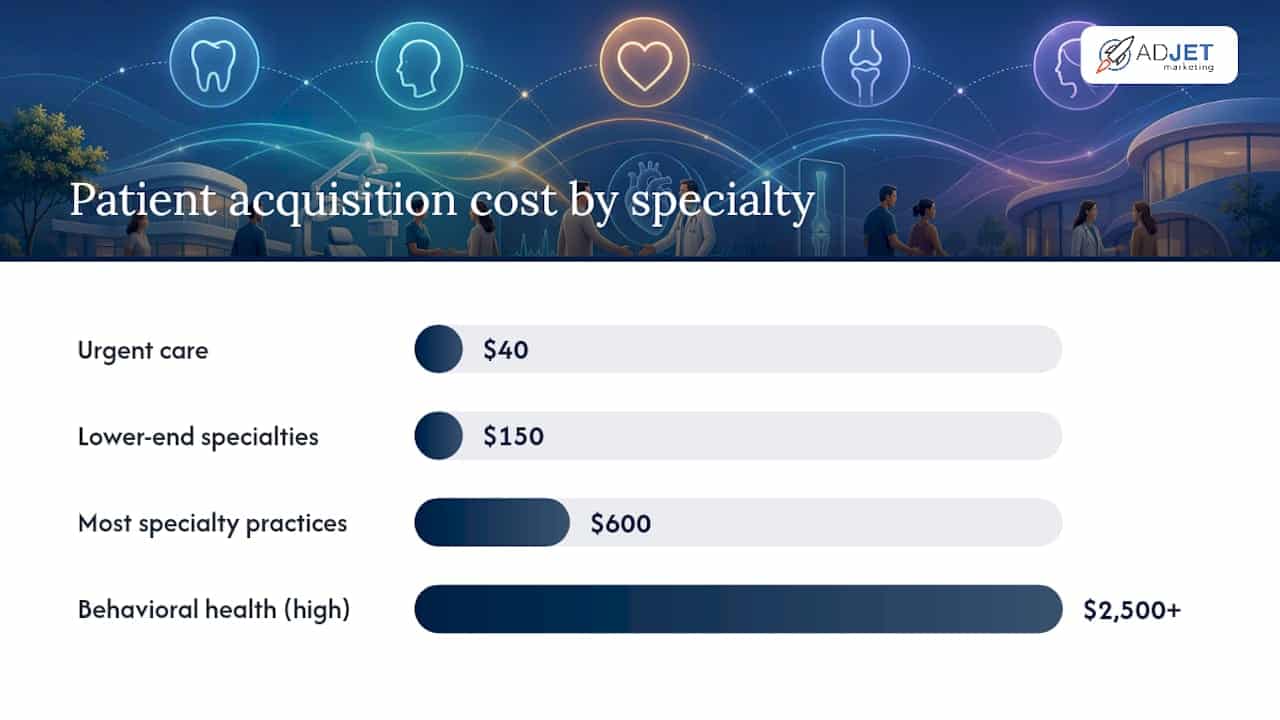
Specialty changes the math more than most owners expect. Industry trend data shows patient acquisition cost running as low as $40 for urgent care and as high as $2,500 or more for behavioral health, with most specialty practices landing between $150 and $600 per new patient. A dermatology practice competing against three med spas on the same street needs a different number than a solo family practice in a smaller market.
Here’s how to read a benchmark instead of just copying it:
- Treat the percentage as a starting range, then adjust based on how aggressively you want to grow.
- Weight your number toward the high end if you’re entering a competitive market or launching a new service line.
- Weight it toward the low end if your growth goal is modest and your referral pipeline is already strong.
Pro Tip: If two competitors in your area are running heavy paid campaigns, your effective floor is probably higher than the survey average, whatever your specialty.
Zocdoc’s budgeting guidance makes a similar point: start from your own growth targets and patient value, then use the percentage-of-revenue figure to sanity check your number, not to set it.
Build the Budget Around What a Booked Patient Is Worth
The number that matters is patient acquisition cost (PAC), not cost per lead (CPL). A lead is a click or a phone call. A patient is someone who showed up and generated revenue. Confusing the two is one of the most common ways practices burn through a medical marketing budget without knowing it.
Here’s a simple way to work the math:
- Calculate your average patient value (first visit plus a realistic estimate of repeat visits over 12 months).
- Divide your monthly marketing spend by the number of new patients who actually booked and showed, not just leads generated.
- Compare that PAC against your patient value using a 3:1 lifetime-value-to-PAC ratio as a working benchmark. Below that ratio, the channel is probably not sustainable long term.
- Track show rate and booking rate separately. A channel that generates cheap leads but a low show rate can cost more per patient than one with pricier leads and a high show rate.
- Build a stage-by-stage dashboard: lead, contacted, booked, showed, revenue. Every channel gets measured against the same four stages.
Industry data backs this up directly: practices that measure only CPL routinely understate their true acquisition cost, because a channel with a low cost per lead can still be expensive per completed patient if the intake process leaks people out along the way. The fix isn’t a bigger budget. It’s better tracking of where people drop off.
Where the Money Should Actually Go
Most medical marketing budgets split across a handful of predictable categories: local listings and Google Business Profile, SEO, paid search or social, landing pages and website infrastructure, conversion optimization, reputation management, retention through email or SMS, and analytics or compliance tooling. The mistake isn’t in the list. It’s in the order.
Prioritize improving your online discoverability and conversion processes before increasing paid media spend. If key factors like your Google Business Profile, website speed, or booking flow are suboptimal, paid advertising will waste budget without quality returns. A step-by-step approach to reputation management can help you systematize review generation instead of leaving it to chance.
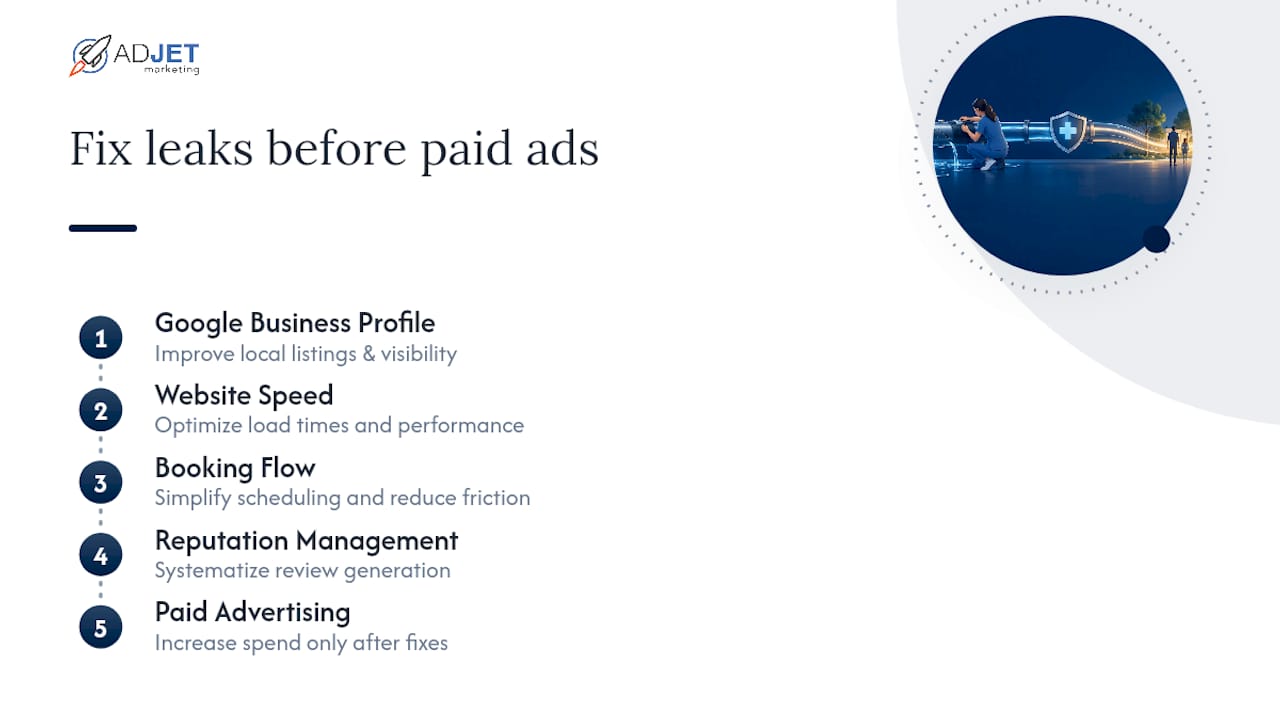
Neither split is universal. Both start from the same principle: fix the leaks first.
A 90-Day Plan to Test, Measure, and Reallocate
You don’t need a year of data to know if a medical marketing budget is working. You need 90 days of clean measurement and the discipline to act on it.
- Weeks 0 to 2: Set up call tracking, booking-flow analytics, and a HIPAA-compliant baseline for cost, lead, and conversion data before spending a dollar on new campaigns.
- Month 1: Run a tightly scoped paid-search test on one or two high-value services, each with its own dedicated landing page rather than a generic homepage link.
- Month 2: Repair local visibility through your Google Business Profile and organic search presence, while fixing conversion friction on your site in parallel.
- Month 3: Pull the numbers. Look at completed appointments, PAC by channel, and remaining appointment capacity.
- Reallocate: Scale whatever channel meets your PAC target and has capacity to absorb more volume. Cut or pause whatever doesn’t, rather than letting it run on inertia.
Pro Tip: Set a minimum sample size before judging a channel. Ten leads isn’t a test; it’s noise. Wait for at least 30 to 50 booked appointments before deciding a channel is working or failing.
The Compliance Line Item Most Budgets Skip
HHS guidance on tracking technologies makes clear that tools like pixels and analytics scripts can implicate protected health information, and covered entities need to evaluate those disclosures and sign business associate agreements when a vendor creates, receives, or transmits PHI. That’s not a legal footnote. It’s a line item.
Budget for these upfront rather than scrambling later:
- A privacy review of your current tracking setup before you run new campaigns.
- Business associate agreements with any vendor touching patient-level data.
- Compliant call-tracking and cookieless attribution tools instead of default analytics tags.
- Legal review for any campaign creative or landing page referencing specific conditions or treatments.
Compliant setups cost more upfront than a plug-and-play pixel, but they prevent both regulatory exposure and inaccurate attribution, which quietly wastes ad spend. If you’re running Google Ads and unsure how pixel tracking intersects with HIPAA, or want a walkthrough on cookieless remarketing tactics, that’s worth reading before your next campaign launch, not after.
Common Budgeting Mistakes and a Quick Approval Checklist
The same mistakes show up across practices of every size. Copying another clinic’s percentage without accounting for specialty or market. Spreading a budget across six channels instead of funding two or three well. Chasing new ad spend while ignoring a booking form that loses half its traffic. Lumping one-time website costs in with recurring monthly spend, which distorts your actual return on ad spend.
- Confirm you have a specific goal, not just “more patients.”
- Confirm you know your estimated patient value.
- Confirm you have baseline pipeline numbers before adding new spend.
- Confirm conversion fixes are prioritized ahead of new channels.
- Confirm your tracking setup is HIPAA compliant.
- Confirm you’ve set a minimum test budget and timeline before judging results.
- Confirm you’ve scheduled a review date, not an open-ended commitment.
| Mistake | Fix |
|---|---|
| Copying a competitor’s percentage | Base your number on patient value and growth goals |
| Measuring cost per lead only | Track cost per completed, booked patient |
| Spreading spend across too many channels | Fund two or three channels well before adding more |
| Mixing one-time and recurring costs | Separate infrastructure spend from monthly acquisition spend |
What We See When Practices Get This Wrong (and Right)
Many clinics come to us after a run of poor lead quality, and it’s rarely the channel’s fault. It’s usually a conversion problem, an intake bottleneck, or tracking that never told them where the money actually went. When measurement comes first, six to twelve months is a realistic window to see PAC stabilize and predictable booked-patient volume. If you don’t have the internal bandwidth to build and monitor that measurement layer, that’s usually the right moment to bring in outside help, not before.
— Felix
How AdJet Marketing Supports a Measurement-First Budget
Adjetmarketing is the alternative to guessing your way through a medical marketing budget. Instead of spreading spend across channels and hoping something sticks, we build the measurement infrastructure first: HIPAA-aware tracking, dedicated landing pages for paid tests, and conversion fixes that make your existing traffic worth more before you spend a dollar more on ads. Our team works directly with clinic owners on Google Ads campaigns built around booked-patient economics rather than raw lead volume, and on landing pages designed to convert that traffic once it arrives, with plans starting at prices listed on our website. If your current budget feels like it’s disappearing without a clear picture of PAC by channel, that’s the gap worth closing first. Reach out to talk through where your practice stands and what a 90-day test would look like.
Sources
This guide draws on the Tebra private-practice marketing survey, HHS guidance on tracking technologies and PHI, Zocdoc’s budgeting recommendations, the AMA’s guide to advanced digital strategies, and specialty-level patient acquisition cost benchmarks.
This article is general information, not a substitute for advice from a qualified doctor. Consult a qualified healthcare professional about your own circumstances before acting on anything here.
- Survey reveals healthcare marketing budget benchmarks for independent practices
- Use of online tracking technologies by HIPAA covered entities and business associates
- Healthcare marketing budget: how much should a practice spend?
FAQ
What Is the 70/20/10 Rule for Marketing Budget?
The 70/20/10 rule allocates 70% of a marketing budget to proven, reliable channels, 20% to channels showing early promise, and 10% to experimental tests. It’s a general framework rather than a healthcare-specific standard, and most independent practices adapt it around their own PAC data rather than following the split exactly.
What Are the 5 P’s of Healthcare Marketing?
The 5 P’s typically refer to product, price, place, promotion, and people, adapted from general marketing to reflect the service, patient experience, and staff quality that shape a healthcare practice’s reputation; definitions vary slightly by source, so treat it as a planning lens rather than a fixed formula.
What Is a Typical Medical Marketing Budget?
Most independent practices report spending 1% to 5% of gross revenue on marketing, according to Tebra’s private-practice survey, with common annual budgets falling in the $10,000 to $15,000-plus range. The right figure for your practice depends heavily on specialty, market competition, and growth goals rather than a single universal number.
How Much Should You Budget for HIPAA-Compliant Tracking?
There’s no fixed industry figure, since it depends on your current tracking setup, vendor choices, and campaign complexity. Budget for a privacy review, business associate agreements with any vendor touching patient data, and compliant call-tracking tools, since HHS guidance treats these as a compliance requirement rather than an optional add-on.
What’s a Reasonable Cost Per Patient Acquired?
Patient acquisition cost varies widely by specialty, ranging from roughly $40 for urgent care to $2,500 or more for behavioral health, with most specialty practices falling between $150 and $600 per new patient. Compare your own PAC against your average patient value using a 3:1 lifetime-value-to-PAC ratio as a working benchmark, not against another practice’s raw number.