









A pain management marketing agency is a specialized digital marketing partner that helps pain clinics attract qualified patients through targeted SEO, paid advertising, and compliant medical messaging. The U.S. pain management market was valued at $31.18 billion in 2025 and is projected to reach $42.87 billion by 2034, a signal that competition for patients is intensifying across every metro area. Generic marketing agencies rarely understand the regulatory constraints, patient psychology, or procedure-specific search behavior that define this specialty. Clinics that partner with agencies experienced in pain specialty marketing strategies consistently outperform those relying on broad healthcare marketing firms, both in lead quality and patient acquisition cost.
What does a pain management marketing agency actually do?
Specialized healthcare marketing for pain clinics goes well beyond running a few Google Ads. Agencies focused on this vertical combine AI-driven keyword research, paid media management, content strategy, and compliance oversight into a single, coordinated program.
The core services a qualified agency delivers include:
- High-intent keyword targeting. Platforms like DocLink Marketing have analyzed data across 710 pain management clinics in 50 U.S. cities, confirming that procedure-plus-location search terms, such as “spinal cord stimulation specialist in Phoenix,” convert far better than generic phrases like “pain management near me.” This means your SEO and paid campaigns need to be built around specificity, not volume.
- Paid advertising with defined benchmarks. Google Ads campaigns targeting high-intent, location-specific keywords improve lead quality and reduce patient acquisition costs compared to broad-match approaches. AI-managed campaigns can establish predictable cost-per-lead and return on ad spend benchmarks from the start of a campaign.
- Content marketing built for chronic pain patients. Educational blog posts, procedure explainers, and FAQ pages written for patients researching treatment options build organic search authority over time. This content also supports paid landing pages by improving Quality Scores in Google Ads.
- Social media campaigns. Platforms like Facebook and Instagram can build community around chronic pain management, but the messaging must be handled carefully to avoid stigma and stay within Meta’s advertising policies.
- Email marketing and patient reactivation. Automated email sequences keep past patients engaged, remind them of follow-up appointments, and reactivate patients who have not returned in six or more months.
- Regulatory compliance. Pain management advertising must comply with DEA, FDA, and Google and Meta ad policies to prevent campaign shutdowns. An experienced agency builds compliant educational content that still converts.
Pro Tip: Request a breakdown of cost-per-lead by procedure type before signing with any agency. A clinic offering interventional procedures like nerve blocks and spinal injections has very different CPL benchmarks than one focused on medication management. Agencies that cannot provide this data have likely not worked deeply in this vertical.
How should your clinic’s messaging speak to chronic pain patients?

The most common mistake in pain treatment marketing is treating chronic pain patients the same way you would treat someone with an acute injury. Healthcare marketing expert Mara Baer argues that clinics must abandon acute-pain stereotypes entirely and instead portray patients as respected partners living with chronic pain.
This shift matters because one in five Americans live with chronic pain, and patients in this group are four to five times more likely to experience anxiety and depression. That statistic means your marketing is reaching people who are exhausted, often dismissed by prior providers, and deeply skeptical of clinical promises. Messaging that treats them as passive recipients of care will not earn their trust.
Practical messaging shifts that improve patient engagement:
- Replace “pain sufferer” with “living with chronic pain” in all copy and ad headlines.
- Swap stock images of people grimacing in bed for realistic, hopeful visuals of patients managing daily life with support from their care team.
- Include mental health and holistic care narratives in your content to reflect the full experience of chronic pain.
- Co-create content with patients who have lived experience. Patient testimonials and story-based case studies increase engagement and authenticity in ways that clinician-written copy cannot replicate.
“Patients with chronic pain want to be seen as active participants in their care, not passive recipients. Marketing that reflects this builds the kind of trust that drives long-term patient relationships.” — Mara Baer, Healthcare Marketing Expert
Pro Tip: Before launching any new campaign, run your ad copy and landing page headlines past one or two current patients. Ask them whether the language feels accurate to their experience. This five-minute review catches tone problems that even experienced copywriters miss.
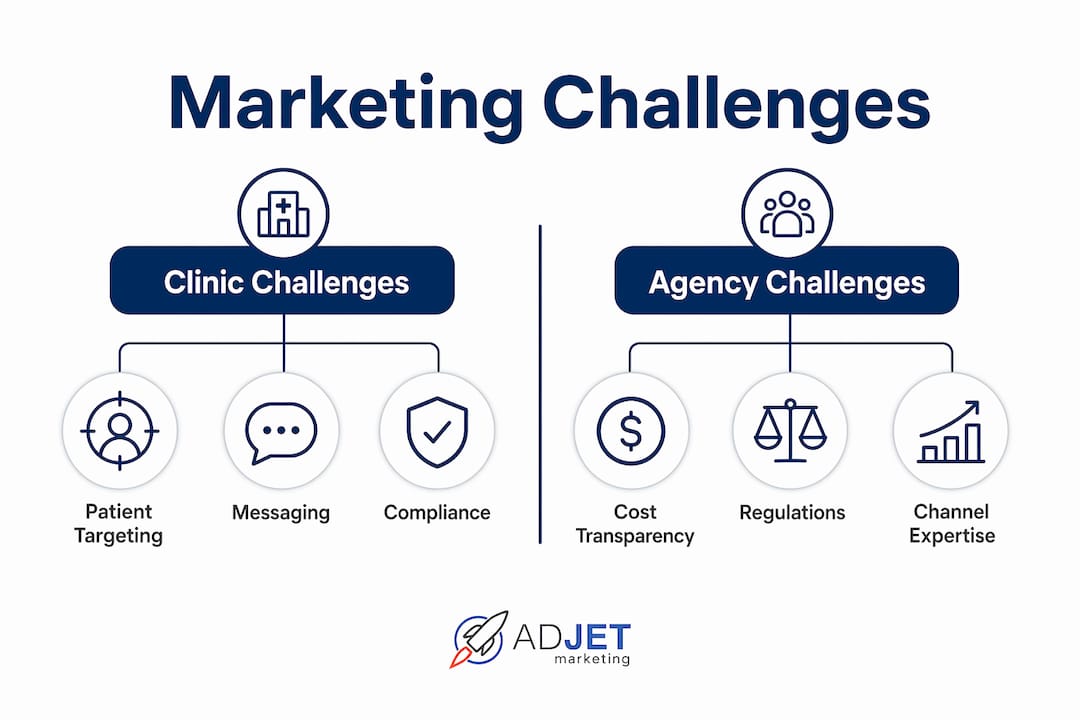
What are the biggest marketing challenges pain clinics face?
Many clinics come to us after spending months generating leads that never convert into booked appointments. The problem is rarely the volume of leads. It is almost always the quality, the intake process, or the disconnect between marketing spend and revenue outcomes.
The most common barriers, and how a specialized agency addresses each one:
-
Regulatory restrictions on ad content. Google and Meta both restrict certain pain-related claims, and DEA and FDA rules limit how opioid-adjacent treatments can be described. Agencies without healthcare experience routinely get campaigns flagged or suspended. A specialized agency builds compliant ad copy from the start, using educational framing rather than direct treatment claims.
-
Vanity metrics masking poor performance. Tracking clicks and form submissions feels productive, but neither metric tells you whether marketing is generating revenue. One O Seven RCM makes the case that clinics must link every marketing dollar to collected revenue rather than measuring success through leads alone. This shift in measurement changes which campaigns you scale and which you cut.
-
Intake bottlenecks that kill lead conversion. A patient who submits a contact form at 9 PM and does not receive a call until the following afternoon will often book elsewhere. Agencies that integrate revenue cycle and patient intake solutions alongside marketing reduce this friction and improve the return on every dollar spent acquiring a lead.
-
Misaligned patient profiles. Not all patients are equally profitable for a pain clinic. A patient covered by a high-reimbursement commercial insurance plan generates very different revenue than a Medicaid patient for the same procedure. Marketing spend should be weighted toward the payer mix that supports your clinic’s financial model.
Pro Tip: Map your top five most profitable procedure and payer combinations before briefing any agency. Share this data with them directly. Agencies that align campaign targeting with your actual revenue profile will deliver measurably better ROI than those optimizing purely for lead volume.
How to choose the right agency for your pain clinic
Selecting a marketing partner for a pain clinic requires more scrutiny than hiring a general marketing vendor. The table below outlines the key differences between agency types you are likely to encounter.
| Agency type | Strengths | Limitations |
|---|---|---|
| Full-service healthcare agency | Broad channel coverage, established compliance processes | May lack deep pain specialty knowledge; higher retainer costs |
| Pain specialty niche agency | Procedure-specific keyword data, chronic pain messaging expertise | Smaller teams; may not cover all channels |
| General digital marketing agency | Lower cost, flexible scope | No healthcare compliance experience; generic messaging |
Beyond the agency type, the evaluation criteria that matter most include:
- Proven compliance track record. Ask for examples of pain management advertising campaigns that ran without policy violations. Request documentation of how they handle DEA and FDA content restrictions.
- Transparent reporting tied to revenue. Any agency worth hiring can show you cost-per-acquisition data broken down by procedure or service line, not just clicks and impressions.
- Realistic timelines. SEO for pain management clinics typically takes four to six months to show meaningful organic traffic gains. Paid ads can generate leads within the first two weeks, but optimizing for quality takes 60 to 90 days of data. Any agency promising immediate organic results is overstating what is achievable.
- No long-term lock-in contracts. Month-to-month or quarterly agreements give you the ability to course-correct if performance falls short. Be cautious of agencies requiring 12-month commitments before demonstrating results.
- Clear communication cadence. Weekly or biweekly check-ins with a dedicated account manager, combined with a live reporting dashboard, keep you informed without requiring you to chase down updates.
Understanding the full range of digital marketing channels available to healthcare providers also helps you ask better questions during agency evaluations and avoid being oversold on tactics that do not fit your patient acquisition goals.
Key takeaways
Specialized pain management marketing outperforms generic healthcare marketing because it combines procedure-specific targeting, compliant messaging, and revenue-linked measurement into a single accountable program.
| Point | Details |
|---|---|
| Specialize keyword targeting | Target procedure-plus-location terms, not generic pain management phrases, to improve conversion rates. |
| Shift chronic pain messaging | Use empowering, patient-as-partner language and realistic visuals to build trust with chronic pain patients. |
| Measure revenue, not leads | Link every campaign to collected revenue through RCM integration to identify what actually drives growth. |
| Vet agency compliance expertise | Confirm the agency has a documented track record managing DEA, FDA, and Google/Meta policy restrictions. |
| Align spend with payer mix | Weight marketing investment toward the procedure and payer combinations that generate the highest reimbursement. |
Why most pain clinics are marketing to the wrong patient
After working with pain clinics across multiple markets, the pattern I see most often is this: a clinic invests in ads, generates a reasonable number of leads, and then wonders why the schedule is not filling. The leads are real. The intake team is responsive. But the patients who book are not the patients the clinic is best positioned to serve.
The root cause is almost always messaging that speaks to acute pain rather than chronic pain. Acute pain patients search differently, convert faster, and often need fewer visits. Chronic pain patients take longer to decide, require more trust-building content, and represent a much larger share of the actual market. The U.S. pain management market growing toward $42.87 billion by 2034 is being driven by chronic conditions, not acute injuries.
The second pattern I see is clinics treating marketing as a lead generation function rather than a patient relationship function. Campaigns that focus purely on first appointments miss the reactivation opportunity sitting in every clinic’s existing patient database. A well-structured email program targeting patients who have not returned in 12 months often generates appointments at a fraction of the cost of new patient acquisition.
My honest advice: before you evaluate any new agency or campaign, spend 30 minutes reviewing your last 90 days of patient data. Identify which procedures generated the most revenue, which payers reimbursed at the highest rates, and which referral sources brought in the most valuable patients. That data is your marketing brief. Any agency that does not ask for it before proposing a strategy is guessing.
— Felix
How Adjetmarketing helps pain clinics grow with precision
Adjetmarketing is a Google Partner agency that works directly with pain management clinics to build patient acquisition programs grounded in data, compliance, and realistic ROI expectations. Our SEO services for healthcare providers target the high-intent, procedure-specific keywords that chronic pain patients actually search, not broad terms that generate traffic without appointments. Our Google Ads management is built around your payer mix and procedure priorities, with transparent cost-per-acquisition reporting from day one. We work without long-term contracts because we believe results should earn the relationship. If you want a marketing plan built specifically for your clinic’s patient profile and growth goals, reach out to the Adjetmarketing team for a direct conversation.
FAQ
What does a pain management marketing agency specialize in?
A pain management marketing agency specializes in patient acquisition strategies tailored to pain clinics, including procedure-specific SEO, compliant Google and Meta advertising, and chronic pain patient messaging. These agencies understand DEA, FDA, and platform policy restrictions that general marketing firms routinely overlook.
How long does it take to see results from pain clinic marketing?
Google Ads campaigns can generate patient leads within the first two weeks, while SEO typically requires four to six months to produce meaningful organic traffic gains. Optimizing paid campaigns for lead quality rather than volume takes 60 to 90 days of performance data.
Why do generic marketing agencies underperform for pain clinics?
Generic agencies lack familiarity with the regulatory environment governing pain management advertising and tend to target broad keywords that attract low-intent traffic. Specialized agencies use procedure-plus-location keyword data from pain-specific market analysis to build campaigns that convert.
How should pain clinics measure marketing ROI?
Pain clinics should measure marketing ROI by linking campaign spend directly to collected revenue, not clicks or form submissions. Integrating marketing data with revenue cycle management systems, as recommended by One O Seven RCM, provides the clearest picture of which campaigns generate profitable patients.
What messaging works best for chronic pain patients?
Messaging that portrays patients as active, empowered participants in their care, uses language like “living with chronic pain,” and features realistic daily-life imagery consistently outperforms acute-pain stereotypes. Co-created content with patients who have lived experience drives stronger engagement than clinician-written copy alone.