









Pain management Google Ads campaigns are paid search advertising programs that connect patients actively searching for relief with your clinic at the exact moment of intent. Running them effectively in 2026 requires more than a budget and a few keywords. Google classifies health services as a sensitive ad category, which means the standard playbook for personalized advertising does not apply. You face restrictions on remarketing, HIPAA obligations around conversion tracking, and a more complex campaign structure than most industries. This guide covers every layer: the restrictions, the setup, the tracking, and the mistakes that quietly drain your budget.
What are the Google Ads restrictions for pain management clinics?
Pain management advertising falls under Google’s sensitive ad categories, and that classification changes nearly everything about how you can target patients. Personalized advertising features like remarketing, customer match, lookalike audiences, and audience expansion are all restricted. This means you cannot retarget someone who visited your chronic pain page, and you cannot build audiences based on condition-specific browsing behavior.
The practical implication is significant. Most clinics assume they can run the same campaigns they see from e-commerce brands, including retargeting ads that follow users around the web. That approach is not available here, and attempting it leads to policy violations and disapproved ads.
What you can use instead:
- Contextual targeting: Place ads on pages with content related to pain, orthopedics, or physical therapy without tracking individual users.
- Keyword targeting: Capture intent directly through search queries like “back pain specialist near me” or “nerve pain treatment.”
- Placement targeting: Choose specific websites or YouTube channels where your audience is likely to be.
- Broad demographic and affinity segments: Non-personalized targeting using age, location, and general interest categories is permitted.
HIPAA adds another layer of complexity. Conversion tracking pixels that collect health-related data are the primary HIPAA risk in Google Ads. The standard Google Ads tag or Google Analytics pixel can inadvertently capture protected health information (PHI) if a user submits a form containing their name, condition, or contact details. That data transmission to Google’s servers is a compliance violation.
The solution is not to abandon tracking entirely. It is to govern what data leaves your site. Google Tag Manager gives you granular control over which data points are sent to Google Ads, allowing you to fire conversion events without transmitting PHI. Alternatively, HIPAA-aware tracking platforms like Freshpaint act as a data filter between your site and ad platforms. For a detailed breakdown of compliant setup options, the guide on HIPAA-compliant Google Ads at Adjetmarketing covers the technical steps clearly.
Pro Tip: Google Call ads are inherently safer from a HIPAA standpoint. Ad text itself does not cause HIPAA violations. The risk lives entirely in your tracking configuration, not in the ad copy.
How to set up pain management Google Ads campaigns for maximum ROI
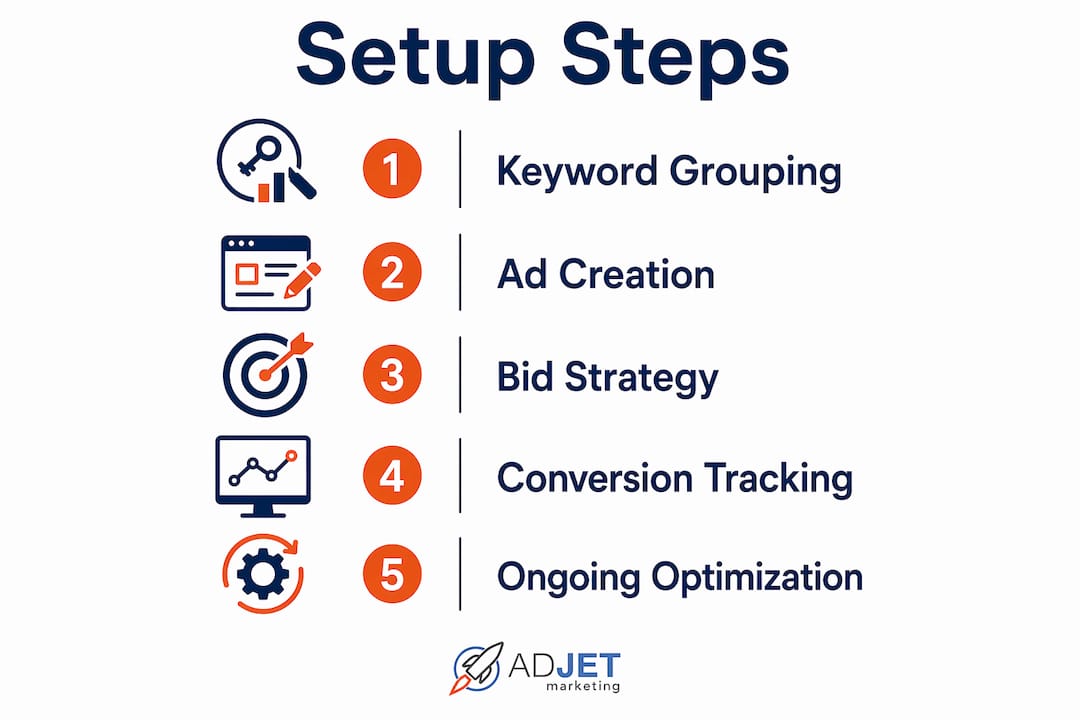
A well-structured campaign is the difference between paying for curious clicks and paying for booked appointments. Here is a step-by-step approach built specifically for pain clinics.
-
Start with high-intent keyword research. Focus on condition-specific and treatment-specific queries: “sciatica treatment,” “pain management clinic [city],” “spinal cord stimulation specialist,” “chronic pain doctor accepting new patients.” These phrases signal that the searcher is ready to act, not just researching.
-
Structure campaigns by service line. Separate ad groups for back pain, neuropathy, joint pain, and interventional procedures. This keeps your ad copy tightly relevant to each query, which improves Quality Score and lowers cost-per-click.
-
Write outcome-focused ad copy. Avoid mentioning specific diagnoses in a way that implies you know the user’s condition. Instead, lead with outcomes: “Get back to daily activities,” “Same-week appointments available,” “Board-certified pain specialists.” Compliant ad copy focused on outcomes avoids disapprovals while still resonating with patients in pain.
-
Build a strong negative keyword list. Add terms like “free,” “home remedies,” “opioid,” “pain medication,” and condition names paired with non-clinical intent. This filters out searches that will never convert and protects your budget.
-
Use Performance Max campaigns selectively. Google’s Performance Max format runs across Search, Display, YouTube, and Gmail simultaneously. For pain clinics, it works best when you have strong creative assets and a clear conversion goal. Without those inputs, the algorithm optimizes for volume rather than quality.
-
Send traffic to dedicated landing pages. A page that matches the ad’s specific promise converts far better than your homepage. A patient clicking “sciatica specialist in Phoenix” should land on a page about your sciatica treatment, not a general “about us” page.
Key elements every pain clinic landing page needs:
- A clear headline matching the ad’s promise
- A single call-to-action (book an appointment or call now)
- Trust signals: board certifications, years in practice, patient reviews
- A short, HIPAA-compliant contact form
Pro Tip: Grouping keyword themes by treatment type and writing one ad group per theme consistently outperforms broad, mixed campaigns. Tighter structure means higher relevance scores and lower costs.
How to navigate lead management and conversion tracking under HIPAA
Tracking which ads generate real patients is the only way to know if your budget is working. The challenge for pain clinics is doing this without violating HIPAA.

The risks are concrete. When a patient fills out a contact form on your site and your standard Google Ads tag fires, it can capture URL parameters, form field data, or referral strings that contain PHI. That data goes to Google’s servers. Google is not a covered entity under HIPAA, and there is no Business Associate Agreement (BAA) available for standard Google Ads tracking. This creates a compliance gap that most clinics do not realize exists until it becomes a problem.
Here is how to close that gap:
- Remove the standard Google Ads conversion tag from form submission pages. Replace it with a server-side or filtered event that confirms a conversion occurred without sending patient data.
- Use Google Tag Manager with strict data layer controls to define exactly what information is passed to Google on a conversion event.
- Explore HIPAA-compliant tracking partners that offer BAAs and act as intermediaries between your site and ad platforms.
- Use Google’s native lead form extensions for certain campaigns. Google Call ads and lead forms keep data within Google’s platform, reducing the risk of PHI leaving your controlled environment.
Google’s new lead management dashboard is a meaningful development for pain clinics. The dashboard integrates lead form tracking and qualification directly inside Google Ads, centralizing lead data and shortening the sales cycle. More importantly, it feeds lead quality signals back into Smart Bidding, so the algorithm learns to prioritize the types of leads that actually become patients rather than optimizing for raw form submissions.
| Tracking method | HIPAA risk level | Smart Bidding compatible |
|---|---|---|
| Standard Google Ads tag | High (PHI exposure risk) | Yes |
| Google Tag Manager (controlled) | Low (with proper setup) | Yes |
| HIPAA-aware platform (e.g., Freshpaint) | Very low (BAA available) | Yes, via API |
| Google native lead forms | Low (data stays in Google) | Yes, via dashboard |
Pro Tip: Smart Bidding improves significantly when you feed it lead quality signals, not just conversion counts. Mark leads as qualified or unqualified inside the dashboard and let the algorithm adjust bids accordingly.
Common mistakes in pain management Google Ads and how to fix them
Many clinics come to Adjetmarketing after months of spending on campaigns that generated calls but no booked patients. The problems are usually structural, not budgetary.
Attempting prohibited targeting. The most common policy violation is setting up remarketing lists based on condition-specific page visits. Sensitive category restrictions prohibit this explicitly. If your campaigns include audience lists built from health-related URLs, expect disapprovals and potential account flags.
Weak negative keyword lists. Running pain management ads without filtering out medication-seeking queries, legal queries, or general research terms wastes a significant portion of your budget. Review your search term reports weekly in the first 60 days and add negatives aggressively.
Sending all traffic to the homepage. This is the single most common conversion killer. A patient searching for “knee pain specialist” who lands on a general clinic homepage has to work to find the information they need. Most will not. Dedicated landing pages for each service line are not optional.
Ignoring lead qualification. A high volume of form submissions means nothing if your front desk cannot convert them. Many clinics optimize for lead volume when they should be optimizing for appointment bookings. Connect your Google Ads data to your actual patient intake process and measure what matters.
“The gap between a lead and a booked patient is where most pain clinic ad budgets disappear. Fixing that gap is a sales and operations problem, not just a marketing one.”
Skipping ongoing optimization. Google Ads is not a set-and-forget system. Bid adjustments, ad copy testing, Quality Score monitoring, and landing page iteration are ongoing tasks. Campaigns that are not actively managed typically degrade in performance within 90 days as competition and Quality Scores shift.
Key takeaways
Pain management Google Ads campaigns succeed when you combine compliant targeting, precise campaign structure, and HIPAA-safe conversion tracking from day one.
| Point | Details |
|---|---|
| Sensitive category restrictions apply | Remarketing and behavioral targeting are banned; use contextual and keyword targeting instead. |
| HIPAA governs your tracking setup | Remove standard pixels from form pages and use controlled or HIPAA-aware tracking tools. |
| Campaign structure drives quality | Separate ad groups by service line and send traffic to condition-specific landing pages. |
| Lead management dashboard adds value | Google’s new dashboard feeds lead quality signals into Smart Bidding for better ROI. |
| Ongoing optimization is required | Weekly search term reviews, bid adjustments, and copy testing are non-negotiable for sustained results. |
What I’ve learned running pain clinic campaigns at scale
After working with pain management clinics across multiple markets, the pattern I see most often is this: clinics underestimate how much the sensitive category restrictions actually help them, once they understand the rules.
When you cannot rely on behavioral retargeting, you are forced to get precise about your keywords, your copy, and your landing pages. That discipline produces better campaigns. The clinics that struggle are the ones that fight the restrictions instead of building around them. The ones that succeed treat contextual targeting and non-personalized ad strategies as a creative challenge rather than a limitation.
The other thing I tell every pain clinic we work with: your Google Ads budget is only as effective as your intake process. I have seen campaigns with a $15 cost-per-lead fail because the front desk was not answering calls within the first hour. The ad did its job. The funnel did not. Before you scale your ad spend, audit what happens to a lead after it enters your system.
On budget expectations: a realistic starting point for a single-location pain clinic in a mid-sized market is $2,500 to $5,000 per month in ad spend, with an additional management fee. That budget, structured correctly, can generate 30 to 60 qualified leads per month. Results vary by market, competition, and how well your landing pages and intake process are set up. Anyone promising specific patient volumes before auditing your market is guessing.
The future of pain management advertising on Google points toward more AI-driven bidding and tighter integration between ad platforms and CRM systems. Clinics that build clean data pipelines now, with proper CRM integration and HIPAA-compliant tracking, will have a significant advantage as Smart Bidding becomes more dependent on first-party quality signals.
— Felix
How Adjetmarketing helps pain clinics get results from Google Ads
Adjetmarketing is a Google Partner agency that specializes in healthcare Google Ads management for pain clinics, medical practices, and specialty providers. We handle campaign architecture, HIPAA-compliant tracking setup, and landing page builds designed to convert search traffic into booked appointments. Every campaign we manage is built around your specific service lines, your market, and your intake capacity. We also help clinics understand why marketing matters as a long-term growth driver, not just a lead source. If your current campaigns are generating clicks but not patients, or if you are starting from scratch, we can build a system that works within Google’s rules and delivers measurable results.
FAQ
What makes pain management Google Ads different from other healthcare ads?
Pain management falls under Google’s sensitive ad categories, which bans remarketing and behavioral targeting. Campaigns must rely on keyword, contextual, and placement targeting instead.
Can pain clinics use Google Ads without violating HIPAA?
Yes. HIPAA compliance in Google Ads is a tracking configuration issue, not an advertising one. Removing standard pixels from form pages and using controlled tracking tools resolves the primary compliance risks.
What keywords work best for pain management Google Ads?
High-intent terms like “pain management clinic near me,” “back pain specialist,” and condition-plus-location phrases consistently produce the most qualified traffic for pain clinics.
How does Google’s lead management dashboard help pain clinics?
The lead management dashboard centralizes lead form data inside Google Ads and feeds qualification signals back to Smart Bidding, improving bid efficiency and reducing lead loss between ad click and patient intake.
How much should a pain clinic budget for Google Ads?
A realistic starting budget for a single-location clinic in a competitive market is $2,500 to $5,000 per month in ad spend. Results depend on market competition, campaign structure, and landing page performance.