









Three priorities drive nearly every pain clinic marketing win we’ve seen: securing local visibility through a fully optimized Google Business Profile (GBP) and local SEO, running a compliant paid campaign with landing pages built to convert, and putting referral and retention systems on autopilot so growth doesn’t stall between marketing pushes. Skip any one of the three and the other two work harder than they should.
This week, do three things. Claim and fully complete your GBP listing, including every service line, updated photos, and booking enablement. Launch one focused Google Ads campaign around your highest-intent procedure keywords, not a scattershot list of every condition you treat. And set up a basic recall or referral automation, even something as simple as a scheduled email to patients who haven’t booked a follow-up in 60 days.
Expect different timelines from each move. Paid campaigns can generate calls within days once the account clears verification. Organic and local SEO improvements typically take weeks to a few months to show up in rankings, according to the 11 clinic marketing strategies outlined by Pabau, which frames clinic marketing as three connected jobs: getting found, winning the first impression, and keeping patients coming back. Referral systems build slower still, but they compound, and they’re often the cheapest patient acquisition channel a clinic has.
Key Takeaways
Pain clinic marketing succeeds when local visibility, compliant paid acquisition, and referral or retention systems run together instead of as separate, disconnected efforts.
| Point | Details |
|---|---|
| Complete your GBP first | Every service, updated photos, and booking enablement drive map-pack visibility before any other tactic matters. |
| Launch one focused ad campaign | Target your highest-intent procedure keywords with a single-offer landing page and real conversion tracking. |
| Build referral relationships deliberately | Prioritize high-volume referrers and follow a consistent outreach and check-in cadence. |
| Automate one retention flow now | Start with a 60-day reactivation email before building a full patient nurture sequence. |
| Bring in AdJet Marketing for execution | AdJet Marketing builds GBP optimization, Google Ads, SEO, and landing pages specifically for pain clinics with booking-level tracking. |
Table of Contents
- Pain Clinic Marketing Fundamentals: Local Search and Website Basics
- What Makes Google Ads and Paid Social Actually Convert for Clinics?
- Building Referral Relationships With Physicians and Allied Providers
- Content Marketing and Patient Education: What Actually Moves the Needle
- How Should Pain Clinics Manage Online Reviews?
- Retention, Loyalty, and Automation That Keeps the Schedule Full
- Advertising Compliance and Patient Privacy: What You Can’t Skip
- What Should You Budget and Measure, and How Fast Will It Work?
- A 90-Day Plan for New and Established Pain Clinics
- What We See Go Wrong in Pain Clinic Marketing
- How AdJet Marketing Helps Pain Clinics Execute This Plan
- Frequently Asked Questions
- Sources
Pain Clinic Marketing Fundamentals: Local Search and Website Basics
Most pain clinic marketing conversations skip straight to ads and content, but neither works well without the foundation underneath them. Google frequently shows a three-listing “map pack” for local health searches, and that real estate captures the majority of nearby patient discovery according to CareCredit’s research on GBP optimization for healthcare. If your GBP is thin or inaccurate, you’re invisible before a searcher even reaches your website.
A complete profile does more than list your address. Google rewards specificity: the right primary category (Pain Management Physician, not just “Doctor”), a full list of services, weekly photo uploads, answered Q&A, and active Google Posts. Booking enablement through GBP shortens the path from search to appointment, which matters because near-me health searches make up a substantial and growing share of how patients find providers.

Local SEO extends that same logic to your website. Consistent name, address, and phone number (NAP) data across your site, directories, and citation sources prevents the kind of confusion that tanks map rankings. Location-specific service pages, structured with schema markup like MedicalOrganization or Physician, help search engines understand exactly who you are and where you practice. Keep your address and service area accurate in Google’s underlying maps data too. Google Cloud’s own documentation notes that outdated or inconsistent location data creates visibility problems that are hard to diagnose after the fact.
Your website itself needs to convert, not just exist. Research indicates that a large majority of patients research providers online before booking, as discussed in this guide to clinic digital marketing, which also stresses mobile speed, clear service pages, and visible credentials as baseline conversion factors. A site that loads slowly or buries your booking link loses patients who already decided to call someone.
Pro Tip: Run your homepage through Google PageSpeed Insights this week. If mobile load time is above three seconds, that alone could be costing you more bookings than a bad ad campaign.
| GBP/Website Element | What to Check |
|---|---|
| Primary category | Set to your exact specialty, not a generic label |
| Service list | Every treatment named individually, not bundled |
| Photos | Updated within the last 90 days, staff and facility included |
| Mobile load speed | Under 3 seconds on a standard connection |
| NAP consistency | Identical across website, GBP, and directories |
| Booking CTA | Visible without scrolling on mobile |
A quick audit checklist: log into your GBP dashboard, verify every service is listed, check that your five most recent photos are current, and confirm your phone number matches exactly across your site and profile. If any of those fail, fix them before spending a dollar on ads.
What Makes Google Ads and Paid Social Actually Convert for Clinics?
Paid acquisition works fast, but healthcare advertising has more guardrails than most industries, and clinics that skip them lose accounts, not just budget. Google requires advertiser verification for healthcare-related campaigns, and certain targeting or claims (implied guarantees of pain relief, for instance) can trigger policy rejections. ClicksGeek’s guide to healthcare digital marketing walks through both the verification process and the tracking approach that keeps campaigns compliant.
Structure your account around intent, not condition breadth. A campaign built for “back pain treatment near me” performs differently than one built for “sciatica specialist,” and mixing them into one ad group muddies your quality score and your data. Separate campaigns by procedure or condition category, then let each one feed a landing page built specifically for that search.
Your landing page checklist matters as much as the campaign structure:
- One offer per page (a consultation, not five services at once)
- Local trust signals: credentials, patient volume, insurance accepted
- Minimal personal health information (PHI) collected in forms, ideally just name and phone
- A single, visible booking or call CTA above the fold
- Conversion tracking wired to calls and form submissions, not just page views
Budget ranges vary by market competitiveness, but new clinics typically see wider swings in cost-per-lead during the first few weeks as Google’s algorithm calibrates. Expect early performance to stabilize after the campaign accumulates enough conversion data, usually two to four weeks in.
| Campaign Type | Early Focus | What to Track |
|---|---|---|
| Search (condition-specific) | High-intent keywords, tight geography | Cost per call, cost per booking |
| Search (branded) | Clinic name protection | Click-through rate, direct bookings |
| Paid social (retargeting) | Website visitors who didn’t convert | Cost per lead, frequency capping |
Paid and SEO aren’t competing strategies. Paid buys you visibility immediately while your organic and local SEO work builds toward the same map-pack real estate over months. Clinics that treat these as an integrated system, rather than separate line items, get more consistent volume, a point echoed in research on integrated healthcare digital marketing. If you want a deeper walkthrough of campaign setup specific to this specialty, this pain management Google Ads strategy guide breaks down structure in more detail.
Pro Tip: Use call-tracking numbers that route to your practice line without recording or storing PHI in the tracking platform itself. This keeps attribution intact without creating a compliance liability you didn’t ask for.
Building Referral Relationships With Physicians and Allied Providers
Referral flow rarely happens by accident. It comes from a deliberate sequence of outreach, education, and follow-up with the providers most likely to see patients who need your services.
- Map your referral universe. List local primary care physicians, emergency departments, physical therapists, chiropractors, and interventionalists within a realistic drive radius. Prioritize by volume: a busy urgent care sees more chronic pain patients in a week than most solo PT practices see in a month.
- Send an introduction, not a sales pitch. A short letter or email describing your treatment focus, insurance participation, and typical referral turnaround gives a referrer enough to remember you.
- Follow with an education drop. A one-page clinical summary, a case outcome, or a short explainer on a procedure you specialize in gives the referrer a reason to keep your name visible on their desk.
- Schedule a face-to-face visit. Fifteen minutes with an office manager or the physician themselves builds more trust than three follow-up emails combined.
- Set a recurring touchpoint. Quarterly check-ins, holiday notes, or a simple “here’s what we treated this quarter” update keep you top of mind without feeling like a sales call.
What you bring to those conversations matters. Referrers want to know your typical wait time for new patients, your communication style back to them (do you send a summary after every visit?), and outcome patterns for the conditions they refer most.
- Track referral volume by source monthly, not just in aggregate.
- Measure conversion rate: how many referred patients actually book and show up.
- Estimate referral lifetime value (LTV) separately from paid-lead LTV, since referred patients often have higher retention.
- Flag any referrer whose volume drops for two consecutive months and follow up personally.
Many clinics we’ve worked with underestimate how much a single strong referring physician can be worth over a year. That relationship, once built, tends to outproduce most standalone ad campaigns for a fraction of the ongoing effort.
Content Marketing and Patient Education: What Actually Moves the Needle
Content works differently in pain clinic marketing than in most industries because it serves two audiences at once: patients researching symptoms, and physicians deciding whether to refer. Get the mix right and both channels benefit from the same publishing calendar.
Location and treatment pages remain the highest-traffic content type for most clinics, because they match exact search intent (“pain management [city]” or “spinal injection [city]”). Condition-focused guides that explain a diagnosis in plain language rank well and build the kind of trust that turns a worried searcher into a booked patient. Procedure explainer videos, even simple ones filmed on a phone with good lighting, reduce pre-visit anxiety and give referring physicians something concrete to share with their own patients.
Case studies and FAQ pages do double duty. A well-written case study (with patient consent and no identifying details) demonstrates outcomes to prospective patients and gives referrers a data point to cite when recommending you. FAQ pages answer the exact questions patients type into Google, which supports both organic ranking and lower bounce rates.
Topic ideas worth prioritizing:
- “What to expect at your first pain management appointment”
- Condition guides for the five conditions you treat most often
- “When to see a pain specialist vs. your primary care doctor”
- Procedure-specific explainer pages with video
- Insurance and cost transparency pages
| Quarter Focus | Content Types | Cadence |
|---|---|---|
| Month 1 | Core service pages, GBP posts | 2 posts/week |
| Month 2 | Condition guides, 1 case study | 1 long-form + 1 short/week |
| Month 3 | Procedure video, FAQ expansion | 1 video, 2 FAQ updates |
If you want a broader framework for the technical SEO work behind this content, this guide on medical SEO for clinics covers the structural side in more depth.
How Should Pain Clinics Manage Online Reviews?
Reviews function as both a ranking signal and a trust signal, which makes them worth systematizing rather than leaving to chance. Clinics that build review requests into their post-visit workflow see faster improvements in both local ranking and conversion rate, according to Pabau’s clinic marketing research.
Prioritize Google first, since it directly influences map-pack ranking and is the platform most patients check before booking. Specialty directories matter too, but Google carries the most weight for local discovery.
Timing shapes response rate more than most owners expect. A request sent immediately after a positive visit outcome, ideally via text with a direct link, converts far better than a generic monthly email blast. Keep the language simple and consent-aware: ask permission before sending automated messages, and always include an opt-out.
- Identify the visit moment with the highest satisfaction (often post-procedure follow-up, not the initial consult).
- Send a same-day or next-day text with a direct review link.
- Follow up once, a week later, only if no review was left.
- Respond to every review, positive or negative, within 48 hours.
- Escalate any review alleging a clinical issue to your compliance or risk management contact before responding publicly.
For negative reviews, resist the instinct to argue. A calm, professional response that acknowledges the concern and offers an offline conversation protects your reputation better than a defensive reply. Track review velocity (new reviews per month) and average rating monthly. A sudden drop in either is worth investigating before it affects rankings.
Retention, Loyalty, and Automation That Keeps the Schedule Full
New patient acquisition gets the attention, but retention is usually the cheaper lever, and it’s the one most pain clinics leave on autopilot the wrong way, meaning not automated at all.
The highest-impact automations are also the simplest: appointment reminders that reduce no-shows, post-visit nurture sequences that check on recovery progress, reactivation campaigns for patients who haven’t booked in 90 days, and referral nudges asking satisfied patients to tell a friend or family member. None of these require complex software, just a consistent trigger and a template.
Loyalty and referral incentives need to stay compliance-friendly in healthcare, which rules out cash-for-referral structures in most cases. Simple, non-monetary gestures, like a handwritten thank-you note or a small branded item after a successful referral, tend to work better anyway because they don’t raise anti-kickback questions.
Practice management platforms that connect marketing tools to patient records make this dramatically easier, since campaigns become attributable to actual bookings rather than guesswork. Pabau’s clinic marketing guide points to this kind of integration as a key factor in lowering acquisition costs over time. A basic sequence might look like this: patient completes visit, automated text goes out 24 hours later asking about pain levels, a review request follows at day 3 if the response was positive, and a reactivation email triggers automatically if no follow-up is booked within 60 days.
Pro Tip: Start with just one automation, the 60-day reactivation email, before building out a full sequence. Clinics that try to automate everything at once often abandon the project halfway through.
Advertising Compliance and Patient Privacy: What You Can’t Skip
Compliance isn’t a separate department’s problem in pain clinic marketing. It shapes how you build forms, write ad copy, and structure your tracking from day one.
Google requires healthcare advertiser verification before certain campaign types go live, and campaigns that imply guaranteed outcomes or misuse patient testimonials risk suspension. Beyond ad policy, HIPAA-minded practices mean your marketing forms should never capture more health information than absolutely necessary. Name, phone number, and a general reason for visit is usually enough; detailed symptom descriptions or diagnosis codes have no business sitting in a marketing CRM.
Call tracking should route calls without recording or storing protected health information (PHI) in the tracking platform itself, a practice detailed in ClicksGeek’s compliance-focused marketing guide. This keeps your attribution data useful without creating an unnecessary compliance exposure.
For SMS and email outreach, always include explicit consent language at signup and a clear, working opt-out in every message. A sample line: “By providing your number, you consent to receive appointment reminders and promotional texts from [Clinic Name]. Reply STOP to opt out.” Document that consent, and keep a record of when and how it was collected.
- Verify your Google Ads healthcare advertiser status before launching campaigns.
- Audit every marketing form for unnecessary PHI fields.
- Add opt-out language to every SMS and email template.
- Keep a simple compliance log noting who approved each campaign and when.
- When in doubt about a claim or targeting approach, consult your compliance officer or healthcare attorney before launch, not after.
This is general marketing guidance, not legal advice. Confirm current advertising and privacy rules with a qualified healthcare compliance professional before launching campaigns.
What Should You Budget and Measure, and How Fast Will It Work?
Every KPI in pain clinic marketing should tie back to one number: booked appointments, and ideally, appointments that convert to ongoing treatment. Track new patient appointments, customer acquisition cost (CAC) by channel, conversion rate from click to booking, patient lifetime value (LTV), and appointment-to-treatment rate.
Budget allocation should shift based on where your clinic sits in its growth curve. New clinics typically invest more heavily in paid acquisition early, since they haven’t built the organic or referral base yet to generate steady volume. Established clinics can shift more budget toward retention, reviews, and referral programs, which tend to produce lower CAC over time, a pattern Gartner’s marketing budget research supports across industries, not just healthcare.
Your tracking checklist should include call tracking numbers on every campaign, UTM tagging on every link you share, conversion actions set up correctly in Google Ads (calls, form fills, booking confirmations), and, where possible, integration between your analytics platform and your practice management software.
Timeline expectations matter more than most owners realize going in. Paid campaigns can produce calls within days, but reliable cost-per-lead benchmarks take two to four weeks to stabilize. SEO improvements generally take three to six months to show meaningful ranking movement, longer in competitive metro markets. Review growth compounds over quarters, not weeks. If you want a side-by-side breakdown of when to lean on each channel, this comparison of SEO versus PPC lays out the tradeoffs in more detail.
A 90-Day Plan for New and Established Pain Clinics
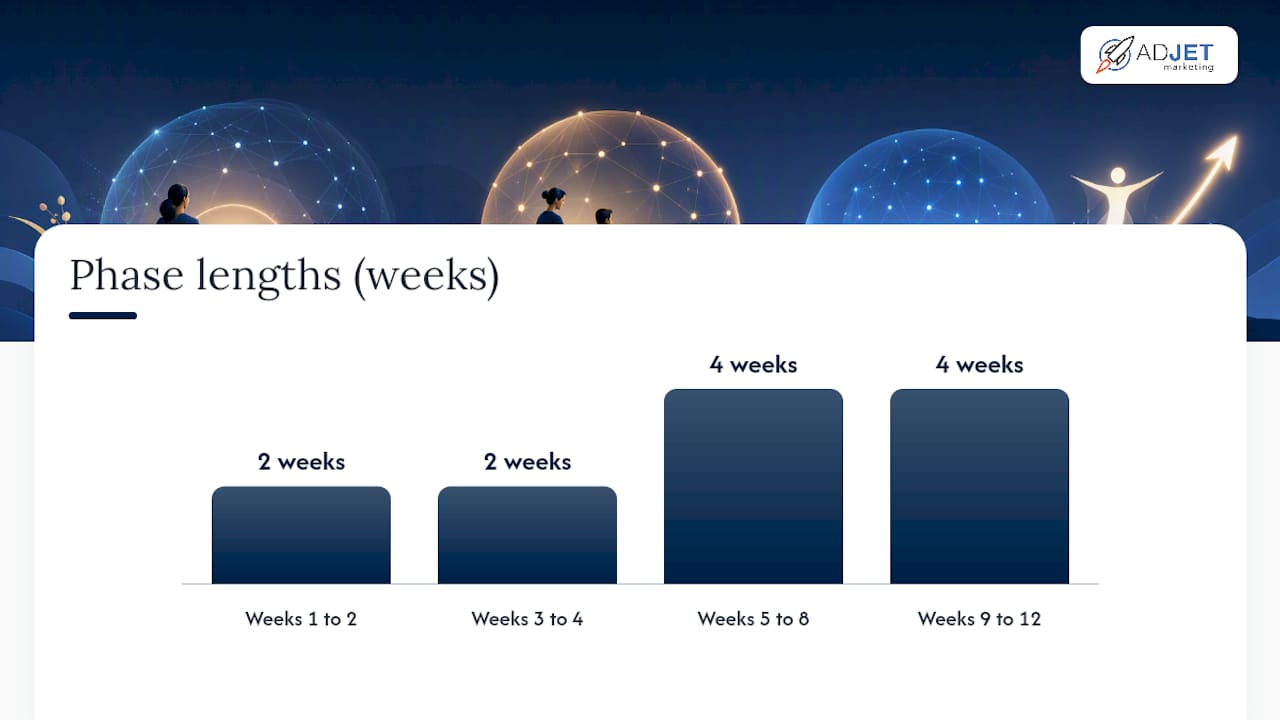
The sequence below assumes you’re running two to three channels at once, not everything simultaneously. Trying to launch SEO, paid, referrals, and a full content calendar in the same week is how most in-house marketing efforts stall by week three.
For a brand-new clinic:
- Weeks 1 to 2: Complete GBP profile fully, set up website tracking, launch one tightly targeted Google Ads campaign around your top procedure.
- Weeks 3 to 4: Begin local SEO groundwork (service pages, NAP consistency, initial citations), start review request workflow for early patients.
- Weeks 5 to 8: Launch referral outreach to five priority physicians or allied providers, publish first two condition guides.
- Weeks 9 to 12: Review campaign performance data, adjust ad spend toward best-performing keywords, add one retention automation (appointment reminders or reactivation).
For an established clinic needing more volume:
- Weeks 1 to 2: Audit existing GBP and website for gaps, review current ad account structure and kill underperforming campaigns.
- Weeks 3 to 4: Rebuild landing pages around single-offer structure, expand referral outreach to underdeveloped provider relationships.
- Weeks 5 to 8: Systematize review requests into post-visit workflow, publish quarterly content batch (case study, video, FAQ update).
- Weeks 9 to 12: Layer in retention automation sequences, analyze CAC by channel and reallocate budget toward the strongest performer.
| Week Range | New Clinic Milestone | Established Clinic Milestone |
|---|---|---|
| 1 to 2 | GBP live, one ad campaign running | Audit complete, weak campaigns paused |
| 3 to 4 | Local SEO foundation set | Landing pages rebuilt |
| 5 to 8 | 5 referral contacts made | Review workflow live |
| 9 to 12 | First retention automation live | CAC reallocation complete |
Think of this as three lanes running in parallel rather than a straight line: visibility work in one lane, paid acquisition in a second, and referral or retention in a third. Each lane has its own pace, but they all need attention every week, even if that attention is just fifteen minutes of review.
What We See Go Wrong in Pain Clinic Marketing
The pain management market is sizable and growing, according to Mordor Intelligence’s market analysis, which means competitor density in most metro areas is higher than clinic owners assume. That context matters, because a lot of what looks like a “bad marketing month” is actually a positioning problem, not a volume problem.
The most common pattern we see: a clinic runs Google Ads for a few weeks, gets calls, but the calls don’t convert to booked appointments. Nine times out of ten, the landing page is the problem, not the ad. A page that lists ten services with no clear next step gives a confused visitor an easy reason to leave. A page with one offer and one button gives them exactly one decision to make.
The second pattern is vanity metric fixation. Owners fixate on impressions or click-through rate when the only number that matters is cost per booked appointment. A campaign with a low click-through rate but a strong conversion rate is outperforming one with flashy clicks and no bookings, even if the second one “feels” more successful in the dashboard.
Do this, not that: do build campaigns around a single, measurable conversion action; don’t spread budget across five campaigns with no clear winner. Do track calls and form fills separately; don’t rely on Google’s default conversion tracking without verifying it’s counting real bookings. Do run landing pages through a real test with actual traffic; don’t assume a page works because it looks good in a design mockup.
If you’re vetting an agency or contractor for this work, ask for three specific deliverables before signing anything: a written tracking plan showing exactly what counts as a conversion, a weekly reporting cadence you can actually read without a marketing degree, and a conversion rate optimization (CRO) testing plan for your landing pages, not just a “we’ll build you a page and hope” approach. Any agency that can’t answer those three questions clearly probably isn’t ready to manage healthcare ad spend responsibly.
How AdJet Marketing Helps Pain Clinics Execute This Plan
Running local SEO, compliant Google Ads, landing page builds, and referral tracking all at once is a lot to manage alongside actually seeing patients, which is exactly why many clinic owners bring in a team that specializes in exactly this. AdJet Marketing works specifically with medical clinics and pain management practices to handle GBP optimization, Google Ads management, technical SEO, and high-converting WordPress landing pages, with tracking built to attribute leads back to actual bookings rather than vague impressions.
A short audit typically surfaces the gaps fastest: incomplete GBP fields, missing conversion tracking, a landing page structure that’s splitting attention across too many offers, and a first-campaign plan built around your highest-intent keywords rather than a broad guess. From there, the next steps are concrete: a prioritized fix list, a campaign structure ready to launch, and a reporting setup that shows cost per booked appointment from week one.
If you’d rather have a team execute this playbook than build it yourself, request a consultation with AdJet Marketing and get a clear read on where your clinic’s marketing stands today.
Frequently Asked Questions
How much should a pain clinic budget for marketing each month?
Budgets vary by market and clinic stage, but new clinics generally lean more heavily into paid acquisition, while established clinics shift more toward retention and referral programs that lower cost per acquisition over time.
How long does pain clinic marketing take to show results?
Paid campaigns can generate calls within days once verified and calibrated. Local SEO improvements typically take a few months. Referral and reputation gains build over quarters rather than weeks.
Is Google Ads or SEO better for pain clinic marketing?
Neither replaces the other. Paid ads produce faster visibility and immediate leads, while SEO builds long-term organic authority and lowers acquisition cost over time. Most clinics benefit from running both together.
What should a pain clinic’s Google Business Profile include?
A complete GBP needs an accurate specialty category, a full service list, recent photos, answered Q&A, active posts, and booking enablement so patients can act directly from the search results.
How do pain clinics get more physician referrals?
Consistent, low-pressure outreach works best: identify high-volume referrers, share concise clinical information, follow up with a face-to-face visit, and maintain a recurring touchpoint like a quarterly update.
Sources
- 11 Marketing strategies that actually grow your clinic | Pabau
- Digital marketing for healthcare practices — ClicksGeek
- Near-me health-related search data — Think with Google
- Digital Marketing for Clinics: Proven 2026 Guide to Get More Patients