









In a standard healthcare website setup, the Meta Pixel is not HIPAA-compliant. The core problem is structural: the Pixel transmits browser-level identifiers, visited URLs, and event parameters directly to Meta’s servers, and Meta does not sign a Business Associate Agreement (BAA) for standard Pixel use. Without a BAA, any disclosure of individually identifiable health information (IIHI) to Meta through the Pixel is an unauthorized disclosure under HIPAA. The HHS Office for Civil Rights (OCR) has confirmed that tracking technologies can collect IIHI that qualifies as protected health information (PHI) when linked to health-related webpages or authenticated portals.
If you have the Meta Pixel installed on your healthcare website right now, take these steps before you read further:
- Remove or disable the Pixel on any page related to conditions, treatments, appointments, patient portals, or provider searches.
- Pause any Meta ad campaigns that use conversion events tied to those pages, including “Schedule Appointment” or “Find a Doctor” events.
- Run a quick scan of your site using a tool like Blacklight or your browser’s network tab to identify all active pixel endpoints and third-party scripts.
- Escalate to your privacy officer and legal counsel before reinstating any tracking on regulated pages.
The enforcement record makes this urgent. The FTC’s action against BetterHelp for sharing mental health data with Meta and others resulted in a $7.8 million settlement, and class-action litigation against health systems using tracking pixels has accelerated since 2022. The risk is real, and it extends beyond HIPAA to FTC enforcement and state privacy law.
Key Takeaways
Meta Pixel is not HIPAA-compliant in standard healthcare website setups because it transmits PHI-capable identifiers to Meta without a BAA, and removing it from regulated pages is the single fastest risk-reduction step available.
| Point | Details |
|---|---|
| Meta Pixel is not HIPAA-compliant | Meta does not sign a BAA for standard Pixel use; any PHI disclosure to Meta is unauthorized under HIPAA. |
| OCR guidance covers most health pages | Condition pages, appointment flows, and portals are regulated regardless of the AHA v. Becerra ruling’s narrow carve-out. |
| Server-side CAPI requires a scrub layer | Switching to Conversions API without stripping IP addresses, device IDs, and URL paths moves the disclosure rather than removing it. |
| Document every decision | A written risk assessment using the HHS SRA Tool is your primary defense in an OCR investigation or class-action discovery. |
| Adjetmarketing builds compliant stacks | Adjetmarketing delivers site audits, server-side implementation, and BAA-ready documentation for healthcare practices. |
Table of Contents
- What does HHS/OCR guidance say about Meta Pixel and HIPAA?
- How can the Meta Pixel expose PHI on your site?
- What did AHA v. Becerra actually change for compliance teams?
- What are your best options for HIPAA-compliant ad measurement?
- How do you audit your site and implement a compliant architecture?
- What should you demand from vendors who touch your tracking data?
- Which pages and campaigns carry the highest PHI risk?
- What does a compliant measurement architecture actually look like?
- How we advise healthcare clients on this at Adjetmarketing
- Adjetmarketing builds HIPAA-aware measurement for healthcare practices
- Sources
What does HHS/OCR guidance say about Meta Pixel and HIPAA?
OCR’s position is direct: tracking technologies that collect IIHI on health-related websites are subject to HIPAA, and covered entities cannot share that data with third-party vendors without either a valid BAA or a patient authorization.
The guidance draws a meaningful distinction between two types of pages:
Unauthenticated pages are publicly accessible pages where a visitor has not logged in. OCR acknowledges that tracking on purely generic, public pages (a homepage with no health content, a general “about us” page) carries lower risk. The AHA v. Becerra ruling in June 2024 created a narrow judicial carve-out for this category.
Authenticated pages are any pages behind a login, including patient portals, appointment management dashboards, and prescription refill pages. OCR’s guidance is unambiguous here: tracking on authenticated pages almost certainly involves PHI, and no cookie banner or generic privacy policy satisfies the HIPAA authorization requirement.
The practical implication most organizations miss: a cookie consent banner does not replace a HIPAA authorization. Cookie consent is a GDPR and CCPA mechanism. HIPAA authorizations require specific elements, including a description of the information to be disclosed, the purpose of the disclosure, and the patient’s signature. Displaying a “We use cookies” banner and recording a click does not meet that standard.
OCR also applies the minimum-necessary principle to tracking. Even if you have a BAA with a vendor, you can only share the minimum PHI necessary for the stated purpose. Sending full URL paths, event parameters, and device identifiers to an ad platform rarely satisfies that test.
How can the Meta Pixel expose PHI on your site?
The Pixel fires client-side, meaning it runs in the visitor’s browser and sends data directly to Meta’s servers before your own servers ever process a request. That architecture is the root of the compliance problem.
When the Pixel fires, it can transmit a package of identifiers that, in combination with a health-related page context, constitutes a PHI disclosure. Specifically, Meta’s client-side script can send:
- IP address (links the visitor to a physical location and, combined with a health page URL, to a care-seeking activity)
- Facebook cookies (persistent identifiers that allow Meta to link the visit to a specific Facebook account)
- Visited URL path (e.g.,
/services/mental-health-therapyor/appointment/dr-smith) - Referrer URL (the page the visitor came from, which may contain diagnostic or condition terms)
- Form parameters (names, email addresses, phone numbers, and free-text fields that users type into contact or intake forms)
- Advanced Matching fields (hashed email, phone, date of birth, and name that Meta uses to improve attribution)
- Device and browser fingerprint data (screen resolution, browser version, OS)
The re-identification risk from advanced matching deserves specific attention. Hashing an email address before sending it to Meta does not make it anonymous. Meta holds the reverse lookup table. When you send a hashed email alongside a URL path like /conditions/diabetes-management, you have effectively told Meta which of its users is researching diabetes treatment at your clinic.
Three scenarios where this becomes a clear PHI disclosure:
-
Appointment scheduling pages. A visitor lands on
/book-appointment?provider=oncology. The Pixel fires, sending the URL path, IP address, and Facebook cookie. Meta now has a record linking a specific device to a cancer-related appointment request. -
Condition-specific service pages. A visitor browses
/services/addiction-treatment. Even without a form submission, the URL path plus persistent identifiers creates a record of care-seeking behavior tied to a sensitive condition. -
Patient portal endpoints. The Pixel is installed in a shared header template and fires on the portal login page at
/patient-portal/login. Every authenticated session now generates a tracking event sent to Meta.
Meta Pixel event telemetry commonly includes parameters tied to bookings or service types such as “Schedule Appointment,” “Find a Doctor,” and “Portal Login.” Those event names, combined with the identifiers above, are precisely what OCR’s guidance targets.
Pro Tip: Disabling “Advanced Matching” in Meta Events Manager reduces one risk vector but does not remove the core problem. The Pixel still transmits IP addresses, cookies, and URL paths regardless of Advanced Matching settings. Turning off Advanced Matching is not a compliance fix.
What did AHA v. Becerra actually change for compliance teams?
The short legal verdict: the AHA v. Becerra ruling (June 2024) narrowed OCR’s enforcement reach for a specific subset of unauthenticated, generic public pages, but it did not create a general safe harbor for healthcare tracking. Compliance teams that read the ruling as permission to reinstate pixels on condition pages or appointment flows are misreading it.
The ruling addressed whether OCR’s 2022 guidance improperly expanded the definition of PHI to cover data collected on public-facing pages where visitors had not identified themselves as patients. The court found that OCR’s guidance overreached in that narrow context. What the ruling did not do:
- It did not authorize tracking on pages that reference specific conditions, treatments, providers, or services.
- It did not authorize tracking on appointment scheduling flows, even if those flows begin on a public page.
- It did not address authenticated pages, patient portals, or any page where a user has logged in.
- It did not create a BAA exemption or change Meta’s position on signing BAAs for Pixel use.
The practical scope of the ruling is genuinely narrow: a generic homepage with no health content, a “contact us” page that collects only a name and phone number, or a blog post about general wellness topics. Those pages may carry lower OCR enforcement risk post-ruling. Everything else remains squarely within OCR’s guidance.
The enforcement and litigation landscape reinforces caution. Class-action lawsuits against health systems for pixel-related disclosures have named hospitals, telehealth platforms, and specialty clinics. The FTC’s enforcement action against BetterHelp demonstrated that sharing sensitive health data with Meta and other ad platforms can trigger regulatory action entirely outside of HIPAA, including FTC Act Section 5 violations and state consumer protection claims. That means even organizations that are not HIPAA covered entities face real exposure.
For compliance teams, the practical conclusion is this: document every decision. If you retain any tracking on public pages based on the AHA ruling, produce a written risk analysis that identifies the specific pages, explains why they qualify as generic and unauthenticated, and records the legal basis. That documentation is your first line of defense in an OCR investigation or class-action discovery.
What are your best options for HIPAA-compliant ad measurement?
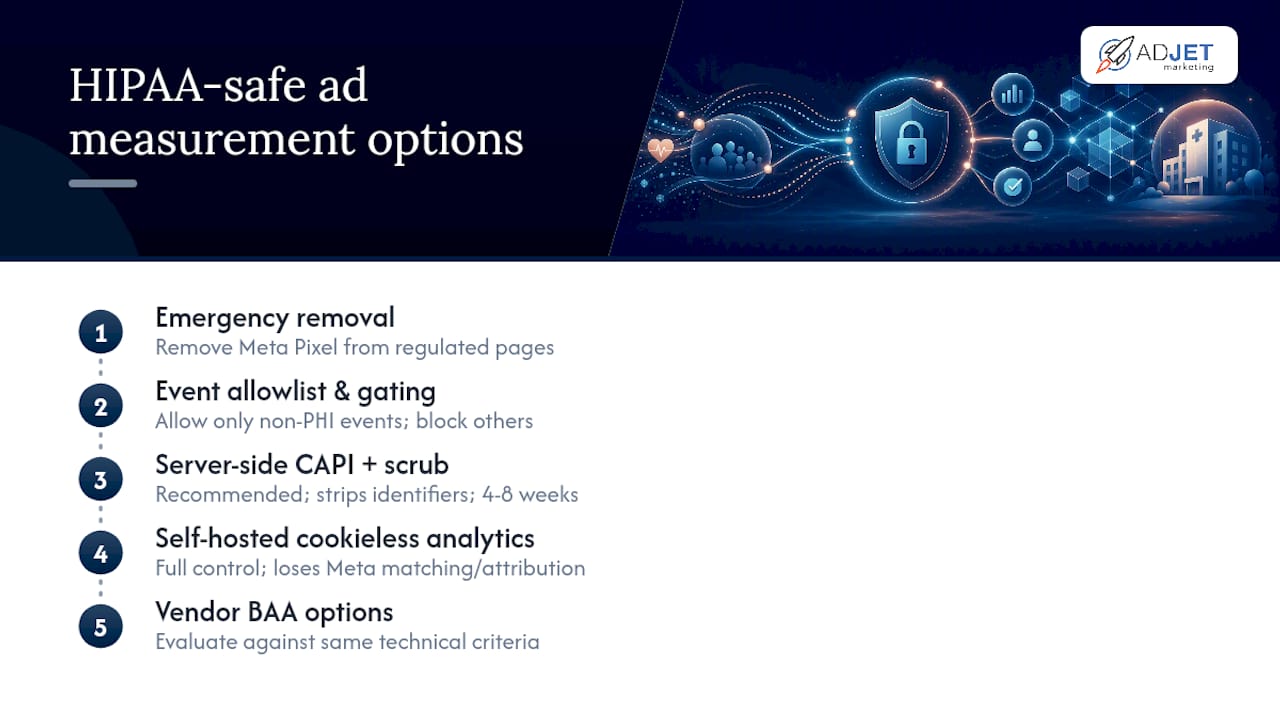
Two paths reduce your exposure meaningfully. The fastest is removing third-party pixels from all regulated surfaces entirely. The more sustainable long-term path is a server-side Conversions API (CAPI) architecture with a privacy gating layer that strips identifiers before any data leaves your infrastructure.
Here are your options, ranked by how quickly they reduce risk:
1. Emergency removal (fastest, lowest complexity)
Remove the Meta Pixel from all pages that reference conditions, treatments, appointments, providers, or authenticated sessions. Keep it only on strictly generic marketing pages where you have documented the legal basis. This takes hours, not weeks, and immediately stops the most obvious PHI disclosures. The downside: you lose conversion tracking on your most valuable pages.
2. Event allowlist with content gating (medium complexity)
Audit every event the Pixel fires and create an explicit allowlist of events that do not involve PHI (e.g., “PageView” on the homepage only, “Lead” on a generic contact form). Block all other events at the tag manager level. This reduces exposure but requires careful governance and ongoing review as your site changes.
3. Server-side CAPI with a privacy scrub layer (recommended for measurement continuity)
Route events through a private server-side gateway that enforces allowlists, strips IP addresses and device identifiers, drops any URL paths containing condition or provider terms, and forwards only minimal, aggregated signals to Meta’s Conversions API. This architecture can support HIPAA-compliant measurement only when the private gateway genuinely strips identifiers before forwarding to Meta. Tools like Freshpaint are built specifically for this use case in healthcare, offering a HIPAA-ready event pipeline with BAA availability. Implementation complexity is medium-to-high and typically requires 4–8 weeks of engineering work.
4. Self-hosted, cookieless analytics (highest privacy, lowest attribution fidelity)
Replace Meta Pixel with a self-hosted analytics platform (Matomo, Plausible, or a custom data warehouse pipeline) that never sends data to third parties. You retain full control of the data, can sign your own BAA with a hosting provider, and eliminate third-party disclosure risk entirely. The trade-off is that you lose Meta’s audience matching and attribution, which affects retargeting and lookalike campaign performance. For cookieless remarketing tactics that preserve measurement without PHI exposure, first-party audience strategies and contextual targeting can partially replace pixel-based retargeting.
5. Vendor BAA options where available
Some specialized healthcare marketing platforms offer HIPAA-ready measurement stacks with BAAs included. Evaluate these against the same technical criteria: does the vendor’s architecture actually strip PHI before transmission, or does the BAA simply shift liability without changing the data flow? A BAA with a vendor that still sends raw identifiers to Meta does not solve the underlying problem.
Pro Tip: Switching to Conversions API without changing your event naming, URL path handling, or allowlist rules is one of the most common remediation failures. Moving from client-side to server-side simply changes the transport layer. If your server-side pipeline still forwards a URL path like /book/addiction-counseling to Meta, you have moved the PHI disclosure, not removed it.
How do you audit your site and implement a compliant architecture?
A one-line plan: scan every surface where tracking fires, document what you find, remove or gate regulated events, then build a server-side architecture if measurement continuity matters to your organization.
Step 1: Scan for pixel presence
- Open Chrome DevTools (Network tab, filter by “facebook.com” or “connect.facebook.net”) on every page type: homepage, service pages, condition pages, appointment flows, portal login, find-a-doctor, blog posts, and any subdomain.
- Use Blacklight (by The Markup) to run an automated scan of your domain and identify third-party trackers.
- Audit your Google Tag Manager containers: export the container JSON and search for “fbq,” “facebook,” and “pixel” strings. Check every tag, trigger, and variable.
- Review your CMS templates and theme files for inline Pixel scripts that bypass Tag Manager.
- Scan subdomains separately. Patient portals often run on a different subdomain and may have been tagged independently by a vendor.
Step 2: Perform a HIPAA risk assessment
Document your findings against the HIPAA Security Rule’s risk analysis requirement. The Health IT SRA Tool provides a structured checklist that covers threat identification, likelihood, impact, and current controls. For each page where the Pixel fires, record: what data is transmitted, to whom, under what legal basis, and whether a BAA exists. This documentation is what your privacy officer and outside counsel need to assess exposure and prepare a remediation plan.
Step 3: Implement server-side tagging
If you are moving to a server-side CAPI architecture, the implementation sequence matters:
- Design your allowlist first. Define exactly which events and parameters are permitted to leave your infrastructure. Start with zero events and add only what you can justify as non-PHI.
- Build the scrubber rules. The server-side gateway must drop IP addresses, truncate device IDs, reject any URL path containing condition or provider terms, and strip free-text fields that could contain medical information.
- Configure the CAPI endpoint. Connect your sanitized event stream to Meta’s Conversions API using a server-to-server call. No client-side Pixel should fire on regulated pages.
- Write QA scripts. Automated tests should verify that no outbound calls to Meta endpoints occur from regulated pages and that the scrubber is dropping expected fields.
- Gate the rollout. Deploy to one page type at a time, verify with server logs and DevTools, then expand.
Pro Tip: After deployment, open Chrome DevTools on your appointment scheduling page and filter network requests by “facebook.com.” You should see zero outbound calls. Then check your server-side gateway logs to confirm the scrubber is dropping the fields you specified. Both checks together give you the audit trail you need.
Realistic timeline and resource notes
A small clinic with a straightforward WordPress site can complete the audit and emergency removal in 2–4 days. A full server-side CAPI implementation with a vendor like Freshpaint typically takes 4–8 weeks, depending on your engineering resources and the complexity of your event taxonomy. Vendor costs for HIPAA-ready server-side platforms range from a few hundred to several thousand dollars per month depending on event volume and support level. Budget for legal review of any new vendor contracts, including BAA negotiation.
What should you demand from vendors who touch your tracking data?
Meta does not sign a BAA for standard Pixel use. That is the baseline assumption your compliance team must start from. Any vendor you bring in to manage or replace your tracking stack needs to be evaluated against a concrete checklist before you sign a contract.
Contractual requirements to demand:
- A signed BAA if the vendor qualifies as a business associate under HIPAA (i.e., they receive, process, or transmit PHI on your behalf).
- A complete data-flow diagram showing every system that touches your tracking data, including subprocessors.
- Purpose limitation language: the vendor may use your data only for the services you contracted, not for their own product improvement, model training, or advertising.
- Data retention and deletion schedules: how long is data stored, in what form, and what is the deletion process when you terminate the contract?
- Access controls and audit logs: who at the vendor can access your data, and can you request an audit log?
- Breach notification timelines: the vendor must notify you within the timeframe required by the HIPAA Breach Notification Rule (no later than 60 days after discovery).
- Indemnity language covering regulatory fines and litigation costs arising from the vendor’s handling of your data.
Technical documents to request:
- Server-side architecture diagrams showing where data is processed and where it is forwarded.
- Sample event payloads at each stage of the pipeline (pre-scrub and post-scrub) so you can verify what actually reaches Meta.
- Documentation of hashing and PII-scrubbing logic, including which fields are dropped, truncated, or hashed.
- TLS configuration and hosting controls (where is the server-side gateway hosted, and who has infrastructure access?).
- SOC 2 Type II report or HIPAA attestation from the vendor’s auditor, if available.
When a vendor claims their platform “de-identifies” data, ask for the specific technical standard they apply. HIPAA’s Safe Harbor de-identification standard requires removing 18 specific identifiers. Expert Determination requires a qualified statistician’s certification. “We hash the email” does not meet either standard. Require written documentation of the de-identification method and the evidence supporting it. Automated compliance platforms like Vanta can help you track vendor attestations and BAA status across your vendor portfolio, but vendor attestation alone does not substitute for architectural PHI removal.
For a deeper look at PHI-safe workflows and BAA management in your marketing stack, the checklist above is a starting point, not a ceiling.
Which pages and campaigns carry the highest PHI risk?
One rule covers most decisions: any page that reveals care-seeking behavior, ties a visitor to a diagnosis, or connects them to a specific clinician or appointment is high risk. Everything else requires a case-by-case judgment.
| Page Type | Risk Level | Why | Recommended Action |
|---|---|---|---|
| Homepage (generic, no health content) | Low | No condition or provider context; post-AHA ruling, lower OCR enforcement risk | Document basis; monitor for content changes |
| Service detail page (e.g., “Addiction Treatment”) | High | URL path and page content reveal condition-seeking behavior | Remove Pixel; use server-side CAPI with scrubber if tracking needed |
| Appointment scheduler | High | Combines provider, service type, and user intent; often collects form data | Remove all client-side tracking; server-side only with strict allowlist |
| Patient portal login | Critical | Authenticated session; any tracking here is almost certainly PHI | Remove all tracking immediately; no exceptions |
| Blog article (general wellness) | Low-Medium | Depends on content; a post about “managing diabetes” carries condition context | Evaluate content; remove Pixel from condition-specific posts |
| Find-a-doctor / provider search | High | Ties user to specialty or condition; URL parameters often contain specialty terms | Remove Pixel; treat same as condition pages |
| Symptom checker | Critical | Directly captures diagnostic intent; any tracking here creates clear PHI | Remove all tracking; no third-party scripts |
Four quick decision rules for a 60-second audit:
- If the URL path contains a condition, specialty, or provider name: remove the Pixel immediately.
- If the page includes a form that collects name, email, phone, or date of birth: treat it as PHI-capable and remove client-side tracking.
- If the page is behind a login or session cookie: no third-party tracking under any circumstances.
- If the page’s primary purpose is to connect a visitor with a specific service or provider: high risk regardless of whether a form is present.
What does a compliant measurement architecture actually look like?
For most healthcare organizations, the choice comes down to two architecture patterns depending on how urgently you need to restore measurement.
Architecture A: Fast containment (2–4 weeks)

Remove the client-side Meta Pixel from all regulated pages immediately. Keep it only on a short, documented list of strictly generic marketing pages (homepage, general blog, careers page) where you have a written legal basis. This stops the most obvious PHI disclosures quickly and requires minimal engineering. The trade-off is a significant gap in conversion data for your most valuable pages. This is the right starting point for any organization that has not yet done a full audit.
Architecture B: Server-side gateway (recommended for long-term measurement)
Build a first-party server-side gateway that sits between your website and Meta’s Conversions API. The gateway receives all events from your site, enforces a strict allowlist of permitted event types and parameters, applies scrubber rules that drop IP addresses, truncate device IDs, reject URL paths containing condition or provider terms, and strip any free-text fields. Only the sanitized, minimal event data is forwarded to Meta CAPI via a server-to-server call. No client-side Pixel fires on regulated pages.
Operational notes for Architecture B: host the gateway on infrastructure you control or on a HIPAA-eligible cloud environment (AWS GovCloud, Google Cloud Healthcare API, or Azure with a BAA). Log every event at the pre-scrub and post-scrub stage for audit purposes. Retain logs for at least six years to align with HIPAA record retention requirements. Use the post-scrub logs to verify that no PHI is leaving your infrastructure.
| Dimension | Architecture A | Architecture B |
|---|---|---|
| Privacy risk | Low (regulated pages untracked) | Low (PHI stripped before transmission) |
| Engineering effort | Low | High |
| Measurement fidelity | Low (significant data gaps) | Medium (aggregated, non-PHI signals) |
| Typical monthly cost | Low | Medium to High |
For healthcare organizations that need to preserve some attribution signal while protecting patient data, Architecture B is the sustainable path. Architecture A is the right emergency move while B is being built. For context on how data strategy fits into a broader medical marketing approach, the architectural decision here connects directly to how you measure ROI across your entire marketing program.
How we advise healthcare clients on this at Adjetmarketing
Our standard recommendation is removal from regulated surfaces first, followed by a phased server-side rollout when measurement continuity matters to the organization. We do not advise clients to rely on the AHA ruling as a reason to keep pixels in place on anything beyond a genuinely generic public page.
The pattern we see most often: a clinic comes to us after a compliance review or a vendor audit flags pixel activity they did not know existed. In many cases, the Pixel was installed by a previous marketing agency or through a Tag Manager container that no one on the current team has reviewed in months. The governance gap is the root cause, not malicious intent. Tag Manager containers accumulate tags over time, and without a regular audit cadence, it is easy to lose track of what is firing and where.
Remediation affects ad performance in the short term. When you remove conversion tracking from appointment pages, your Meta campaigns lose the signal they were optimizing against. Expect a 2–4 week re-learning period as campaigns adjust to new conversion events or shift to upper-funnel signals. The performance dip is real, but it is manageable with the right campaign structure adjustments. We typically rebuild conversion tracking around server-side events that have been through the scrub layer, which restores most of the optimization signal without the PHI exposure.
For a small clinic with a straightforward site, a full audit and emergency containment takes 2–4 weeks. A server-side CAPI implementation with proper testing and documentation typically runs several weeks, depending on the complexity of the event taxonomy and whether a vendor like Freshpaint is handling the pipeline or your engineering team is building it from scratch. Budget for legal review of any new BAAs and for the privacy officer’s time in reviewing the risk assessment documentation.
Adjetmarketing builds HIPAA-aware measurement for healthcare practices
Healthcare marketing does not have to stop at the compliance line. Adjetmarketing builds measurement stacks for medical clinics, aesthetic practices, and mental health providers that are designed from the ground up to keep PHI out of third-party ad platforms. We start with a full site audit to identify every pixel, tag, and script on your domain, then deliver a written remediation plan your privacy officer and counsel can review. From there, we handle server-side implementation, event allowlist configuration, and the documentation your compliance team needs for OCR readiness.
If your practice needs compliant lead generation without the PHI exposure risk, see how our medical marketing services work and reach out to schedule a compliance-focused audit conversation.
Sources
- Hhs
- Meta Pixel and HIPAA, in plain English — Blue Trust
- Meta Pixel in Healthcare: HIPAA Compliance, Privacy Risks, and Safer Alternatives
- Security Risk Assessment Tool
- FTC ban BetterHelp revealing consumers data including sensitive mental health information Facebook
This article provides general information about HIPAA compliance considerations for online tracking technologies. It is not legal advice. Consult qualified legal counsel and your organization’s privacy officer before making compliance decisions.
This article is general information, not a substitute for advice from a qualified doctor. Consult a qualified healthcare professional about your own circumstances before acting on anything here.
Recommended
- How Do We Set Up Remarketing Without PHI Risk? → Cookieless Tactics That Work – AdJet Digital Marketing & Google Partner Agency | SEO Development Google Ads Social
- Is HIPAA-Compliant Marketing Possible With Google Ads? → Yes—Here’s How To Do It Right – AdJet Digital Marketing & Google Partner Agency | SEO Development Google Ads Social
- Ensuring Compliance With HIPAA Standards: A Key Priority For Medical Spas In 2023 – AdJet Digital Marketing & Google Partner Agency | SEO Development Google Ads Social
- 10 Healthcare PPC Tips To Improve Your Marketing