









A medical practice website in the United States can cost anywhere from a couple of thousand dollars to well over $10,000 to build, plus a monthly bill for hosting, security, updates and content. The spread comes from scope: how many pages, which integrations, how much custom design, and how carefully patient data is protected. This guide breaks the budget into its parts so you can compare quotes on the same terms.
TL;DR
- Duke Health’s published guidance put professionally designed practice sites at roughly $1,500 to $2,000 at the low end and above $10,000 for complex builds. That was 2018, so treat it as a floor, not today’s price.
- Ongoing costs matter as much as the build. HIPAA-ready hosting alone often runs several hundred dollars a month for a small practice.
- Patient portals, EHR integrations, booking tools and tracking setup are what push a quote up. A brochure site does not need them.
- Ask every vendor whether the price includes the build, hosting, security, updates, SEO setup and a business associate agreement (BAA), if one is required.
- A site that does not bring in booked appointments is expensive at any price. Budget for conversion and visibility, not only for design.
Table of Contents
- What a medical website costs to build
- What pushes the price up
- Privacy, security and accessibility: the costs people miss
- Ongoing costs: hosting, maintenance and updates
- How our pricing is structured
- Our perspective: what we would budget for
- How to budget for your practice
- Get a quote that fits your clinic
- FAQ
- Sources
What a medical website costs to build
The most useful published benchmark we can point to comes from Duke Health. Its guidance for physicians says professionally designed medical-practice websites started at about $1,500 to $2,000 and could exceed $10,000 depending on complexity and features. The article is from 2018, and web design labor, hosting and security expectations have all moved since then. Read it as proof of the shape of the market: a low entry point, and a high ceiling driven by features.
In practice, we see most independent clinics fall into three tiers:
| Tier | What you get | Typical fit |
|---|---|---|
| Template or DIY | A pre-built theme, your logo and text, basic pages | A new solo practice testing the market |
| Custom small-practice site | Custom design, service and provider pages, booking or contact forms, basic SEO setup | Single-location clinics, med spas, therapists |
| Complex build | Patient portal, EHR links, multi-location structure, custom features | Multi-provider groups, imaging centers, specialty practices |
We deliberately do not put a dollar figure on each tier in this table. Quotes vary by market, scope and who is doing the work, and we would rather show you the drivers than invent averages. What we can say from the sources and from our own pricing is where the numbers sit, and the rest of this article walks through it.
DIY and template sites
DIY builders and low-cost templates exist, and for a brand-new practice they can be a reasonable first step. Duke Health acknowledges these tools but urges physicians to use professional designers, and notes that building and maintaining a site takes substantial time. That matches what clinic owners tell us. The software is cheap; the hours are not. A physician or office manager who spends 40 hours on a site is paying for it in lost clinical or administrative time.
The bigger issue is performance. A template site often looks fine but lacks the page structure, speed and conversion elements that turn a visitor into a booked appointment. Many clinics come to us after a DIY site has been live for a year with almost no inquiries.
Custom-built sites
A custom site is designed around your services, your patients and your local market. It usually includes dedicated pages for each service and provider, mobile layouts, fast load times, structured data and a clear path to book. Duke notes that an estimate may include mobile and tablet optimization, SEO, social-media integration and targeted specialty content, which is a good checklist to hold a quote against.
What pushes the price up
Two quotes for “a medical website” can differ by a factor of five and both be honest. These are the variables that explain it.
Number and depth of pages
A five-page site (home, about, services, providers, contact) is a different project from a 40-page site with a page for each procedure, condition, provider and location. Service pages are also where most organic patient leads come from, so cutting them to save money often costs more later.
Integrations
Duke’s guidance notes that integrations such as patient portals and EHRs can push costs above the basic range. Online scheduling, intake forms, telehealth links, payment tools and review platforms add the same kind of cost: each one needs setup, testing and ongoing maintenance, and each can create a privacy question.
Custom design and photography
Stock imagery is cheap. Custom photography of your providers, your space and your equipment costs more up front, but patients choose a clinic partly on trust, and real faces help. For aesthetic practices, before-and-after galleries also bring consent and compliance work.
Content and copywriting
Who writes the service pages? If you supply the text, the build is cheaper. If the agency writes medically accurate, search-focused copy for each service, the price rises, and so does the likely return. Clinical content should always be reviewed by a licensed provider at your practice.
Privacy, security and accessibility
This is the category owners most often underestimate, so it gets its own section below.
Privacy, security and accessibility: the costs people miss
If your practice is a HIPAA covered entity, your website is not just a brochure. HHS guidance on online tracking technologies explains that the HIPAA Rules apply when tracking technologies collect or disclose protected health information, that disclosures must be permitted, and that required safeguards include risk analysis and protection of electronic PHI. The same guidance says tracking vendors that are business associates must sign a BAA.
What that means for your budget:
- Hosting. Standard shared hosting is usually not built for patient data. One hosting provider’s 2026 pricing guide says small medical practices commonly pay $300 to $500 per month for managed HIPAA-compliant WordPress hosting, though it also lists lower-priced plans. Whether you need this tier depends on whether the site stores or transmits PHI, such as through forms, portals or booking. A purely informational site that collects nothing is a different case. Ask your compliance advisor or healthcare attorney.
- Forms and scheduling. Any form that collects health details needs a compliant tool and, where applicable, a BAA with the vendor.
- Analytics and ad pixels. Tags from advertising and analytics platforms can send visitor data to third parties. Setting these up with consent controls takes expertise, and it takes time. Budget for it as part of the build, not as an afterthought.
- Accessibility. Making a site usable for people with disabilities is part of building it properly. It adds design and testing hours, and it reduces legal risk. Ask any vendor how they test for it.
This is the part of the quote where we see the biggest gaps. A low price often means none of the above is included.
Ongoing costs: hosting, maintenance and updates
A website is not a one-time purchase. Plan for these recurring items:
- Hosting. From a modest monthly fee for a non-PHI informational site to the HIPAA-ready tiers described above.
- Maintenance and security. Core, theme and plugin updates, backups, malware scanning and uptime monitoring. On WordPress, skipping updates is the most common way sites get compromised.
- Domain and SSL. Small annual costs, but they must be renewed and owned by you.
- Content updates. New providers, services, hours, insurance changes and seasonal offers.
- SEO. Ranking in local search takes continuing work: new pages, reviews, technical fixes and tracking.
- Advertising spend. If you run Google Ads, the ad budget is separate from the agency or management fee.
A practical rule: whatever a vendor quotes for the build, ask for the first-year total with all of these included. A $3,000 site with $400 a month in required add-ons costs $7,800 in year one.
How our pricing is structured
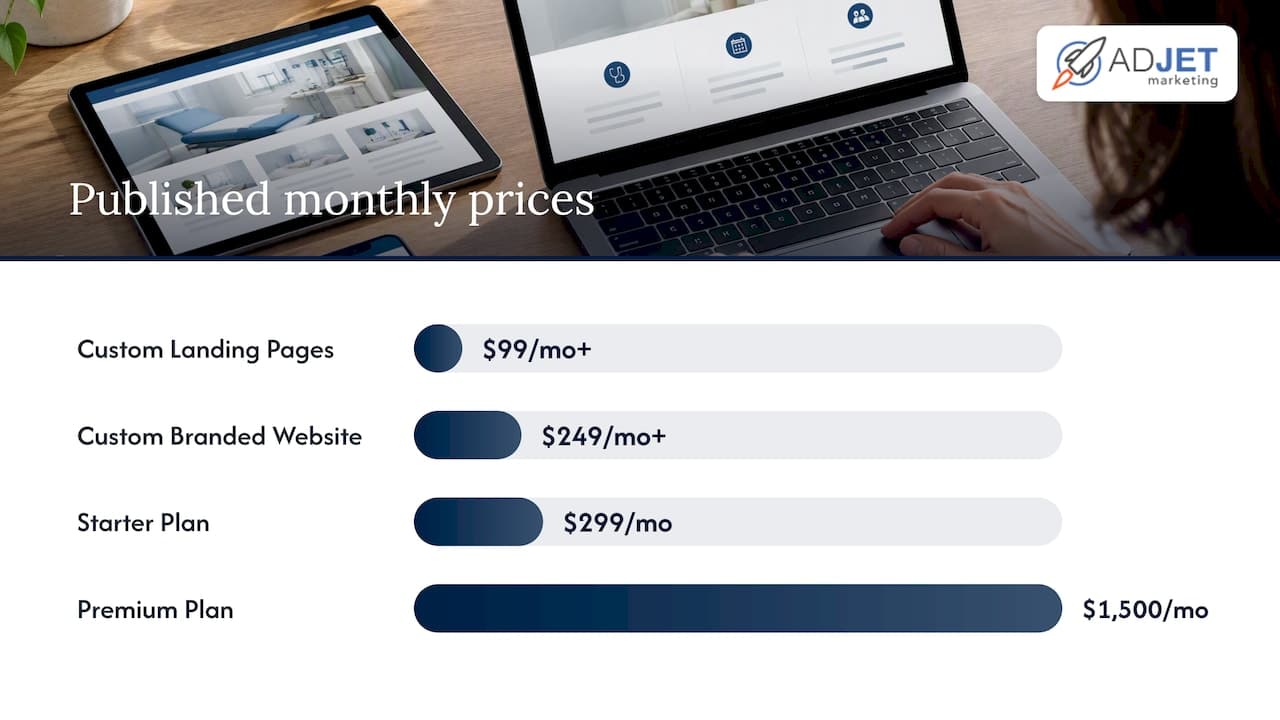
We publish prices where we can, because cost is the first question owners ask. Here is what is currently listed on our site:
| Offer | Price |
|---|---|
| Custom Landing Pages | from $99 per month |
| Custom Branded Website | from $249 per month |
| Starter Plan | $299 per month |
| Premium Plan | $1,500 per month |
| Single Landing Page | $2,000 one-off |
| Monthly page subscription | $200 per month per page |
| Optimization plan | $300 to $1,500 per month |
The Growth Plan, SEO, Google Ads management and full web design are scoped to the practice and do not have a published price. The monthly model means you are not paying a large lump sum, and the site is maintained as part of the relationship. The trade-off is the usual one with subscriptions: you pay over time, so compare the total across 24 to 36 months with a one-time build plus separate maintenance.
If you want to see how the plans differ, our landing page design plans lay out the tiers, and our web design service covers full custom sites for clinics.
Our perspective: what we would budget for
We build and manage WordPress sites for medical clinics, aesthetic practices, pain management centers, therapists and other local providers, and we are a Google Partner agency with HIPAA-conscious processes. A few patterns repeat in our work.
The cheapest quote is rarely the cheapest site. Many clinics come to us after a low-cost build produced almost no booked appointments, or after poor lead quality made the front desk’s job harder. The rebuild then costs more than doing it properly the first time.
Design is only part of the job. A site that looks good but loads slowly, hides the booking button or has thin service pages will not convert. That is why we build landing pages and conversion tracking into the project instead of treating them as extras. We cover this in more depth in our guide to choosing a medical website design company.
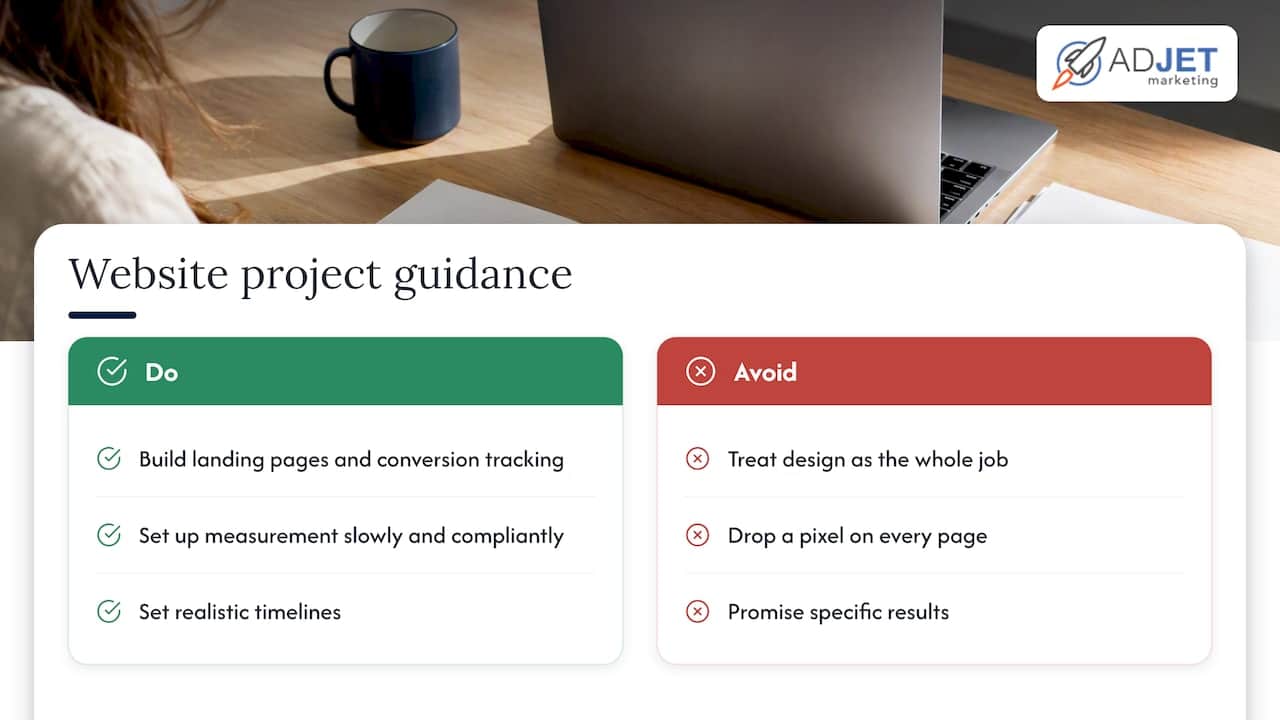
Be careful with tracking. We would rather set up measurement slowly and compliantly than drop a pixel on every page. Your site should tell you which pages produce calls and forms without exposing patient information to third parties.
Set realistic timelines. A custom site typically takes weeks, not days, depending on content and approvals. SEO results build over months. Paid ads can produce traffic faster, but they need a site that converts, and they stop when the budget stops. Neither channel is a guarantee, and we do not promise specific results.
— Felix
How to budget for your practice
Use this sequence to get a number you can trust.
- Define the job. New patients, fewer no-shows, a specific service line? A site built for a single goal is cheaper and performs better than one built to do everything.
- List what must integrate. Scheduling, intake, portal, EHR, telehealth, payments. Each adds cost.
- Decide whether the site handles PHI. This single answer determines your hosting tier and form tools.
- Count your pages. One page per service and per provider is a reasonable starting plan.
- Ask for a year-one total. Build, hosting, maintenance, security, SEO setup and any required BAA.
- Add marketing. A site with no traffic plan is a cost with no return. Compare SEO and Google Ads honestly: ads bring visits quickly while you pay for them, and SEO takes longer but compounds.
For ideas on what a well-built site includes, see our roundup of medical website examples that convert patients, and our guide to optimizing a clinic website for more patients.
Get a quote that fits your clinic
If you want a site scoped to your services, your compliance needs and your local market, we can price it with you before you commit. Start with our landing page and website plans, or talk to us about a custom build for a multi-provider practice.
FAQ
How much does a medical website cost in the United States?
There is no single price. Duke Health’s guidance put professionally designed practice sites at about $1,500 to $2,000 on the low end and above $10,000 for complex ones, and that was in 2018. Current quotes depend on the number of pages, integrations and compliance needs, so ask for a written first-year total.
What ongoing costs should I expect after launch?
Expect hosting, security and updates, content changes, and SEO or advertising if you want patients to find you. For practices handling PHI on the site, hosting is often the largest fixed line, with one provider citing $300 to $500 per month for managed HIPAA-ready WordPress hosting.
Does my medical website need to be HIPAA compliant?
If you are a covered entity and the site collects or discloses PHI, including through tracking technologies, HIPAA applies, according to HHS guidance. A purely informational site with no forms or tracking sits in a different position. Confirm your setup with a healthcare attorney or compliance advisor.
Is a DIY or template site good enough?
It can work as a starting point for a new practice. Duke Health still recommends professional designers, and in our experience DIY sites tend to lack the structure and conversion elements that produce booked appointments.
Sources
- Building a Practice Website That Works, Duke Health
- Use of Online Tracking Technologies by HIPAA Covered Entities and Business Associates, HHS
- How Much Does HIPAA Hosting Cost in 2026?