









Medical clinic SEO is the practice of optimizing your clinic’s online presence through Google Business Profile, structured data, and patient-focused content to attract more patients through organic search. Unlike general SEO, healthcare search engine optimization operates under stricter trust requirements because Google classifies medical content as Your Money or Your Life (YMYL). That classification means Google holds clinic websites to a higher standard of expertise, authority, and trustworthiness. Get it right, and your clinic appears when patients search for the exact conditions you treat.
What does a medical clinic SEO guide actually cover?
A complete approach to clinic SEO covers three interconnected layers: local visibility, technical credibility, and content relevance. Each layer builds on the others. A clinic with strong content but a neglected Google Business Profile will lose local patients to a competitor with a complete listing. A clinic with a great listing but no structured data will struggle to rank for condition-specific searches. This guide walks through each layer in order, with specific steps you can act on today.
How to optimize your Google Business Profile for local patient searches
Your Google Business Profile (GBP) is the single most visible asset in local search. GBP completeness is foundational for medical clinic local SEO performance. An incomplete profile signals to Google that your business is less relevant, which directly reduces your chances of appearing in the local pack.
Follow these steps to build a complete, high-performing profile:
- Fill in every field. Enter your exact business name, primary and secondary categories, NAP (name, address, phone), hours, service areas, and website URL. For categories, go specific. “Pain management clinic” outperforms “medical clinic” for patients searching for that specialty.
- Upload at least 10 photos. Adding photos to your GBP increases clicks by approximately 35%. Include interior shots, exterior shots, and team photos. Update them quarterly.
- Post regular updates. Use the Posts feature to share new services, seasonal health tips, or appointment availability. Google treats active profiles as more prominent.
- Collect and respond to reviews. Clinics should aim for 4.5 or more stars and 50 or more reviews within the first 12 months. Respond to every review within 48 hours. Never purchase reviews. Use QR codes at checkout to make leaving feedback easy for patients.
- Maintain NAP consistency. Your business name, address, and phone number must match exactly across your website, GBP, Healthgrades, Zocdoc, and every other directory listing.
Google ranks local results based on three factors: relevance, distance, and prominence. Relevance measures how well your profile matches the search query. Distance favors clinics physically closer to the searcher. Prominence reflects your reviews, ratings, and overall web authority. You can control relevance and prominence directly. Distance is fixed, which is why local SEO has geographic limits no amount of optimization can fully overcome.
Pro Tip: Use Google’s “suggest an edit” feature to check what your competitors have listed under their categories. If they are using a more specific category than you, update yours to match or go more specific.
What schema markup does a medical clinic need?
Structured data is code you add to your website that tells search engines exactly what your pages are about. For medical clinics, MedicalClinic and Physician schema are the two most important types. MedicalClinic schema goes on your main practice pages. Physician schema goes on individual provider pages.

Here is how the key schema types compare:
| Schema type | Where to use it | Primary benefit |
|---|---|---|
| MedicalClinic | Practice homepage and location pages | Identifies your clinic as a medical entity to Google |
| Physician | Individual provider bio pages | Links clinician credentials to trusted registries |
| MedicalCondition | Condition and symptom pages | Improves topical relevance for patient searches |
| FAQPage | Any page with a Q&A section | Adds structured Q&A for entity clarity |
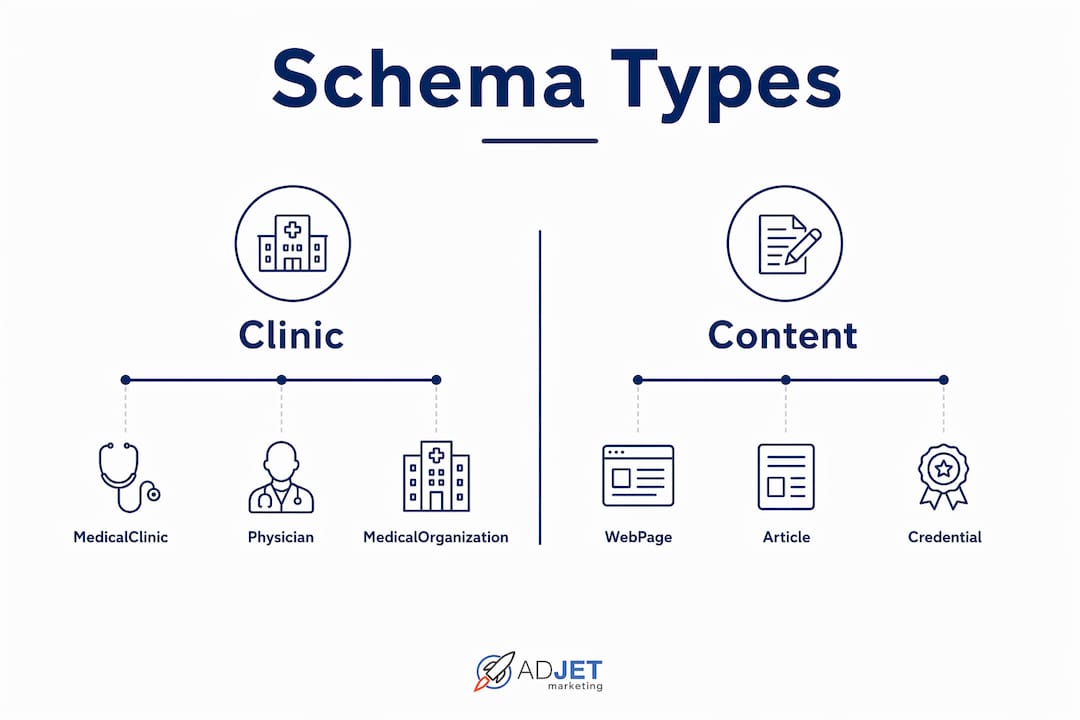
Multi-provider clinics have a specific challenge. Multi-location clinics should use distinct MedicalClinic entities per location and link individual Physician entities through member arrays or @id references. This prevents duplicate attribution and keeps your entity graph clean for both search engines and AI citation systems.
One important update: Google dropped FAQ rich results from search as of may 7, 2026. FAQ rich snippets no longer appear in search results. FAQPage schema still has value for entity clarity and AI-driven search, but you should not build your schema strategy around expecting visual FAQ results in Google.
E-E-A-T compliance goes deeper than adding an author bio. Every clinical claim must link to a credentialed clinician entity with a sameAs property pointing to professional registries like the National Provider Identifier (NPI) database or state medical board listings. That connection is what separates a credible healthcare site from a generic content site in Google’s evaluation.
Pro Tip: Validate your schema using Google’s Rich Results Test before publishing. Even a single syntax error can prevent Google from reading your structured data entirely.
How do you create patient-focused content that ranks and converts?
The most effective content strategy for clinics is built around specific conditions and symptoms, not general health topics. Dedicated condition pages improve topical relevance and patient engagement more than broad service pages. A page titled “Knee Pain Treatment in Dallas” with MedicalCondition schema, a FAQ section, and a booking call to action will consistently outperform a generic “Orthopedic Services” page.
Build your content around these principles:
- Match patient search intent. Patients search for symptoms first, then conditions, then providers. Create pages for each stage: “why does my knee hurt,” “knee osteoarthritis treatment,” and “orthopedic clinic near me.”
- Back every clinical claim with a credentialed provider. The clinician named on the page must have verifiable credentials. Link their name to their provider bio, which in turn links to their NPI record.
- Include FAQ sections on every condition page. Even though FAQ rich results no longer appear in Google, FAQ content still answers conversational and voice search queries. Keep questions and answers visible on the page, and make sure the FAQ schema text matches the visible content exactly.
- Add a clear booking call to action. Every condition page should make it easy for a patient to book an appointment. Place the call to action above the fold and repeat it at the bottom of the page.
- Write at a readable level. Patients are not reading medical journals. Aim for a 7th to 8th grade reading level on patient-facing pages. Save clinical language for provider bios and credentialing sections.
Content depth matters, but readability keeps patients on the page. A 1,200-word condition page that a patient can actually understand will convert better than a 3,000-word clinical overview they abandon after two paragraphs. You can find more patient lead strategies that connect content quality to appointment volume.
How do you monitor and improve your clinic’s SEO performance?
Tracking SEO performance requires more than checking your Google ranking once a month. Effective monitoring combines ranking data, technical audits, competitor benchmarking, and patient feedback into a regular review cycle.
Use this framework to stay on top of your SEO health:
- Google Search Console shows which queries bring patients to your site, your average position, and your click-through rate. Review it weekly. A drop in impressions often signals a Google algorithm update or a technical issue.
- Ranking tracking tools like Semrush or Moz track your position for target keywords over time. Benchmark your rankings against two or three local competitors in your specialty.
- Technical audits catch problems that quietly drain your visibility. Common issues include broken links, slow page load times, missing meta descriptions, and schema errors. Run a full audit monthly using tools like Screaming Frog or Ahrefs.
- Patient reviews function as a live trust signal. A drop in your average star rating affects your GBP prominence score. Monitor reviews on Google, Healthgrades, and Yelp weekly.
- Algorithm updates in healthcare SEO tend to hit YMYL sites harder than other industries. When Google releases a core update, compare your traffic before and after. If you see a significant drop, audit your E-E-A-T signals first.
Avoiding common SEO mistakes on your clinic website is as important as implementing new tactics. Broken internal links, duplicate content across location pages, and missing alt text on images are the most frequent issues we see when auditing clinic sites for the first time.
| Metric | Tool | Review frequency |
|---|---|---|
| Keyword rankings | Semrush, Moz | Weekly |
| Organic clicks and impressions | Google Search Console | Weekly |
| Technical errors | Screaming Frog, Ahrefs | Monthly |
| Review ratings and volume | Google, Healthgrades | Weekly |
| Competitor ranking gaps | Semrush, Ahrefs | Monthly |
Key takeaways
Medical clinic SEO requires integrating local optimization, structured data, credentialed content, and consistent performance monitoring to generate sustainable patient growth.
| Point | Details |
|---|---|
| Complete your Google Business Profile | Fill every field, add 10 or more photos, and respond to reviews within 48 hours. |
| Use MedicalClinic and Physician schema | Link clinician credentials to NPI records via sameAs properties for E-E-A-T compliance. |
| Build condition-specific content pages | Target symptom and condition queries with dedicated pages, FAQs, and booking calls to action. |
| Monitor performance weekly | Use Google Search Console and ranking tools to catch drops before they become costly. |
| Adapt to schema policy changes | FAQ rich results ended in may 2026; update your schema strategy to focus on entity clarity instead. |
Why most clinic SEO fails before it starts
After working with dozens of clinics at Adjetmarketing, I have seen the same pattern repeat. A clinic owner invests in content, adds an author bio, and waits for results. Six months later, rankings have barely moved. The problem is almost never the content itself. It is the architecture underneath it.
Google’s trust evaluation for YMYL sites goes deeper than most agencies acknowledge. A well-written article about back pain treatment means very little if the Physician schema on that page does not link to a verifiable NPI record. The content looks credible to a human reader. To Google’s systems, the credentialing chain is broken.
The second pattern I see constantly is over-reliance on local SEO. Local SEO is powerful, but geographic proximity limits it. A clinic in a suburban area will always struggle to rank for searches originating five miles away, regardless of how well-optimized the GBP is. Clinics that understand this invest in condition-specific content to capture patients who are searching by symptom rather than by location. That content ranks nationally and feeds the local funnel from the top.
My honest recommendation: treat SEO as a 12-month commitment, not a 90-day project. Most clinics see meaningful ranking improvements in months four through six. Significant patient volume from organic search typically arrives in months nine through twelve. Pair SEO with Google Ads during that ramp-up period so you are not waiting on organic traffic to fill your schedule. The two channels work better together than either does alone.
— Felix
How Adjetmarketing supports medical clinic SEO growth
Adjetmarketing is a Google Partner agency that works exclusively with healthcare providers, med spas, pain clinics, and private practices. We handle the full scope of medical SEO services, from schema implementation and Google Business Profile management to condition-specific content and technical audits. Our team also builds high-converting WordPress websites and manages Google Ads campaigns designed to fill appointment slots while your organic rankings build. If you want to understand why marketing matters for your specific practice type, that resource breaks down the ROI case clearly. Reach out to Adjetmarketing for a personalized SEO audit and a clear picture of where your clinic stands today.
FAQ
What is medical clinic SEO?
Medical clinic SEO is the process of optimizing a clinic’s website and online profiles to rank higher in search results and attract more patients organically. It includes local SEO, structured data, and patient-focused content tailored to healthcare search intent.
How long does SEO take for a medical clinic?
Most clinics see meaningful ranking improvements between months four and six, with significant patient volume from organic search arriving around months nine through twelve. Results depend on competition level, website age, and how consistently SEO best practices are applied.
What schema markup should a medical clinic use?
Medical clinics should implement MedicalClinic schema on practice pages, Physician schema on provider bios, and MedicalCondition schema on condition-specific pages. Each Physician entity should link to a verifiable NPI record via the sameAs property.
Does local SEO work for all clinic locations?
Local SEO is effective within a limited geographic radius because Google’s local ranking algorithm factors in physical proximity to the searcher. Clinics in competitive urban markets benefit from pairing local SEO with condition-specific content that captures patients searching by symptom rather than location.
What is the most common SEO mistake clinics make?
The most common mistake is treating SEO as a content-only project while neglecting technical foundations like schema markup, website accessibility, and NAP consistency across directories. Without those foundations, even high-quality content struggles to rank.