









A med spa marketing calendar is a 12-month plan that sets your monthly themes, the date each campaign goes live, who owns it, and the booking goal it has to hit. Build it around your capacity and your treatment seasons, not around every holiday on the calendar. Plan themes a year out, campaigns four to six weeks ahead, and review open appointment slots every week.
Many clinics come to us with a full content calendar and a half-empty schedule. The posts went out on time, but nothing tied them to a treatment, an offer, or a number of bookings. This guide shows how to build the calendar the other way around: start from the schedule you need to fill, then work back to the content.
TL;DR
- Start with your services, margins and open slots. Pick the treatments you want to sell more of, then assign them to months.
- Plan in layers: themes 12 months ahead, campaigns 4 to 6 weeks ahead, social posts 1 to 2 weeks ahead.
- Run one treatment-focused promotion at a time, and match it to the capacity of your providers and rooms.
- Give every calendar entry a measurable goal, such as consultations booked, and review results one week after each offer ends.
- Check every before-and-after post, email and testimonial against FTC and HIPAA rules before it goes on the calendar.
Table of Contents
- Start with capacity, not with holidays
- How far ahead to plan each layer
- A month-by-month med spa marketing calendar
- Choose one offer at a time
- Planning social media inside the calendar
- Email dates belong on the same calendar
- Build compliance into every entry
- Measure what each entry books
- Our perspective on med spa calendars
- Paid ads and SEO on the same calendar
- Where AdJet can help
- FAQ
- Sources
Start with capacity, not with holidays
Most calendar templates begin in January and list a hook for each month. That is useful, but it skips the question that decides whether a campaign makes money: can you deliver the appointments it creates?
Before you fill in a single month, gather four things:
- Your service list with margins. Which treatments earn the most per provider hour? Those deserve the best calendar slots.
- Last year’s booking data. Look at bookings by month and by service. Note the weeks that were slow and the weeks you turned people away.
- Provider and room capacity. If your injector is booked three weeks out in March, a March injectables promotion adds stress, not revenue.
- Your current channels. List what you already run: Google Business Profile, email, Instagram, paid search, your blog.
This audit usually takes a few hours and changes the whole plan. A clinic that is full in November and empty in February needs a very different calendar from one with the opposite pattern.
How far ahead to plan each layer
A calendar works best as layers with different lead times. Mixing them up is the most common reason campaigns launch late.
| Layer | What it covers | Plan it |
|---|---|---|
| Annual themes | Monthly focus, big events, treatment priorities | 12 months out, revised each quarter |
| Campaigns and offers | Promotions, emails, landing pages, ad copy | 4 to 6 weeks before peak demand |
| Larger events | Open houses, pop-ups, partner events | At least 8 weeks ahead |
| Seasonal SEO content | Blog posts and service pages | 8 to 12 weeks before demand |
| Social content | Posts, Reels, Stories | Batch-created 1 to 2 weeks ahead |
The four-to-six-week lead time for seasonal campaigns matches what Prospyr’s seasonal guidance recommends, along with keeping email, SMS, social and in-clinic messaging consistent. The reason is practical. Patients searching for a treatment before an event need time to book a consultation, then the treatment, then recover.
SEO needs the longest runway. A page published the week demand peaks will rarely rank in time. If you want to rank for a seasonal treatment, publish the page in late summer for a fall push. Our guide to SEO tactics for med spas covers how to structure those pages.
A month-by-month med spa marketing calendar
The themes below are a starting point. Adjust each to your treatment menu and your local market. A med spa in Phoenix has a different summer from one in Minneapolis.
| Month | Theme | Example focus |
|---|---|---|
| January | New year resets, body goals | Consultations, body contouring, skin resets |
| February | Valentine’s Day, date-night prep | Gift cards, quick glow treatments |
| March | Weddings, spring break prep | Bridal timelines, pre-trip treatments |
| April | Sun prep, “six weeks to summer” | Body treatments, skin prep |
| May | Graduations, Mother’s Day, early summer | Gift cards, packages |
| June | Summer events and travel | Low-downtime treatments |
| July | Hydration, post-sun recovery, SPF | Skincare retail, facials |
| August | Back to school, fall previews | Plan fall laser and peel launch |
| September | Fall skin repair | Peels, pigment concerns |
| October | Holiday-party preparation | Injectables, laser series |
| November | Black Friday and gifting | Gift cards, packages |
| December | Year-end spending, quick treatments | Gift cards, last-minute appointments |
Winter: January to March
January is the month of intent. People are researching, so this is where landing pages and Google Ads earn their keep. Treatments with more downtime also tend to be easier to schedule when sun exposure is low. SearchMedSpa’s seasonal guide, for example, lists January as the lowest-UV month and a fit for deeper resurfacing, though you should confirm any treatment timing with your medical director, not a marketing calendar.
The American Med Spa Association’s 2026 marketing plan guide suggests a Q1 “New Year, New You” event or aesthetic showcase to generate new consultations. It also advises scheduling vendors, invitations and promotions before the holidays rather than waiting until January. That fits the eight-week rule for events.
February and March are shorter, lighter campaigns: gift cards for Valentine’s Day, then bridal and trip preparation. Bridal clients need a timeline, so publish a “how far ahead to start” page and link to it from your emails.
Spring: April to June
Spring is when body and sun-prep messaging pays off. “Six weeks to summer” works because it gives the patient a deadline and gives you a realistic treatment window. Run it as one offer, not five.
May is crowded with Mother’s Day and graduation gifting. Gift cards are the simplest product to sell here. Keep the redemption process easy, because a gift card nobody can book online is a wasted sale. Our tips for setting up online booking for your medspa cover the basics.
Summer: July and August
Summer is often the lightest month for treatments that require sun avoidance, so shift the message. July works for hydration, post-sun recovery, SPF and skincare retail. August is the planning month: it is when you publish fall content and start building your list for October.
Fall and holidays: September to December
Fall is a strong season for pigment and skin repair concerns, and October brings holiday-party preparation. Start those campaigns in September, not October.
Q4 also changes your revenue picture. Prospyr notes that gift cards sold in Q4 are often redeemed in January, so a strong November and December can fill the following January schedule. Account for that when you set capacity targets.
Choose one offer at a time
The most common calendar mistake we see is stacking promotions. Three offers running at once confuse patients and make results impossible to read.
A cadence we like for most clinics:
- Run one treatment-focused promotion every six to eight weeks.
- Put three dates in a shared calendar for each one: content live, offer start, offer end.
- Around each offer, mix content types: education to explain the treatment, proof such as reviews or approved results, and one clear call to action.
A useful ratio is three education pieces, two proof points and one offer. This keeps your feed from becoming a stream of discounts. If you want ideas for the proof piece, our page on generating more medspa reviews is a good place to start.
Planning social media inside the calendar
Social is where calendars most often become unrealistic. Be honest about how many posts your team can produce.
WellnessLiving’s 2026 guide recommends four to seven content buckets, a schedule of one to two posts per week, batch creation of a month’s content at once or in two- to three-week chunks, and 10 to 20 minutes a day engaging with followers. Their example buckets include treatment explanations, beauty tips, behind the scenes, testimonials, post-care instructions, product spotlights and Q&As.
A practical weekly structure:
- Monday: one educational post tied to the month’s featured treatment.
- Thursday: one proof or behind-the-scenes post.
- Daily: a short engagement block to reply to comments and messages.
- Weekly: a Google Business Profile post that mirrors the current offer.
Two posts a week that you actually publish beat five a week that stop in March. For channel-specific tactics, see our guides on Instagram marketing for medspas and creating engaging social media campaigns for medspas.
Email dates belong on the same calendar
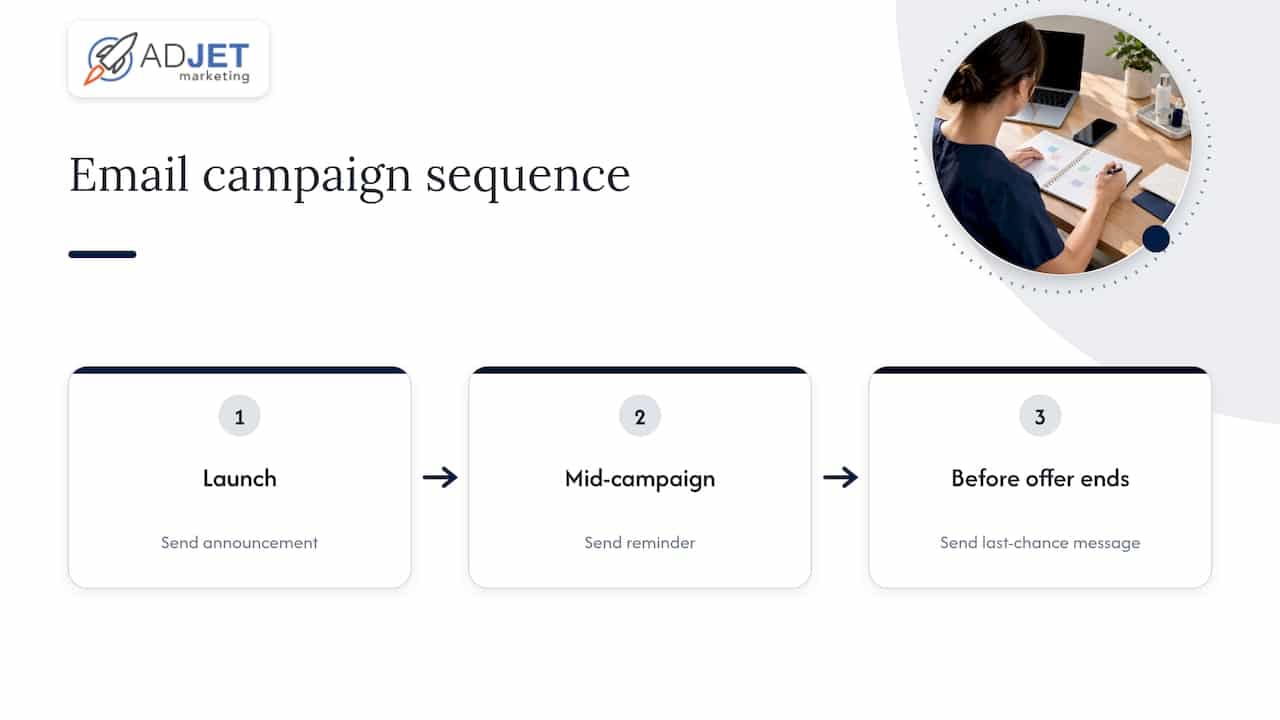
Email is the channel closest to booking. Put send dates on the calendar next to the offer start and end dates: an announcement at launch, a reminder mid-campaign, and a last-chance message before it ends. Segment where you can, so past filler clients and current members do not get the same message. Our page on medical spa email marketing explains how we set this up.
Build compliance into every entry
A calendar is also where compliance checks should live. Add a review step before each scheduled post, not after.
- Before-and-after photos. The FTC expects advertisers to represent typical results or clearly disclose what results can generally be expected when a pictured result is not typical, and to avoid undisclosed edits that materially change the image, according to MedSpa Standards’ summary of FTC guidance. Our before-and-after rules playbook walks through the details, and our article on using before-and-after photos covers the marketing side.
- Testimonials and incentives. The same source says any payment, free treatment or discount connected to a testimonial must be disclosed clearly near the claim, not buried in hashtags or fine print.
- Patient photos and stories. Using a patient’s image or story in marketing generally calls for written authorization under the HIPAA Privacy Rule. Ask your compliance advisor to approve your release form.
- Email. Under the FTC’s CAN-SPAM rules, commercial email needs accurate subject lines and sender names, a physical postal address and a working unsubscribe option that you honor promptly. Check the current requirements with your counsel.
Have your medical director review any clinical claim in a campaign, and keep a record of who approved what.
Measure what each entry books
A calendar without goals is a content schedule. Give each entry one number:
| Calendar entry | What to track |
|---|---|
| Seasonal email | Attributed bookings or revenue |
| SEO page | Clicks to the booking page |
| Instagram Reel | Profile visits and link clicks |
| Google Business Profile post | Calls and direction requests |
| Event | Consultations booked within seven days |
| Gift card campaign | Sales now, redemptions later |
To make attribution possible, give each offer its own landing page or booking code and add a “how did you hear about us” question at checkout. Train the front desk to ask the same question on calls. Then set a results review for one week after the offer ends and write down what worked.
Prospyr lists package sales, new bookings, service-specific volume, gift-card redemptions and campaign ROI as the seasonal metrics worth watching. Check open appointment slots weekly, and adjust upcoming content when a service is already full. Our guide to online booking conversion optimization helps when clicks do not turn into appointments.
Our perspective on med spa calendars
Clinics rarely fail because they ran out of ideas. They fail because the plan was disconnected from the schedule. We have seen many owners come to us after months of posting with poor lead quality, and the pattern is usually the same: no single offer, no landing page, and no way to tell which post produced a booking.
Our approach is to treat the calendar as a booking plan. Paid search captures people already looking for a treatment, so we line up Google Ads with the months when demand rises. SEO takes longer, so we start it earlier and expect it to pay off over months, not weeks. A dedicated landing page for each major offer lets us report on what the campaign actually produced.
We also set expectations plainly. Results depend on your market, budget and capacity, and we do not promise a specific number of leads. What we can do is build a calendar you can measure, and adjust it every month using real data. As a Google Partner agency with HIPAA-compliant processes, we build that review into how we work.
Felix
Paid ads and SEO on the same calendar
The two channels work on different clocks, so schedule them differently.
- Google Ads can start generating inquiries within days of launch, so tie them to a specific offer or a high-intent window such as January. They need ongoing budget and tuning.
- SEO compounds. Pages you publish this quarter can support next year’s seasonal demand, but you should not expect quick returns.
Most clinics benefit from both: ads for near-term bookings while SEO builds. If budget is tight, start with the treatments that have the best margin and the most open capacity, and add channels as you see results.
Where AdJet can help
If your calendar needs a landing page for each major offer, we build them. Custom landing pages start from $99 per month, and a single landing page is a $2,000 one-off project, with other plans listed on our landing page design page. We also manage Google Ads and SEO for med spas and aesthetic practices, so the calendar and the campaigns run from one plan.
FAQ
How far in advance should a med spa plan its marketing calendar?
Set your themes 12 months out and revisit them each quarter. Plan campaigns four to six weeks before peak demand, events at least eight weeks ahead, and batch social posts one to two weeks ahead.
How often should a med spa run promotions?
One treatment-focused promotion every six to eight weeks is a workable pace for most clinics. It leaves room for education and proof content between offers, and it keeps results easy to measure.
How many times a week should a med spa post on social media?
One to two posts a week is a realistic schedule for most teams, per WellnessLiving’s guidance. Consistency matters more than volume, so choose a number you can sustain all year.
Which months are busiest for med spas?
It depends on your market and services, so check your own booking data by month. Many clinics see interest around January resets, spring and summer prep, and holiday events in Q4.
What should a med spa check before posting before-and-after photos?
Confirm you have written patient authorization, that the result is typical or clearly disclosed as not typical, and that no edits materially change the image. Disclose any incentive tied to a testimonial next to the claim.
Sources
- How to Build Your 2026 Med Spa Marketing Plan, American Med Spa Association
- How to Align Aesthetic Services with Seasonal Trends, Prospyr
- 5 Steps for Growing Your Medical Spa with Social Media, WellnessLiving
- FTC Before and After Photo Rules for Med Spas, MedSpa Standards