








The medspa industry is more competitive than ever. Clients searching for Botox, laser treatments, or body contouring have dozens of options within a few miles, and they’re making decisions based almost entirely on what they find online. If your medspa isn’t showing up prominently in search results, you’re losing bookings to competitors who are. This article walks you through a clear, actionable framework to assess your current digital presence, implement SEO that builds lasting visibility, run paid ads that generate leads right now, and combine both channels for maximum impact.
Table of Contents
- Assessing your medspa’s digital presence
- Leveraging SEO for sustainable growth
- Using paid advertising for immediate results
- Combining strategies to maximize lead flow
- What most medspa owners overlook about digital visibility
- Take your medspa visibility further with expert help
- Frequently asked questions
Key Takeaways
| Point | Details |
|---|---|
| Visibility drives growth | Effective digital strategies directly increase client inquiries for medspas. |
| SEO builds sustainability | SEO takes longer but produces compounding, lasting visibility. |
| Paid ads offer immediacy | Google Ads and similar campaigns generate instant lead flow for high-intent keywords. |
| Combined approach is best | Mixing SEO and paid ads stabilizes and maximizes new client acquisition. |
| Track and refine continually | Monitoring results and adjusting strategies boosts long-term ROI. |
Assessing your medspa’s digital presence
Before jumping into strategies, you need an honest picture of where you stand online right now. Many medspa owners assume their website is working fine, until they realize a competitor three miles away is ranking on page one for every service they offer.
Start with this quick checklist of core digital assets:
- Website: Is it mobile-friendly, fast-loading, and built on a secure HTTPS connection?
- Google Business Profile: Is it claimed, verified, and fully filled out with services, photos, and hours?
- Online reviews: Do you have at least 20 Google reviews with an average rating above 4.5 stars?
- Social media profiles: Are your Instagram, Facebook, and TikTok pages consistent, active, and linked to your website?
- Local citations: Is your business name, address, and phone number listed consistently across directories like Yelp, Healthgrades, and RealSelf?
Once you’ve inventoried your assets, benchmark your current performance against what strong visibility actually looks like. The table below gives you a direct comparison:
| Visibility indicator | Current (weak presence) | Optimal (strong presence) |
|---|---|---|
| Google page ranking | Page 2+ for key services | Page 1, top 5 results |
| Google Business Profile clicks | Under 50/month | 200+ clicks/month |
| Website organic traffic | Under 200 visits/month | 1,000+ visits/month |
| Average cost per lead (CPL) | $120+ | $35–$90 |
| Online review count | Fewer than 10 reviews | 50+ with 4.7+ average |
| Click-through rate (CTR) | Below 2% | 4–7% or higher |
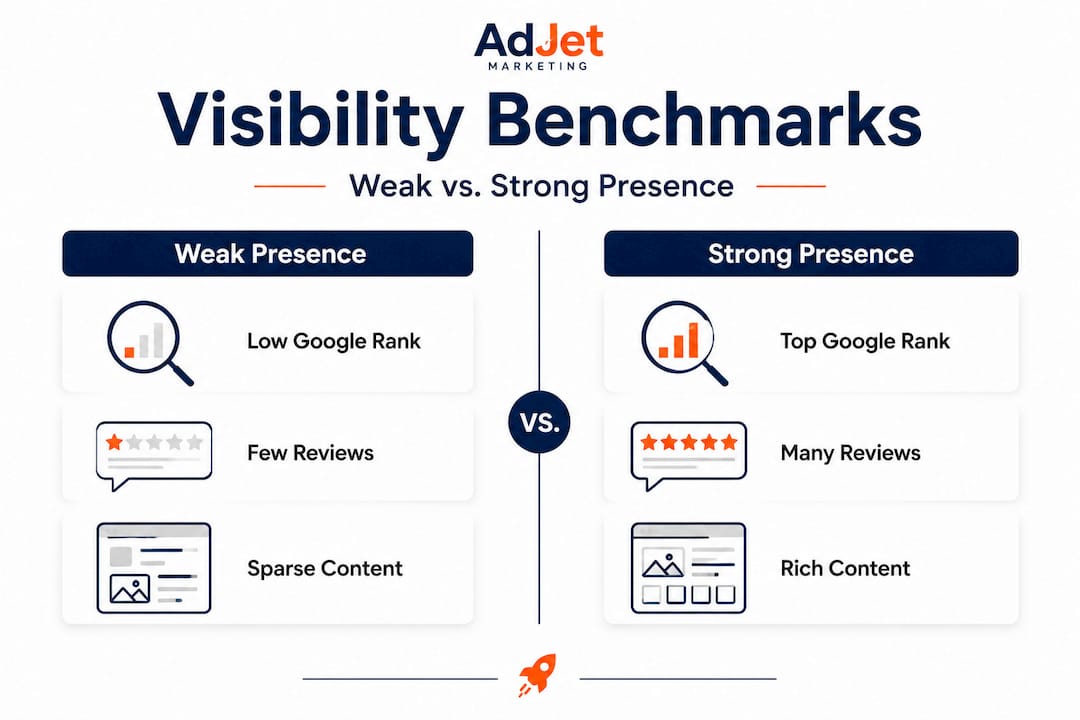
These benchmarks give you a realistic target. The goal isn’t perfection on day one. It’s identifying which indicators are furthest from optimal so you can prioritize your efforts. For example, if your website traffic is low but your Google Business Profile is strong, SEO content is likely your biggest gap. If your reviews are sparse, a focused reputation management campaign should come first.
Our local medspa SEO tips article goes deeper on optimizing your local presence, and our local SEO guide for medspas outlines the full framework for building strong local rankings from the ground up. Track metrics monthly so you can see whether your investments are moving the needle, and adjust your strategy based on real data rather than guesswork.
Leveraging SEO for sustainable growth
Once you’ve assessed your presence, it’s time to implement foundational SEO strategies. SEO, or search engine optimization, means making your website and online listings more relevant and trustworthy in Google’s eyes so you rank higher when potential clients search for your services.
Here’s a practical, step-by-step approach:
-
Keyword research: Identify the exact phrases your target clients use. Think “CoolSculpting near me,” “Botox in [your city],” or “best medspa for laser hair removal.” Use free tools like Google’s Keyword Planner to find search volume and competition levels for each term.
-
On-page optimization: For each core service, create a dedicated page on your website. Write clear, informative content that uses your target keywords naturally. Include before-and-after photos where appropriate, FAQs, and a visible call-to-action to book a consultation.
-
Local citation building: Submit your business information consistently to directories like Yelp, Healthgrades, RealSelf, and local business associations. Inconsistent listings confuse Google and hurt your local rankings.
-
Content marketing: Publish blog posts answering questions your clients actually ask. Topics like “What to expect during a HydraFacial” or “How many Botox units do I need?” attract organic search traffic and build trust before a client ever calls you.
-
Review generation: After every appointment, send a short text or email asking satisfied clients to leave a Google review. Reviews are a direct local ranking factor and influence whether new clients choose your practice.
-
Backlink acquisition: Earn links from local news sites, beauty bloggers, and healthcare directories. Each high-quality link signals to Google that your medspa is credible and worth ranking.
The Google Ads vs SEO tradeoff is generally a time-and-risk tradeoff: Google Ads offers immediacy while SEO builds compounding long-term visibility, and combining both often stabilizes lead flow. SEO rarely delivers results overnight. Plan for a 3 to 6 month timeline before you see meaningful ranking improvements, with the best returns compounding over 12 months or more. The upside is that those results don’t disappear when you pause a budget, unlike paid ads.
Pro Tip: Create a dedicated location page for every city or neighborhood you serve. A page titled “Medical Spa in [Neighborhood Name]” that includes local landmarks, client testimonials, and service details ranks faster and more specifically than a generic service page. Pair this with consistent review generation, and your local SEO velocity increases significantly.
Our guide to effective medspa SEO tactics covers what’s working in the current search landscape, and for deeper technical strategies, see our resource on advanced medspa SEO.
Using paid advertising for immediate results
To complement SEO, let’s see how paid advertising can bring instant visibility and leads for your medspa. While SEO builds your foundation over months, Google Ads can place your medspa at the very top of search results the same day your campaign goes live.

Paid search can produce immediate top-of-page visibility for high-intent queries like “Botox near me,” but costs and conversion benchmarks vary by keyword and market competition. That’s why understanding the cost landscape upfront is critical before you commit budget.
Here’s a general overview of what medspa practices typically see for paid search metrics:
| Keyword type | Average CPC | Typical CPL | Competition level |
|---|---|---|---|
| “Botox near me” | $6–$12 | $45–$80 | Very high |
| “Laser hair removal [city]” | $4–$9 | $40–$75 | High |
| “Medical spa [city]” | $3–$7 | $35–$65 | Medium-high |
| “CoolSculpting near me” | $5–$10 | $50–$90 | High |
| “Medspa specials” | $2–$5 | $30–$55 | Medium |
These are real-world benchmarks, not guaranteed outcomes. Your actual CPL will depend on your landing page quality, geographic competition, ad copy, and how aggressively you’re willing to bid.
High-intent keywords to prioritize in your campaigns include:
- “Botox near me” or “Botox in [city]”
- “Medical spa appointment [city]”
- “Laser facial near me”
- “Dysport injections [city]”
- “Body contouring near me”
- “HydraFacial [city]”
- “Lip filler near me”
Pro Tip: Use negative keywords to filter out irrelevant searches and protect your budget. For example, adding “at home,” “DIY,” and “certification course” as negative keywords prevents your ad from showing to people who aren’t looking to book a service. This one step alone can reduce wasted spend by 15 to 25 percent in many medspa campaigns.
One of the biggest mistakes medspa owners make with paid ads is sending traffic to a generic homepage. Every ad should link to a dedicated landing page that matches the specific service advertised, includes a clear booking call-to-action, and loads in under 3 seconds on mobile. A well-optimized landing page can double your conversion rate without increasing your ad budget.
For a deeper breakdown of campaign structure and bidding strategy, our Google Ads strategies for medspas guide walks through every component. If you’re deciding between Google and social platforms, our comparison of Google Ads vs Meta Ads for medspas breaks down where each channel delivers better ROI by service type.
Combining strategies to maximize lead flow
To get the best results, combine strategies and avoid common pitfalls while transitioning to long-term gains. Running both SEO and paid ads together isn’t just additive. It’s multiplicative. The two channels reinforce each other in ways that neither achieves alone.
Here’s how to phase your budget effectively across the first 12 months:
- Months 1 to 3: Allocate 70 to 80 percent of your marketing budget to Google Ads for immediate leads. Use this time to identify which keywords and services convert best. Simultaneously, begin building your SEO foundation: optimize your Google Business Profile, fix on-page issues, and start publishing content.
- Months 4 to 6: Start shifting budget slightly toward SEO investments. You may still rely heavily on ads, but your organic traffic should begin increasing. Analyze which ad campaigns are most profitable and consolidate spend to those.
- Months 7 to 12: As organic rankings improve, reduce your reliance on paid traffic for branded and lower-competition keywords. Keep ads running for high-competition terms where paid placement is still more cost-effective than organic.
- Year 2 and beyond: Your SEO now generates consistent organic leads. Paid ads become a precision tool targeting new services, seasonal promotions, or specific high-value keywords rather than covering your entire visibility gap.
The most common pitfalls in medspa marketing include over-reliance on a single channel, inconsistent tracking, and failing to follow up with leads quickly. Studies consistently show that leads contacted within five minutes of inquiry are far more likely to convert than those contacted even 30 minutes later.
“SEO vs. ads is generally a time-and-risk tradeoff: Google Ads offers immediacy; SEO builds compounding long-term visibility, and combining both often stabilizes lead flow.” — Google Ads vs SEO for Medspas
Pro Tip: Set up conversion tracking in Google Ads and Google Analytics 4 before launching any campaign. Track phone calls, form fills, and online bookings as separate conversion events. Without this data, you’re flying blind. With it, you can calculate exact ROI for every dollar spent and make confident decisions about where to invest more.
Poor tracking is one of the most expensive mistakes medspa owners make. Many practices spend thousands on ads and SEO without ever knowing which channel generated a single booked appointment. Integrated tracking solves this completely.
What most medspa owners overlook about digital visibility
Here’s an uncomfortable truth: most medspa owners focus obsessively on rankings and almost never think about what happens after someone clicks. A page one ranking is only valuable if the person who lands on your website actually becomes a client. We’ve worked with practices that had strong rankings and terrible conversion rates, and others that ran Google Ads with generous budgets but weak landing pages. The result in both cases was the same. Expensive traffic with few bookings.
Visibility is not a destination. It’s the beginning of a conversion process. Before you invest heavily in SEO or ads, make sure your website can actually convert the traffic you’re about to send it. That means fast load times, clear service pages, visible pricing or consultation CTAs, strong social proof through reviews, and a mobile experience that doesn’t frustrate users.
The second thing most owners overlook is the quality of leads versus the volume of leads. Ranking for “medspa near me” sounds great until you realize that term attracts people comparing dozens of options with no real intent to book. Ranking for “morpheus8 treatment [your city]” is far more specific and attracts someone ready to make a decision. Precision always beats volume in aesthetic marketing.
Our advanced medspa SEO strategies outline how to target intent-rich keywords that convert, not just keywords that attract traffic. The difference in revenue between a practice that understands this distinction and one that doesn’t is significant.
Invest equally in tracking, follow-up, and closing as you do in generating the lead in the first place. Your digital marketing strategy is only as strong as the system that receives the leads it produces.
Take your medspa visibility further with expert help
Building and managing an effective medspa digital strategy takes real expertise, consistent effort, and a data-driven approach that evolves with the market. At AdJet Marketing, we specialize in exactly this. Our medspa SEO services are built to grow your organic rankings and local visibility over time, while our medspa Google Ads management delivers immediate, measurable lead flow from day one. Whether you’re starting from scratch or optimizing an existing campaign, our team builds strategies around your specific services, market, and growth goals. Explore our marketing ideas for medspas for additional inspiration, or reach out to discuss a tailored plan for your practice.
Frequently asked questions
How long does it take before SEO impacts medspa visibility?
Most medspas see measurable SEO improvements within 3 to 6 months, with rankings and traffic continuing to compound over 12 months or more. The SEO timeline is longer than paid ads, but the results are more durable and cost-effective over time.
What keywords should medspas target for Google Ads?
Focus on high-intent terms like “Botox near me,” “medical spa appointments,” and specific treatment names tied to your city. High-intent queries convert at significantly higher rates and deliver better ROI than broad, generic terms.
Should I prioritize SEO or paid advertising first?
Start with paid ads for immediate visibility while simultaneously building your SEO foundation. The phased budget approach works best: heavier ads early, then gradually shifting investment toward SEO as organic rankings strengthen.
What is a typical cost per lead using Google Ads for medspas?
Average CPL ranges from $35 to $90 depending on market competition, keyword selection, and landing page quality. Optimizing your landing pages and targeting high-intent terms keeps your CPL at the lower end of that range.
Recommended
- How To Create Effective Social Media Campaigns For Med Spas: Insta-Glam: Social Media Strategies That Make Med Spas Shine – AdJet Digital Marketing & Google Partner Agency | SEO Development Google Ads Social
- Top Digital Marketing Strategies For MedSpas In 2024 – AdJet Digital Marketing & Google Partner Agency | SEO Development Google Ads Social
- Revitalise Your Med Spa: Mastering Digital Marketing Strategies To Boost Patient Volume
- Creating Engaging Social Media Campaigns For MedSpas – AdJet Digital Marketing & Google Partner Agency | SEO Development Google Ads Social