








Yes, Google Ads can generate booked exams for imaging centers, but only when you build campaigns around high-intent search terms, track phone calls and bookings as real conversions, and configure your tracking to keep protected health information out of third-party tools. Skip any one of those three and you end up with a campaign that spends money without producing patients. Start with search campaigns built for calls and location visits, turn on call and booking conversion tracking with CRM import, and run your tracking setup past HIPAA guidance before you launch.
TL;DR:
- High-intent search terms like “near me” and specific service queries are essential for successful imaging center campaigns; broad match is less effective without strict negative keywords.
- Conversions must be tracked through booked exams and scheduled appointments, not just click or call signals, requiring proper CRM integration and call duration filters.
- Using call-only ads paired with location assets often outperforms standard search ads for phone-heavy centers, especially when directing patients to specific booking or information pages.
- HIPAA compliance necessitates avoiding PHI in URLs and tracking pixels, requiring server-side tracking or first-party solutions and vendor agreements for sensitive data.
- Improving campaign structure, landing pages, and conversion tracking typically results in more booked exams without increasing ad spend, as demonstrated by Adjetmarketing’s case study.
Table of Contents
- Campaign Setup and Account Structure That Produces Bookings
- Targeting, Keywords, and the Negative Keyword List That Saves Your Budget
- Budgeting and Bidding for Booked Exams, Not Clicks
- Measuring Conversions: Calls, Bookings, and Qualifying the Leads That Matter
- HIPAA, Tracking, and Vendor Risk: Keeping PHI Out of Your Ad Tools
- The Optimization Playbook: Landing Pages, Testing, and Cutting Waste
- AdJet Case Study: Booking More Exams Without Increasing Traffic
- Felix’s Quick View on What Actually Trips People Up
- How Adjetmarketing Can Help You Launch and Track Campaigns Correctly
- Sources
- FAQ
Campaign Setup and Account Structure That Produces Bookings
Most imaging centers we work with start with one big, messy campaign lumping MRI, CT, mammography, and ultrasound into the same ad group. That structure makes it almost impossible to tell which service is actually generating revenue. Split campaigns by service line first, then by intent, separating people ready to book from people still researching symptoms or costs.
For phone-heavy imaging centers, call-only ads paired with call assets and location assets often outperform standard search ads, since patients calling to schedule an MRI usually want a person on the line, not a web form. Sitelinks should point to prep instructions, insurance and financing pages, and a direct booking page, not your homepage.
- Group campaigns by modality (MRI, CT, mammography) so budget and bidding reflect actual demand for each
- Use call assets and location assets on every search campaign serving phone-first patients
- Write ad copy that names the exam and mentions same-day or next-day availability when true
- Match landing pages to the ad’s specific promise, not a generic services page
Pro Tip: If your call volume is meaningful, test a call-only campaign against your standard search campaign for the same modality. The winner usually surprises people who assumed everyone books online.
Targeting, Keywords, and the Negative Keyword List That Saves Your Budget
Keyword strategy for imaging centers comes down to matching search intent to booking readiness. The strongest performers are almost always high-intent, location-modified terms:
- “MRI near me” and “CT scan near me” — high commercial intent, usually ready to book
- “mammogram appointment” and “open MRI same day” — specific service plus urgency signal
- “[imaging modality] cost” or “[imaging modality] with insurance” — price-sensitive but still booking-stage
Phrase match and exact match still do the heaviest lifting for these queries, since they give you control over which searches trigger your ads. Broad match paired with Smart Bidding can work, but only once you have solid negative keyword lists and enough imported conversion data for the algorithm to learn from. Without that foundation, broad match tends to pull in job seekers, students researching radiology careers, and people hunting for free screening programs. Build negative lists covering “jobs,” “salary,” “training,” “certification,” and “free” early, and revisit them monthly as search term reports reveal new junk traffic.
Budgeting and Bidding for Booked Exams, Not Clicks
Medical imaging keywords run expensive. Benchmark data from 2026 puts Search CPCs between $18.50 and $45.00, with an average conversion rate around 3.8%. At the high end of that CPC range, a center converting at 3.8% is looking at a cost per booked exam well into the hundreds of dollars unless keyword selection and tracking are tight.
That math changes the bidding conversation. Manual bidding or Maximize Clicks makes sense in the first few weeks while you gather conversion data. Once you have at least 30 to 50 recorded conversions in a rolling window, Target CPA or Maximize Conversions bidding starts to work in your favor, because the algorithm finally has real booking signals to optimize against instead of guessing from click data alone.
Measuring Conversions: Calls, Bookings, and Qualifying the Leads That Matter
Clicks don’t pay your radiologists. Booked exams do, so your conversion tracking has to reflect that. Set up both “Calls from ads” and “Calls from website” as separate conversion actions in Google Ads, and use Google forwarding numbers where your account is eligible to capture call data automatically.
- Configure call conversion tracking for both ad-click calls and website calls
- Import CRM-confirmed booked appointments back into Google Ads so bidding optimizes on actual scheduled exams, not just phone activity
- Set a minimum call duration (often 60 to 90 seconds) to filter out wrong numbers and quick hang-ups
- Assign different conversion values to a booked scan versus a general inquiry call
Google Ads can apply AI analysis to call recordings to flag high-quality leads, or fall back on duration thresholds when recordings aren’t available. That AI-assisted call analysis currently works best when both parties are in the U.S. or Canada, which covers most imaging centers reading this.
Pro Tip: If your front desk logs bookings in a scheduling system, ask whoever manages that system whether it can export confirmed appointments on a schedule. That CRM import is usually the single biggest improvement you can make to bidding accuracy.
HIPAA, Tracking, and Vendor Risk: Keeping PHI Out of Your Ad Tools
This is where a lot of imaging centers get nervous, and rightly so. HHS guidance makes clear that online tracking technologies disclosing protected health information can trigger HIPAA obligations, which means the pixel you dropped on your appointment confirmation page might be a bigger liability than you realized.
The practical distinction that matters: unauthenticated pages, like your general services pages, typically carry lower PHI risk than authenticated pages such as patient portals or appointment confirmations, where tracking tools can inadvertently capture identifiable health information.
- Never place exam type, diagnosis codes, or appointment identifiers in URL parameters passed to ad platforms
- Require a signed Business Associate Agreement from any tracking vendor that could access PHI
- Avoid third-party pixels on authenticated pages entirely when possible
- Route conversion data through server-side tracking or first-party systems rather than client-side scripts wherever you can
Google also enforces its own layer of scrutiny here. Advertisers running healthcare-related campaigns must apply for and be approved through Google’s healthcare advertising application before certain ads go live, since personalized advertising based on sensitive health conditions is restricted by policy.
The Optimization Playbook: Landing Pages, Testing, and Cutting Waste
A dedicated landing page per service line, with one obvious next action and a click-to-call number visible without scrolling, consistently outperforms a shared services page. That’s not a matter of taste. It’s a matter of matching the ad’s promise to what the patient actually sees when they land.
- Build one landing page per modality with a single booking call-to-action, whether that’s a phone number or a short form
- Run headline and form-length tests, watching call outcomes and session recordings to see where people hesitate
- Pull the search terms report monthly and add job-seeker, student, and “free” queries to your negative list
- Narrow your geographic radius if you’re paying for clicks from patients too far away to realistically book
- Pause keywords with 15+ clicks and zero conversions rather than letting them bleed budget
Pro Tip: If mobile click-to-call rates are strong but desktop form fills lag, that’s usually a sign your desktop landing page buries the phone number below the fold. Fix visibility before you touch the copy.
AdJet Case Study: Booking More Exams Without Increasing Traffic
Adjetmarketing’s Book More Exams in 90 Days campaign for an imaging center focused on tightening targeting, fixing call tracking gaps, and rebuilding landing pages around a single booking path rather than chasing more clicks.
- Restructured campaigns by modality and added call/location assets to surface phone numbers directly in ads
- Fixed a broken call conversion setup so the bidding algorithm finally had real booking data to optimize against
- Rebuilt service landing pages around one clear call-to-action instead of a shared, generic page
- Appointment bookings rose over the 90-day window once conversion signals were flowing correctly into Google Ads
Full operational detail on targeting changes and tracking fixes is in the imaging center marketing case study.
Felix’s Quick View on What Actually Trips People Up
Give it six to twelve weeks to gather clean conversion signals before judging results. Most underperforming accounts I see share the same root causes: no call import, a weak landing page, or broad match running wild without negatives. If your team can’t fix those three within a month, that’s usually the signal to bring in outside help.
— Felix
How Adjetmarketing Can Help You Launch and Track Campaigns Correctly
Building a compliant, booking-focused Google Ads account takes more time than most in-house marketing managers have between patient scheduling and vendor calls. Adjetmarketing works specifically with medical practices, which means the account structure, call-tracking fixes, and HIPAA-aware measurement setup described above aren’t theoretical for us. They’re the actual audit checklist we run on imaging center accounts every month.
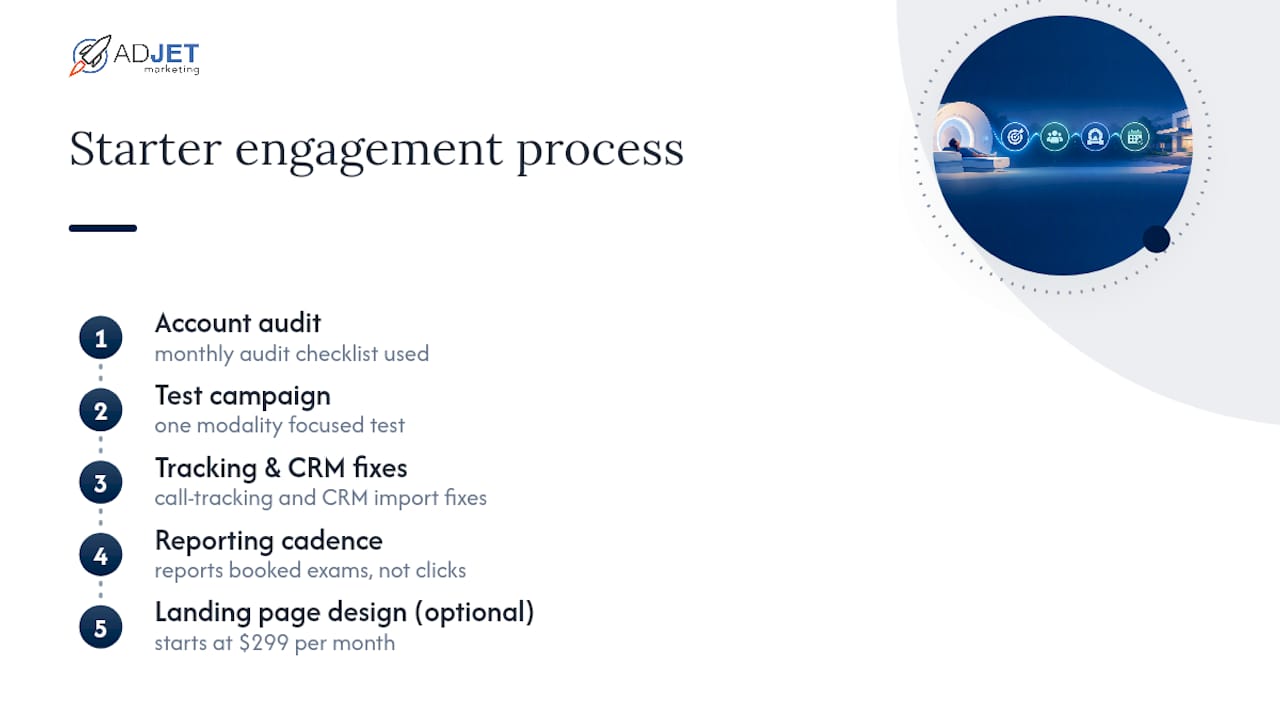
A typical starter engagement looks like an account audit, a test campaign focused on one modality, tracking and CRM import fixes, and a reporting cadence that shows booked exams, not just clicks. If your landing pages need rebuilding to match that campaign structure, custom landing page design starts at $299 per month under the Starter Plan. If you’re ready to have someone else own the account structure, targeting, and tracking setup, start with an audit through Google Ads management services.
This article is general information, not a substitute for advice from a qualified doctor. Consult a qualified healthcare professional about your own circumstances before acting on anything here.
Sources
- Hhs
- About importing call conversions – Google Ads Help
- Medical Imaging Industry Marketing Benchmarks 2026
FAQ
Is $20 a Day Good for Google Ads for an Imaging Center?
A modest daily budget is a workable starting point for testing one modality in a smaller market, but it rarely covers enough clicks to gather reliable conversion data given imaging keyword CPCs running $18.50 to $45.00. Most imaging centers need a larger daily budget once they expand beyond a single test campaign to multiple service lines.
What Is an Imaging Center?
An imaging center is a medical facility that performs diagnostic scans such as MRI, CT, ultrasound, and mammography, typically without the overnight care or emergency services of a hospital. Patients are usually referred by a physician and schedule appointments directly with the center.
How Do I Access the Google Ads Healthcare Advertising Application?
You apply through Google’s healthcare-related advertising troubleshooter, which reviews your business and ad content before approving personalized health advertising. Google requires this application for certain medical advertisers because it restricts ads based on sensitive health information.
How Much Does Google Ads Pay Per 1,000 Views?
Google Ads doesn’t pay advertisers for views. That model applies to publishers running Google AdSense on their own content, not to businesses like imaging centers running search ads, where you pay per click rather than earn per impression.
How Much Does Adjetmarketing Charge for Google Ads Management?
Pricing for Google Ads Services isn’t published and depends on account complexity and ad spend, so current rates are available directly on the Adjetmarketing site. Landing page work tied to those campaigns starts at $299 per month under the Starter Plan.