









Real estate landing page optimization is the practice of designing focused, conversion-driven pages that turn website visitors into qualified leads. Unlike a general website, a dedicated landing page removes distractions and guides the visitor toward one action: submitting their contact information. When done correctly, this single focus is what separates agents generating 20 leads a week from those getting 2. This guide covers the core tactics for how to optimize landing pages real estate professionals use in competitive markets, including headline structure, form design, trust signals, mobile performance, and SEO alignment.
What are the essential elements of a high-converting real estate landing page?
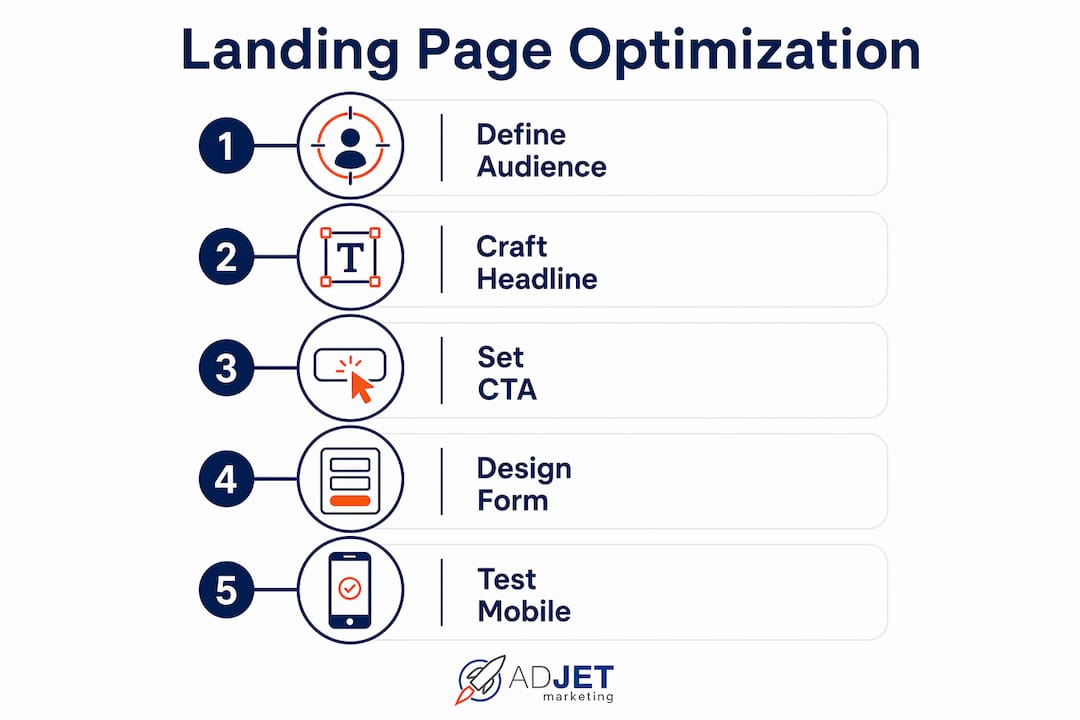
Effective real estate landing pages focus on a single audience, a single offer, and a single call-to-action. Overloading a page with multiple goals splits visitor attention and reduces conversions. Every design decision should serve one purpose: moving the visitor toward the form.
Headline and value proposition
Your headline is the first thing a visitor reads. A good landing page headline communicates your core value in five seconds or less. If a visitor cannot understand what you offer in that window, they leave. Strong real estate headlines are specific: “See Every Home Listed in Austin Under $450,000 Before Anyone Else” outperforms “Find Your Dream Home” every time.

Your value proposition sits directly below the headline. It answers the question: “Why should I give you my information?” For sellers, this might be a free home valuation. For buyers, it could be early access to off-market listings.
Call-to-action, social proof, and visual hierarchy
The CTA button is where conversion happens. Use action-oriented text tied to the offer: “Get My Free Home Value” beats “Submit” by a wide margin. Social proof placed near the CTA increases visitor trust and conversions. Placement matters as much as the existence of social proof. A five-star Google review directly above your form button does more work than a testimonials section buried at the bottom of the page.
A clean layout with white space and clear visual hierarchy keeps visitors focused and increases time on page. Good design guides the eye from headline to value proposition to form without friction. Avoid sidebars, navigation menus, and outbound links that pull visitors away from the conversion path.
Pro Tip: Remove your site’s main navigation menu from landing pages. Every extra link is an exit ramp. Pages without navigation menus consistently outperform those that include them.
Page speed and mobile design
Page speed is a conversion factor, not just a technical detail. A page that loads slowly loses visitors before they read a single word. Compress images, use a content delivery network, and minimize third-party scripts to keep load times under three seconds.
How can real estate professionals optimize lead capture forms?
Form design is where most real estate landing pages fail. Agents ask for too much information upfront, which creates friction and drives visitors away. The goal is to collect enough data to qualify the lead without scaring them off before they submit.
The multi-step form approach
Multi-step forms starting with a single, low-friction question increase completion rates by building micro-commitments. Each small “yes” makes the next step feel easier. A buyer-focused form might start with “Are you looking to buy or sell?” before asking for a name and phone number.
Here is a proven field order for real estate lead capture forms:
- Start with intent. Ask “Are you buying, selling, or both?” This is low-stakes and gets the visitor engaged.
- Qualify with budget or timeline. “What is your target price range?” or “When are you hoping to move?” filters serious leads from casual browsers.
- Request location preference. Neighborhood or ZIP code narrows the lead for your follow-up.
- Collect contact information last. Name, email, and phone number come after the visitor is already invested in the process.
Progressive profiling works because visitors feel they are answering questions relevant to their search, not filling out a generic form. This approach also improves lead quality because the answers you collect help you prioritize follow-up.
Pro Tip: Never label your CTA button “Submit.” Replace it with something specific to the offer: “Show Me Available Homes” or “Get My Free Valuation.” This single change can meaningfully lift form completion rates.
Common form mistakes to avoid
Avoid long legal disclaimers directly above the form button. They create hesitation at the worst possible moment. Keep any required disclosure short and place it below the button in small, clean text. Also avoid asking for a phone number without explaining why you need it. A simple line like “We’ll call to confirm your preferences” reduces abandonment.
Connect your form to a CRM like Follow Up Boss or kvCORE so leads receive an automated response within minutes. Speed of follow-up is one of the strongest predictors of lead conversion in real estate.
Which visual and content strategies build trust on real estate landing pages?
Trust is the single biggest barrier between a visitor and a form submission. Homeowners often treat a home valuation request as a low-risk curiosity exercise. Your landing page needs to meet them at that mindset and build confidence gradually, not push for an immediate commitment.
Social proof and local credibility
The most effective trust signals in real estate are local and specific. Generic five-star ratings feel less credible than a testimonial that names a neighborhood: “Felix helped us sell our Plano home in 11 days at $15,000 over asking.” Real agent photos outperform stock images. Video testimonials outperform text testimonials.
Live review widgets that pull current ratings from Google Business Profile or Zillow increase trust more than static testimonials. Dynamic social proof signals authenticity because visitors can see the reviews are real and recent.
| Trust Element | Placement | Impact |
|---|---|---|
| Video testimonial | Above the fold or near CTA | High: builds personal connection |
| Live Google review widget | Near the form | High: signals authenticity |
| MLS or NAR logo | Header or near CTA | Medium: establishes professional credibility |
| Agent headshot with bio | Near the headline | Medium: humanizes the page |
| Neighborhood statistics | Body copy | Medium: demonstrates local expertise |
Property visuals and copy clarity
High-quality property photos and drone footage increase time on page. For luxury listings, 3D virtual tours from Matterport reduce bounce rates by giving remote buyers a reason to stay. Copy should read at a clear, accessible level. Avoid industry jargon like “motivated seller” or “turnkey property” without explanation.
High-value lead magnets such as neighborhood market reports or early access to new listings encourage form submissions. Offering something tangible in exchange for contact information shifts the dynamic from “give us your data” to “get something useful.”
How does mobile-first design improve real estate landing page performance?
Over 65% of US real estate searches happen on mobile devices. That statistic means your landing page must perform on a 390-pixel screen before you worry about desktop. Mobile-first design is not a bonus feature. It is the baseline.
Mobile UX and technical performance
Mobile-first real estate landing pages follow these principles:
- Thumb-friendly CTAs. Buttons should be at least 44 pixels tall and centered on the screen, not tucked into a corner.
- Single-column layouts. Multi-column designs break on small screens and confuse the visual hierarchy.
- Fast-loading images. Use WebP format and lazy loading so images load only when the visitor scrolls to them.
- Short, tappable forms. On mobile, every extra field costs you completions. Limit forms to four fields maximum on the first step.
- Click-to-call buttons. Mobile visitors convert faster when they can call directly from the page without copying a phone number.
Pro Tip: Test your landing page on a real phone, not just a browser emulator. Emulators miss real-world issues like font rendering, tap target spacing, and scroll behavior that affect actual visitors.
SEO integration and message match
Real estate landing pages built for paid traffic also benefit from local SEO signals. Target specific neighborhoods, ZIP codes, and school districts in your page title, meta description, and body copy. Relevant terms like walkability scores, HOA fees, and property tax rates attract organic visitors with high purchase intent.
Message match between your ads and landing page reduces bounce rates. If your Google Ad says “Homes for Sale in Frisco TX Under $500K,” your landing page headline must reflect that exact promise. A mismatch between the ad and the page creates confusion and drives visitors away immediately. Track performance through Google Analytics 4 and run A/B tests on headlines, CTA text, and form length using tools like Google Optimize or VWO to find what works for your specific audience.
Key takeaways
A focused, mobile-ready real estate landing page with clear social proof, a single CTA, and a multi-step form is the most reliable structure for generating qualified leads.
| Point | Details |
|---|---|
| Single CTA per page | One focused offer and one action prevents visitor confusion and improves conversions. |
| Multi-step forms increase completions | Start with low-friction questions before asking for contact information to build commitment. |
| Social proof placement matters | Place testimonials and review widgets directly near the CTA button, not at the bottom of the page. |
| Mobile-first is non-negotiable | Over 65% of real estate searches happen on mobile, so design for small screens first. |
| Message match reduces bounce | Your landing page headline must mirror the exact promise made in your ad or email. |
What I’ve learned from building real estate landing pages that actually convert
After working with real estate agents across competitive markets, the pattern I see most often is this: agents spend money on Google Ads or Facebook campaigns and send traffic to their homepage. The homepage has navigation, multiple offers, a blog, and a contact form buried three scrolls down. The traffic arrives, gets confused, and leaves. The agent concludes that paid ads do not work.
The real problem is the destination, not the traffic source.
The agents who see consistent lead flow share one habit: they treat every campaign as a separate conversation. A campaign targeting first-time buyers in a specific ZIP code goes to a page built only for that buyer, in that area, with that offer. Nothing else. That level of specificity is what makes a landing page design worth the investment.
I also see agents underestimate how much trust matters at the top of the funnel. A seller visiting a home valuation page is not ready to sign a listing agreement. They are curious. The page’s job is to answer that curiosity and earn the next conversation, not close the deal. Agents who understand this build pages that feel helpful rather than pushy, and their lead quality reflects it.
The other mistake I see regularly is treating a landing page as a one-time project. The agents generating the most leads test continuously. They change one element at a time, measure the result, and keep what works. A headline test that runs for 30 days and improves form completions by 15% compounds over a year into a significant number of additional leads. That is not a minor improvement. It is the difference between a slow month and a strong pipeline.
— Felix
How Adjetmarketing helps real estate professionals generate more leads
Real estate agents come to Adjetmarketing after months of inconsistent lead flow from campaigns that send traffic to pages that were never built to convert. Our team builds and manages high-converting landing pages and full Google Ads campaigns designed specifically for real estate lead generation. We handle the technical setup, the copy, the form integration, and the ongoing testing so you can focus on closing deals. If you want to know what your current pages are leaving on the table, our SEO and conversion services include a full landing page audit as part of our onboarding process. Contact Adjetmarketing to schedule a consultation and get a clear picture of where your leads are going.
FAQ
What makes a good real estate landing page?
A good real estate landing page has one clear offer, one CTA, a benefit-driven headline, and social proof placed near the form. Pages that focus on a single audience and goal consistently outperform pages with multiple offers or navigation menus.
How many fields should a real estate lead capture form have?
Start with one to two questions in the first step, then collect contact information in the second step. Multi-step forms that build micro-commitments produce higher completion rates than long single-page forms.
Why use landing pages for real estate instead of a website homepage?
A homepage serves multiple audiences and goals. A landing page serves one visitor, one offer, and one action. That focus is what produces measurable lead generation results from paid and organic traffic.
How does mobile design affect real estate lead conversion?
Over 65% of real estate searches happen on mobile devices, so a page that loads slowly or displays poorly on a phone loses the majority of potential leads before they read your offer.
How often should I test and update my real estate landing pages?
Test one element at a time on a 30-day cycle. Start with your headline, then your CTA button text, then your form length. Continuous testing compounds into meaningful lead volume improvements over time.
Recommended
- What Landing Pages Do Top Realtors Use? | Convert More Clicks Into Clients – AdJet Digital Marketing & Google Partner Agency | SEO Development Google Ads Social
- What’s The Best Way To Get Real Estate Leads? | 10 Scalable Lead Gen Hacks – AdJet Digital Marketing & Google Partner Agency | SEO Development Google Ads Social
- Real Estate Website Design That Actually Converts Buyers
- How To Get High-quality Real Estate Leads Online