









Medical clinics pour thousands of dollars into Google Ads every month and walk away with a flood of unqualified inquiries, sky-high cost per lead, and a scheduling team chasing people who never intended to book. The problem is rarely the platform. It is almost always a misaligned strategy. This guide gives you a structured, field-tested framework for optimizing your clinic’s Google Ads campaigns from the ground up, covering goal selection, tracking setup, bidding alignment, and ongoing iteration so you generate more booked appointments and fewer wasted clicks.
Table of Contents
- Get your foundations right: Mapping your lead path and setting optimization goals
- Preparing your assets: Tracking, data signals, and creative essentials
- Executing your optimization: Aligning bidding and conversion signals
- Monitor, iterate, and troubleshoot: Using reporting and signals for long-term success
- Why most clinics sabotage their Google Ads (and how to avoid it)
- Supercharge your clinic’s lead generation with expert Google Ads help
- Frequently asked questions
Key Takeaways
| Point | Details |
|---|---|
| Map your lead journey | Clarify your path from ad click to booked appointment so you can optimize the right stage. |
| Choose conversion goals wisely | Align every conversion goal with meaningful outcomes to boost lead quality and ROI. |
| Set up tracking and assets | Accurate data and compelling creative assets are vital for Google’s automation to work. |
| Iterate with discipline | Troubleshoot systematically, avoid constant goal changes, and focus on steady improvement. |
| Expert help accelerates growth | Partnering with professionals can help your clinic achieve better lead generation faster. |
Get your foundations right: Mapping your lead path and setting optimization goals
With the problem defined, we begin at the root: laying the right groundwork in your account before touching a single campaign setting.
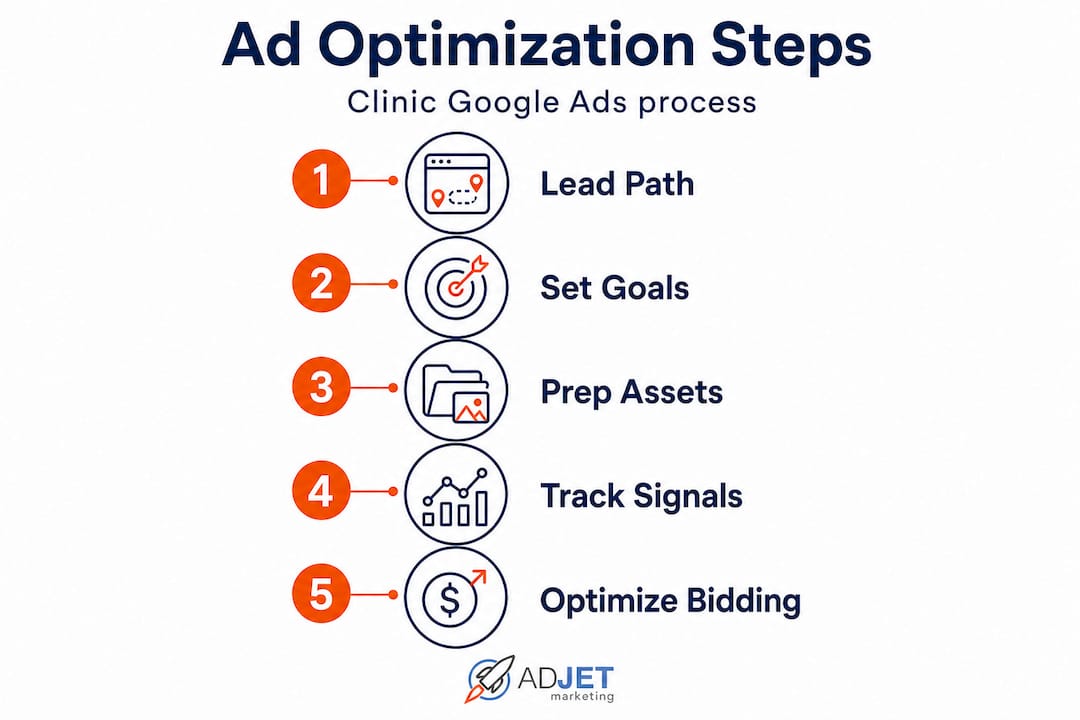
Most clinic owners jump straight to adjusting bids or writing new ad copy when results disappoint. That instinct skips the most important question: what exactly are you asking Google’s algorithm to optimize for? The answer shapes everything downstream.
Start by mapping your entire patient acquisition path. A typical medical lead journey looks like this:
- Ad click: A prospective patient sees your ad and visits your landing page.
- Form fill or call: They submit a contact form or call your front desk.
- Qualified lead: Your team confirms the person is a genuine candidate for your service.
- Booked consultation: A specific appointment is scheduled.
- Converted patient: The patient shows up and receives care.
Each stage is measurable, and each one represents a different conversion goal. The stage you choose to optimize for tells Google’s automation what kind of person to find more of.
| Conversion goal | Optimization impact | Best for |
|---|---|---|
| Page visit | Maximizes traffic volume, low quality control | Brand awareness only |
| Form submission | Mid-funnel, moderate quality | Early-stage campaigns with high volume |
| Qualified lead | High-quality signal, slower data accumulation | Established campaigns with CRM integration |
| Booked appointment | Strongest ROI signal, requires tracking setup | Mature campaigns with reliable call/form tracking |
According to Google’s lead-gen optimization mechanics, you should map your lead-to-sale journey, choose conversion goals that match the stage you want to optimize, and avoid mixing goals across stages for bidding optimization. That last point is critical and often ignored.
Warning: If you add both “form submission” and “booked appointment” as conversion actions in the same bid strategy, you are giving Google conflicting signals. The algorithm cannot tell which outcome matters more, so it optimizes for whichever happens most frequently, which is almost always the lower-quality action.
Pro Tip: Align every chosen conversion action with a real business outcome. A form fill only counts if your team actually calls it a lead. A booked appointment only counts if the patient shows up. Work backward from revenue, not forward from clicks.
Skipping this step does not just slow you down. It actively limits every optimization you attempt later. If your conversion goals are wrong, your bidding strategy, your audience signals, and your creative testing all build on a broken foundation. You can review more healthcare Google Ads tips to see how goal selection plays out across different clinic types, and the same principles apply whether you are running Google Ads for dental practices or a pain management clinic.
Preparing your assets: Tracking, data signals, and creative essentials
Once your lead path and goals are clear, the next step is setting yourself up for success by preparing all your assets before a single dollar is spent.

Google Ads automation, especially Performance Max, is only as smart as the data you feed it. A campaign with incomplete tracking, missing creative assets, or inconsistent conversion signals will underperform no matter how well you configure the bidding strategy.
Here are the must-have tracking and data signals every medical clinic needs in place before launching or relaunching a campaign:
- HIPAA-safe conversion tracking: Standard Google tag implementations can capture protected health information (PHI) inadvertently. Use a HIPAA-compliant Google Ads setup that avoids passing diagnosis codes, appointment types, or any patient identifiers into your tag parameters.
- Call reporting: Track calls from ads and from your website separately. Calls that last longer than 60 to 90 seconds are typically a reliable proxy for a qualified inquiry.
- Form completions: Fire a conversion event only on the confirmation page, not on the form page itself. This prevents counting incomplete submissions.
- CRM integration: If your practice management software or CRM supports it, import offline conversions to tell Google which leads actually became patients.
Creative assets matter just as much as tracking. Here is how different asset types contribute across campaign formats:
| Asset type | Best campaign fit | Primary value |
|---|---|---|
| Search headlines and descriptions | Search campaigns | Intent capture, direct response |
| Display images and banners | Display, Performance Max | Awareness, retargeting |
| Short-form video (15 to 30 sec) | Performance Max, YouTube | Trust building, procedure education |
| Sitelinks and callouts | All campaign types | Credibility, click-through rate |
| Landing page content | All campaign types | Conversion rate, Quality Score |
Performance Max lead gen optimization works best when you provide the right inputs: strong data signals, clearly defined conversion actions, and a full library of creative assets. When any of these are missing, the algorithm fills the gap with guesswork, and guesswork in a medical campaign is expensive.
Pro Tip: Never launch a Performance Max campaign without at least three to five high-quality images, two to three headline variations, one short video, and clean conversion tracking already verified in Google Tag Manager. Launching incomplete is worse than not launching at all because you burn budget during the learning phase on bad data.
Proper preparation also makes future reporting and troubleshooting far easier. When something goes wrong, and it will, you need clean historical data to diagnose the issue. Clinics that skip this step often cannot tell whether a performance drop came from a bidding change, a tracking error, or a seasonal shift in demand. You can see how these principles apply specifically to medspa booking strategies where creative assets and tracking precision directly affect appointment volume.
Executing your optimization: Aligning bidding and conversion signals
With tracking and assets in place, it is time to execute high-impact optimizations that move the needle on lead quality and cost efficiency.
The single biggest lever most clinics have not pulled is aligning their bid strategy directly to a qualified outcome rather than a top-funnel action. Google’s algorithm learns from your conversion goals and the consistency of your lead path, so the biggest wins usually come from aligning conversion signals to qualified outcomes rather than optimizing for earlier engagement.
Here is a step-by-step process for implementing qualified conversion optimization:
- Define your trigger event. Decide what action a prospective patient must take to be counted as a qualified lead. This might be a call lasting more than 90 seconds, a form submission confirmed by your front desk, or a CRM status change to “appointment booked.”
- Configure the conversion goal. Set this trigger as your primary conversion action in Google Ads. Mark all other actions, such as page views or soft form fills, as secondary conversions so they inform reporting without influencing bidding.
- Choose your smart bidding strategy. Use Maximize Conversions or Target CPA (cost per acquisition) linked specifically to your qualified lead goal. Do not use Target ROAS unless you have revenue data flowing back into Google Ads.
- Allow the learning period. Google’s algorithm needs at least 30 to 50 conversions in a 30-day window to exit the learning phase reliably. Resist the urge to make changes during this window.
- Review and adjust the target. After the learning period, compare your actual cost per qualified lead against your target. Make incremental adjustments of no more than 10 to 15 percent at a time.
Stat to know: Clinics that shift their primary conversion goal from form submissions to qualified leads or booked appointments typically see a 30 to 50 percent improvement in lead quality within 60 days, even when total lead volume temporarily decreases.
Pro Tip: Avoid “goal sprawl.” Every additional conversion action you add to a bid strategy dilutes the signal. Pick one goal per campaign that represents the lead stage you care most about, and stick with it long enough to generate meaningful data.
Consistency in conversion settings is what allows Google’s automation to improve over time. Every time you change your conversion goal or reset your bid strategy, you restart the learning phase. This is one of the most common and costly mistakes we see in clinic accounts. For more detail on how this applies across specialties, explore our guides on Google Ads for dental clinics, healthcare PPC tips, and Google Ads for therapists.
Monitor, iterate, and troubleshoot: Using reporting and signals for long-term success
Optimizations are only as good as their ongoing verification. Here is how successful clinics iterate and improve over time without chasing every fluctuation.
Routine checkups should focus on these key signals and events:
- Conversion totals: Are you hitting enough conversions to keep the algorithm out of the learning phase?
- Lead quality surveys: Ask your front desk team weekly whether the calls and forms coming in match your target patient profile.
- Cost per qualified lead: Track this separately from cost per form fill. They often diverge significantly.
- Asset performance ratings: Google labels assets as “Low,” “Good,” or “Best.” Replace “Low” assets regularly.
- Search term reports: Review which queries are triggering your ads and add negative keywords for irrelevant searches.
When performance drops, the root cause usually falls into one of a few categories:
| Root cause | Symptoms | Recommended response |
|---|---|---|
| Conversion tracking error | Sudden drop in reported conversions | Audit tags in Google Tag Manager, verify confirmation page fires |
| Learning phase disruption | Erratic CPA, inconsistent volume | Pause changes for 2 to 3 weeks, let algorithm stabilize |
| Asset fatigue | Declining click-through rate | Refresh images, test new headlines, add video |
| Keyword mismatch | High impressions, low conversions | Review search terms, tighten match types, add negatives |
| Seasonal demand shift | Volume drop without tracking issues | Compare year-over-year data, adjust budget expectations |
As Google’s Performance Max guidance makes clear, when outcomes drop, you should first check whether conversions and valuable signals are correct, then iterate on asset quality and variety, and allow learning time rather than constantly changing targets.
“Iterate on assets, not just targets.” This is the principle that separates clinics with steadily improving results from those that spin their wheels making bid adjustments that never stick.
One of the most common mistakes we see is over-adjusting targets in response to a two-week dip. A single bad week can reflect a holiday, a local event, or a tracking glitch. It rarely signals that your entire strategy needs an overhaul. Give changes at least three to four weeks before drawing conclusions. For a broader view of how paid search compares to other channels for clinics, the analysis of Google Ads versus Meta Ads for medspas offers useful context on where each platform excels.
Why most clinics sabotage their Google Ads (and how to avoid it)
Here is an uncomfortable truth we see play out repeatedly: most clinics that struggle with Google Ads are not victims of a bad platform. They are victims of their own impatience and misaligned priorities.
The pattern is predictable. A clinic launches a campaign optimized for form submissions because it is the easiest thing to track. Volume looks decent for a few weeks. Then the owner notices the leads are not converting into patients, so they switch to a broader match type to get more volume. Cost per lead drops, but quality drops further. They add more conversion goals to capture more data. The algorithm gets confused. Results deteriorate. They conclude Google Ads does not work for their specialty.
Every step in that sequence was a rational-seeming response to a real problem. And every step made things worse.
The clinics that consistently win with Google Ads share one trait: discipline. They choose one qualified conversion goal and defend it. They resist the urge to change bid strategies every two weeks. They use telehealth keywords strategy research to filter out low-intent traffic before it wastes budget, rather than broadening reach in hopes of finding hidden volume.
They also understand that Google’s automation is genuinely powerful, but it needs time and clean signals to work. Constantly resetting the learning phase is like hiring a new employee every three weeks and wondering why nothing gets done. The algorithm needs stability to improve.
The most effective clinic marketers we work with treat Google Ads like a long-term investment, not a short-term faucet. They make incremental changes, document every adjustment, and measure results over 30 to 60 day windows. That patient, structured approach compounds over time in ways that frantic campaign managers never achieve.
Supercharge your clinic’s lead generation with expert Google Ads help
Once you have mastered core optimizations, working with specialists accelerates and secures your clinic’s growth in ways that are difficult to replicate internally. At AdJet Marketing, we work exclusively with medical clinics, aesthetic practices, mental health providers, and pain management centers to build Google Ads systems that generate real, bookable patient leads. Our Google Ads services are built around the same framework outlined in this guide: proper goal alignment, HIPAA-safe tracking, disciplined bidding, and structured iteration. Whether you need a full campaign build or an audit of your existing account, we bring the data and the experience to move your numbers. You can also explore our step-by-step guide for therapists or learn more about why marketing matters in healthcare to deepen your strategy. Contact us to request a consultation and start turning your ad spend into scheduled appointments.
Frequently asked questions
What is the best Google Ads conversion goal for medical lead generation?
Optimizing for qualified leads or booked appointments drives better ROI than focusing on simple engagement actions. As Google’s lead-gen guidance states, you should choose conversion goals that match the stage you want to optimize in your lead-to-sale journey.
How can I tell if my Google Ads campaign is working?
Monitor cost per qualified lead, lead volume trends, and the accuracy of your conversion tracking on a weekly basis. Performance Max reporting recommends iterating based on asset and bid-strategy insights rather than surface-level metrics like impressions or clicks alone.
What should I do if Google Ads lead quality drops suddenly?
First verify that your conversion goals and valuable signals are still recording correctly, then review asset performance and allow the algorithm time to stabilize before making major changes. Google’s Performance Max guidance specifically advises iterating on asset quality and variety rather than immediately adjusting targets.
Do I need HIPAA-compliant tracking for Google Ads medical campaigns?
Yes, all clinics must ensure their tracking setup does not capture or transmit protected health information through ad tags or analytics tools. Standard Google tag configurations can inadvertently collect PHI, so a compliant implementation is required before launching any campaign.
Is campaign type important for optimizing medical clinic results?
Performance Max provides powerful cross-channel automation, but it only works well when you supply complete creative assets, clean conversion data, and clearly defined goals. Google’s own documentation confirms that the right inputs, including data signals, conversion actions, and creative assets, are what determine whether Performance Max delivers strong lead-gen results.