









Most businesses don’t struggle with marketing because they lack effort. They struggle because they’re getting activity without results: traffic that never calls, ad spend with no return, and a pipeline that stays dry. When you decide to hire a digital marketing agency for leads, the difference between a good outcome and a wasted budget often comes down to how prepared you are before you sign anything. This guide walks you through everything: what to clarify before you start, how to evaluate agencies honestly, how to structure the engagement, and how to tell if it’s working.
Table of Contents
- Key Takeaways
- What to prepare before hiring a digital marketing agency for leads
- How to find and evaluate agencies specialized in lead generation
- The hiring and onboarding process, step by step
- Common mistakes that hurt lead generation results
- Realistic timelines and outcomes to expect
- My honest take after years of watching these partnerships play out
- How Adjetmarketing approaches lead generation for your business
- FAQ
Key Takeaways
| Point | Details |
|---|---|
| Prepare before you search | Define your lead goals, ideal customer, and budget before contacting any agency. |
| Vet for lead-specific experience | Choose an agency with proven results in your industry, not just general digital marketing. |
| Start small, then commit | Test alignment with a scoped deliverable before signing a long-term retainer. |
| Track revenue metrics | Focus on qualified leads and pipeline impact, not clicks or impressions. |
| Protect yourself contractually | Month-to-month agreements create accountability and reduce risk for your business. |
What to prepare before hiring a digital marketing agency for leads
Before you contact a single agency, you need clarity on three things: what you actually want, who you want to reach, and what you can spend. Most bad agency relationships start before the contract is signed, because the client entered the process without defined goals.
Define your lead generation objective clearly. “More leads” is not a goal. “20 qualified consultation requests per month from homeowners in the Dallas metro” is a goal. Be specific about lead volume, lead quality, geography, and what a conversion looks like for your business. This matters because a digital agency for lead generation will structure your campaigns, landing pages, and targeting around these parameters.
Know your ideal customer profile. Think beyond demographics. What problem are they trying to solve? What search terms would they use? How quickly do they make decisions? Agencies that specialize in lead generation will ask you these questions. If you don’t have answers, your campaigns will lack the targeting precision needed to compete.
Understand how agency pricing works. Agency pricing models vary widely, with monthly retainers ranging from $2,000 to $25,000 depending on channel mix, scope, and vertical. Here’s a breakdown of the most common structures:
| Pricing Model | Typical Range | Best For |
|---|---|---|
| Monthly retainer | $2,000 to $10,000+ | Ongoing SEO, paid ads, full funnel |
| Project-based fee | $1,500 to $8,000 | Audits, website builds, one-time campaigns |
| Per-lead pricing | $30 to $200+ per lead | Volume-focused campaigns with clear CPL targets |
| Commission-only | 10% to 25% of deal value | Rarely used; creates misaligned incentives |
Commission-only models tend to misalign incentives and increase upfront delivery costs for agencies. Reputable agencies avoid them. If you see one offered, treat it as a red flag.
Finally, confirm your internal readiness. You need a CRM or some form of lead tracking, someone who will follow up with leads promptly, and a process for reporting back to the agency what happened to those leads. Agencies can only optimize what gets measured.

How to find and evaluate agencies specialized in lead generation
There is no shortage of agencies claiming to specialize in lead generation. The challenge is identifying which ones can actually deliver in your specific market and industry.
Where to start your search. Referrals from trusted business connections remain the most reliable starting point. Beyond that, review platforms and Google searches for agencies in your vertical will surface candidates. When evaluating top marketing agencies for businesses in specialized sectors like healthcare, legal, or home services, prioritize firms with documented experience in your space, not just case studies from unrelated industries.
Questions to ask every agency before deciding:
- What industries have you generated leads for in the last 12 months?
- What channels do you use for lead generation, and how do you determine the right mix?
- Can you share two or three case studies with specific lead volume and cost-per-lead data?
- How do you define a qualified lead, and how do you track lead quality over time?
- What does your reporting look like, and how often will we meet to review results?
- Do you require a long-term contract, or do you offer month-to-month terms?
Agency transparency and measurable outcomes are among the most critical factors when vetting candidates. If an agency can’t explain what tools they use to track results, or can’t show you a past campaign with clear data, move on.
Red flags to watch for. Be cautious of agencies that lead with vanity metrics: impressions, reach, and click-through rates are not lead generation results. Also watch for one-size-fits-all packages that don’t account for your specific audience or funnel. The best digital marketing firms build their recommendations around your goals, not around a prebuilt service tier.
Pro Tip: Ask specifically how they handle leads that don’t convert. An agency that has a process for reviewing lead quality and adjusting campaigns accordingly is far more valuable than one that just sends you a traffic report.
If you’re in healthcare, the evaluation process has additional layers. Working with a Google Partner agency means the team has demonstrated proficiency with Google Ads and meets ongoing performance requirements. That matters when your ads are for medical services.
The hiring and onboarding process, step by step
Once you’ve identified a shortlist of candidates, the way you engage them matters as much as who you choose.
-
Start with a discovery call. Use this to assess communication style, how well they listen, and whether they ask smart questions about your business. An agency that talks more than it listens in the first call will do the same throughout the engagement.
-
Request a scoped initial deliverable. Before committing to a full retainer, ask for a paid audit, a campaign proposal, or a small test project. Starting with narrow deliverables improves alignment and gives you real evidence of how the agency works. This is not about being cheap; it’s about earning trust on both sides before making a larger commitment.
-
Negotiate clear contract terms. Define deliverables in writing. Specify what channels will be managed, what ad spend is included versus billed separately, who owns the ad accounts and website assets, and what happens if the relationship ends. Ownership of accounts and data is non-negotiable; always retain access.
-
Set KPIs before launch. Agree on specific metrics before campaigns go live. At a minimum, track cost per lead, lead volume, and lead-to-appointment or lead-to-sale conversion rate. Revenue-connected metrics like Sales Qualified Leads and pipeline impact are far more telling than surface-level engagement data.
-
Prepare your internal team. Your sales team or front desk staff needs to know leads are coming and how to handle them. Slow follow-up is one of the most common reasons lead generation campaigns underperform, and it has nothing to do with the agency.
-
Agree on a reporting cadence. Monthly reporting is a minimum. For paid campaigns, bi-weekly reviews let you catch problems earlier and optimize faster.
Pro Tip: Month-to-month agreements reduce your risk and create natural accountability checkpoints. If an agency resists short-term agreements entirely, ask why.
Common mistakes that hurt lead generation results
Even with the right agency in place, avoidable mistakes can undermine your results. Here’s what to watch for.
Focusing on the wrong metrics. Traffic is not leads. Leads are not revenue. Qualified leads and pipeline impact should be at the center of every performance conversation. If your agency’s monthly report is full of charts showing impressions and social reach but says nothing about how many leads converted, you have a reporting problem.
Ignoring lead quality. Not all leads are equal. A high lead volume with poor qualification is a drain on your sales team and your budget. Build a feedback loop where your team reports back on which leads were qualified and which were not. Your agency needs this data to adjust targeting and messaging.
Not disputing invalid leads. For businesses running Google Local Services Ads, this is a concrete, underused lever. Practitioners who systematically dispute bad leads within the 30-day window recover 10 to 20 percent of monthly ad spend. That’s a meaningful CPL reduction with zero budget increase. Your agency should be doing this as standard practice.
Here’s a practical comparison of what good versus poor agency performance looks like after 90 days:
| Performance Indicator | Signs It’s Working | Signs It’s Not |
|---|---|---|
| Lead volume | Steady increase month over month | Flat or declining without explanation |
| Lead quality | Leads match your ICP and convert | High volume, low qualification rate |
| Reporting | Data tied to revenue and pipeline | Impressions, clicks, and reach only |
| Communication | Proactive updates and honest reviews | Reactive, delayed, or vague responses |
| Account ownership | You have full access to all accounts | Agency controls access and data |
- Watch for agencies that redefine success after launch to match whatever results came in.
- If you consistently question whether leads are actually qualified, schedule a formal review with the agency, not just a casual mention in a monthly call.
- Disputing invalid LSA leads is free and takes minutes when done systematically. If your agency isn’t doing it, ask them to start.
Realistic timelines and outcomes to expect
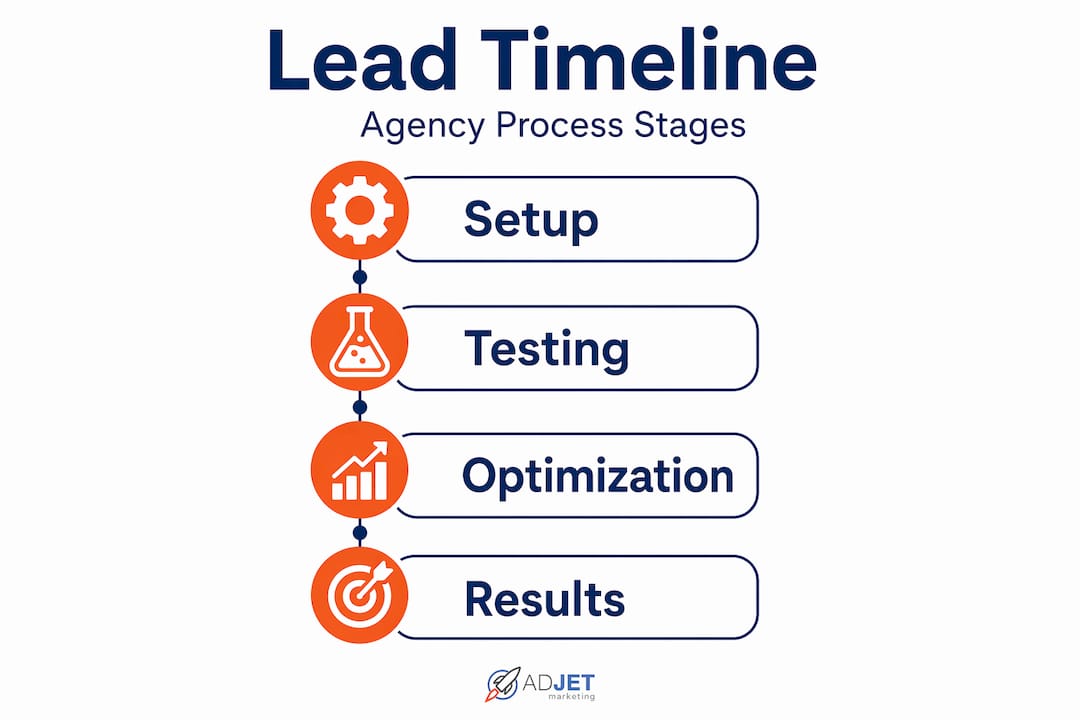
One of the most common sources of frustration in agency relationships is misaligned expectations around timing. Paid ads can generate leads faster than SEO, but even paid campaigns need 60 to 90 days of learning and optimization before performance stabilizes.
During the first month, the focus is on account setup, audience testing, and early data collection. You may see some leads, but this is not the period to judge performance. Months two and three are when meaningful optimization begins, bidding strategies mature, and you start seeing real cost-per-lead data.
For context on benchmarks: Google Local Services Ads average $55.08 per lead, compared to $90.92 for standard Google Search ads, with a 43.5% booked appointment rate for LSA leads. These figures vary by vertical, location, and competition, but they give you a realistic starting point for planning.
Over time, iterative optimization lowers cost per lead while improving lead quality. That’s the compounding benefit of a sustained engagement: the data from month three makes month six significantly more efficient. Expect steady improvement, not overnight results. If an agency promises fast wins without any discussion of the learning period, that’s a sign they’re selling, not advising.
My honest take after years of watching these partnerships play out
I’ve seen businesses with real growth potential hand over their marketing budgets to agencies that sent back polished reports full of meaningless numbers. I’ve also seen the opposite: a modest budget combined with clear goals and an agency that communicated honestly, producing a consistent pipeline within four months.
What I’ve learned is that the client’s preparation determines as much as the agency’s skill. Businesses that come in with a defined customer profile, a working CRM, and a realistic budget consistently get better outcomes. The ones that struggle often treat the agency as a magic solution and then disengage from the process entirely.
I’m also skeptical of long-term contracts when there’s no established track record. A 12-month commitment to an unproven agency removes accountability. Month-to-month structures force both parties to stay focused on results, which is exactly the pressure you want in a lead generation context.
The other thing I’d push back on is the idea that affordable lead generation services always means low quality. Some of the most effective campaigns I’ve seen ran on modest budgets with precise targeting and strong landing pages. Budget matters less than focus. Know your numbers, hold the agency to revenue-connected metrics, and stay involved.
— Felix
How Adjetmarketing approaches lead generation for your business
At Adjetmarketing, we work with medical clinics, aesthetic practices, mental health therapists, home service businesses, and real estate professionals who need more than traffic. They need booked appointments and qualified inquiries. Our work combines Google Ads management, SEO, and high-converting website design into a performance-focused strategy built around your specific goals.
We use month-to-month agreements because we believe accountability should be built into the relationship, not removed by a long contract. Every campaign includes transparent reporting tied to lead volume, cost per lead, and conversion outcomes. Whether you’re reviewing healthcare marketing mistakes you want to avoid or ready to build your first lead generation campaign, we’re here to give you an honest assessment of what’s possible and what it will take to get there.
FAQ
How much does it cost to hire a lead generation agency?
Monthly retainers range from $2,000 to $25,000 depending on scope and vertical, with project-based and per-lead pricing available as alternatives. Cost per lead benchmarks vary significantly by channel and industry.
How long before a digital marketing agency generates results?
Most paid campaigns require 60 to 90 days of learning and optimization before producing stable, reliable lead volume. SEO takes longer, typically four to six months, before meaningful organic lead flow begins.
What metrics should I track to measure lead generation success?
Focus on qualified lead volume, cost per lead, and lead-to-sale conversion rate. Vanity metrics like clicks and impressions do not reflect actual pipeline performance and should not drive campaign decisions.
Should I sign a long-term contract with a lead generation agency?
Not until you’ve tested the relationship. Starting with month-to-month terms or a scoped project protects your budget and holds the agency accountable to delivering measurable results before any longer commitment is made.
What’s the difference between a lead generation agency and a general digital marketing agency?
A dedicated digital agency for lead generation structures every campaign around filling your pipeline with qualified prospects, whereas general agencies may focus more broadly on brand awareness, content, or social media presence without direct pipeline accountability.
Recommended
- Digital Marketing Strategies That Grow Real Estate Leads
- 10 Ways To Generate More Leads For My Manufacturing Business In 2025? “Turn Prospects Into Customers!” – AdJet Digital Marketing & Google Partner Agency | SEO Development Google Ads Social
- Digital Marketing Strategy Development – AdJet Digital Marketing & Google Partner Agency | SEO Development Google Ads Social