









Healthcare marketing ROI is the return you get after subtracting marketing spend from the revenue tied to patients who actually booked and kept their appointments, then dividing by that spend. Leads and impressions don’t count until someone shows up in the chair. The working benchmark most practices should aim for is a lifetime value to acquisition cost ratio near 3:1, and getting there requires joining your CRM or practice management system, your EHR, and call tracking data so the number reflects real revenue, not guesses.
TL;DR:
- Most healthcare practices should aim for a lifetime value to acquisition cost ratio near 3:1, which requires linking revenue data to actual booked visits.
- First-visit ROI often underestimates true value as lifetime patient potential can multiply revenue, especially for repeat-treatment clinics like med spas and behavioral health practices.
- Accurate attribution involves multi-touch tracking, CRM-EHR matching, and adjusting for non-incremental traffic, with at least 85% patient match rate and 80% call tracking coverage for reliability.
- Short-term metrics like cost per booked appointment and show rate are crucial for immediate campaign management, while lifetime value provides a comprehensive ROI view over time.
- Improving marketing ROI starts with fixing measurement infrastructure first, then focusing on short-term acquisition tactics, SEO, referral programs, and retention efforts.
Table of Contents
- Healthcare Marketing Roi Metrics: What To Pull From Your Systems
- How Do You Calculate Booked-And-Kept Healthcare Marketing Roi?
- Attribution And Tracking: Closing The Online-To-Offline Gap
- Dashboard And Reporting Cadence: Three Views, Three Audiences
- How To Improve Healthcare Marketing Roi: What Actually Moves The Number
- AdJet Marketing’s Playbook For Measuring And Improving ROI
- Case Studies: What Healthcare Marketing Roi Looks Like In Practice
- Where Clinics Go Wrong On Roi, And How To Fix It
- Get A Measurement Plan Built For Booked Appointments, Not Clicks
- Sources
- FAQ
Healthcare Marketing Roi Metrics: What To Pull From Your Systems
The formula itself is simple: (Revenue from attributed patients minus marketing spend) divided by marketing spend. The hard part isn’t the math. It’s getting revenue numbers that actually reflect booked-and-kept visits instead of raw form fills or ad clicks, a distinction Zocdoc’s guide to measuring healthcare marketing ROI treats as the foundation of any credible ROI number.
Two terms get used loosely and shouldn’t be. Return on marketing investment (ROMI) measures the profitability of a campaign after costs. Return on ad spend (ROAS) measures gross revenue against ad spend alone, with no cost accounting. A campaign can post a strong ROAS but a mediocre ROMI once you factor in staff time, no shows, and discounting. Clinics that report only ROAS to leadership tend to overstate performance.
Patient lifetime value (PLV) is where healthcare marketing ROI gets interesting compared to retail. A single visit might net $180 in collections, but if that patient returns for three follow ups a year over an average four year relationship, PLV can run into the thousands. Calculate it as average revenue per visit multiplied by average visits per year multiplied by average years retained.
The metrics that actually predict revenue, in order of how directly they map to booked appointments, are detailed in this partner perspective on SEO measurement that includes tools applicable to clinics:
- Cost per booked appointment: total channel spend divided by confirmed bookings, before show rate is applied
- New patient acquisition cost (nPAC): spend divided by new patients who complete a first visit
- Show rate: percentage of booked appointments that are kept, often the single biggest swing factor in real ROI
- Channel conversion rate: site visits or calls that convert to booked appointments, by source
Industry data on hospital and clinic campaigns shows average ROMI around 3.62:1, but the spread by service line is wide. A dermatology practice running elective cosmetic ads will post different numbers than a pain clinic dependent on physician referrals, so treat any single benchmark as a starting point, not a target that applies evenly across specialties.
How Do You Calculate Booked-And-Kept Healthcare Marketing Roi?
Start by picking your attribution window and your revenue basis before you touch a spreadsheet. A 30 day window works for elective services with quick decision cycles; specialty referrals often need 60 to 90 days. Decide whether you’re counting net collections or gross charges, and stay consistent, because switching mid-year makes trend lines meaningless.
Here’s the sequence we walk clinics through:
- Pull total campaign spend for the period, broken out by channel.
- Pull tracked bookings attributed to each channel through call tracking and UTM data.
- Apply your actual show rate to get kept appointments, not just booked ones.
- Multiply kept appointments by average first-visit revenue to get first-visit ROI.
- Multiply new patients by PLV to get lifetime ROI, which usually tells a very different story.
Pro Tip: Run both first-visit ROI and lifetime ROI side by side. A channel that looks weak on visit one revenue can be your best performer once PLV kicks in, especially for primary care and mental health where retention drives the real return.
Here’s a worked example. A med spa clinic spends $6,000 on Google Ads in a month and tracks 40 booked appointments from that spend. Average first-visit revenue is $220. First-visit revenue equals $6,600, and marketing spend was $6,000, so first-visit ROI is roughly 10%, barely break even. But average PLV for that clinic is $1,400 across repeat treatments over two years. Lifetime revenue on those 30 patients is $42,000 against the same $6,000 spend, an ROI north of 600%.
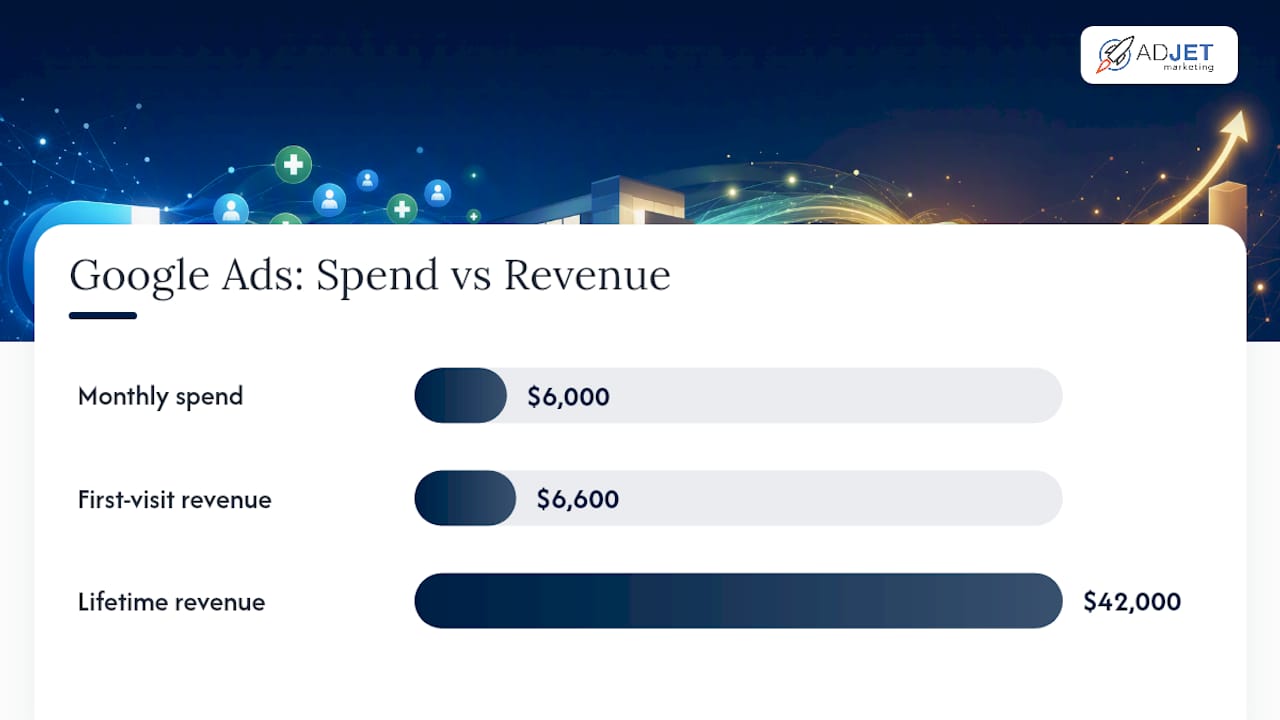
That gap is the whole point. A campaign that looks flat on day one revenue can be excellent once you account for retention, and a campaign that looks great on cost per lead can be a loser if show rate is low or patients never return.
Attribution And Tracking: Closing The Online-To-Offline Gap
Last-click attribution gives full credit to whatever channel a patient touched right before booking, usually branded search or a direct visit. That systematically undercounts the paid search ad, the review site, or the referral that started the journey weeks earlier. It also overcredits your own brand name, since patients who already decided to book with you will often just search your practice name last.
Closing that gap takes four pieces of instrumentation working together, not one silver bullet:
- UTM tagging on every paid, email, and social link so session data in Google Analytics ties back to a specific campaign
- Dynamic call tracking that swaps phone numbers by traffic source, since a large share of healthcare bookings still happen by phone
- An intake source field at the front desk, so staff ask “how did you hear about us” and log it in the system, catching conversions no pixel ever sees
- CRM-to-EHR patient matching, tying the person who clicked the ad to the person who showed up and paid
A reliable multi-touch setup generally needs above an 85% CRM-to-EMR match rate and 80% call tracking coverage to be trustworthy. Below that, you’re extrapolating from a small, possibly biased sample of your actual patient base.
Even with solid multi-touch data, branded search and physician referrals inflate reported numbers, because much of that traffic would have converted anyway. Adjusting for this non-incremental volume, sometimes with survey data or a market-level holdout test, is what turns a flattering ROMI number into one your CFO can trust, a point the hospital marketing ROI playbook makes clearly. If you’re running paid social alongside search, it’s worth reviewing how Meta pixel tracking intersects with HIPAA before you expand instrumentation, since patient-level tracking on social platforms carries its own compliance requirements.
Dashboard And Reporting Cadence: Three Views, Three Audiences
Weekly, monthly, and quarterly reporting shouldn’t repeat the same numbers at different intervals. Each tier answers a different question for a different audience, a structure Zocdoc’s ROI framework lays out clearly.
- Weekly operating view: bookings by channel, cost per booked appointment, and show rate, pulled straight from ad platforms and call tracking, meant for whoever runs the campaigns day to day
- Monthly performance view: nPAC, channel conversion rates, and early retention cohorts, meant for practice managers deciding whether to shift budget between channels
- Quarterly ROI rollup: PLV-adjusted revenue by channel with attribution adjustments applied, meant for ownership and finance
Present quarterly numbers with a confidence range rather than a single hard figure, especially for smaller clinics where sample sizes make month-to-month swings noisy. A channel showing a 15% drop in cost per booked appointment two months running is worth acting on. A single bad week from one referral source usually isn’t.
How To Improve Healthcare Marketing Roi: What Actually Moves The Number
Fix measurement before you touch budget allocation. This sounds backward to marketers eager to cut underperforming channels, but if your attribution is unreliable, you’ll cut the wrong one. The State of Healthcare Marketing 2026 report/2026%20State%20of%20Healthcare%20Marketing%20Report.pdf?hsLang=en) found most healthcare marketers can currently connect only 10 to 25% of spend to actual outcomes, which means most budget decisions right now are being made on incomplete information.
Once instrumentation is solid, here’s where we tell clinics to focus, roughly in order:
- Instrumentation first: call tracking, intake-source fields, CRM-EHR matching. Highest leverage, and it can be done in two to six weeks.
- Short-term acquisition: tightened Google Ads structure, landing pages built for a single conversion action, and call tracking layered on top so you can see what’s actually working within 30 to 60 days.
- Medium-term investment: SEO and referral programs that compound over 6 to 12 months and tend to raise PLV rather than just first-visit volume.
- Retention campaigns: recall reminders, follow-up sequences, and review requests that lift show rate and repeat visits, both of which move lifetime ROI more than any single acquisition channel.
Pro Tip: If your budget is tight, spend on instrumentation before you spend on more ads. A clinic running $5,000 a month with clean tracking will make better decisions than one running $15,000 a month blind.
The real trade-off is speed versus durability. Paid search gets you bookings this month. SEO and retention build a patient base that keeps generating revenue with no marginal ad spend two years from now. Most clinics need both running at once, just weighted differently depending on how urgently they need patients in the door versus how much runway they have to build. For a broader view of how channels fit together, our guide to digital marketing strategies for clinics covers the sequencing in more depth.
AdJet Marketing’s Playbook For Measuring And Improving ROI
Our sequence with new clients is consistent: instrument first, then attribute, then test, then scale. Skipping straight to scaling a campaign without solid tracking in place is the single most common mistake we see when clinics come to us after a bad experience with a previous agency.
A typical engagement runs like this:
- Weeks 1 to 3: audit existing tracking, install call tracking and intake-source capture, connect CRM/PMS data to reporting.
- Weeks 4 to 8: run campaigns with clean attribution in place, gather enough volume to trust the numbers.
- Days 60 to 90: deliver a KPI playbook with real cost-per-booked-appointment and PLV figures by channel, plus recommended reallocation.
That 90 day window mirrors what most clinics need to move from data gaps to confident decisions. Our own 90 day healthcare KPI playbook walks through the deliverables in more detail.
Case Studies: What Healthcare Marketing Roi Looks Like In Practice
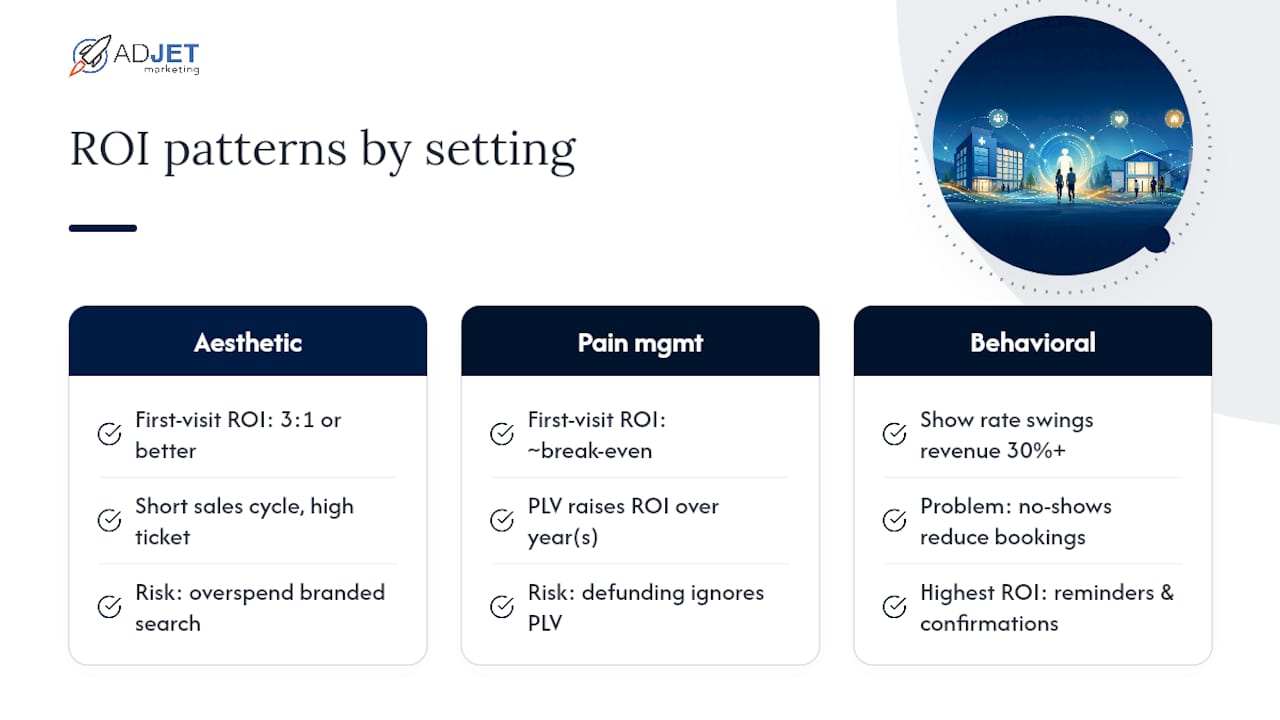
The gap between reported and real ROI shows up differently depending on the setting, which is why a single industry benchmark rarely tells the full story.
A solo aesthetic practice running Google Ads for injectables often sees a strong first-visit ROI, sometimes 3:1 or better, because average ticket size is high and the sales cycle is short. The risk there is overspending on branded search once the practice’s name recognition grows locally, since much of that traffic would have booked anyway.
A multi-location pain management group tells a different story. First-visit ROI on paid search can look mediocre, closer to break even, because patients often start with a primary care referral and only search directly once they’re already considering the practice. Once PLV is factored in, accounting for ongoing injections, physical therapy referrals, and follow-up visits over a year or more, ROI climbs substantially. Ignoring PLV here would lead a clinic to defund a channel that’s actually working.
A behavioral health practice offers a third pattern. Show rate is the dominant variable, sometimes swinging booked-appointment revenue by 30% or more between a well-run intake process and a sloppy one. For that setting, the highest-ROI investment often isn’t more ad spend at all. It’s a better reminder and confirmation workflow, since no amount of clean attribution fixes a no-show problem. Each of these settings needs its own read of the same formula, not a one-size benchmark.
Where Clinics Go Wrong On Roi, And How To Fix It
The most common mistake I see is measuring leads instead of kept visits, then wondering why marketing “isn’t working” when the clinic is actually busy. A close second is trusting last-click data that quietly credits branded search for work done by an upstream paid campaign weeks earlier. Underinvesting in retention is the quiet one. Clinics chase new patients while ignoring the recall and follow-up systems that would have made existing patients worth more.
The fix isn’t complicated, but it takes ownership. Assign one person, not a committee, to own the ROI number. Run a 90 day instrumentation sprint before changing budget. And have finance co-sign the ROI report before it goes to leadership, since that single step catches more bad assumptions than any dashboard will.
Expect three to six months before your numbers are fully trustworthy, and don’t budget as if month one will look like month six.
— Felix
Get A Measurement Plan Built For Booked Appointments, Not Clicks
Our advantage isn’t a bigger media budget. It’s building the tracking infrastructure first, so the campaigns run afterward are judged on booked-and-kept revenue instead of vanity clicks. That’s the same instrumentation-first sequence covered above, applied by an agency that works inside HIPAA-compliant workflows for clinics.
If cost per booked appointment is the metric you actually need clarity on, our Google Ads services are built around that number specifically, with call tracking and intake-source capture set up before spend even scales. For clinics whose booking funnel is leaking at the landing page rather than the ad, custom landing pages start at $99 a month, built specifically for a single conversion action instead of a generic homepage. Reach out for an initial assessment and we’ll show you exactly where your current attribution gaps are costing you.
Sources
- How to Measure Healthcare Marketing ROI
- Hospital marketing ROI measurement and campaign playbook
- Measuring ROI in Digital Marketing for Healthcare Providers
FAQ
What Is A Good Roi In Healthcare Marketing?
A commonly cited average is around 3.62:1 return on marketing investment, though results vary widely by service line and whether you’re measuring first-visit or lifetime revenue. A practical target most clinics work toward is a 3:1 lifetime value to acquisition cost ratio once PLV is factored in.
What Is An Average Roi For Marketing In General?
Outside healthcare, marketing ROI benchmarks vary heavily by industry and channel, and there’s no single universal number that applies across sectors. In healthcare specifically, the more useful comparison is service line to service line, since a dermatology practice and a pain clinic will post very different numbers even with identical marketing execution.
What Are The 5 P’s Of Healthcare Marketing?
Definitions vary across sources, but a common version includes product, price, place, promotion, and people, adapted from general marketing theory to account for patient experience and provider relationships. Some frameworks add a sixth “P” for process, reflecting how much patient satisfaction depends on the booking and intake experience itself.
What Type Of Marketing Has The Highest Roi In Healthcare?
There’s no single channel that wins across every practice type, since the answer depends heavily on service line, sales cycle length, and how well the practice tracks show rate and retention. Paid search tends to produce faster first-visit ROI, while SEO and retention campaigns generally produce stronger lifetime ROI once PLV is factored in.
How Do I Know If My Attribution Data Is Reliable?
Check your CRM-to-EHR match rate and call tracking coverage first. Reliable multi-touch attribution generally needs above an 85% patient match rate and 80% call tracking coverage before you should trust channel-level ROI numbers enough to shift budget based on them.