









Most clinic owners still rely on word-of-mouth and printed flyers to fill their appointment books. It works, until it doesn’t. Patient expectations have shifted online, and the gap between clinics that invest in digital marketing and those that don’t is widening fast. Systematic reviews confirm that digital and CRM strategies outperform traditional methods for patient engagement and measurable performance. This guide breaks down exactly why digital marketing is no longer optional for clinics, which strategies deliver results, and how you can measure your return with confidence.
Table of Contents
- What makes digital marketing vital for clinics?
- How clinics benefit from digital marketing strategies
- Choosing the right digital marketing channels for your clinic
- Measuring digital marketing ROI: Metrics clinics must track
- The uncomfortable truth most clinics miss about digital marketing
- Next steps: Digital marketing solutions for clinics
- Frequently asked questions
Key Takeaways
| Point | Details |
|---|---|
| Digital drives patient growth | Clinics using digital marketing see greater patient acquisition and engagement than those using traditional methods. |
| Channel choice matters | The digital channels you invest in—Google Ads, SEO, or social—can profoundly impact clinic results. |
| ROI must be measured | Tracking marketing metrics is essential for clinics to optimize budgets and prove effectiveness. |
| Privacy is priority | Successful digital marketing must respect patient privacy and comply with healthcare regulations. |
| Expert guidance helps | Working with digital marketing specialists enables clinics to avoid common pitfalls and accelerate growth. |
What makes digital marketing vital for clinics?
Digital marketing for clinics means using online channels such as search engines, social media, email, and paid advertising to attract, engage, and retain patients. Unlike a newspaper ad or a referral network, digital marketing gives you precise control over who sees your message, when they see it, and what action they take next.
The core advantage is measurability. Every click, every form submission, and every booked appointment can be tracked and attributed to a specific campaign. Traditional channels simply cannot offer that level of accountability.
Here is how digital and traditional marketing stack up for clinics:
| Factor | Traditional marketing | Digital marketing |
|---|---|---|
| Cost per lead | High, often untracked | Lower, trackable |
| Audience targeting | Broad, geographic | Precise, demographic |
| Speed to results | Weeks to months | Days to weeks |
| Measurability | Difficult | Real-time analytics |
| Patient engagement | Passive (read or hear) | Interactive (click, book, review) |
Key advantages digital marketing offers your clinic:
- Personalized outreach: You can target patients based on location, age, search intent, and health interest.
- Scalability: Start small with a modest budget and scale what works.
- 24/7 visibility: Your clinic appears in search results even when your front desk is closed.
- Reputation building: Collect and display reviews that influence new patient decisions.
Digital and CRM strategies have proven superior for patient engagement and performance metrics compared to offline alternatives. This is not a marginal difference. Clinics using structured digital campaigns consistently report higher patient acquisition rates and lower cost per appointment.
If you want to go deeper, explore mastering digital marketing strategies or review high-converting medspa website tips to see how optimized web presence feeds directly into patient volume.
“The clinics that win online are not the ones with the biggest budgets. They are the ones that know their patients, target them precisely, and measure everything they do.” — AdJet Marketing
Now that you understand why digital marketing matters, let’s clarify what sets it apart for clinic owners.
How clinics benefit from digital marketing strategies
With the basics covered, let’s look at how clinics actually realize benefits from digital marketing efforts.
The practical gains fall into four core areas:
- Patient acquisition: Targeted Google Ads and local SEO campaigns place your clinic in front of people actively searching for your services. This is intent-based marketing. You are not interrupting someone’s day. You are answering a question they already asked.
- Patient retention: Email campaigns, appointment reminders, and personalized follow-ups keep patients engaged between visits. A CRM (customer relationship management) system automates this so your team does not have to manage it manually.
- Clinic reputation: Online reviews on Google and health directories act as social proof. New patients consistently check ratings before booking. Managing and responding to reviews builds trust before a patient even walks through your door.
- Operational efficiency: Digital tools like online booking, automated intake forms, and patient portals reduce administrative load and improve the patient experience simultaneously.
Here is a direct comparison of outcomes:
| Outcome | Traditional approach | Digital approach |
|---|---|---|
| New patient discovery | Referrals, print ads | Google search, paid ads |
| Review management | Manual, inconsistent | Automated request systems |
| Appointment booking | Phone only | Online, 24/7 |
| Follow-up communication | Letters, cold calls | Email, SMS automation |
Privacy and budget constraints are real barriers. Digital and CRM strategies outperform offline alternatives, but clinics must also navigate patient data regulations and work within realistic budgets. The good news: starting lean with one or two well-chosen channels is far more effective than spreading a small budget across every platform.

For specialty clinics, see how digital marketing for dentists and proven dental marketing strategies translate these principles into specialty-specific wins.
Pro Tip: Focus your early budget on the platforms where your target patients are most active. For most medical clinics, Google Search and Google Business Profile deliver the fastest results because patients are searching with clear intent.
Choosing the right digital marketing channels for your clinic
Having explored the benefits, let’s break down how to choose the channels that match your clinic’s needs.
The four primary digital channels for clinics are:
- Google Ads: Paid search campaigns that put your clinic at the top of results when patients search for your services. Fastest way to generate leads, but requires ongoing budget and optimization.
- SEO (search engine optimization): Organic strategies that improve your clinic’s ranking in Google results over time. Slower to start but builds compounding, long-term visibility.
- Social media: Platforms like Instagram and Facebook work well for aesthetic clinics and med spas where visual content drives interest. Less effective for urgent-care or diagnostic services.
- Email marketing: Best for patient retention and re-engagement. Low cost, high return when managed with a CRM.
When choosing your channels, consider these factors:
- Your patient demographics: Older patients often search Google. Younger patients discover clinics on Instagram.
- Your budget: Google Ads requires consistent spend. SEO is a longer investment with a lower monthly cost.
- Your compliance obligations: HIPAA (Health Insurance Portability and Accountability Act) rules limit how you can use patient data in retargeting campaigns. Always verify your ad platform’s data practices.
- Your timeline: Need patients this month? Google Ads. Building for 12 months from now? Invest in SEO.
Tailored digital marketing strategies consistently show stronger outcomes than one-size-fits-all approaches in healthcare. Matching your channel selection to your specific patient profile is not optional. It is the difference between wasted spend and measurable growth.
For a detailed breakdown, read our comparison of social media vs Google for clinics and explore medspa social campaign tips to understand how content strategy differs by platform.
Pro Tip: Before committing a large budget to any single channel, run a 30-day test with a controlled spend. Track cost per lead and booked appointments separately so you know exactly what each channel is producing.
Measuring digital marketing ROI: Metrics clinics must track
After channel selection, it is critical to understand how to measure the results of your investment.
Without consistent measurement, you are making budget decisions based on guesswork. The clinics that scale successfully treat marketing as a financial function, not just a creative one.
The four metrics every clinic should track:
- CPL (cost per lead): How much you spend to generate one patient inquiry. Lower is better, but quality matters too.
- Conversion rate: The percentage of inquiries that become booked appointments. A high CPL with a high conversion rate can still be profitable.
- LTV (lifetime value): The total revenue a patient generates over their relationship with your clinic. This number changes how you think about acceptable CPL.
- CAC (customer acquisition cost): The total cost to acquire one new patient, including all marketing spend and overhead.
Example clinic marketing metrics:
| Metric | Benchmark (small clinic) | Benchmark (med spa) |
|---|---|---|
| Cost per lead | $30 to $80 | $50 to $150 |
| Conversion rate | 20% to 40% | 15% to 35% |
| Patient lifetime value | $500 to $2,000 | $1,500 to $6,000 |
| CAC | $100 to $300 | $200 to $600 |
Steps for setting up effective tracking:
- Install Google Analytics 4 on your website
- Set up conversion goals for form submissions and phone calls
- Connect your ad platforms (Google Ads, Meta) to your CRM
- Review metrics weekly, not monthly, to catch problems early
- Benchmark each metric against your clinic’s historical data
Standardized ROI metrics are needed across healthcare digital marketing, with privacy and budget as persistent barriers to consistent measurement. Knowing this, build your tracking infrastructure before you scale your spend.
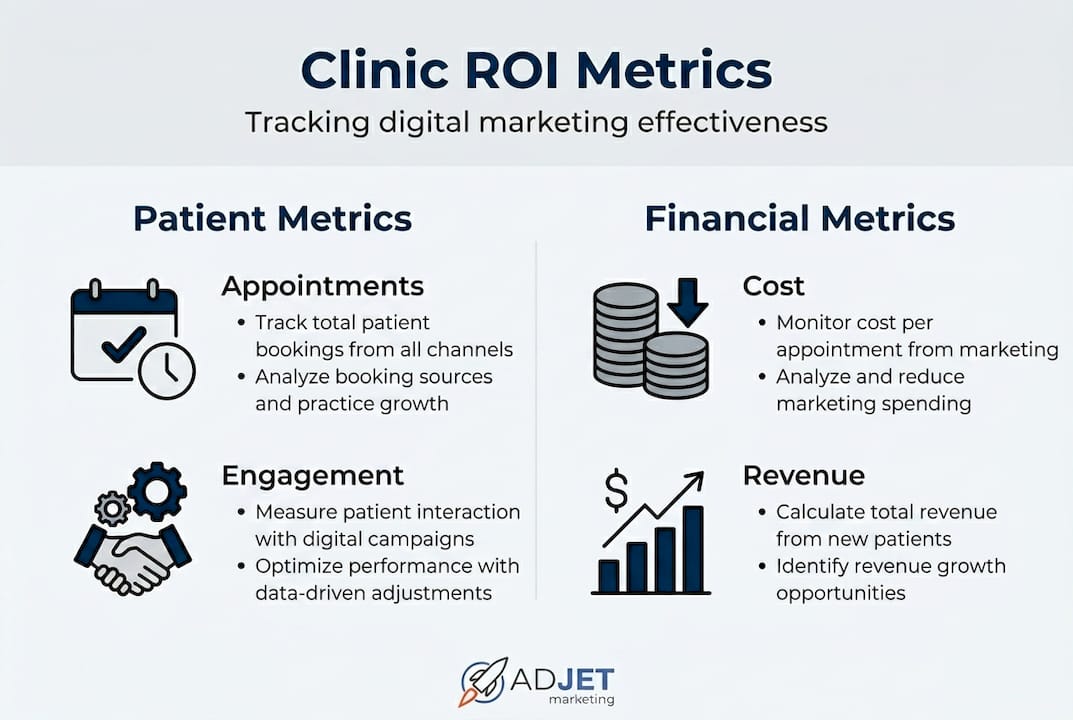
For a deeper look at ROI frameworks, explore measuring clinic marketing ROI and see which approaches deliver fastest returns in our guide on mental health marketing ROI.
Pro Tip: Use a CRM system to automate patient data collection and link it to your marketing platforms. This gives you a single source of truth for acquisition costs, patient value, and campaign performance without manually pulling reports.
The uncomfortable truth most clinics miss about digital marketing
Here is what we see repeatedly with clinics that struggle online: the problem is almost never the platform. It is the preparation.
Clinics rush to launch Google Ads or post on Instagram before they have built the foundation. There is no clear conversion path on the website, no tracking in place, and no understanding of what a patient is actually worth. Then when results fall short, the platform gets blamed.
Barriers to digital adoption consistently include privacy concerns, compliance gaps, and budget misalignment. These are not small obstacles. A clinic that runs retargeting ads without understanding patient privacy compliance risks regulatory fines that far exceed any marketing budget.
Digital success requires learning, not just spending. The clinics that grow consistently are those that invest in understanding their numbers, respect their patients’ privacy, and treat digital marketing as a long-term discipline rather than a quick fix. Start with a solid plan, build clean tracking, and protect compliance from day one. Explore med spa digital marketing insights to see what a structured approach looks like in practice.
Next steps: Digital marketing solutions for clinics
You now have a clear framework for building a digital marketing strategy that generates real patient growth. The next step is applying it to your specific clinic type and goals. At AdJet Marketing, we work directly with clinic owners to build and manage performance-driven campaigns across Google Ads, SEO, and conversion-optimized websites. Whether you are a med spa looking for your first 50 new patients or an established practice ready to scale, we have solutions built for your situation. Start with our medical spa marketing ideas or dive into our step-by-step Google Ads for therapists guide to see how targeted campaigns translate into booked appointments.
Frequently asked questions
What is the main advantage of digital marketing for clinics?
Digital marketing lets clinics reach more patients through targeted, measurable campaigns. Digital and CRM strategies consistently outperform traditional advertising for both patient engagement and performance outcomes.
How can clinics protect patient privacy in their digital marketing?
Clinics should use HIPAA-compliant platforms, anonymize patient data before use in ad systems, and audit their marketing tools regularly for compliance gaps. Privacy concerns are one of the top barriers to digital adoption in healthcare, so treating compliance as a priority from the start protects both patients and your practice.
Which digital marketing channels bring the best ROI for clinics?
Google Ads and SEO typically deliver the strongest ROI for clinics because they capture patients with active search intent. Digital channels show strong ROI across healthcare settings, though the best channel depends on your clinic type and patient demographics.
What common mistakes should clinics avoid in digital marketing?
The most damaging mistakes are skipping ROI tracking, ignoring privacy compliance, and allocating budget without testing first. Standardized ROI metrics and budget discipline are the two areas where clinics most often fall short, and both are fully correctable with the right setup.
Recommended
- Digital Marketing For Dentists : Get More Patients In 2023
- Social Media Vs. Google — Which Brings Better Patients? – AdJet Digital Marketing & Google Partner Agency | SEO Development Google Ads Social
- Revitalise Your Med Spa: Mastering Digital Marketing Strategies To Boost Patient Volume
- How To Get More Patients For Your Dental Practice – Proven Marketing Strategies – AdJet Digital Marketing & Google Partner Agency | SEO Development Google Ads Social