









Over 70% of patients now begin their search for a provider online before ever calling your front desk. That single shift changes everything about how clinics need to compete. If your practice is not visible at the moment patients are searching, you are simply not in the running. This guide breaks down the core digital marketing strategies that actually move the needle for medical clinics, explains what compliance looks like in practice, and shows you how to build a patient acquisition system that delivers measurable, lasting results.
Table of Contents
- The new patient journey: Why digital marketing is non-negotiable
- Core strategies: What works (and why) for patient acquisition
- Compliance essentials: HIPAA, privacy, and digital risk
- Beyond basics: Building a future-ready clinic marketing engine
- A practitioner’s view: The hidden cost of outdated marketing and what actually moves the needle
- Ready to see more patients? Get expert digital marketing help
- Frequently asked questions
Key Takeaways
| Point | Details |
|---|---|
| Patients start online | Over 70% of patients search for clinics online before making an appointment. |
| ROI-driven strategies | Local SEO, Google Business Profile, and email marketing provide the highest ROI for clinics. |
| Compliance is essential | HIPAA compliance requires BAAs, privacy-focused tech, and careful messaging to protect patient data. |
| Future-ready performance | Full-funnel marketing and proper measurement drive sustainable clinic growth. |
The new patient journey: Why digital marketing is non-negotiable
Patient behavior has changed fundamentally. It is not just that people use Google occasionally. Nearly 70% of patients start their care journey online, and over 80% use search engines and social media before choosing a provider. That means your clinic is being evaluated digitally long before anyone picks up the phone.
Think about what that looks like in practice. A patient wakes up with back pain. They search “pain clinic near me,” scan the top three results, check Google reviews, visit a website, and book an appointment. If your clinic does not appear in those top results, you never existed for that patient. The decision was made without you.

Clinics without a strong digital presence face a compounding problem. Not only do they miss immediate appointment opportunities, they also accumulate a trust deficit over time. Patients who find little to no information about your clinic online often assume it is less credible than a competitor with a polished profile and 200 five-star reviews. Research from Intrepy confirms that a lack of online visibility is one of the top drivers of patient loss for independent practices.
Here is what a strong digital presence can do for your clinic:
- Increase discoverability when patients are actively searching for care
- Build trust through consistent reviews, photos, and up-to-date information
- Reduce no-show rates by setting clear expectations before the first visit
- Shorten the decision cycle with informative content that answers patient questions
- Compete with larger health systems that have bigger advertising budgets
“Practices that actively manage their online presence see significantly higher patient acquisition rates than those that rely on referrals alone.”
One of the most immediate wins available to any clinic is a properly optimized Google Business Profile setup. This free tool places your clinic on the map, shows your hours, collects reviews, and drives direction requests from patients nearby. It is often the single highest-return action a clinic can take in the first 30 days of a digital marketing program.
Core strategies: What works (and why) for patient acquisition
Not all marketing channels deliver equal results for clinics. Budget is limited, and the wrong channel mix wastes money fast. Here is a clear breakdown of the strategies that consistently produce new patients, along with the data to back them up.
| Channel | Avg. ROI | Best use case |
|---|---|---|
| Local SEO | $2.75 per $1 spent | Long-term visibility, ongoing patient volume |
| Google Business Profile | Highest long-term ROI | Map pack visibility, local trust |
| Google Ads (PPC) | Varies by specialty | Fast patient acquisition, high-intent searches |
| Email marketing | $36 per $1 spent | Reactivation, recall, retention |
| Social video | Growing ROI | Brand awareness, education, trust-building |
| SMS campaigns | High open rates | Appointment reminders, follow-ups |
Healthcare marketing ROI averages 5.44:1 across channels, but the mix matters. Here is how to prioritize:
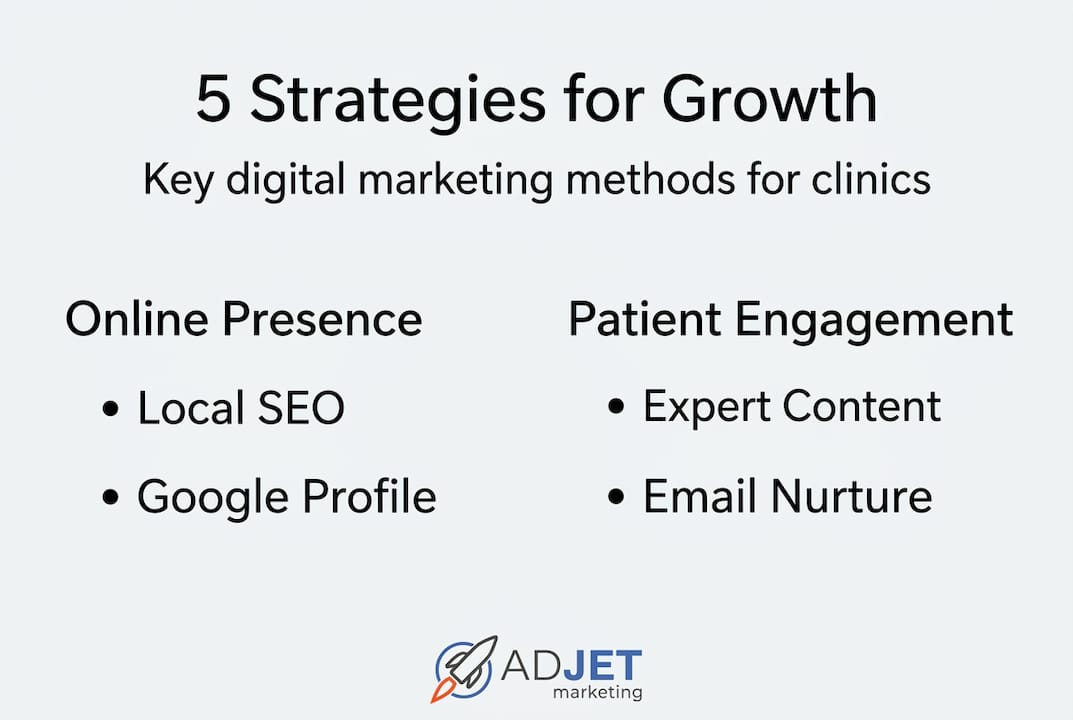
- Start with local SEO and Google Business Profile. These are your foundation. Patients searching for care nearby need to find you first.
- Add Google Ads for immediate patient flow. PPC targets high-intent searches and delivers results while SEO builds over time.
- Build a content strategy around expertise. Educational blog posts and FAQs establish authority and improve organic rankings.
- Implement email and SMS for patient retention. Keeping existing patients active is far cheaper than acquiring new ones.
- Layer in social video as your budget grows. Short-form video on platforms like YouTube or Instagram builds familiarity and trust over time.
Pro Tip: Expertise-focused content (answering real patient questions) and a consistent flow of authentic reviews almost always outperform discount-based campaigns. Patients choose providers they trust, not just the cheapest option.
For clinics with specific contexts, nuance matters. Mental health practices should avoid highly targeted ad audiences that could expose sensitive conditions. Telehealth providers need to address multi-state licensing in their SEO strategy. Multi-location groups benefit from local SEO for clinics at the individual location level, not just the brand level. ClinicNudge recommendations also highlight the importance of specialty-specific landing pages that match patient intent precisely.
Always connect your channel strategy to revenue outcomes. Learn how measuring ROI in healthcare marketing goes well beyond cost-per-lead so you can make smarter budget decisions.
Compliance essentials: HIPAA, privacy, and digital risk
Effective digital marketing for clinics carries a layer of responsibility that other industries do not face. HIPAA (the Health Insurance Portability and Accountability Act) governs how patient information is handled, and violations in digital campaigns happen more often than most clinic owners realize.
HIPAA compliance in digital marketing requires clinic operators to use business associate agreements (BAAs) with vendors, avoid PHI (protected health information) in tracking pixels and ad platforms, and ensure all digital communications are encrypted and secure.
The most common compliance hazards include:
- Tracking pixels (like Meta Pixel or Google Tags) that inadvertently capture patient appointment data or browsing behavior tied to medical conditions
- Unencrypted web forms that transmit patient intake data without proper security
- Email campaigns that include identifiable health details in subject lines or preview text
- Ad retargeting built from patient lists or appointment records without proper de-identification
- Third-party chat widgets that store conversation data on non-HIPAA-compliant servers
Pro Tip: Never include any identifiable health information in email subject lines. Even something like “Your upcoming appointment for [condition]” can constitute a PHI exposure if the email is forwarded or accessed on a shared device.
“Clinics that assume their marketing vendors are automatically HIPAA-compliant take on enormous risk. Always verify a BAA is in place before sharing any patient data.”
Mental health clinics and telehealth providers face heightened scrutiny because of the sensitivity of the data involved. Condition-specific targeting on ad platforms can expose patients to discrimination or stigma if PHI leaks occur. SmartBug Media’s HIPAA compliance tips offer a practical checklist for marketers navigating these nuances.
To keep your campaigns safe, explore how HIPAA-compliant marketing with Google Ads works in practice, and review proven workflows for protecting PHI in marketing to reduce your exposure without limiting your reach.
Beyond basics: Building a future-ready clinic marketing engine
Once your foundation is in place and compliance is covered, the real question becomes sustainability. How do leading clinics build a marketing system that keeps delivering new patients without requiring constant manual effort?
The answer is a full-funnel approach. Instead of running isolated campaigns, a full-funnel system moves patients from awareness to appointment through coordinated touchpoints. Full-funnel strategies treat AI as a force multiplier and measure success through attended appointments and ROAS (return on ad spend), not just clicks or impressions.
Here is what that looks like in practice:
- Awareness: Social video, blog content, and Google Display Ads introduce your clinic to potential patients who do not yet know they need you.
- Consideration: Local SEO, Google Ads, and detailed service pages capture patients who are actively comparing providers.
- Conversion: High-converting landing pages, online booking, and live chat turn interest into booked appointments.
- Retention: Email sequences, SMS reminders, and loyalty programs keep patients returning and referring others.
| Traditional marketing | Modern, diversified approach |
|---|---|
| Yellow pages, direct mail | Local SEO, Google Ads, content |
| Referral-only growth | Multi-channel patient acquisition |
| Brand awareness focus | ROAS, CAC, LTV measurement |
| Single channel dependency | Diversified, resilient channel mix |
| Manual campaign management | AI-assisted optimization |
AI tools now play a meaningful role in content creation, audience segmentation, and bid optimization. Clinics using AI to personalize follow-up sequences and optimize ad spend are seeing measurable lifts in appointment conversion rates. Cardinal Digital’s marketing trends research highlights that multi-channel diversification is the single biggest differentiator between clinics that scale and those that plateau.
The biggest risk for clinics right now is over-relying on one channel. If all your patients come from Google Ads and costs rise or your account gets suspended, your pipeline stops overnight. Diversify. And always use measuring marketing impact frameworks that account for LTV and true acquisition cost, not just surface-level metrics.
For clinics using retargeting, make sure your approach follows safe, remarketing without PHI risk methods using cookieless tactics that stay compliant.
A practitioner’s view: The hidden cost of outdated marketing and what actually moves the needle
Here is something most marketing agencies will not tell you directly: the clinics that fall furthest behind are not always the ones with no marketing budget. Often, they are the ones spending money on tactics that feel familiar but produce little measurable return.
Word-of-mouth is genuinely valuable. But it is passive. Relying on it exclusively means your growth is determined by other people’s conversations, not by any action you take. That is not a strategy. That is hoping.
The other common trap is chasing the cheapest lead. A $30 cost-per-lead sounds better than $90, but if the $30 lead never shows up and the $90 lead becomes a $4,000 annual patient, the math is not even close. Patient lifetime value (LTV) and retention are where real clinic growth lives.
Modern patient journeys are complex. A patient might see your Instagram post, search your name on Google, read your reviews, visit your website, and then call three days later. If you are only tracking the last click, you are misreading your entire marketing performance. That misreading leads to cutting the wrong channels and doubling down on the wrong ones.
If you feel behind, start with one foundational action: get your advanced ROI tracking for clinics in place so you can see what is actually working. Small steps taken with clear data compound quickly into a real competitive advantage.
Ready to see more patients? Get expert digital marketing help
Building a compliant, high-performing patient acquisition system is achievable. But it requires the right expertise, the right tools, and a team that understands the specific demands of healthcare marketing. At AdJet Marketing, we help medical clinics grow their patient base through SEO, Google Ads, and conversion-focused website design while keeping every campaign HIPAA-safe.
Whether you need to start with the fundamentals of protecting PHI in marketing or want to understand how to compare social and search for your specific specialty, we have the answers and the execution experience to back them up. Explore our full suite of digital marketing for clinics solutions and take the next step toward predictable, measurable patient growth.
Frequently asked questions
How much should medical clinics budget for digital marketing?
Most clinics should allocate 6-10% of revenue to digital marketing to stay competitive and drive consistent patient growth, though practices in earlier growth stages may start at 2-5%.
Is digital marketing for clinics HIPAA-compliant?
Yes, when you use HIPAA-safe vendors with BAAs and avoid sending protected health information through ad platforms, tracking pixels, or email campaigns, digital marketing is fully achievable within compliance requirements.
Which digital marketing channel brings the best ROI for clinics?
Local SEO and Google Business Profile typically offer the highest long-term ROI, while email yields $36 per $1 spent, making it one of the strongest channels for patient retention and reactivation.
What metrics should clinics track to measure digital marketing success?
Focus on attended appointments and ROAS as primary indicators, along with cost per acquisition (CAC) and patient lifetime value (LTV), rather than surface-level metrics like clicks or impressions alone.
Recommended
- Which Mental Health Marketing Services Drive The Fastest ROI? → Our Top 5 Winners – AdJet Digital Marketing & Google Partner Agency | SEO Development Google Ads Social
- What Are The Best Marketing Strategies For A Med Spa? Boost Your Marketing Game With These Proven Strategies – AdJet Digital Marketing & Google Partner Agency | SEO Development Google Ads Social
- Social Media Vs. Google — Which Brings Better Patients? – AdJet Digital Marketing & Google Partner Agency | SEO Development Google Ads Social
- Should We Run Brand Campaigns For Our Clinic Name? Why It Pays – AdJet Digital Marketing & Google Partner Agency | SEO Development Google Ads Social