









Contractor marketing services are specialized digital and local marketing strategies designed to increase a contractor’s online visibility, generate qualified leads, and convert website visitors into paying customers. The industry term for this practice is performance-driven local marketing, and it covers everything from Google Ads and search engine optimization to Google Business Profile management and social media advertising. If you run a home service business and your phone isn’t ringing consistently, your marketing strategy is the first place to look. The right mix of services can change that quickly.
What are the essential contractor marketing services and how do they work?
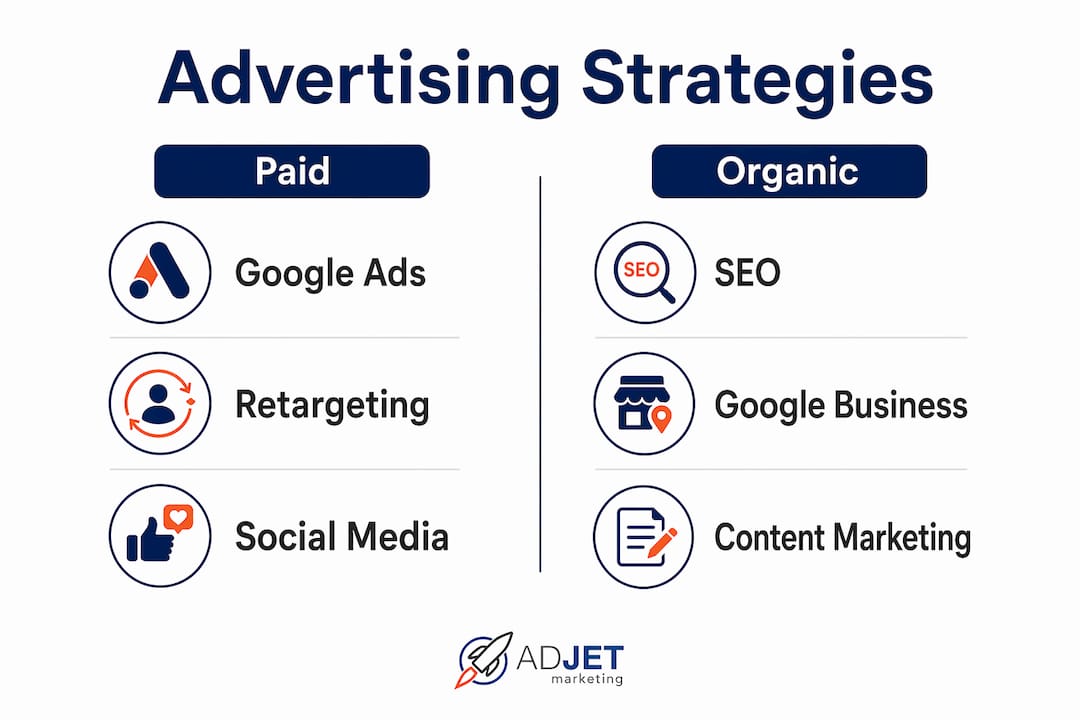
The foundation of any effective marketing program for contractors rests on four core services: local SEO, pay-per-click advertising, Google Business Profile management, and social media. Each one serves a distinct role, and together they create a system that generates leads at multiple stages of the customer decision process.
Local SEO targets the searches your customers make when they need a contractor right now. Phrases like “roof repair near me” or “licensed plumber in [city]” are high-intent searches, and ranking for them organically puts your business in front of buyers who are ready to call. SEO takes three to six months to build momentum, but the leads it produces are consistent and cost less per acquisition over time.

Google Ads and PPC campaigns fill the gap while SEO builds. You bid on the same high-intent keywords and appear at the top of search results immediately. The trade-off is cost: you pay for every click, so campaign structure and landing page quality determine whether that spend turns into profit or waste.
Social media advertising on platforms like Facebook and Instagram works differently. These users are not actively searching for a contractor, so the goal is awareness and retargeting. You show your work to homeowners in your service area, then follow up with ads to people who visited your website but did not call.
Here is what a well-structured contractor marketing program typically includes:
- Local SEO with keyword targeting for specific service areas and trade types
- Google Ads campaigns structured around service categories and zip codes
- Google Business Profile optimization with regular photo uploads and review management
- Facebook and Instagram ads for brand awareness and retargeting
- A conversion-optimized website or landing page that turns traffic into calls
- Monthly reporting on leads, calls, and cost per acquisition
Pro Tip: Platforms like Marketing360 consolidate SEO, PPC, and social media reporting into one dashboard, which makes it far easier to see which channel is actually driving your calls.
The most important thing to understand is that no single channel works in isolation. SEO and PPC work best as complementary strategies: PPC provides quick leads while SEO builds reliable long-term visibility. Contractors who invest in only one often plateau or overspend.
How does Google Business Profile optimization impact contractor marketing?
Google Business Profile (GBP) is the single most underused asset in local contractor marketing. Most contractors claim their profile and stop there. That is a significant missed opportunity.
Businesses with 100+ photos on their Google Business Profile receive approximately 520% more calls than average listings. They also see 42% more direction requests and 35% more website clicks. That is not a marginal improvement. It means a fully optimized photo profile can be the difference between a phone that rings and one that doesn’t.
The type of photos you upload matters as much as the quantity. Here is the order of priority:
- Before and after project photos. These are the most persuasive images you can post. Before and after photos build customer trust faster than testimonials alone because they show proof of work, not just claims about it.
- Team photos. Faces build trust. A photo of your crew in branded uniforms signals professionalism and makes your business feel real to someone who has never met you.
- Fleet and equipment photos. Branded trucks and equipment reinforce that you are an established operation, not a one-person side job.
- Job site photos. Document active projects to show scale and variety of work.
- Customer-submitted photos with reviews. Encouraging customers to upload photos with their reviews increases third-party validation and signals trustworthiness to Google’s local ranking algorithm.
Photo freshness also matters. Uploading 5 to 10 new photos each month signals ongoing business activity to Google, which improves your local search ranking over time. Think of it as a consistency signal: Google rewards businesses that look active.
Two technical details most contractors skip: name your image files descriptively before uploading (for example, “kitchen-remodel-austin-tx.jpg” instead of “IMG_4821.jpg”), and geo-tag your photos with location data when possible. Both practices reinforce your local relevance to Google’s algorithm.
“Regular, recent, and diverse photos on Google Business Profile are fundamental levers for local visibility and engagement.” — NSO.ca
The ideal GBP setup goes beyond photos. It includes accurate service categories, a keyword-rich business description, consistent NAP (name, address, phone number) data, and a steady flow of new reviews. Each element compounds the others.
What are the best contractor advertising strategies and how do they compare?
Choosing between paid and organic advertising is one of the most common questions contractors ask. The honest answer is that the right mix depends on your timeline, budget, and growth stage. Here is a direct comparison:
| Strategy | Speed to leads | Cost structure | Best for |
|---|---|---|---|
| Google Ads (PPC) | Immediate (days) | Pay per click, ongoing spend | New businesses, seasonal pushes |
| Local SEO | Slow (3-6 months) | Agency retainer, lower long-term cost | Established businesses, sustained growth |
| Social media ads | Fast (1-2 weeks) | Pay per impression or click | Brand awareness, retargeting |
| Retargeting ads | Fast (1-2 weeks) | Pay per impression | Recapturing website visitors |
| Google Business Profile | Medium (weeks to months) | Low cost, time investment | Local search dominance |
PPC advertising through Google Ads gives you immediate placement at the top of search results. The downside is that the moment you stop paying, the leads stop. For contractors launching a new service area or running a seasonal promotion, PPC is the right tool. For contractors who want a predictable lead flow without an ever-increasing ad budget, SEO is the better long-term investment.
Retargeting deserves more attention than most contractors give it. When someone visits your website and leaves without calling, a retargeting campaign shows them your ads on other websites and social platforms for the next 30 to 60 days. This keeps your business top of mind during the consideration phase, which for larger jobs like roofing or HVAC replacement can last weeks.
Pro Tip: If your budget is limited, start with Google Ads targeting your highest-margin services, then reinvest a portion of that revenue into SEO. This approach funds organic growth without starving your lead pipeline while you wait for rankings to build.
The most effective contractor advertising strategies combine paid and organic channels. Contractors benefit most from marketing services that balance lead quantity with lead quality, with a strong emphasis on local engagement. A campaign that generates 50 low-quality leads costs more in time and follow-up than one that generates 15 qualified calls.
How to set a realistic marketing budget and measure ROI for contractors
Budget is where most contractor marketing conversations stall. The number that comes up most often in the industry is clear: contractors should spend 8 to 12% of their target revenue on marketing to drive growth effectively. That percentage shifts based on your margins, average job size, and how aggressively you want to grow.
A contractor targeting $1 million in annual revenue should plan to invest between $80,000 and $120,000 per year in marketing, or roughly $6,500 to $10,000 per month. That range covers agency fees, ad spend, and tools. Contractors in highly competitive markets like roofing or HVAC in major metros often need to sit at the higher end of that range.
Tracking ROI requires more than counting leads. Here are the metrics that actually tell you whether your marketing is working:
- Cost per lead (CPL): Total marketing spend divided by number of leads generated. Compare this against your average job value to assess profitability.
- Lead-to-close rate: What percentage of leads turn into booked jobs? If this is low, the problem may be your sales process, not your marketing.
- Call tracking data: Use a call tracking platform like CallRail to attribute phone calls to specific campaigns and keywords.
- Website conversion rate: The percentage of website visitors who submit a form or call. A rate below 3% usually signals a landing page problem.
- Google Ads Quality Score: Higher scores mean lower cost per click, which directly improves your return on ad spend.
Review these numbers monthly, not quarterly. Marketing performance shifts quickly, especially with paid campaigns. A Google Ads campaign that performed well in spring may need restructuring by summer if competition increases or search behavior changes.
Key takeaways
Effective contractor marketing requires a coordinated mix of SEO, Google Ads, and Google Business Profile optimization, each tracked by specific performance metrics to justify spend and guide budget decisions.
| Point | Details |
|---|---|
| GBP photos drive real results | Businesses with 100+ photos receive 520% more calls than average listings. |
| SEO and PPC are complementary | PPC delivers immediate leads; SEO builds lower-cost, long-term visibility. |
| Budget to your revenue target | Invest 8 to 12% of target revenue in marketing to sustain consistent growth. |
| Track cost per lead monthly | Divide total spend by leads generated and compare against average job value. |
| Photo freshness signals activity | Upload 5 to 10 new GBP photos monthly to maintain local search ranking momentum. |
What I’ve learned from watching contractors market themselves
I’ve worked with enough home service businesses to spot a pattern: most contractors who come to us frustrated with their marketing have been spending money on one channel in isolation. They ran Google Ads for six months, got some leads, then stopped because it felt expensive. Or they hired someone to “do SEO” and saw no results after 90 days and gave up. Neither of those outcomes is a failure of the channel. It’s a failure of strategy.
The contractors who grow consistently do two things differently. First, they treat their Google Business Profile like a living asset, not a set-it-and-forget-it listing. They upload photos weekly, respond to every review, and update their services seasonally. Second, they run paid ads and SEO simultaneously, even at a modest budget, because they understand that the two channels reinforce each other in ways that neither can achieve alone.
The other thing I’d push back on is the expectation that marketing should produce results in 30 days. Paid ads can, but SEO cannot. If an agency promises you page-one rankings in a month, that’s a red flag, not a selling point. Realistic SEO timelines are three to six months for meaningful movement and six to twelve months for competitive keywords. Plan your budget and expectations accordingly.
One more thing worth saying directly: lead quality matters more than lead volume. A campaign that generates 100 low-intent clicks costs more to manage than one that generates 20 calls from homeowners ready to book. When you evaluate your marketing results, always ask what percentage of leads turned into actual jobs. That number tells you more than any traffic report.
— Felix
How Adjetmarketing helps contractors generate more qualified leads
Adjetmarketing is a Google Partner digital marketing agency with direct experience in performance-driven marketing for home service businesses. The team builds and manages Google Ads campaigns structured around your specific service areas and trade categories, so your budget targets the searches most likely to convert. On the organic side, Adjetmarketing’s SEO services are built around local keyword targeting, GBP optimization, and technical site improvements that compound over time. If you want to understand how a coordinated marketing approach translates into measurable growth, the team can walk you through what that looks like for your specific market and service type.
FAQ
What do contractor marketing services typically include?
Contractor marketing services typically include local SEO, Google Ads management, Google Business Profile optimization, social media advertising, and conversion-focused website design. The goal is to generate qualified leads from homeowners actively searching for your services.
How long does it take to see results from contractor marketing?
Google Ads can generate leads within days of launch. SEO takes three to six months to produce meaningful ranking improvements and six to twelve months to compete for high-value keywords in competitive markets.
How much should a contractor spend on marketing?
Most contractors should invest 8 to 12% of their target annual revenue in marketing. For a business targeting $500,000 in revenue, that means a monthly marketing budget of roughly $3,300 to $5,000 covering agency fees and ad spend.
Why does Google Business Profile matter for contractor marketing?
Businesses with 100 or more photos on their GBP receive approximately 520% more calls than average listings. Consistent photo uploads, accurate business information, and regular review responses directly improve local search visibility and call volume.
Is SEO or Google Ads better for contractors?
Neither is better in isolation. SEO and PPC complement each other: PPC delivers immediate leads while SEO builds lower-cost, long-term visibility. The most effective approach runs both simultaneously, with budget allocated based on your growth stage and timeline.