









Start with $1,500 to $5,000 a month for a single-location clinic if you’re testing Google Ads for the first time, and adjust up as your services justify it. The real work isn’t picking a number, though. It’s working backwards from what a booked patient is worth (your LTV), setting a target cost per acquisition from that figure, and letting that math tell you the most you can pay per lead. Factor in HIPAA-compliant tracking setup too. It’s a real line item, not an afterthought.
TL;DR:
- Most clinics should start with a monthly PPC budget between $1,500 and $5,000, with adjustments based on service value and patient lifetime revenue.
- Calculations should focus on specific data like LTV, target CPA, and conversion rates rather than industry averages, to set realistic and effective budgets.
- Separating campaigns and budgets for each service line and location helps prevent low-margin ads from cannibalizing high-margin traffic.
- Rely primarily on Google Search for new patient acquisition, and wait for about 30 conversions before switching to automated bidding strategies.
- Proper tracking, including privacy-safe solutions and a signed BAA, is essential to maintain HIPAA compliance and accurate measurement.
Table of Contents
- What Should Your Clinic PPC Budget Actually Be?
- How Do You Calculate the Right PPC Budget for Your Clinic?
- How Should You Split Your Budget Across Services and Locations?
- Where Should You Spend First, and How Should You Bid?
- What Do HIPAA Rules Mean for Your Tracking Budget?
- Why Is Your PPC Budget Underperforming (and How Do You Fix It)?
- What Role Does Competitor Analysis Play in Setting Your Budget?
- How Does PPC Fit Into Your Overall Marketing Budget?
- How Should Seasonality Change Your Clinic’s PPC Budget?
- How Do You Adjust Your Budget During Market Disruptions?
- Your One-Week Action Plan for Setting a Clinic PPC Budget
- How AdJet Marketing Helps Clinics Turn Budget Into Booked Patients
- Sources
- FAQ
What Should Your Clinic PPC Budget Actually Be?
Every clinic owner asks the same question first: “How much should I spend?” The honest answer is that the number matters less than the ratios behind it. A $10,000 monthly budget can be reckless for a clinic with a $200 average service value and brilliant for one selling $8,000 treatment packages. Before you land on a figure, you need to understand the metrics that determine whether that figure works.
Cost per lead (CPL) is what you pay for each form fill, call, or booking request. Cost per acquisition (CPA) is what you pay for each patient who actually books and shows up, which is always higher than CPL because not every lead converts. Lifetime value (LTV) is the total revenue a patient generates across their relationship with your clinic, not just their first visit. Click-through rate (CTR) and conversion rate tell you whether your ads and landing pages are doing their jobs. Return on ad spend (ROAS) ties it all back to revenue.
Here’s where most budget conversations go wrong: they lean on a single industry average as if every clinic experiences the same cost structure. They don’t.
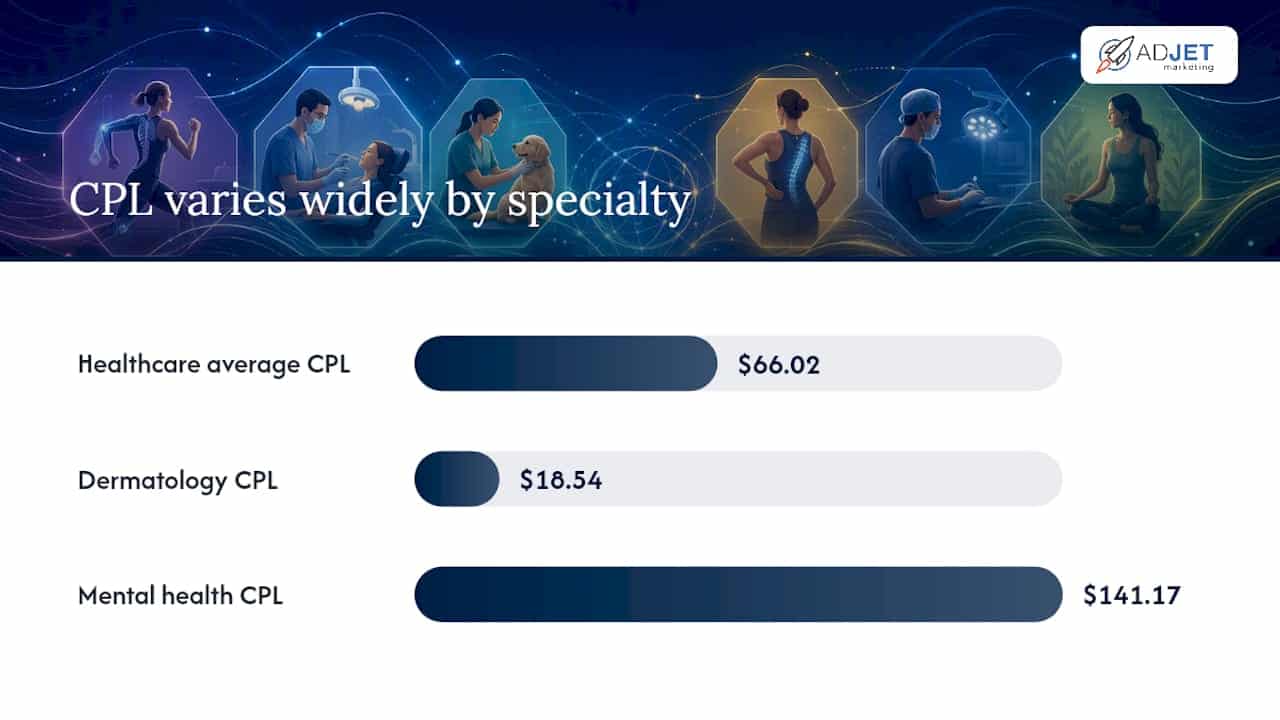
By the numbers: Healthcare search ads average around $5.64 per click and $66.02 per lead industry-wide, but the spread by specialty is enormous. Dermatology often sees CPL closer to $18.54, while mental health services can run $141.17 per lead or higher.
That gap exists because of two forces: how competitive the keyword auction is in your specialty, and how much a converted patient is worth once they walk through the door. A mental health practice paying $141 per lead can still turn a profit if a client stays in ongoing treatment for months. A dermatology practice paying $18 per lead for a one-time cosmetic consult needs volume to make the math work.
When you read a benchmark report, treat it as a sanity check, not a target. If your CPL is triple the reported average for your specialty, something is likely broken in your account structure or landing page. If it’s roughly in line, the number itself tells you less than your own conversion data does. A few reference points worth keeping in your back pocket:
- CTR on healthcare search campaigns: typically 3% to 6% for well-matched keywords and ad copy.
- Lead-to-booking conversion rate: commonly 20% to 40% depending on how quickly your team follows up.
- ROAS expectations: vary too widely by service value to generalize, which is exactly why the calculation in the next section matters more than any external benchmark.
How Do You Calculate the Right PPC Budget for Your Clinic?
Most clinics guess at a monthly number, watch it underperform, and conclude PPC “doesn’t work” for their specialty. The fix isn’t a bigger budget. It’s building the number from the bottom up using three inputs you already have sitting in your practice management software.
-
Find your average treatment LTV. Add up the total revenue a typical patient generates, including repeat visits, add-on services, or a full treatment course, not just the first appointment. A med spa client who returns for four sessions at $300 each has an LTV of $1,200, even if the first visit only brings in $300.
-
Set your target CPA as a percentage of LTV. A common starting point is 15% to 25% of LTV, though high-margin services can tolerate more and thin-margin services need to stay closer to 10%. If LTV is $1,200, a 20% target CPA lands at $240.
-
Back into your allowable CPL using your close rate. If one in three consultations converts to a booked treatment, and your target CPA is $240, your allowable cost per consultation is $80. If your lead-to-consultation rate is 50%, your allowable CPL drops to $40.
-
Convert CPL into a monthly spend target. If you want 30 booked patients a month and each costs $240 to acquire, you need roughly $7,200 in monthly spend, assuming your funnel holds steady. Build in a testing buffer of 15% to 20% above that figure for the first two months while Google Ads collects data.
Pro Tip: Run this calculation separately for every distinct service line. A clinic that averages its LTV across botox touch ups and full surgical consults will consistently underprice one and overprice the other.
Here’s how the math shifts across service tiers:
Notice how the allowable CPL climbs sharply as treatment value rises. This is the single most common mistake we see: clinic owners set one CPL ceiling across every campaign and wonder why their high-value service ads never spend. Google’s own learning period guidance also matters here. Automated bidding needs weeks of consistent data before it stabilizes, so budget for a testing phase, not instant results.
How Should You Split Your Budget Across Services and Locations?
A single shared budget across every service you offer almost guarantees your algorithm chases whatever converts cheapest, usually your lowest-margin service. Google Ads optimizes for volume unless you tell it otherwise, which means a $99 skin consult can quietly cannibalize the budget meant for a $4,000 procedure.
The fix is ring-fencing: separate campaigns and separate budgets for each service line, so a high-margin offering never has to compete against a high-volume, low-margin one for the same dollars.
A few allocation heuristics that hold up across most clinic types:
- Protect your highest-margin service first. Give it a guaranteed minimum spend even if its lead volume looks small early on.
- Cap low-margin, high-volume campaigns so they can’t absorb budget meant for higher-value services.
- Reserve 10% to 15% of total spend for testing new keywords, ad copy, or landing pages without disrupting proven campaigns.
- Set a floor budget per campaign, generally $500 to $1,000 a month, below which Google can’t gather enough data to optimize meaningfully.
Pro Tip: If you run multiple locations, don’t combine them into one campaign “for simplicity.” Each location has its own local competition, its own cost per click, and its own booking capacity. Separate campaigns let you shift budget toward the location that’s actually converting.
For multi-specialty clinics, the same logic scales up. A pain management clinic offering both injections and physical therapy referrals should treat those as entirely separate funnels with separate CPL targets, because their LTV and close rates rarely match. Trying to average them produces a budget that serves neither service well.
Where Should You Spend First, and How Should You Bid?
Google Search should get the majority of a new clinic’s budget. It captures people actively searching for your service, which means higher intent and generally better conversion rates than social platforms. Bing Ads is worth a modest test allocation, often 10% to 15% of your search budget, since cost per click tends to run lower and the audience skews slightly older, which fits certain specialties like orthopedics or dermatology. Meta plays a different role entirely: it’s better suited to remarketing people who already visited your site, or building awareness for services with longer consideration windows, like elective surgery.
On bidding strategy, resist the urge to switch to Smart Bidding (Target CPA or Target ROAS) too early. Google’s automated bidding needs a meaningful volume of conversion data, often 30 or more conversions in a recent 30-day window, before it can optimize reliably. Launch new campaigns on manual or enhanced CPC bidding, gather that data, then transition once you have a stable baseline.
A few pacing and hygiene habits that consistently protect budget from waste:
- Use dayparting to pause ads during hours when your front desk can’t answer calls, since an unanswered lead is a wasted click.
- Apply device bid adjustments if mobile traffic converts at a different rate than desktop, which it almost always does for healthcare searches.
- Review search term reports weekly in the first month to catch irrelevant queries before they drain budget.
- Build a negative keyword list early, excluding terms like “free,” “jobs,” or “training” that signal non-patient intent.
What Do HIPAA Rules Mean for Your Tracking Budget?
Tracking your campaigns properly isn’t optional, and for healthcare clinics, it isn’t simple either. The HHS guidance on online tracking technologies makes clear that tracking vendors can become business associates under HIPAA if they create, receive, maintain, or transmit protected health information as part of a covered function. That means standard pixel-based tracking, dropped carelessly on an appointment confirmation page, can create real compliance exposure.
Improper sharing of patient data through tracking tools can trigger breach costs that dwarf a full year of ad spend, which is exactly why privacy-safe measurement deserves its own line in your budget rather than being treated as a free add-on.
Before you launch anything, confirm two things: whether your tracking vendor requires a business associate agreement (BAA), and whether your conversion events could inadvertently capture protected health information, like a patient’s specific diagnosis or treatment type in a URL parameter.
Practical, privacy-safe approaches worth budgeting for:
- Server-side conversion tracking, which keeps sensitive data off the browser and reduces exposure compared to standard client-side pixels.
- Consent-based event tracking, firing conversions only after a patient has explicitly agreed to data collection.
- Call tracking with anonymized numbers, useful for measuring phone bookings without linking call content to identifiable web activity.
- A signed BAA with any vendor that touches patient-level data, including your analytics platform if it’s configured to capture PHI.
Budget realistically for setup: a proper privacy-safe tracking build, including server-side conversion tracking configuration and BAA review, is often a one-time project cost separate from your monthly ad spend, not something to squeeze out of your existing media budget.
Why Is Your PPC Budget Underperforming (and How Do You Fix It)?
When a clinic’s PPC results disappoint, the cause is almost always one of two things: the account is underfunded for the market it’s competing in, or the account is misconfigured and burning budget on the wrong clicks. Telling these apart quickly saves months of wasted spend.
Signs of underfunding include ads that rarely show for high-intent keywords, or a “limited by budget” status flagging in Google Ads. Signs of misconfiguration look different: decent spend but almost no conversions, broad match keywords pulling irrelevant traffic, or a landing page that doesn’t match what the ad promised.
- Audit your search terms report for the last 30 days and add negative keywords for anything clearly off-target.
- Tighten match types from broad to phrase or exact if irrelevant clicks are common.
- Check landing page alignment — a $300 procedure ad sending traffic to a generic homepage is a near-guaranteed conversion killer, and Quality Score improvements from better landing pages often lower CPC more reliably than raising bids.
- Layer in remarketing to recapture visitors who didn’t convert on the first visit.
- Test conversion-rate improvements before increasing spend; a 2% to 4% conversion rate is often more fixable through landing page changes than through a bigger budget.
Pro Tip: If your CPC spikes suddenly, check for a new local competitor entering the auction before assuming your account broke. Rising competition raises the market price for everyone, and it’s often the real explanation.
What Role Does Competitor Analysis Play in Setting Your Budget?
Your allowable CPL might look perfect on paper and still fail to win auctions if three well-funded competitors are bidding aggressively on the same keywords. Competitor density directly shapes what you’ll actually pay per click, regardless of what your internal formula says you should pay.
Before finalizing a budget, take a rough inventory of who else is advertising for your core keywords. Search your top three service terms in an incognito browser and note how many paid ads appear, how polished their landing pages look, and whether national chains or well-funded local groups are among them. A market with two competitors bidding modestly behaves very differently from one where five aesthetic practices are fighting over the same “botox near me” query.
This matters most when your calculated allowable CPL sits below the market’s actual cost per click. If your formula says you can afford $40 per lead but the auction is clearing at $60, you have two honest options: raise your target CPA by increasing average treatment value through bundling or upsells, or accept a smaller share of voice and lean more heavily on SEO and organic visibility to fill the gap. Competitor analysis won’t change your math but tells you whether your math is compatible with the market you’re bidding in.
How Does PPC Fit Into Your Overall Marketing Budget?
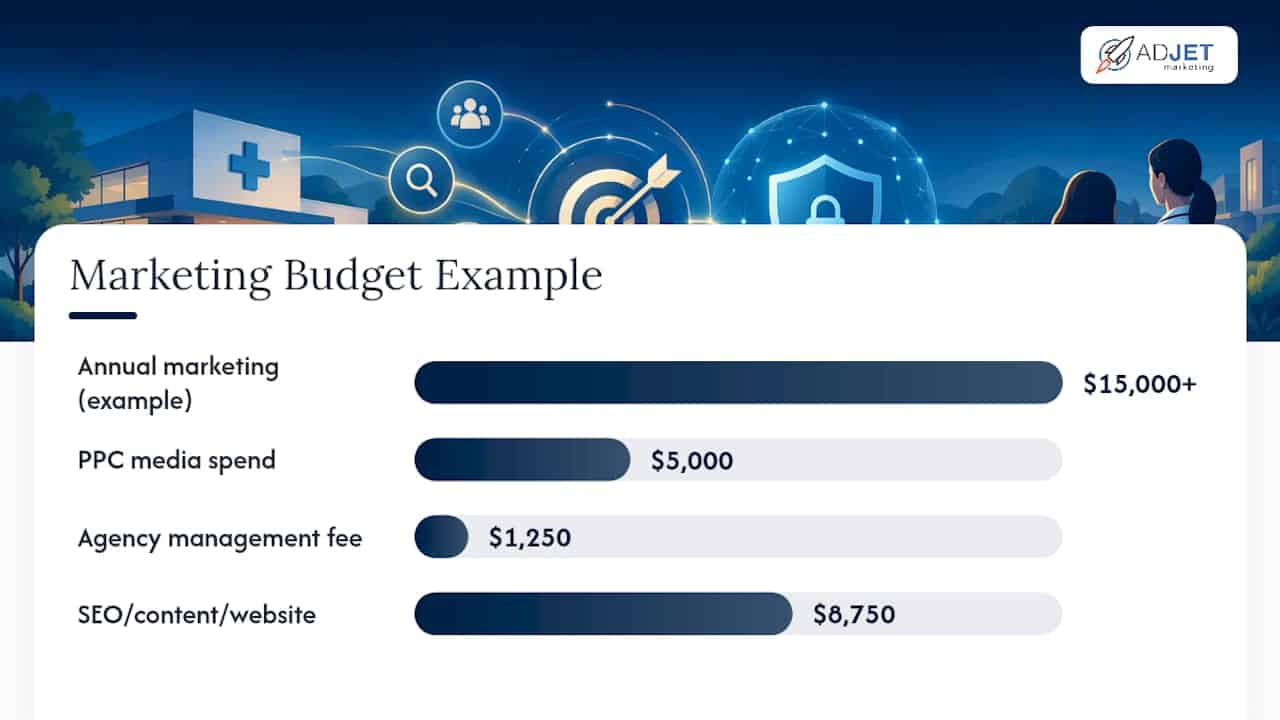
PPC shouldn’t be planned in isolation. Most independent practices allocate 1% to 5% of gross revenue to marketing overall, with many landing at $15,000 or more annually once they’re past the startup phase. PPC typically represents one piece of that total, alongside SEO, content, and website investment, not the entire marketing line.
A reasonable split for a growing clinic looks like PPC covering immediate lead flow while SEO and content build toward lower long-term cost per lead. PPC delivers patients this month; SEO compounds over six to twelve months and eventually reduces your dependence on paid clicks entirely. Clinics that pour everything into PPC without ever investing in organic visibility tend to stay permanently dependent on rising auction prices.
If you’re working with an agency, factor in management fees as part of your total marketing line, not as a surprise on top of it. Agency fees for PPC management commonly run around 25% of ad spend in independent practice surveys, so a $5,000 media budget might carry roughly $1,250 in management costs on top. Build that into your total marketing allocation from the start rather than discovering it after signing a contract.
How Should Seasonality Change Your Clinic’s PPC Budget?
Patient demand isn’t flat across the calendar, and neither should your budget be. Aesthetic and cosmetic services often see demand climb ahead of summer and holiday seasons, when patients want results visible for events or vacations. Mental health search volume tends to spike in January and again in the fall, tied to New Year’s resolutions and seasonal mood shifts. Elective procedures frequently dip during December as patients delay spending, then surge again in Q1.
The practical move is building seasonal flex into your annual plan rather than running the same flat monthly budget all year. Increase spend 20% to 30% ahead of your specialty’s known demand window, and pull back during predictable slow periods rather than maintaining full spend against a shrinking pool of searchers. If you don’t have a full year of data yet, check Google Trends for your core service terms. It’s a free way to spot seasonal patterns before you commit budget against them.
Don’t confuse a seasonal dip with a broken campaign. If your CPL rises every December and every clinic in your specialty sees the same pattern, that’s the market, not your account. Reacting by slashing budget entirely during a temporary lull can mean losing auction position right before demand picks back up again.
How Do You Adjust Your Budget During Market Disruptions?
Economic downturns, local competitor launches, algorithm updates, or even a public health event can all shift your PPC math overnight. The instinct many clinic owners have is to cut budget entirely when uncertainty hits, but that’s often the wrong move for a lead-generation channel that depends on consistent data.
A better approach: protect your highest-margin, most essential service lines first, and trim discretionary or lower-value campaigns before touching your core revenue drivers. If overall ad costs spike because a new competitor enters your market, revisit your target CPA calculation rather than assuming your account is broken. Sometimes the honest fix is raising your allowable CPL because treatment value has grown, and sometimes it’s recognizing the market has genuinely gotten more expensive and adjusting expectations accordingly.
During a true emergency, like a sudden clinic closure risk or a supply shortage affecting your core service, pause campaigns for services you can’t currently deliver rather than letting Google keep serving ads for appointments you can’t book. Redirect that budget toward services you can still fulfill. The worst outcome is spending on ads that generate leads your front desk then has to turn away, which damages both your budget efficiency and your reputation.
Your One-Week Action Plan for Setting a Clinic PPC Budget
You don’t need a consultant to get started this week. Pull your average treatment LTV, your consultation-to-booking close rate, and your lead-to-consultation rate from whatever records you already keep. Run the formula from the calculation section above for your two or three highest-volume services. Set separate campaign budgets for each, with your highest-margin service protected first. Confirm your tracking setup is privacy-safe and that any vendor touching patient data has a signed BAA. Then commit to a 30-day test window before judging results, since Google’s own systems need that runway to stabilize.
If you’re comfortable reading campaign data weekly and adjusting bids yourself, DIY management can work for a single-location clinic with modest spend. Once you’re running multiple service lines, multiple locations, or a budget above roughly $5,000 a month, the time cost of managing it properly usually exceeds what agency fees would run.
— Felix
How AdJet Marketing Helps Clinics Turn Budget Into Booked Patients
Unlike hiring a generalist agency that splits attention across dozens of unrelated industries, Adjetmarketing works specifically with medical clinics and aesthetic practices, which means the budget conversation starts from LTV and close rates instead of generic benchmarks. Many clinics come to us after burning through a budget with poor lead quality or a landing page that never matched the ad promise, and the fix is usually less about spending more and more about restructuring where that spend goes.
Our Google Ads management builds campaigns around the service-line ring-fencing described above, paired with conversion rate optimization so your existing traffic converts at a higher rate before you increase spend. If your current site is the bottleneck, landing page design starts at $99 per month for a Custom Landing Page, with the Starter Plan at $299 per month for clinics ready for a fuller build. Most engagements begin with a 30 day data collection window, matching the learning period Google itself recommends, before we make major bidding changes. If you want a second read on your current numbers, that’s a conversation worth having before your next budget cycle starts.
This article is general information, not a substitute for advice from a qualified doctor. Consult a qualified healthcare professional about your own circumstances before acting on anything here.
Sources
- Hhs
- Discover healthcare marketing budget benchmarks for independent practices — The Intake (Tebra)
- About Google Ads learning period — Google Ads Help
FAQ
What Does PPC Mean in Healthcare?
PPC, or pay-per-click advertising, means paying only when someone clicks your ad, typically running on Google Search or social platforms to drive patients toward booking a consultation. For clinics, it’s usually paired with conversion tracking that measures calls, form submissions, and booked appointments rather than just clicks.
How Much Does PPC Usually Cost for a Clinic?
Costs vary enormously by specialty, with overall healthcare search ads averaging around $5.64 per click and $66.02 per lead, though dermatology often runs cheaper and mental health services often run higher. A realistic starting monthly budget for a single-location clinic is $1,500 to $5,000 while testing.
Why Is PPC So Expensive for Some Clinics?
PPC costs climb when competition for your keywords is high, your Quality Score is low due to a weak landing page, or your campaign targets broad match keywords that pull in irrelevant clicks. Improving landing page relevance and tightening match types often lowers cost per click faster than simply raising bids, since Quality Score directly affects the price you pay.
How Much Does a Full PPC Campaign Cost Including Management?
Beyond ad spend itself, agency management fees commonly run around 25% of the ad budget based on independent practice surveys. Landing page and campaign services are listed with current pricing on the site for various plans.
How Long Before a Clinic PPC Campaign Shows Real Results?
Google Ads needs a learning period, generally two to eight weeks, before automated bidding stabilizes and delivers predictable cost per acquisition. Plan for a 30-day minimum test window before judging whether a budget or campaign structure is working.