









Most healthcare providers assume any web designer can build their practice website. That assumption is costly. A medical website design company does far more than make your site look professional. It builds a digital presence that handles patient-identifiable data responsibly, satisfies HIPAA requirements, loads fast on every device, and converts visitors into booked appointments. Generic designers rarely understand these layers. This guide covers what to look for, what to budget, what mistakes to avoid, and how the right partner supports your practice’s long-term growth.
Table of Contents
- Key takeaways
- What sets a medical website design company apart
- How to evaluate the right partner
- Understanding what medical web design costs
- Common mistakes when working with designers
- How specialization supports your practice growth
- My perspective on choosing the right design partner
- How Adjetmarketing helps healthcare practices grow online
- FAQ
Key takeaways
| Point | Details |
|---|---|
| Compliance must come first | HIPAA architecture built into the initial design prevents costly delays and security gaps later. |
| Budget realistically | Medical website projects range from $3,000 to $30,000+ depending on complexity, integrations, and compliance requirements. |
| Specialization matters | A designer with healthcare experience understands patient workflows, regulatory obligations, and medical SEO in ways general designers do not. |
| SEO drives patient acquisition | Technical SEO built into your site’s foundation improves both search rankings and patient trust from day one. |
| Ongoing support is non-negotiable | Post-launch maintenance protects compliance, closes security vulnerabilities, and keeps your site aligned with updated regulations. |
What sets a medical website design company apart
The most common misconception we hear from clinic owners is that healthcare web design is just “regular web design with a medical theme.” It is not. The difference sits in the technical and regulatory architecture underneath the surface.
A patient-centric healthcare site must be accessible across all devices, comply with data security laws, and support clinical workflows to build loyalty and trust. That means your designer needs to think about how patients actually use your website. They are often anxious, in pain, or searching for reassurance. A confusing navigation or a form that fails on mobile creates friction at exactly the wrong moment.
Core features that belong in every medical site
- HIPAA-compliant data handling. Any contact form, appointment request, or chat feature that collects patient information is a potential liability if not properly secured. Your site’s architecture must treat protected health information (PHI) with the same care as your clinical staff.
- Appointment scheduling and patient portal integration. These are not optional add-ons. Patients expect to book online. Integrating scheduling tools like a HIPAA-compliant booking system directly into your site reduces front-desk load and improves conversion rates.
- Responsive medical website design. More than 60% of healthcare searches happen on mobile. A site that behaves differently on a phone than on a desktop loses patients before they reach your contact page.
- Accessibility compliance. ADA accessibility standards apply to healthcare websites. This includes proper color contrast, screen-reader compatibility, and keyboard navigation support.
- Local SEO structure. Technical SEO for healthcare includes fast loading, mobile optimization, and secure browsing as factors that influence both rankings and patient trust. Your site needs schema markup, optimized location pages, and a Google Business Profile that connects to your web presence.
Pro Tip: Ask any design candidate to show you a healthcare site they built that has an active patient portal. How it handles form submissions and data storage tells you immediately whether they understand HIPAA or are just using the word.
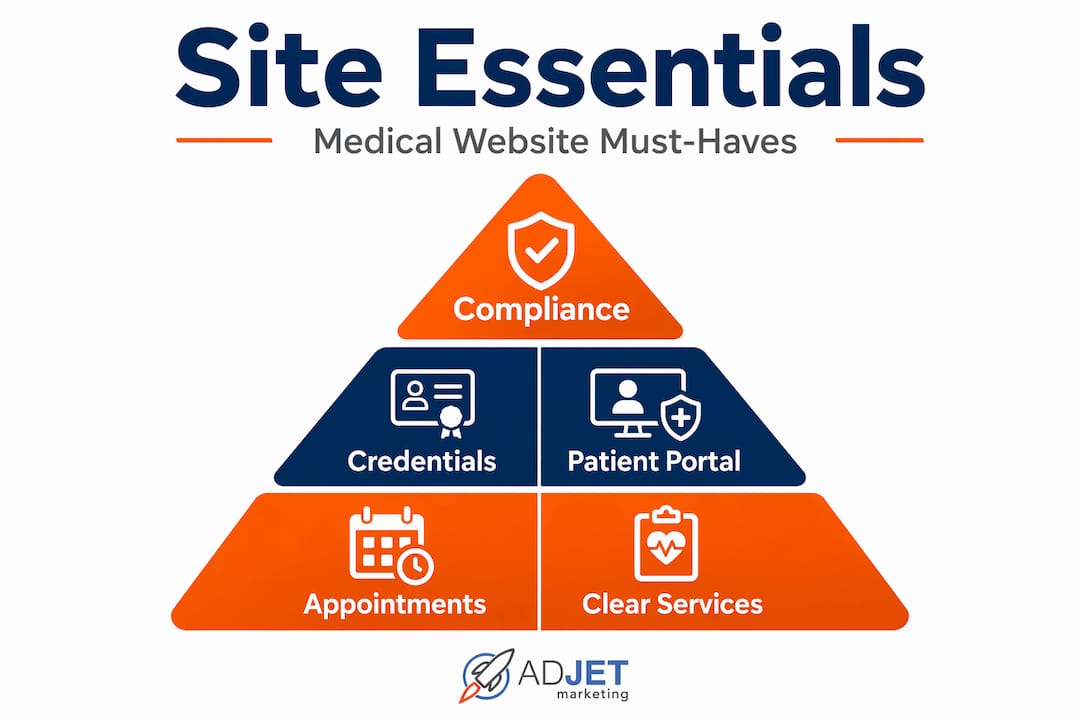
Patients value transparent web experiences that communicate credentials and services clearly while simplifying appointment scheduling. Your site’s design decisions should reflect that psychology at every step.
How to evaluate the right partner
Choosing a medical website design company is a business decision with real compliance implications. The selection criteria matter more here than in almost any other industry.
Start with portfolio evidence. Ask specifically for healthcare clients, not just “professional services.” A plastic surgery practice, a pain management clinic, and a mental health therapy group all have different compliance needs and patient journeys. A designer who has built for one of these understands the stakes.
- Verify regulatory knowledge. Can they explain Business Associate Agreements (BAAs)? Do they know which third-party tools require one? If they look confused when you mention BAAs, they are not the right fit for medical website development.
- Check their custom vs. template approach. Many healthcare websites start on generic builders, but custom solutions better support growth, scalability, and compliance. Templates can work at low cost entry points, but they often create hidden problems with integrations and SEO flexibility down the line.
- Ask about ongoing support. Who handles the site after launch? Security patches, plugin updates, and regulatory changes do not pause after go-live. You need a maintenance plan with a named point of contact.
- Evaluate their digital marketing integration. A site that looks great but does not attract traffic is a liability, not an asset. The best medical web design services include SEO groundwork, Google Ads compatibility, and conversion tracking from the start. Review their patient lead SEO strategies to understand how they think about growth beyond design.
- Assess pricing transparency. Vague proposals with large ranges often signal a company that does not have a repeatable process. Ask for itemized quotes that separate design, development, compliance features, and ongoing support.
Outsourcing medical website design to specialized companies saves time, reduces risk, and provides scalability that in-house development cannot match for most healthcare providers. This is especially true for practices that want to grow without hiring a full internal marketing team.
Understanding what medical web design costs
Healthcare website projects carry costs that general web projects do not, and knowing the ranges upfront prevents budget surprises.

Professional healthcare website design typically costs between $3,000 and $30,000 or more, with ongoing monthly subscriptions starting around $200. The wide range reflects genuine differences in scope.
| Project type | Estimated cost | What drives the range |
|---|---|---|
| Simple informational site (5-10 pages) | $3,000 to $7,000 | Basic design, no patient portal, limited integrations |
| Mid-tier clinic site with scheduling | $8,000 to $18,000 | Booking integration, local SEO setup, responsive design |
| Full custom healthcare platform | $20,000 to $30,000+ | Patient portal, EHR integration, full compliance architecture |
| Monthly maintenance and hosting | $200 to $800/month | Security updates, content changes, SEO monitoring |
HIPAA and regulatory compliance integration increases medical website development costs by 20 to 35%, reflecting essential architectural requirements. This is not padding. It is the cost of building the site correctly the first time.
Pro Tip: When comparing quotes, separate the one-time build cost from the recurring support cost. A company charging $5,000 upfront with no maintenance plan may cost you more in emergency fixes within 12 months than a $10,000 project with a structured support agreement.
The upfront vs. subscription model debate is worth understanding. Some agencies offer lower build fees paired with monthly retainers that cover hosting, updates, and support. Others charge a full build cost upfront. Neither is inherently better. The right model depends on your cash flow and how much control you want over the ongoing relationship.
Common mistakes when working with designers
Many practices run into the same problems. Recognizing these pitfalls early saves you time, money, and compliance risk.
- Hiring non-specialized designers. A designer who has built restaurant websites and e-commerce stores has not encountered HIPAA, BAA obligations, or healthcare-specific UX patterns. The learning curve happens on your project, at your expense.
- Treating compliance as a post-launch task. Embedding HIPAA compliance from the first development stage reduces remediation costs and launch delays significantly. Bolt-on compliance after launch can cost two to three times more and cause months of delays.
- Ignoring mobile and accessibility requirements. Designing for desktop first and adjusting for mobile later creates structural problems that are expensive to fix. Accessibility compliance is also a legal requirement for healthcare providers, not a nice-to-have.
- Neglecting SEO from day one. Technical SEO in healthcare is not only about rankings. It directly impacts patient data privacy perceptions and establishes trust through site security and performance. Skipping it limits your patient acquisition from the moment you launch.
- Skipping ongoing support planning. Failure to plan for ongoing maintenance creates security vulnerabilities and outdated compliance, harming both patient trust and your SEO performance over time.
- Prioritizing aesthetics over function. A visually impressive site that makes it difficult to book an appointment or find your location has failed its primary job. Patient conversion depends on function first, design second.
How specialization supports your practice growth
Working with a dedicated medical website design company is not just about avoiding problems. It creates real, compounding advantages for your practice over time.
- Targeted local SEO brings in patients who are ready to book. When your site is built with healthcare keyword structures and local search signals in place, you attract patients searching specifically for your specialty in your area. This is far more efficient than broad digital advertising. The digital marketing guide for healthcare clinics breaks down how these strategies work together.
- Secure, reliable data handling builds patient confidence. Patients who see clear privacy disclosures, secure forms, and professional design are significantly more likely to share their information and complete a booking. Trust is a conversion factor.
- Better user engagement reduces no-shows and increases referrals. Sites with clear service pages, staff bios, and easy scheduling reduce appointment anxiety and give patients confidence before they arrive. Satisfied patients who had a smooth digital experience are more likely to refer.
- Compliance maintenance protects your practice from liability. Regulations change. HIPAA guidance evolves. An ongoing relationship with a specialized company means your site adapts without you needing to monitor regulatory updates yourself.
- Video content on your clinic site increases patient confidence, and clinic websites with professional video content are increasingly effective at converting visitors who are comparing multiple providers. A specialized design team can structure your site to integrate video without sacrificing load speed or compliance.
My perspective on choosing the right design partner
I have worked with dozens of medical practices at Adjetmarketing, and the pattern is consistent. Practices that come to us after a bad experience with a general web designer almost always share the same story. They chose based on price or a portfolio that looked polished. The designer delivered something that looked good in screenshots but failed in practice. Forms were not HIPAA-compliant. The site loaded slowly on mobile. SEO was an afterthought. The redesign cost more than the original build would have if they had started with the right partner.
What I have learned is that compliance complexity gets underestimated almost every time. Clinic owners hear “HIPAA-compliant website” and assume it means adding an SSL certificate and a privacy policy. It is much more layered than that. It includes how form data is stored and transmitted, which third-party tools are running on your site, how analytics are configured, and whether your hosting provider has signed a BAA.
The other thing I see missed repeatedly is the connection between the website and the full medical SEO strategy. A great site with no traffic strategy is a brochure, not a growth tool. The best outcomes I have seen come from practices that treat their website and their patient acquisition strategy as a single system, not two separate projects.
My practical advice: communicate your growth goals clearly before design begins. If you want to rank for pain management services in your city, that affects your site architecture, not just your blog. If you plan to run Google Ads in six months, your landing pages need to be built for that from the start. Early clarity makes the whole project faster and more effective.
— Felix
How Adjetmarketing helps healthcare practices grow online
At Adjetmarketing, we work specifically with medical clinics, aesthetic practices, plastic surgeons, mental health therapists, and pain management providers. We understand the importance of marketing in healthcare and build websites that connect your practice to the patients who need you.
Our web design services combine compliance-first architecture with conversion-focused design and technical SEO built in from day one. We do not hand you a site and disappear. We provide ongoing support, handle Google Ads campaigns that feed directly into your site’s landing pages, and track the metrics that actually matter: booked appointments and patient inquiries.
If you are ready to build a medical website that works as hard as you do, we would be glad to talk through what your practice needs. Reach out to Adjetmarketing for a consultation tailored to your specialty and growth goals.
FAQ
What does a medical website design company actually do?
A medical website design company builds HIPAA-compliant websites tailored to healthcare workflows, including patient scheduling, secure data handling, local SEO, and patient-centered UX. They go beyond aesthetics to address regulatory and conversion requirements specific to healthcare providers.
How much does a medical website cost in 2026?
Medical website projects typically range from $3,000 to $30,000 or more depending on complexity, integrations, and compliance features, with monthly maintenance starting around $200.
Why can’t I just use a general web designer?
General designers rarely understand HIPAA, BAA obligations, or healthcare-specific patient experience patterns. Non-compliant design choices can create legal liability and cost significantly more to fix after launch than building correctly from the start.
How long does healthcare website development take?
Most healthcare website projects take between 8 and 16 weeks depending on scope, the number of integrations required, and how quickly the client provides content and feedback. Compliance reviews can add time if not planned for early.
Does my medical website need ongoing maintenance?
Yes. Failure to maintain your site post-launch creates security vulnerabilities and outdated compliance features that harm both patient trust and your search rankings over time. A structured maintenance plan is part of responsible medical website ownership.
Recommended
- Medical SEO: How Clinics Boost Visibility And Patient Leads
- Essential Tips For Creating A High-Converting MedSpa Website – AdJet Digital Marketing & Google Partner Agency | SEO Development Google Ads Social
- Elevate Your Online Presence: Essential Website Design Tips For Therapists – AdJet Digital Marketing & Google Partner Agency | SEO Development Google Ads Social