









A clinic script is a short written guide that tells whoever answers the phone what to say, what to ask and when to hand a caller to someone else. Done well, it gives every caller the same clear, warm experience and keeps front-desk staff from improvising on privacy or clinical questions. This guide shows how to build one for a medspa, therapy practice, pain clinic, imaging center or similar practice, and why the phone is where your marketing spend is either won or lost.
TL;DR
- Write scripts as a minimum service standard with room for personality, not as a word-for-word recording. Federal patient-experience guidance says the same.
- Prepare separate scripts for new-patient inquiries, scheduling and cancellations, prescription or results questions, billing, urgent calls and upset callers.
- Verify identity with more than a name, and never read a caller’s details back to them. Let them state the details and confirm.
- Staff schedule and route. A physician or licensed clinician owns anything that needs clinical judgment.
- Review call outcomes regularly: wait times, resolution and patient experience. Then rewrite the script.
Table of Contents
- Why the phone call is where marketing pays off
- What a good clinic script does
- Which calls need a script
- Phone menus and routing
- Script templates you can adapt
- Questions that need clinical judgment
- Privacy and identity checks in the script
- Training staff to use scripts and still sound human
- Measure and improve over time
- Our perspective
- Getting more of the right calls
- FAQ
- Sources
Why the phone call is where marketing pays off
Most clinic marketing ends in one of two actions: a form submission or a phone call. Google Ads, local SEO and a good landing page all aim to get a prospective patient to contact you. If that call reaches a rushed greeting, a long hold or an unsure answer, the click you paid for is gone.
This is why we treat call handling as part of lead generation rather than an office-management afterthought. A clinic can have strong rankings and well-built ads and still lose patients in the first 30 seconds of conversation. For a broader view of the pipeline that feeds your phones, see our patient lead generation playbook.
A script is the cheapest fix for this. It costs staff time to write and train, and it makes every caller’s first impression of your practice predictable.
What a good clinic script does
The goal is not to make staff sound like a recording. The AHRQ patient-experience guide says scripts should set a minimum positive standard of service without making staff sound robotic. It also offers a small example of the principle: replacing “I don’t know” with “I think I can help you find the answer.” The same guidance describes scripts as creating shared expectations while leaving room for each person’s personality.
Three practical rules follow from that:
- Script the structure, not every word. Fix the greeting, the questions you must ask and the handoff points. Let staff phrase the rest.
- Write for the ear. Short sentences, plain words, no insurance or clinical jargon the caller did not use first.
- Cover the frequent questions in writing. The AHRQ Health Literacy toolkit recommends written scripts for frequently asked questions so staff give clear, consistent answers. Hours, parking, what to bring, how first visits work and what a consultation includes are good starting points.
The American Dental Association’s phone guide adds delivery advice that applies to any specialty: a warm greeting, speaking slowly and clearly, and listening without interrupting. It also advises adapting scripts until they sound natural in your own voice.
Which calls need a script
Start by listing the calls your front desk actually receives. A typical list for a clinic looks like this, and the American College of Gastroenterology’s telephone guide names several of the same categories: scheduling and cancellations, care coordination, results follow-up, prescription issues and patient satisfaction.
| Call type | What the script must do | Who takes over |
|---|---|---|
| New-patient inquiry | Greet, capture name and number, ask what brings them in, offer the next available slot, confirm how they found you | Front desk books it |
| Scheduling, rescheduling, cancellation | Verify identity, confirm the appointment, offer alternatives | Front desk |
| Results, prescription or medication questions | Take a clear message, verify identity, set a callback expectation | Nurse or clinician |
| Billing and insurance | Verify identity, route to the right person | Billing staff |
| Urgent or distressed caller | Stay calm, follow your urgent-call protocol | Clinician or emergency services |
| Complaint | Listen, acknowledge, avoid defending, escalate | Practice manager |
The new-patient row deserves the most care because it is the call your marketing created. Track which campaign or page produced each one so you can tell good lead sources from poor ones. Our guide to converting website visitors into new patients covers what happens before the phone rings.
Phone menus and routing
If you use an automated menu, keep it short. AHRQ recommends a menu with no more than five choices, including a direct option to speak to a person and an option to repeat the menu. It also says menus should offer languages commonly spoken by your patients and that a human option should always be available.
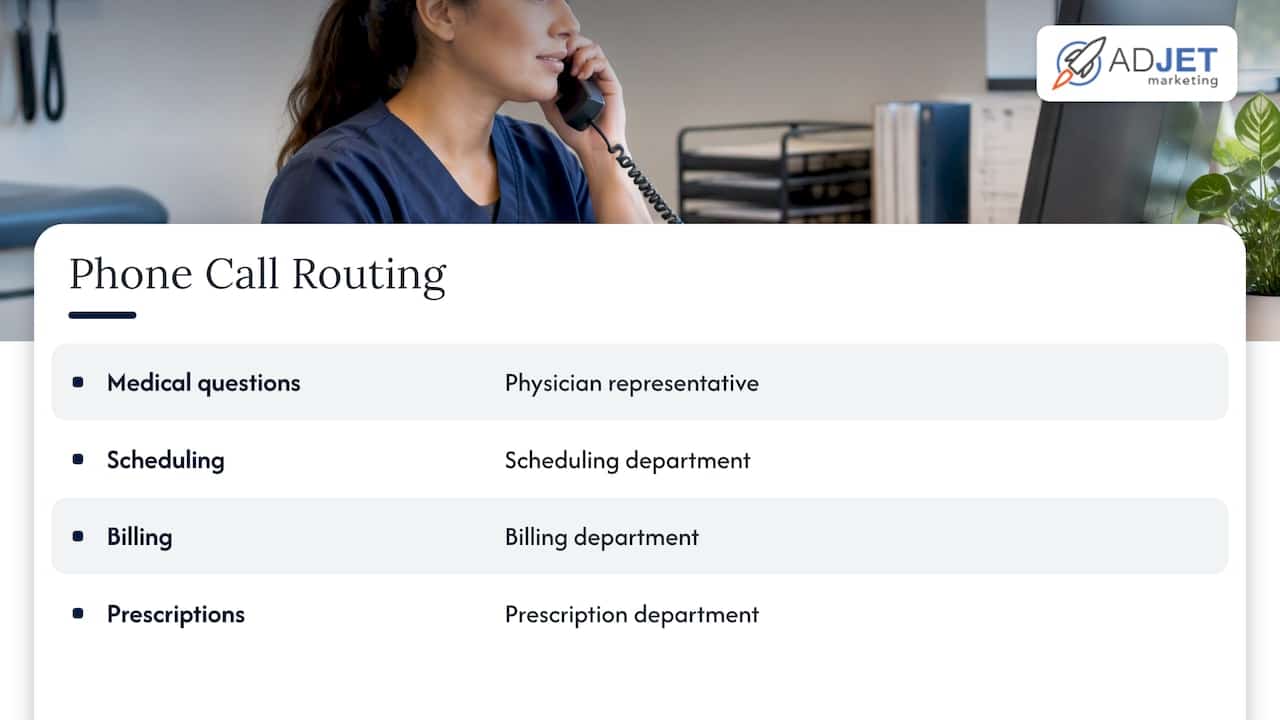
The ACG guide recommends a simple decision tree, an early option to reach a physician representative for medical questions, and routing of scheduling, billing and prescriptions to the right departments. In a small practice, the “departments” may be two people. The principle holds anyway: the caller should not have to repeat their story.
Script templates you can adapt
The templates below are starting points we wrote for this article. Change the words until they sound like your front desk.
The opening
The ADA’s sample greeting is a good model: “Good (morning/afternoon). Thank you for calling (practice name). This is (greeter’s name). How may I (we) help you?” It is published in the ADA phone-call guide. Keep it that short. Callers decide quickly whether they are talking to someone attentive.
New-patient inquiry
A workable flow:
- Greet and ask for the caller’s name and best callback number first, so you can reconnect if the call drops.
- Ask an open question: “What are you hoping we can help with?”
- Listen without interrupting, then repeat back what you heard in one sentence.
- Explain the next step in plain terms: “The first visit is a consultation. I can offer Tuesday at 10 or Thursday at 2.”
- Ask how they found you. Record the answer in your tracking sheet or CRM.
- Confirm the appointment, address, arrival time and anything to bring.
Offer two specific times rather than asking “when works for you?” It moves the call toward a booking and is easier for the caller.
Urgent calls
Specialties differ here, so build this script with your medical director or clinical lead. The ADA gives a pattern for dental practices: try to arrange same-day care for emergency callers, and if that is not possible, explain the situation and refer the patient to a trusted colleague or suggest where they can be seen sooner. For a model of how a practice presents same-day dental emergency care to callers, look at how the service is described and what the patient is asked to do first.
For pain, psychiatry and mental health practices, the script should name the symptoms or statements that move a call straight to a clinician or to emergency services, and tell staff exactly what to say while that happens. Your clinical lead writes that list, not the front desk.
Upset callers
The ACG guide recommends training staff in active listening, practice operations, handling upset patients and crisis de-escalation, with continuing coaching and supervision. A simple pattern to script: let the caller finish, acknowledge the frustration, state what you can do now, and give a time for the follow-up. Do not argue about facts on the first call.
Questions that need clinical judgment
A script should make it obvious where staff stop. The American College of Physicians’ telephone-triage policy warns that triage by phone can be impaired by inadequate documentation, failure to speak directly with the patient and misjudging urgency. It recommends physician oversight and review of scripts and protocols.
In practice, that means:
- Front-desk staff schedule, route and take messages. They do not interpret symptoms, side effects, results or medication questions.
- The script gives a ready phrase for the handoff: “That’s a question for our nurse. I’ll make sure she gets your details and calls you back by end of day.”
- Every clinical message is documented the same way: who called, what they said in their own words, when, and who received it.
- A licensed clinician reviews the script and protocols on a schedule.
Privacy and identity checks in the script
Phone scripts are where privacy mistakes happen, because staff are trying to be helpful. Build these habits into the wording:
- Use more than a name. The ONC SAFER guide on patient identification says names alone are not enough and recommends multiple identifiers to reduce wrong-patient errors. Ask for full name plus date of birth, for example.
- Let the caller state the detail. A 2025 privacy-training document from UC Irvine advises asking callers to state identifiers rather than revealing a value and asking them to confirm it. Say “Can you tell me your date of birth?” and not “Is your birthday March 3?”
- Check consent before talking to family or friends. The same document advises checking restrictions and patient consent before sharing protected health information with a relative or friend. Add a line to the script: “I can’t share details without the patient’s permission on file. I can take a message.”
- Keep voicemails minimal. Leave your practice name and a callback number. Put appointment reasons and clinical details in a secure channel instead.
Privacy rules and state requirements change, so have your compliance officer or healthcare attorney review the finished script. The same applies to call recording: check which notices and consents your state requires before you record.
Training staff to use scripts and still sound human
The script is only as good as the person reading it. A routine that works for most small teams:
- Read it aloud together. Anything that sounds stiff gets reworded on the spot.
- Role-play the hard calls first. Upset callers, privacy requests and urgent symptoms are the calls where a script earns its place.
- Give a one-page cheat sheet. The opening, the five questions to ask, the handoff phrases and the escalation contacts. Keep it by the phone.
- Coach in the first month. Sit with new staff for a handful of calls and give feedback right after, as the ACG recommends with continuing coaching.
- Let staff flag what does not work. They hear the real questions every day and will tell you which line callers keep stumbling over.
The ADA’s reminder that tone, listening, clarity and empathy shape both the immediate experience and a prospective patient’s impression of the practice is the right training goal. You are not teaching lines. You are teaching a conversation with a safety net.
Measure and improve over time
A script that is never reviewed drifts. The ACG guide recommends tracking wait times, issue resolution and patient experience as process-improvement measures, and says physicians should stay involved in the telephone process.
For a clinic that markets itself, add the marketing view:
- Answer rate. How many calls from ads and organic search were answered live?
- Booking rate. Of the new-patient inquiries, how many became appointments?
- Source quality. Which campaigns produce callers who book, and which produce price shoppers or wrong-fit calls?
- Missed-call follow-up. How fast does someone call back, and what do they say?
Review a sample of calls each month with your clinical lead and practice manager, rewrite the two lines that cause the most friction, and repeat. Call data belongs next to your ad and SEO reporting, because it shows whether your traffic is the right traffic. Our online booking conversion guide looks at the same question from the website side.
Our perspective
Clinics often judge their marketing by the number of leads and judge their front desk by whether the phones got answered. Those are the same problem. A campaign can send a steady stream of calls, and if the first ninety seconds of each one is rushed or unclear, the lead report looks fine while the schedule stays empty.
We build landing pages, Google Ads and SEO around getting the right patient to contact you, and we report on what those efforts produce with data-backed reporting. The script is the other half of that. Our view is that a clinic should know which pages and campaigns lead to calls, and which of those calls become booked appointments. That is also how a script gets better: from real outcomes, not guesses.
Be realistic about timing. A new script helps within weeks, but ad and SEO results take longer to read, and neither works without the other. Keep the script simple, keep clinical decisions with clinicians, and keep privacy in every line.
Felix
Getting more of the right calls
A good script handles the calls you already get. To get more of the right ones, the landing page and campaign need to be set up to attract patients who fit your services. We are a Google Partner agency, and we manage Google Ads and SEO for medical, aesthetic and mental health practices, with HIPAA-compliant processes. Our landing page plans start with a Starter Plan at $299 per month, and custom landing pages are available from $99 per month. Pricing for SEO and Google Ads management is not published, so those start with a conversation about your goals and budget.
FAQ
How long should a clinic call script be?
Keep the opening to two sentences and the whole new-patient flow to about six steps. Anything longer gets ignored under pressure. Put detail in a one-page cheat sheet for specific call types rather than one long document.
Should staff read scripts word for word?
No. Federal patient-experience guidance describes scripts as a minimum service standard that still leaves room for each staff member’s personality. Fix the structure, the required questions and the handoffs, and let the wording sound like your team.
What should a script say when a caller asks a medical question?
It should give staff a calm handoff phrase, a way to document the question and a promised callback time. Staff do not answer the question themselves. A nurse or physician does, and a clinician should review the protocols that decide which calls go where.
How often should we update our scripts?
Review them on a regular schedule, such as monthly at first and then quarterly. Update them sooner when call data shows a repeated problem, when services or hours change, or when privacy requirements change.
Sources
- AHRQ Health Literacy Universal Precautions Toolkit, 2nd edition
- AHRQ CAHPS: Strategies for Improving Patient Experience, customer service
- American Dental Association: Patient Phone Calls, Standard Telephone Greetings and Scripts
- American College of Gastroenterology: Answering the Call, Improving Telephone Management
- American College of Physicians: Telephone Triage policy (2000)
- ONC SAFER Guide 6: Patient Identification (August 2024)
- UC Irvine Privacy and Security Training (2025)