









There is no single “Botox advertising policy” in the United States. There are several layers that apply at once: federal rules from the FDA and FTC, your state medical or nursing board, and the platform rules on Google and social media. The short version is that you can tell patients you offer botulinum toxin injections, but your ads must be truthful, substantiated and balanced, and on Google Ads the word “Botox” itself is where campaigns usually get stuck.
Many of the pages that rank for this phrase describe the UK, where advertising codes bar public promotion of prescription-only medicines. That is not the U.S. framework, and copying it can lead you to the wrong conclusions. Below is how it works for a U.S. clinic, med spa or practice, and how we set up campaigns around it.
TL;DR
- Federal law treats Botox as a prescription drug, so advertising claims about it must be truthful, substantiated and balanced with risk information.
- Google Ads monitors Botox and botulinum toxin terms under its healthcare and medicines policy, so plan your ads, keywords and landing pages around that restriction.
- Testimonials, before-and-after photos and influencer posts count as advertising claims, and paid relationships must be clearly disclosed.
- Your state board may add its own rules on who can inject, supervision and what an ad must include, so check it before launch.
- Compliant Botox marketing usually leads with the provider, the consultation and the concern, not the product name or a discount.
Table of Contents
- Why the UK rule keeps showing up in your search results
- What the FDA requires of prescription drug advertising
- What the FTC adds for clinics and med spas
- Can a clinic say it offers Botox?
- Botox advertising on Google Ads
- Testimonials, reviews and before-and-after photos
- Social media and influencer posts
- State rules and what can go wrong
- A compliance checklist before you launch
- Our perspective on Botox marketing
- Where AdJet can help
- FAQ
- Sources
Why the UK rule keeps showing up in your search results
Search this topic and the first pages explain that prescription-only medicines cannot be advertised to the public under UK advertising rules. Those are UK rules from UK bodies. They do not govern a clinic in Texas, Florida or California.
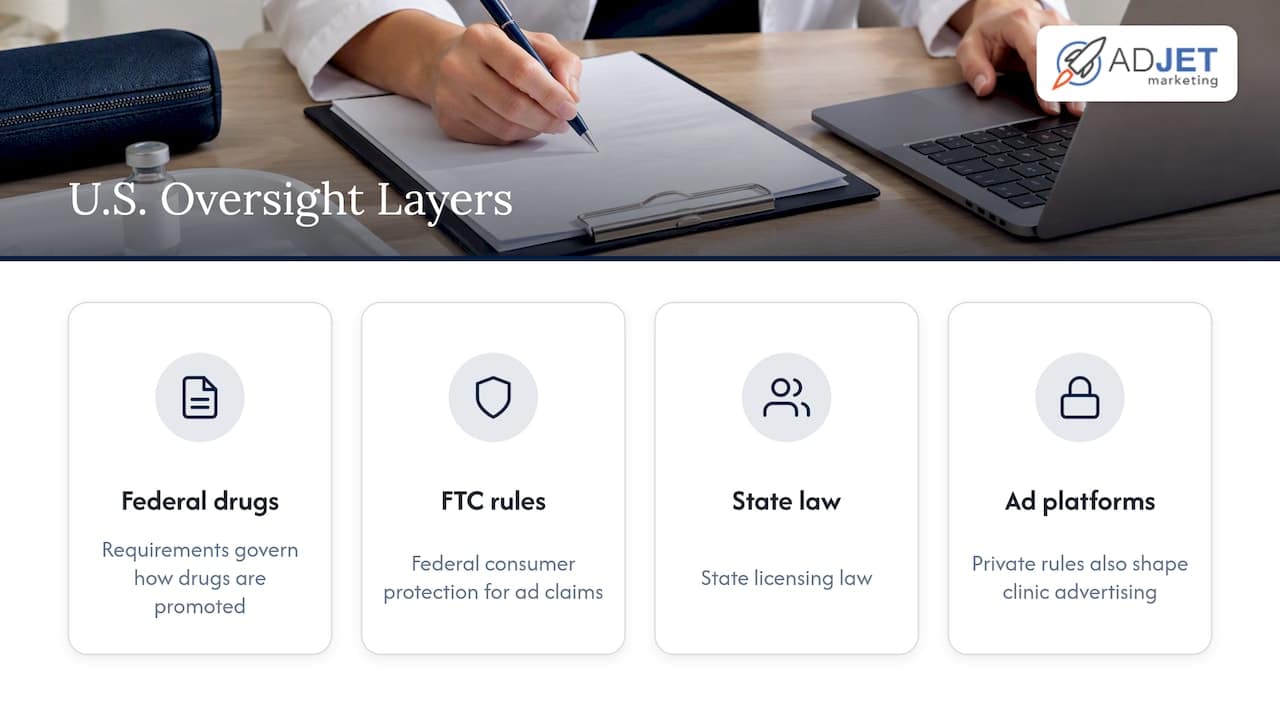
The U.S. approach is different in structure. It does not rely on one sentence that bans the word. It relies on a set of federal requirements for how drugs are promoted, a federal consumer protection regime for advertising claims, state licensing law, and the private rules of ad platforms. The result is more room to describe your services and more ways to get something wrong.
What the FDA requires of prescription drug advertising
The FDA’s advertising and promotional labeling framework points to 21 CFR 202.1 and sections of the Federal Food, Drug, and Cosmetic Act that address false, misleading or inadequately balanced claims. For an ad that is not a simple reminder, the rules call for a true brief summary covering effectiveness, side effects and contraindications.
Three details in 21 CFR Part 202 matter for a clinic writing copy:
- Effectiveness information has to accurately state the specific approved indications for the purposes claimed.
- Side-effect and contraindication information has to reflect the applicable labeling.
- Truthful risk information in one part of an ad does not cure misleading content elsewhere. Each claim or theme needs its own appropriate qualifications.
That last point is the practical one. A headline that promises a “wrinkle-free face” with a fine-print disclaimer at the bottom of the page does not fix the headline. Risk and limitation language has to travel with the claim.
In practice, much of the manufacturer-facing framework is aimed at the companies that make and market the drug. Clinics are still caught by the same principles through FTC enforcement and state law, which is why we write clinic ads as though every claim has to stand on its own.
What the FTC adds for clinics and med spas
The FTC says advertising claims must be truthful, non-deceptive and backed by evidence. Its advertising and marketing guidance expects substantiation before an ad runs, and its Health Products Compliance Guidance generally calls for competent and reliable scientific evidence for health-benefit and safety claims.
The same guidance explains how the agencies divide the work: the FDA has primary responsibility for claims in labeling and point-of-sale promotional materials, and the FTC has primary responsibility for claims in advertising. For a clinic, that means an ad, a landing page and an Instagram post can all be reviewed under the FTC lens, even if the product is FDA-regulated.
The guidance also treats implied claims as claims. A photo, a testimonial or a before-and-after pair can communicate “this is what you will get” without a single word of copy. If you cannot support that message, it is a problem.
Claims to avoid or handle carefully
| Claim type | Risk | Safer approach |
|---|---|---|
| “Guaranteed results” or “permanent” smoothing | Unsubstantiated certainty about an outcome | Describe what a consultation covers and what is typical |
| “Safe, painless, no downtime” | Overstates safety and omits risk | Explain that a licensed provider assesses suitability and discusses risks |
| Price-led offers such as per-unit specials | Pushes a prescription product as a commodity and can create unjustified expectations | Lead with a consultation and the provider’s expertise |
| “Best injector in the city” | Unsupported claim of exclusive skill | State training, credentials and years of experience you can document |
| Unusually dramatic photos | Implies results are typical | Use representative results with a clear statement of expected outcomes |
Can a clinic say it offers Botox?
Yes, with care. The CDC states that FDA-approved botulinum toxin is prescription-only and may be purchased only by people with a valid healthcare license. Saying that your licensed providers administer injectables is not the problem. The problems start when copy turns that service into an unsupported promise or a pitch for a drug product.
The FDA also has real enforcement attention here. In November 2025 it issued 18 warning letters to website owners marketing unapproved and misbranded botulinum toxin products. Those cases involved illegal products sold online rather than licensed clinics, but they show that the agency is watching how this product is marketed. Patients are told to receive injections from a licensed, trained provider and products from an authorized source, so those facts are worth building into your pages.
The CDC also warns that botulinum toxin can cause difficulty swallowing, trouble breathing and other serious symptoms if it spreads beyond the injection site, and that counterfeit or improperly handled products can be dangerous. A page that describes safety and risk plainly will do more for trust than a page that avoids the subject.
Botox advertising on Google Ads
This is where most clinics we speak with run into trouble. Google’s list of monitored prescription drugs under its healthcare and medicines policy includes Botox and botulinum toxin. Google’s healthcare and medicines policy also restricts the use of prescription drug terms in ads, landing pages and keywords, depending on location.
What that means for you:
- Ads that name the drug can be disapproved, and a disapproval on a landing page can affect a whole ad group.
- Policy review looks at the ad, the keyword and the page the click lands on, so a clean ad pointing to a page full of drug terms can still fail.
- Policies and enforcement change. Check the live policy before you build, and again before you scale.
We have seen clinics lose weeks of spend to disapprovals they could have avoided at the planning stage. Our Google Ads compliance checklist for clinics walks through the checks we run before launch, and our guide to negative keywords for healthcare campaigns covers how to keep irrelevant and risky searches out of your account.
How we structure campaigns around the restriction
We don’t promise that any particular wording will always be approved, because Google decides. What we do is reduce exposure:
- Build campaigns around the concern and the service category, such as wrinkle treatments, facial rejuvenation and injectable consultations.
- Keep ad copy focused on the provider, the location and the consultation.
- Make landing pages describe the treatment accurately, with provider credentials and a risk-aware explanation, instead of stacking product claims.
- Test small before scaling, and watch the policy status of every ad.
- Pair paid search with SEO so a disapproval does not take your whole lead flow with it.
If you are deciding where the budget goes, our comparison of Google Ads and Meta Ads for medspas explains the trade-offs.
Testimonials, reviews and before-and-after photos
The FTC’s Endorsement Guides treat testimonials and before-and-after presentations as advertising claims. An ad can convey that the depicted result is typical. When consumers cannot reasonably expect that outcome, the ad needs a clear disclosure of what is generally expected. A testimonial does not remove the duty to substantiate the claim it conveys.
The AMA’s Code of Medical Ethics goes in the same direction. Physician advertising should not omit material information, contain false or misleading statements, create unjustified medical expectations, or make unsupported claims about experience, quality or certainty of results. It also cautions that patient testimonials can mislead when they do not reflect the results comparable patients generally receive.
Some working rules we give clinics:
- Use photos that are unretouched, taken with consistent lighting and angles, and from real patients who gave written consent.
- Avoid using your single best result as the face of the campaign.
- State plainly that results vary.
- Do not pay for or incentivize reviews without disclosure.
- Keep patient identity and health information out of ads. If you retarget, read our healthcare remarketing audit first.
For a deeper look at photo use, see our med spa before and after rules.
Social media and influencer posts
The FTC has said that paid social-media influencers must adequately disclose that they are paid to promote a product. In a 2023 warning letter, it noted that video endorsements may need disclosures in the video itself, both visually and audibly when the endorsement is both, and that a platform label such as “Paid partnership” may not be conspicuous enough on its own.
For a clinic, this applies to:
- Influencers you comp or pay to post about a treatment.
- Staff who post about services from personal accounts.
- Patients who receive a free or discounted treatment in exchange for content.
Put the disclosure where an ordinary viewer will notice it right away, not in a buried hashtag list. Then keep a record of who posted what, because you are responsible for what you ask others to say about your services.
State rules and what can go wrong
Federal rules are only part of the picture. Your state medical board, nursing board or other licensing body may regulate who can inject, what supervision is required, how providers describe their credentials and what must appear in an advertisement. We are not a law firm and these rules differ across states, so confirm them with your board or a healthcare attorney before you launch a campaign.
On the federal side, the FDA identifies 21 U.S.C. 331, 332 and 333 as covering prohibited acts, injunction proceedings and penalties. Beyond legal exposure, the more common cost is the one you feel first: disapproved ads, suspended accounts and wasted spend.
A compliance checklist before you launch
- Confirm your state board rules on advertising and provider credentials.
- Have a licensed provider review every treatment claim for accuracy.
- Remove guarantees, absolute safety language and unsupported superlatives.
- Add clear risk and suitability language where the claim appears.
- Check Google’s current healthcare and medicines policy for your ads, keywords and landing pages.
- Document consent for every patient photo and testimonial.
- Put paid-relationship disclosures where viewers will notice them.
- Review live ads weekly for policy status and edit what is flagged.
Our perspective on Botox marketing
Many clinics come to us after a period of poor lead quality. The pattern is common: a discount-led offer brings price shoppers, the ads get flagged, the budget stalls, and the owner concludes that Botox cannot be advertised. In our experience that is the wrong conclusion. The better conclusion is that the offer and the structure were built around the product instead of the patient.
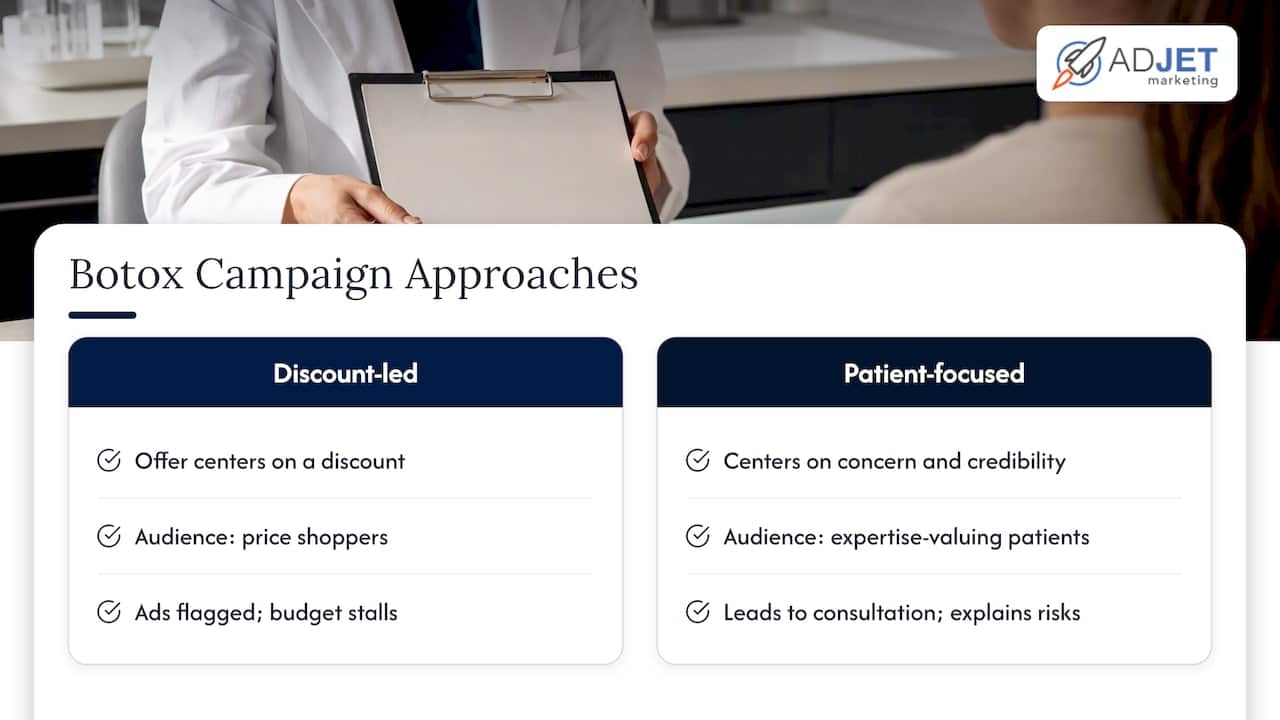
We build around the patient’s concern and the provider’s credibility. The campaign leads to a consultation, the landing page explains the process and the risks plainly, and the tracking is set up with privacy in mind. That approach tends to be more compliant, and it also attracts patients who value expertise over a coupon.
We also set realistic expectations. Paid search can produce inquiries within weeks once approved, but policy reviews, testing and tracking take time. SEO usually takes longer to build and then keeps working. For most clinics a mix is more resilient than either channel alone, and we say so before a contract is signed. None of this is a guarantee of results, and no honest agency should offer one.
— Felix
Where AdJet can help
If you want a compliant landing page that explains injectable services without relying on drug-name claims, our landing page plans start with the Starter Plan at $299 per month. If you want paid search managed with policy review built in, see our Google Ads services. We are a Google Partner agency and work with med spas, aesthetic practices and other healthcare providers.
FAQ
Can you advertise Botox treatments in the U.S.?
Yes, you can promote that your licensed providers offer injectable treatments, but the ads must be truthful, substantiated and balanced with risk information. Federal drug advertising rules, FTC claim standards and state board rules all apply. Platforms such as Google add their own restrictions on drug terms.
Can you use the word “Botox” in Google Ads?
Google lists Botox and botulinum toxin among the prescription drugs it monitors under its healthcare and medicines policy, and it restricts prescription drug terms in ads, landing pages and keywords depending on location. Disapprovals are common when the drug name is prominent. Read the live policy and test small before scaling.
Are before-and-after photos allowed?
They are treated as advertising claims. They should be real, consented, representative of what patients can expect and accompanied by a clear statement when results are not typical. Your state board may add further requirements.
Do influencer posts about Botox need a disclosure?
Yes. The FTC expects paid endorsers to disclose the relationship clearly, and a platform label alone may not be enough. Put the disclosure where viewers will see it, including in the video itself where relevant.
Sources
- FDA: Laws and regulations about advertising and promotional labeling
- eCFR: 21 CFR Part 202, Prescription Drug Advertising
- FTC: Advertising and Marketing
- FTC: Health Products Compliance Guidance
- CDC: How to stay safe when getting botulinum toxin injections
- Google Ads Help: Prescription drugs
- Google Ads Help: Healthcare and medicines
- FTC: Guides concerning endorsements and testimonials
- AMA: Code of Medical Ethics, Chapter 9
- FTC: Teami, LLC
- FTC: Warning letter to Adam Pecoraro