








Aesthetic clinic marketing services are specialized digital marketing strategies designed to increase a clinic’s online visibility, attract qualified clients, and generate consistent appointment bookings. Unlike general business marketing, these services account for the unique trust requirements, regulatory considerations, and local search behaviors that define the aesthetic treatment industry. The core channels include local SEO, Google Ads, content marketing, social media, and email automation. Platforms like Google Business Profile and tools like Patient Perfect play a direct role in how clinics acquire and retain clients. Done right, marketing for an aesthetic practice is less about promotion and more about building the kind of credibility that converts a curious searcher into a booked consultation.
What key digital marketing channels are essential for aesthetic clinics?
Aesthetic clinic marketing covers several distinct service areas, each serving a different stage of the client acquisition process. Understanding which channels to prioritize and why is the first decision you need to make.
Local SEO is the foundation. When someone searches “lip filler near me” or “Botox clinic in [city],” Google’s Map Pack determines who gets seen. Local cosmetic treatment searches have risen 127% in two years, which means the competition for those top three map positions has intensified significantly. Clinics that neglect local SEO are invisible to the most motivated buyers.
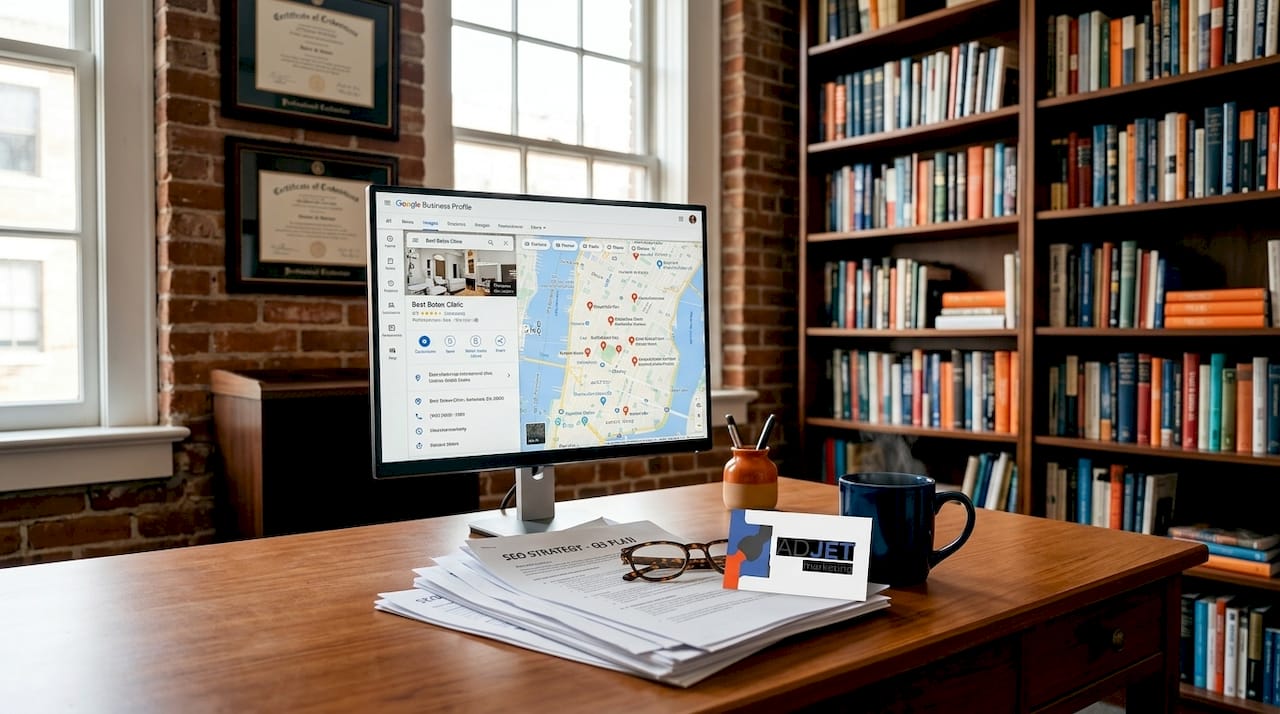
Paid advertising through Google Ads and Meta Ads fills the gap while organic rankings build. Google Ads targeting high-intent keywords like “dermal filler consultation” or “laser hair removal [city]” captures clients who are actively ready to book. Meta Ads work differently. They build awareness and retarget website visitors, which is particularly effective for higher-ticket treatments like body contouring or skin resurfacing.
Content marketing builds the trust that converts a visitor into a patient. Educational blog posts, “what to expect” videos, and myth-busting Reels address the questions clients are already asking before they pick up the phone.
Email marketing is the most underused retention tool in aesthetic practices. Personalized email campaigns yield an average of $36 to $42 return on every $1 spent when segmented by treatment history and client behavior. That return makes email one of the highest-ROI channels available to any clinic.
AI-powered tools are now practical, not experimental. AI technology enables personalized follow-ups, predictive treatment offers, and automated content repurposing without removing the human touch that aesthetic clients expect.
Pro Tip: Don’t try to activate every channel at once. Start with Google Business Profile and local SEO, add Google Ads for immediate visibility, then layer in content and email as your capacity grows.
How does local SEO and Google Business Profile drive measurable growth?
Google Business Profile (GBP) is the single most direct pathway to high-intent appointment bookings for any aesthetic clinic. It is the listing that appears in Google Maps and the Map Pack, which sits above organic search results for most local treatment queries.
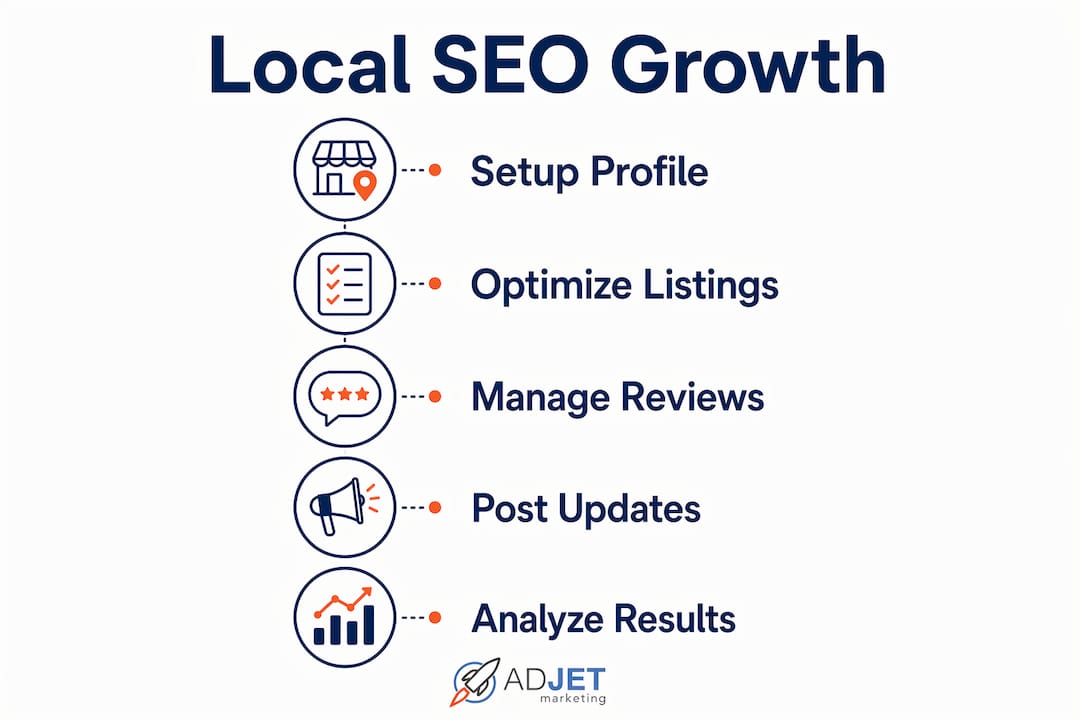
Optimized GBP listings drive 44% of clicks in local aesthetic treatment searches, and clinics with fully optimized profiles see 35% more consultation bookings than those with incomplete listings. That gap is not marginal. It represents a significant number of appointments going to a competitor simply because their profile is better configured.
Setting up GBP correctly requires attention to several specific elements:
- Primary category selection. Choose the most specific category available, such as “Medical Spa” or “Skin Care Clinic,” rather than a broad term like “Health Clinic.” Secondary categories can include “Laser Hair Removal Service” or “Facial Spa” depending on your treatment menu.
- NAP consistency. Your name, address, and phone number must match exactly across your website, GBP, and every directory listing. Inconsistencies confuse Google’s local ranking algorithm.
- Service listings with detail. Each treatment should have its own service entry with a description that includes benefits, not just the procedure name.
- Photo volume and quality. Clinics with 100 or more photos receive significantly more direction requests and website clicks than those with fewer than 20.
- Review management. Clients read an average of 7 or more reviews before choosing an aesthetic clinic, making a consistent post-treatment review request process non-negotiable.
- GBP posts. Treatment spotlights with clear benefits, a call to action, and relevant keywords generate 40 to 50% higher engagement than generic updates. Post at least twice per week.
Advanced tactics like integrated messaging, detailed service benefit descriptions, and a prominent booking link can boost conversion rates by 25 to 30%. For a deeper walkthrough, Adjetmarketing’s guide on optimizing your medspa GBP covers every configuration step in detail.
Pro Tip: Never add a service area to your GBP unless your clinic is genuinely mobile. Adding a service area to a fixed-location clinic can suppress your Map Pack visibility entirely.
What content strategies build trust and client loyalty in 2026?
The most significant shift in aesthetic practice promotion over the past two years is the move away from discount-led marketing toward consultative, education-first content. Consultative, trust-building marketing outperforms transactional discounting in 2026, particularly for clinics targeting clients who are making considered, higher-value treatment decisions.
“Clients don’t just want a deal. They want to feel confident they’re choosing the right clinic and the right practitioner. Content that answers their real questions does more for bookings than a 20% off promotion.” — Patient Perfect, 2026 Aesthetics Marketing Guide
The content types that consistently perform for aesthetic practices include:
- Myth-busting blog posts. Articles addressing common fears (“Does Botox look natural?” or “Is laser hair removal safe for darker skin tones?”) attract high-intent organic traffic and position your clinic as a credible source.
- “What to expect” videos. Short-form videos walking through a treatment from consultation to aftercare reduce anxiety and increase booking confidence. These work particularly well as Instagram Reels and YouTube Shorts.
- Behind-the-scenes content. Showing your team, your clinic environment, and your preparation process humanizes your brand in a way that polished promotional content cannot.
- Educational Reels. Short, specific, and informative. A 30-second Reel explaining the difference between hyaluronic acid and collagen stimulating fillers builds more trust than a before-and-after photo alone.
Structured offers like memberships and treatment bundles outperform crude discounts for client retention and lifetime value. A monthly membership that includes a maintenance treatment and priority booking creates a recurring relationship rather than a one-off transaction. Referral programs and loyalty rewards work on the same principle. They give existing clients a reason to stay and a reason to bring others.
Branded clinic apps like Patient Perfect allow clinics to send push notifications, manage rebooking reminders, and deliver personalized content directly to a client’s phone. This level of direct engagement is difficult to replicate through social media alone, where algorithm changes can reduce your organic reach overnight.
How can new aesthetic clinics overcome SEO visibility delays?
New aesthetic clinic websites face a well-documented challenge: new clinics experience a 6 to 12 month delay before achieving significant organic Google rankings. For a clinic that opened last month and needs clients now, that timeline is not acceptable.
The table below compares the two primary approaches to managing this delay:
| Approach | Timeline to visibility | Cost profile | Best for |
|---|---|---|---|
| Build new website and wait for SEO | 6 to 12 months | Lower upfront, slower return | Clinics with existing patient base |
| Buy pre-built, Google-indexed website | Immediate to 4 weeks | Higher upfront, faster ROI | New clinics with no existing traffic |
| Google Ads while SEO builds | 1 to 2 weeks | Ongoing ad spend required | Any clinic needing immediate leads |
Buying a pre-built, Google-indexed clinic website targeting local keywords is a viable strategy to bypass the ranking delay entirely. Providers like Aesthetic Launch Lab offer these as turnkey solutions. The site already has Google’s trust signals, existing indexed pages, and local keyword targeting built in.
The most practical approach for most new clinics is to run Google Ads immediately while building the SEO foundation in parallel. Ads provide bookings now. SEO reduces your cost per acquisition over time. The two strategies are not in competition. They serve different timeframes.
Working with a specialist aesthetic marketing agency matters here. Generic digital marketing agencies often underestimate the compliance requirements, the local search nuances, and the trust signals that Google applies differently to healthcare-adjacent businesses. A specialist understands why a clinic’s website needs E-E-A-T signals (Experience, Expertise, Authoritativeness, and Trustworthiness) and how to build them correctly.
Pro Tip: If you’re launching a new clinic, allocate at least 60% of your initial marketing budget to Google Ads and GBP optimization. These channels produce measurable results while your organic SEO authority develops.
What are the ethical and compliance considerations for cosmetic clinic advertising?
Aesthetic clinic advertising operates within a regulatory framework that is tightening in most markets. In the UK, the Advertising Standards Authority (ASA) enforces rules that penalize misleading aesthetic clinic advertising, including exaggerated before-and-after claims, pressure-based promotional tactics, and content that targets vulnerable audiences. In the US, the FTC applies similar standards to health and cosmetic claims.
Compliance-aware marketing is not a limitation. It is a competitive advantage. Clinics that communicate honestly about treatment outcomes, realistic timelines, and potential side effects build a level of patient trust that clinics making inflated claims cannot sustain.
The core compliance practices every aesthetic clinic should follow include:
- Accurate claims only. Never promise specific results. Use language like “many clients experience” rather than “you will see.”
- Transparent influencer disclosures. Any paid partnership or gifted treatment must be clearly labeled as such on all platforms.
- No targeting of minors. Paid advertising for injectable treatments must exclude audiences under 18 across all platforms.
- Review authenticity. Incentivizing reviews in exchange for discounts violates both Google’s terms and FTC guidelines. Request reviews, but never purchase them.
- Internal approval process. Before any marketing content goes live, it should pass through a review that checks for compliance with current advertising standards.
Building an internal approval process sounds bureaucratic, but it takes less than 30 minutes per week for most clinics. The cost of a single ASA ruling or FTC complaint far exceeds the time investment. Ethical marketing also compounds over time. Clinics with a reputation for transparency attract clients who are more likely to return and refer others.
Key takeaways
Effective aesthetic clinic marketing requires combining local SEO, paid advertising, trust-building content, and compliance-aware practices into a single, coordinated strategy.
| Point | Details |
|---|---|
| Local SEO is the highest-ROI channel | Optimized GBP listings drive 44% of clicks in local treatment searches and increase bookings by 35%. |
| New clinics need a paid ads bridge | Google Ads provide immediate visibility while organic SEO authority builds over 6 to 12 months. |
| Trust content outperforms discounts | Educational Reels, myth-busting blogs, and memberships build loyalty better than one-off promotions. |
| Email marketing delivers strong returns | Segmented email campaigns return $36 to $42 per $1 spent, making them a top retention tool. |
| Compliance protects long-term credibility | Transparent advertising practices reduce regulatory risk and build the patient trust that drives referrals. |
What I’ve learned after years of working with aesthetic clinics
Most clinics that come to us at Adjetmarketing have tried marketing before. They ran some Facebook ads, posted on Instagram for a few months, maybe hired a general marketing agency. The results were inconsistent, and they’re not sure why.
The pattern I see most often is this: clinics invest in tactics before they have a foundation. They spend money on ads before their GBP is optimized. They post on social media before they have a clear message. They chase new clients before they have a system to retain existing ones. The tactics aren’t wrong. The sequence is.
The clinics that grow steadily are the ones that treat marketing as infrastructure, not a campaign. They build their GBP correctly, invest in a website that actually converts, create content that answers real client questions, and then use paid ads to accelerate what’s already working. That sequence produces compounding results. The other approach produces a cycle of spending without confidence in what’s driving bookings.
I also want to be direct about AI. It is genuinely useful for content repurposing, personalized follow-up sequences, and predictive treatment recommendations. But it does not replace the judgment required to position a clinic correctly in a competitive local market. The clinics using AI most effectively are using it to do more of what already works, not to replace the strategic thinking that determines what works in the first place.
Measure what matters: consultation bookings, cost per booked appointment, and client retention rate. Everything else is a leading indicator. If those three numbers are moving in the right direction, your marketing is working.
— Felix
How Adjetmarketing helps aesthetic clinics grow
Adjetmarketing is a Google Partner agency with direct experience in aesthetic clinic digital marketing, including local SEO, Google Ads, and conversion-focused website design built specifically for medical spas and cosmetic practices. We understand the compliance requirements, the local search dynamics, and the trust signals that determine whether a clinic’s marketing actually produces bookings.
If you’re looking to improve your clinic’s visibility, our medical spa SEO services and Google Ads management are built around measurable outcomes, not vanity metrics. We work with clinic owners who want a clear picture of what their marketing spend is producing and a realistic plan for scaling it. Reach out to discuss what a performance-driven approach looks like for your specific market.
FAQ
What are aesthetic clinic marketing services?
Aesthetic clinic marketing services are specialized digital strategies including local SEO, Google Ads, content marketing, and email automation designed to increase a clinic’s visibility and attract qualified clients. They differ from general marketing by addressing the trust requirements, compliance standards, and local search behaviors specific to aesthetic practices.
How long does SEO take for a new aesthetic clinic?
New aesthetic clinic websites typically take 6 to 12 months to achieve significant organic Google rankings. Running Google Ads in parallel provides immediate visibility while the SEO foundation develops.
Why is Google Business Profile important for aesthetic clinics?
Google Business Profile drives 44% of clicks in local aesthetic treatment searches, and optimized listings produce 35% more consultation bookings. It is the most direct channel for reaching clients who are actively searching for treatments in your area.
What content performs best for aesthetic practice promotion?
Educational content consistently outperforms promotional content. Myth-busting blog posts, “what to expect” treatment videos, and behind-the-scenes Reels build the trust that converts a curious visitor into a booked client.
How do I market my aesthetic clinic without violating advertising regulations?
Use accurate, evidence-based claims, disclose all influencer partnerships, exclude minors from injectable treatment ads, and build an internal review process for all marketing content before it goes live. Compliance with ASA and FTC standards protects your clinic’s reputation and builds long-term patient trust.