









Negative keywords tell Google which searches should never trigger your ads. For a healthcare practice, they do two jobs: they stop you from paying for clicks from people who will never book, and they keep your ads away from searches you cannot serve compliantly. Build your first list before launch, then review the search terms report on a fixed schedule and add to it. Below we cover how the match types work, what to exclude by specialty, where compliance changes the list, and how often to maintain it.
TL;DR
- Negative keywords block ads on searches containing your excluded terms. In healthcare, the biggest wasted-spend categories are job seekers, free or DIY intent, students, and services you do not offer.
- Negative keywords do not match close variants, so you need to add singular, plural and spelling variations yourself. Use phrase and exact match to avoid blocking good searches.
- Some exclusions are about compliance, not budget. Searches that push people toward sharing health details you cannot protect, or toward restricted drug categories, deserve a deliberate decision.
- Review the search terms report weekly at first, then every two to four weeks. A list is never finished.
Table of Contents
- What negative keywords do in a medical account
- How the three match types work
- Where to apply them: account, list or campaign
- Starter negative keyword categories for healthcare
- Compliance: when a negative keyword is a risk decision
- A worked example: a pain management campaign
- A maintenance routine that works
- Realistic expectations
- Our perspective
- How AdJet can help
- FAQ
- Sources
What negative keywords do in a medical account
A negative keyword is a term that prevents your ads from appearing on searches containing that term. Positive keywords tell Google where you want to appear. Negatives tell it where you do not.
This matters more in healthcare than in most categories because medical language is ambiguous. “Botox” can be a patient ready to book, a nursing student, a person asking about side effects, or someone looking for a job as an injector. “Back pain” can mean a person who wants an appointment this week or someone who wants stretches they can do on the couch. Google cannot tell the difference on its own. You have to.
Many clinics come to us after a period of poor lead quality: plenty of clicks, a lot of calls asking for prices of things the clinic does not offer, and very few consultations. In most of those accounts the keywords themselves were reasonable. What was missing was a negative list, and a habit of reading the search terms report.
Negatives will not fix a weak offer, a slow-loading page or a confusing intake form. They simply stop you from paying for traffic you should never have bought.
How the three match types work
Negative keywords follow different rules than the positive keywords you may be used to. Google documents three types: negative broad, negative phrase and negative exact.
| Match type | How you enter it | Ad is blocked when | Typical use in a clinic account |
|---|---|---|---|
| Negative broad | -free consultation | The search contains all the terms, in any order | Single words you never want, such as jobs or salary |
| Negative phrase | -“free consultation” | The search contains the terms in that order, possibly with other words around them | Multi-word intents like “home remedies” or “nursing school” |
| Negative exact | -[botox] | The search is exactly that term and nothing else | Protecting a short, ambiguous term without blocking longer, valuable searches |
The dash goes at the front. Phrase match uses quotation marks and exact match uses brackets, as in the Google Ads Help page on negative keyword symbols and match types. Commas, exclamation points and several other symbols are not valid in a keyword, so if you paste a long list from a spreadsheet, clean it first.
Broad negatives are narrower than they sound
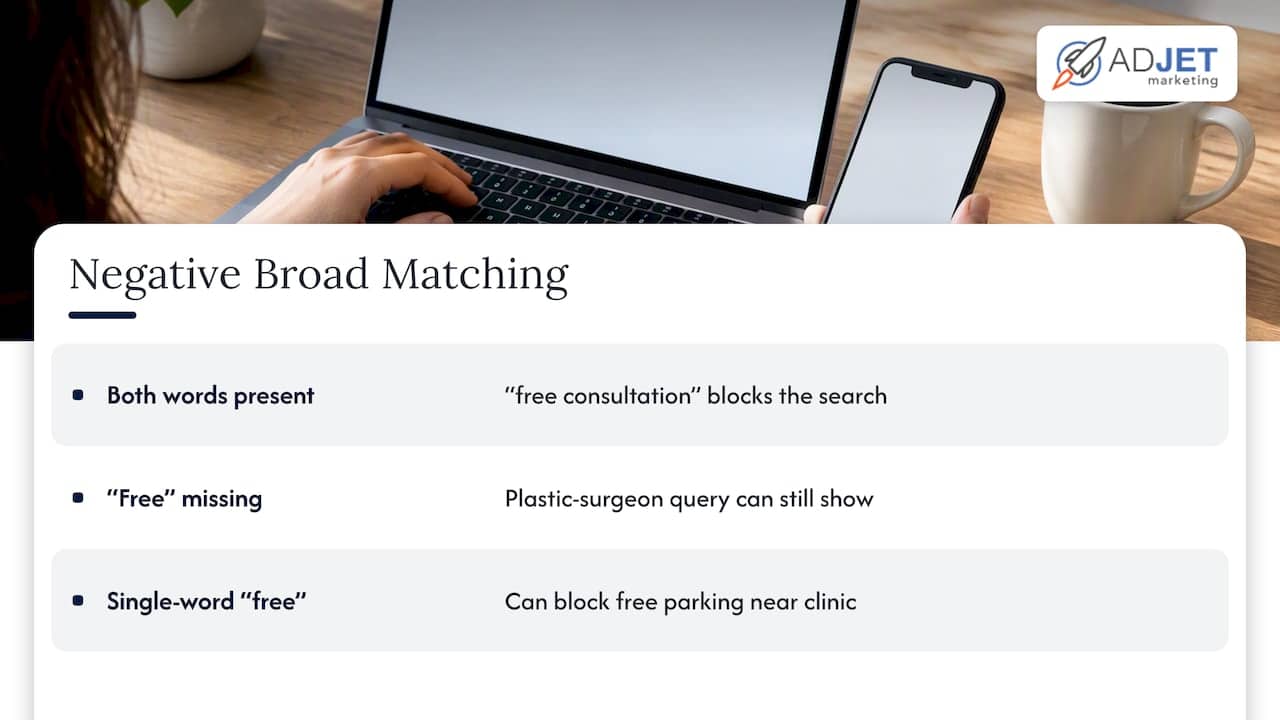
A negative broad keyword blocks a search only when every word in it is present. If you add the negative broad term “free consultation”, a search for “consultation with a plastic surgeon” can still show your ad, because “free” is missing. If you want to block anything containing “free”, add “free” by itself. That is a bigger decision, because it can also block a legitimate search such as “free parking near [clinic name]”. Read your own data before blocking a common word.
Close variants are not covered
Unlike positive keywords, negatives do not automatically match plurals, misspellings or other close variants. Blocking “intern” does not block “interns” or “internship”. If a term is truly unwanted, add the common forms yourself. This is one of the most common reasons a list that looks complete still leaks budget.
Where to apply them: account, list or campaign
Google lets you apply negatives at several levels. According to Google’s page on negative keyword lists, you can maintain an account-level list that applies across relevant campaigns (up to 1,000 negative keywords), and you can build shared lists of up to 5,000 negatives each, with up to 20 lists in an account.
A structure that works for most practices:
- Account-level list for universal exclusions: jobs, careers, salary, training, free, DIY, coupons for the wrong audience, and similar.
- Shared lists by theme, for example “employment and education” or “competitor and brand terms you decided to exclude”.
- Campaign or ad group negatives to separate services from each other. If you run one campaign for injectables and another for laser hair removal, each should block the other’s core terms so they do not compete in the auction.
That third layer is easy to skip and it matters. When two ad groups in the same account could both match one search, you lose control over which ad and landing page the patient sees. We structure campaigns by service and location for that reason, and negatives are what keep the structure clean. Our healthcare PPC overview explains how we think about that structure.
Starter negative keyword categories for healthcare
These are categories to evaluate, not a list to paste in blind. A term that is wasteful for one practice can be gold for another. A cosmetic practice may want to block “cheap”, while a community clinic that serves self-pay patients may not.
Job and education intent
People researching careers are among the most common sources of irrelevant clicks. Consider terms such as:
- jobs, job, hiring, career, careers, salary, internship, resume
- training, course, certification, school, degree, classes, continuing education
- how to become, assistant, technician (check first, since some terms overlap with your own staff pages)
Do not forget the variants. “Career” and “careers” are different strings.
Free and DIY intent
Searchers who want something for nothing rarely book a paid service. Typical candidates are “free”, “home remedy”, “DIY”, “at home”, “natural cure”, “exercises” and “stretches”. Google’s own guidance on the search terms report is to use real query data to find terms to add, and this category is nearly always in that data.
There is a tradeoff. A pain practice that also offers physical therapy may want “exercises” traffic as an education channel, but that belongs in organic content, not in a paid campaign aimed at booked appointments.
Services and conditions you do not treat
This category is specific to you. A few examples of the logic:
- A med spa that does not offer surgical procedures excludes “surgery”, “surgeon” and “implants” unless those terms appear in its own campaign.
- A therapy practice that does not accept children excludes “child therapist” and “kids”.
- An imaging center that offers MRI but not ultrasound excludes “ultrasound”.
- A practice that does not accept a given insurer excludes that insurer’s name, if the data shows people searching with it.
The last point deserves care. Patients who ask about insurance are often high intent. Excluding them only makes sense if you truly cannot serve them, and if your landing page does not already explain what you accept.
Research and informational intent
Terms like “what is”, “side effects”, “pictures”, “before and after” (when you cannot show them), “reddit”, “reviews” and “lawsuit” often signal a researcher or a person with a problem. Some are worth keeping in a separate, lower-bid campaign. Others should simply be blocked. Decide per account after you see conversion data, not before.
Competitor and location mismatches
If you serve a single metro area, add the names of cities you do not serve once they show up in your search terms. Location targeting reduces this problem but does not erase it, because people searching from home may type another city’s name. Separately, decide whether you want to appear on searches that include other practices’ names. Those clicks tend to be expensive and convert poorly, so many accounts exclude them. We do not list any names here, since that is a choice for each practice.
Compliance: when a negative keyword is a risk decision
This is where healthcare differs from, say, home services. Some searches are not just low value. They lead to ads or landing pages that create policy or privacy exposure.
Restricted categories in Google Ads policy
Google’s advertising policies restrict healthcare content, and some categories require certification. For instance, Google does not allow ads for prescription opioid painkillers, except for medication-assisted treatment for opioid use disorder that meets all other requirements. Programs for certain prescription drug services and addiction treatment go through a separate healthcare advertising application.
If you run a pain management clinic, this has a practical consequence. Your campaign should target the services you legitimately offer, and your negatives should keep it off searches for restricted prescription products you cannot advertise. Broad matching on a general pain term can drift toward drug-name queries, and a disapproval or account-level problem costs far more than the clicks. Our Google Ads compliance checklist for clinics and the pain management Google Ads strategy guide walk through this in more detail.
Searches that invite health data you cannot protect
The Federal Trade Commission has made clear that health information handling is covered by more than HIPAA. The FTC Act and the Health Breach Notification Rule can apply to businesses that collect or share consumer health information, including when a company is not a HIPAA covered entity. The FTC also publishes a plain-language PDF, Sharing Consumer Health Information? Look to HIPAA and the FTC Act.
What does that mean for negatives? Think about your landing page and what happens after the click. If a search such as “online prescription” or “free medical advice” would send a visitor to a page where they type symptoms into a form, and you have not secured that data flow, you have two choices: fix the flow or exclude the search. We tend to recommend the second when the first is not realistic, and to say so in plain terms to the practice owner. This is a risk call, and your compliance counsel or privacy officer should make the final decision on anything involving protected health information.
To be clear on scope: negative keywords do not make an account HIPAA compliant. They are one input. Tracking setup, forms, analytics, and vendors matter as much.
Landing page language
Ads are reviewed with their destination. When page copy reads like definitive medical advice, or mirrors clinical keywords too aggressively, it can draw disapprovals under Google’s policies. Pair your negative planning with a landing page review. Our guide to the role of landing pages in healthcare marketing covers what to check.
A worked example: a pain management campaign
Here is an illustrative scenario, not a client result. A pain clinic runs a campaign on “back pain treatment [city]” and “pain doctor near me”. After two weeks the search terms report shows these queries with clicks and no conversions:
- “back pain exercises for seniors”
- “pain management nurse jobs”
- “best pain relief cream”
- “how to get oxycodone prescription”
- “back pain treatment cost without insurance free clinic”
Here is how we would handle each:
| Query | Decision | Entry |
|---|---|---|
| back pain exercises for seniors | Block the intent, keep the audience | -“exercises” (and -“stretches”) |
| pain management nurse jobs | Block employment | -jobs, -job, -“nurse jobs”, -career, -careers |
| best pain relief cream | Not a service you provide | -cream, -creams, -“over the counter” |
| how to get oxycodone prescription | Compliance exclusion | -oxycodone and other drug names you will not advertise against |
| …treatment cost… free clinic | Likely mismatch | -“free clinic” (phrase) |
Notice that we did not block “cost” or “without insurance”. Price-conscious patients are often real prospects, and a blunt negative would remove them. The skill in this work is blocking the intent without blocking the patient.
A maintenance routine that works
A list built once and abandoned decays. New search behavior appears, Google’s matching changes, and your own services evolve. We suggest the following routine.
- Before launch: build the starter list from the categories above, adapted to the practice’s services and insurance policy.
- Weeks one to four: open the search terms report at least weekly. Google explains how to use the report to find negative keyword ideas. Sort by cost and look at queries with spend and no conversions.
- Judge by intent, not by one click. A single non-converting search is noise. A pattern of ten similar searches is a signal. For low-volume local campaigns, you may need weeks of data before a call is clear.
- Add the narrowest match type that does the job. Use exact for ambiguous short terms, phrase for multi-word intents, and broad negative only for words you never want.
- Add variants (plural, singular, common misspellings) for any term you block.
- Log changes with a date and reason, so you can undo a decision if call volume drops.
- After the first month, review every two to four weeks and after any change in services, locations or budgets.
We also check for the opposite problem: over-blocking. If impressions fall sharply after a big batch of negatives, some of them were too broad. Pull the list apart and test.
Realistic expectations
Negatives reduce waste. They do not guarantee more patients, and the effect varies by account. Low-budget accounts see the effect quickly because every wasted click is a large share of spend. Larger accounts gain more from structure and bidding than from any one negative. Expect the first meaningful clean-up in the first few weeks, ongoing refinement after that, and a slight drop in raw click volume with it. That drop is the point. Judge the work by cost per booked consultation, not by clicks.
It also helps to compare channels honestly. Paid search captures demand that exists today, and negatives make it more efficient. SEO builds slower and compounds. Many practices need both, and we describe the tradeoffs in our piece on the benefits of Google Ads for medical clinics.
Our perspective
We manage Google Ads for medical clinics, aesthetic practices, pain management clinics and therapists, and we see the same pattern often. A practice looks at its reports, sees plenty of clicks and a respectable click-through rate, and assumes the campaign is healthy. Then someone listens to the call recordings or reviews form submissions, and half of them are job seekers, students or people asking for something the clinic does not do.
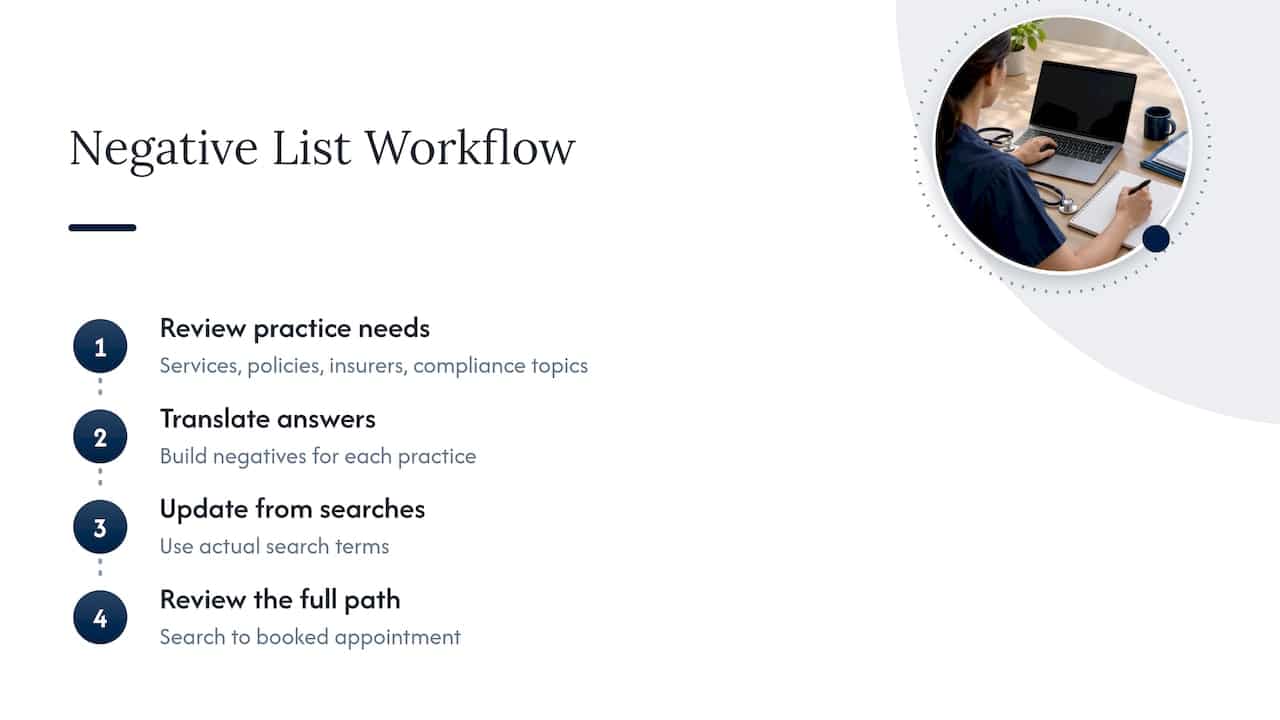
Our view is that the negative list is part of the campaign strategy, not cleanup you do later. We build it from the services and policies of each practice. We ask which treatments the practice wants more of, which it does not offer, which insurers it takes, and which topics its compliance team does not want to touch. Then we translate those answers into negatives, and we keep updating them from the actual search terms.
We are also cautious about promises. A tidy list helps most accounts, but it cannot rescue a landing page that does not answer the patient’s question or an intake process that loses callers. That is why we look at the whole path from search to booked appointment, and why we are open with practice owners when the problem is outside the ads.
— Felix
How AdJet can help
If you would rather not do this yourself, our Google Ads management service includes keyword structure, negative keyword maintenance and search terms review for clinics and other local businesses. We are a Google Partner agency and our processes are built with HIPAA considerations in mind. Pricing is scoped to your account, since we do not publish a price for ad management. If your landing pages need work before ads make sense, see our landing page design options.
FAQ
What symbol do you use to add a negative keyword?
A dash (-) placed directly before the term. For phrase match, put quotation marks around the term after the dash. For exact match, put brackets around it. The Google Ads Help page on negative keywords lists the valid and invalid symbols.
How many negative keywords should a clinic have?
There is no right number. A new account may start with a few hundred well-chosen terms, and a mature one may have more. Google caps an account-level list at 1,000 negatives and shared lists at 5,000 each, but quality matters more than size. Every term should come from a clear reason.
Can negative keywords stop all irrelevant clicks?
No. Negatives only block terms you have identified, and they do not match close variants automatically. New irrelevant searches appear over time, which is why a regular search terms review matters.
Do negative keywords help with HIPAA or privacy compliance?
They can reduce exposure by keeping your ads off searches that lead to data collection you cannot secure, but they are not a compliance program. Privacy depends on your site, forms, analytics and vendors. Ask your compliance counsel or privacy officer about anything involving protected health information.
Should I block competitor names?
It depends on your data. Searches that include another practice’s name are often costly and convert poorly, but some patients are comparing options. Test it in your own account, and review the numbers before deciding.
Sources
- About negative keywords, Google Ads Help
- About negative keyword lists, Google Ads Help
- Get negative keyword ideas using the search terms report, Google Ads Help
- Google Ads policies, Google Ads Help
- Prescription opioid painkillers policy, Google Ads Help
- Apply for healthcare-related advertising, Google Ads Help
- Collecting, Using, or Sharing Consumer Health Information? FTC
- Sharing Consumer Health Information? Look to HIPAA and the FTC Act, FTC