








To win visibility in AI search, make your content easy to extract and easy to trust. That means three things working together: self-contained, snippable passages; technical access that lets AI systems actually crawl and render your pages; and credible signals, from schema to earned mentions, that justify citing you. This isn’t a ranking hack you flip on overnight. It’s an eligibility problem, and you solve it the same way you’d earn a spot on a shortlist: by being the obvious, verifiable choice.
TL;DR:
- Content must be unique, helpful, and directly answer specific questions to be eligible for AI search citation, not just well-structured or schema-marked.
- Place answers at the beginning of paragraphs, ensure each paragraph covers a single idea, and incorporate clear question-answer pairs for better extractability.
- Use visible author and date information, avoid hidden content behind scripts or interactions, and provide accurate, text-based facts in images and videos.
- Track AI citation rate, share of voice, and generated CTR as key metrics, focusing on improving citations and visibility over traditional rankings alone.
- Small, targeted improvements like front-loading answers, fixing schema mismatches, and adding factual text near the top of pages rapidly enhance AI search prominence.
Table of Contents
- What Makes Content Eligible for AI Search Optimization?
- How Do You Write Content AI Can Actually Extract?
- Which Schema and Technical Signals Help AI Trust Your Content?
- How Does AI Handle Images, Video, and PDFs?
- What Metrics Actually Show AI Search Visibility?
- What Small Fixes Yield the Biggest AI Visibility Gains?
- How Do Agencies Apply GEO for Local-Service and Clinic Content?
- How Do AI Algorithms Interpret Search Intent?
- How Do You Use AI Tools for Keyword Research That Feeds Extractable Content?
- How Can AI Tools Support Competitor Analysis?
- How Should SEO Strategy Adapt to AI-Powered Search Features?
- What Are the Ethical Risks in AI Search Optimization?
- What’s Next for AI in Search Optimization?
- The Overlooked Truth About AI Search Optimization
- How Adjetmarketing Helps You Implement AI Search Optimization
- Sources
What Makes Content Eligible for AI Search Optimization?
Google’s own guidance is blunt about this: unique, genuinely helpful content and technical accessibility are what separate pages that get cited from pages that get ignored in AI-generated search experiences. No shortcut file, no clever markup trick, replaces that. If your page says the same thing as five competitors, in the same order, with the same generic advice, an AI system has no reason to pick you over the others. It picks the source that adds something the others don’t.
For content teams, that starts with a hard look at whether a page earns its own existence. Ask: does this page contain a fact, a number, an example, or a framework you won’t find restated verbatim elsewhere? If the honest answer is no, that page is a weak candidate for AI citation no matter how clean its schema is.
From there, a handful of practices consistently separate cited pages from ignored ones:
- Match your title, H1, and meta description to the actual question the page answers. If a searcher’s query is “how much does Invisalign cost,” your H1 should not be a vague brand tagline. AI systems use this alignment to confirm intent match before they ever read your body copy.
- Keep the answer in rendered HTML, not buried in JavaScript that loads after the initial crawl. If a crawler can’t see it without executing scripts, treat that content as invisible until proven otherwise.
- Avoid client-side blocking that hides your best content behind interaction (accordions, “read more” toggles) unless the underlying HTML still contains the full text. Collapsed doesn’t mean gone, as long as the markup carries the text.
- Show who wrote the page and when it was last updated. A visible byline and a date stamp are small signals, but they’re part of how both Google and generative systems weigh trustworthiness, especially on medical, financial, or other high-stakes topics.
- Run a basic indexability check before obsessing over structure. A perfectly written page that returns a noindex tag or sits behind a robots.txt block will never be cited, full stop.
None of this is exotic. It’s the same discipline that’s underpinned good SEO for over a decade, just applied with a sharper eye toward the fact that your reader might now be a language model instead of a human scrolling a results page. The pages that struggle most are the ones that treated content as a box to fill rather than a question to answer.
How Do You Write Content AI Can Actually Extract?
Generative systems don’t read your page top to bottom the way a person does. They parse it into modular chunks and pull out the pieces that stand alone cleanly. Technical breakdowns of how large language models handle content structure confirm this: passages that make sense in isolation get extracted and reused far more often than passages that depend on three paragraphs of setup to make sense. Practitioner guides on generative engine optimization echo the same rule: front-load the answer and keep one idea per paragraph.
Here’s how that translates into actual writing decisions:
- Put the answer in the first sentence of the paragraph, not the last. If a paragraph is about recovery time after a procedure, sentence one should state the recovery window. Everything after that is context, caveats, or nuance.
- Write one idea per paragraph. A paragraph that starts on pricing and drifts into scheduling and then insurance coverage is unusable as a standalone snippet. Split it into three.
- Use direct question-to-answer pairs for anything a searcher would plausibly type as a query. A heading like “How long does laser hair removal take?” followed immediately by a direct answer sentence is far easier to lift than a heading like “Treatment Duration Considerations.”
- Reach for a list or table only when the content is genuinely enumerable (steps, comparisons, specs). Forcing narrative explanation into bullet form just to look scannable does the opposite of what you want. It strips out the reasoning an AI system might otherwise cite.
- Format Q&A sections so each answer is a complete sentence that doesn’t rely on the question for grammatical sense. “Yes, in most cases” is not extractable on its own. “Most insurance plans cover the initial consultation but not the procedure itself” is.
Pro Tip: Write one or two sentences near the top of every important page that could function as a citation on their own, no context needed. Read them out loud without the surrounding paragraph. If they still make a complete, factual claim, you’ve written something an AI system can safely lift and attribute to you.
This is also where a lot of well-intentioned content fails quietly. Writers who were trained to build suspense, tease a conclusion, or “hook” the reader before answering the question are doing the opposite of what extractable content needs. Save the storytelling for your perspective pieces. Save the direct answer for everything else.
Which Schema and Technical Signals Help AI Trust Your Content?
Structured data helps AI systems label what a page is about, but it is not a substitute for the content itself. Google has said as much directly: schema is helpful, not required, and the visible HTML on your page needs to match whatever your schema claims. A page marked up as a FAQPage that doesn’t actually contain visible, readable Q&A content is a mismatch that erodes trust rather than building it.
With that caveat in place, a handful of schema types earn their place on most content sites:
- Article or BlogPosting schema for editorial content, so systems can identify author, publish date, and headline cleanly.
- FAQPage schema only when the visible page genuinely presents a question-and-answer format, not as a way to game snippet real estate.
- HowTo schema for genuine step-by-step processes, matched to numbered steps that actually appear in the HTML.
- Organization and Person schema to establish who is behind the content and who wrote it, which matters more on medical and financial pages than almost anywhere else.
Beyond markup, the boring technical checks still decide whether any of this matters. Confirm your sitemap actually lists the pages you want indexed. Check robots.txt isn’t quietly blocking sections you’ve spent weeks writing. Use a renderability test to see what a crawler sees when JavaScript doesn’t execute, since a lot of modern site builders quietly hide content this way. Google Search Console’s generative AI reporting is worth checking on a regular basis too. It’s a more direct window into how your pages perform in AI-generated results than general ranking reports give you.
Implementation-wise, JSON-LD through your CMS or a developer beats manual markup nearly every time, since it’s easier to keep in sync as pages change. And keep the author name and last-updated date visible in the actual HTML, not just tucked into schema where a reader never sees it.
How Does AI Handle Images, Video, and PDFs?
Multimodal content helps, but it’s a supporting act, not the headline. AI systems still extract facts from images and PDFs less reliably than they do from plain HTML, which is why industry guidance is consistent on one point: critical facts belong in text, not locked inside a graphic or a scanned document.
A few practices keep media from becoming a liability:
- Provide a transcript for every video, and place it on the page as visible text, not just an attached file.
- Write alt text that describes the actual content of the image, not a keyword-stuffed guess at what might rank.
- Use descriptive filenames (before-after-rhinoplasty-results.jpg beats IMG_4021.jpg) since some systems still weigh this lightly.
- Never publish a pricing sheet, fee schedule, or FAQ exclusively as a PDF. If the facts inside matter, restate them in HTML on the page that links to the PDF.
- Add a short HTML summary above any embedded infographic or chart that states the key numbers in sentence form.
Treat images and video as reinforcement for a reader who wants visual confirmation, not as the only place a fact lives. If the PDF disappeared tomorrow, the page should still make its case.
What Metrics Actually Show AI Search Visibility?
Ranking position doesn’t mean much anymore on its own. The metrics that matter now measure whether AI systems are actually citing you, and how often that citation turns into a click.
- AI citation rate tracks how frequently your content gets referenced in generative answers for queries you care about. This is the closest thing to a “ranking” metric in this new environment.
- AI share of voice measures your citation rate against competitors answering the same set of queries, giving you a relative benchmark rather than an isolated number.
- SGE or generative CTR tracks how often a citation in an AI Overview actually drives a click through to your site, since citation without traffic doesn’t help your business.
Google Search Console’s generative AI reporting is the first place to look, since it’s a direct line into how your pages perform inside AI Overviews specifically. Third-party GEO tracking tools have emerged to fill the gaps, mostly by running sample queries against public AI interfaces and logging which domains get cited.
Simple experiment design tells you what’s actually working. Publish two versions of a similar page, one written with front-loaded, self-contained paragraphs and one written the old way, and track citation frequency over several weeks rather than days. Generative systems synthesize from multiple sources and weigh freshness and topical depth, so movement in AI Overview performance tends to lag behind traditional ranking changes. Set targets accordingly. A realistic first goal is measurable citation presence within a quarter, not a week, tied to a business outcome like appointment requests, not just impressions.
What Small Fixes Yield the Biggest AI Visibility Gains?
Most AI visibility problems trace back to a short list of repeat offenders, and most of them are cheap to fix.
- Long walls of text with no paragraph breaks or headings. AI systems can’t extract a clean passage from an undifferentiated block.
- Critical facts that exist only inside an image, chart, or PDF.
- Schema that claims one thing while the visible page says another, or says nothing at all.
- Answers buried three paragraphs deep instead of stated in sentence one.
- No visible author or update date, which weakens trust signals on exactly the pages that need them most.
Pro Tip: Run this as a 72-hour sprint on your five highest-intent pages before touching anything else on the site: front-load the answer, add a one-sentence summary near the top, confirm the author and date are visible in HTML, and check that every fact in an image also exists in text somewhere on the page.
Small, targeted fixes on high-intent pages tend to move faster than a full-site overhaul, and they’re a lot easier to measure.
How Do Agencies Apply GEO for Local-Service and Clinic Content?
For medical and local-service clients, the balancing act is topical depth against extractability. A page can be thorough and still fail if the thoroughness buries the answer. Our typical sequence runs audit, then content restructuring, then measurement, usually over 60 to 90 days before we draw conclusions.
- We prioritize pages tied to high-intent queries first (procedure costs, insurance questions, appointment logistics) since those carry the clearest business payoff.
- Expect a trade-off: pages optimized hard for AI citation sometimes need a second pass for conversion, since a snippable answer and a persuasive call to action don’t always sit in the same sentence.
- Results patterns vary by niche and competition, so timelines and outcomes get discussed case by case rather than promised upfront.
How Do AI Algorithms Interpret Search Intent?
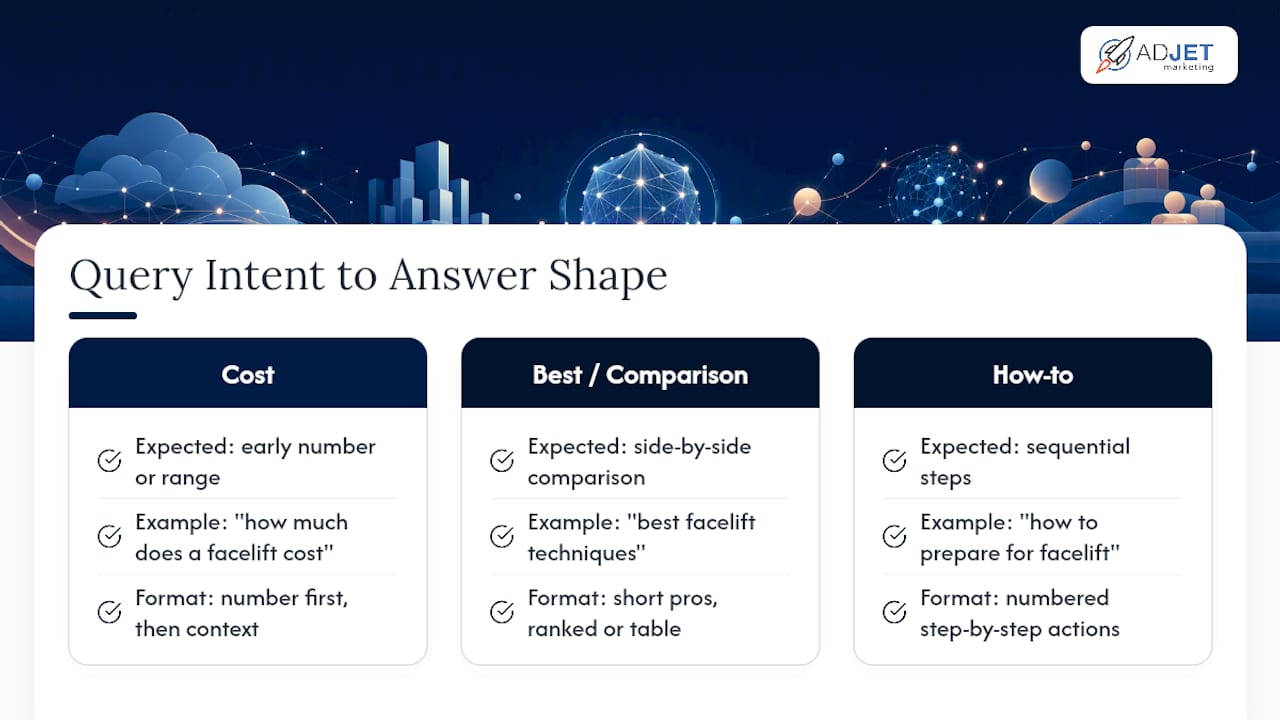
AI systems classify a query’s intent before deciding what kind of answer to build, and getting that classification wrong is a common reason good content gets skipped. A query like “how much does a facelift cost” reads as informational with a commercial undertone. The system expects a direct number or range, followed by context, not a paragraph of brand storytelling before the figure appears.
The practical shift from traditional SEO is that AI systems weigh how well your content’s structure matches the expected answer shape for that intent type, not just whether your keywords match the query. A “best” query expects a comparison structure. A “how to” query expects sequential steps. A “cost” query expects a number near the top. Writing to intent now means writing to the shape of the expected answer, not just its topic.
This is also why generic, top-of-funnel content struggles more in AI search than it did in traditional search. A page that hedges on every question to stay broadly relevant gives the system nothing concrete to extract. Specificity, even when it narrows your audience, tends to perform better than breadth.
How Do You Use AI Tools for Keyword Research That Feeds Extractable Content?
AI-driven keyword research tools are good at one thing traditional keyword tools weren’t: surfacing the actual phrasing people use when they ask a conversational question, rather than the clipped, fragment-style queries typed into a search bar a decade ago. That distinction matters because AI Overviews and chat-based search interfaces respond to full questions, not fragments.
Instead of building a page around a keyword like “botox cost,” pull the full range of conversational variants: “how much does botox cost per unit,” “is botox covered by insurance,” “how long does botox last before it wears off.” Each of those deserves its own direct, front-loaded answer somewhere on the page, ideally as its own heading and paragraph rather than crammed into one generic FAQ entry.
The practical technique is to feed a seed topic into an AI research tool and ask it to generate the follow-up questions a real searcher would ask next. That chain of follow-ups (cost, then insurance, then recovery, then results timeline) becomes your subheading structure. It’s a faster way to map the full intent cluster than manually guessing, and it tends to surface long-tail questions a traditional keyword tool would miss entirely because search volume on any single variant looks too small to matter alone.
How Can AI Tools Support Competitor Analysis?
AI tools change competitor analysis from a manual page-by-page crawl into something closer to a pattern-matching exercise. Feed a set of competitor URLs into an AI summarization tool and ask it to identify what facts, numbers, or claims appear across all of them. Whatever consensus emerges is table stakes. Whatever’s missing from all of them is your opening.
The more useful application is running your own target queries against AI Overviews and chat interfaces directly, then logging which domains get cited and what specific sentence or claim earned the citation. That tells you exactly what tone and structure won the spot, not just who ranked. If a competitor keeps getting cited for a statistic you don’t have on your own page, that’s a concrete, fixable gap rather than a vague sense that “their content is better.”
Watch for one trap here: don’t mistake volume for insight. A tool that tells you a competitor “covers 40 topics” isn’t giving you anything actionable. A tool that tells you a competitor is the only one citing a specific statistic on recovery timelines is.
How Should SEO Strategy Adapt to AI-Powered Search Features?
Featured snippets taught the SEO industry the value of a direct, front-loaded answer years before generative answers made it mandatory. AI Overviews just raised the stakes: instead of one snippet slot, the system now synthesizes from multiple sources at once, which means competing for a mention isn’t winner-take-all the way a single snippet slot was.
That changes the strategic calculus. Where featured-snippet optimization used to focus on winning one specific query, generative answer optimization rewards owning a topic cluster deeply enough that you show up across several related queries in the same synthesized answer. A page that answers one narrow question well might win a snippet. A cluster of pages that together answer cost, timeline, risk, and aftercare for the same procedure is more likely to earn repeat citations across an entire AI Overview.
Practically, that means auditing your content in clusters rather than page by page, and it means paid and organic strategies increasingly need to work in tandem. A well-optimized organic page earning AI citations builds pre-click trust; a well-structured Google Ads campaign captures the click when the reader is ready to act. Neither replaces the other.
What Are the Ethical Risks in AI Search Optimization?
The biggest ethical risk in this space isn’t malicious, it’s careless: publishing thin content dressed up with schema markup to look more authoritative than it is. Google’s own guidance explicitly warns against markup and content that misrepresents what’s actually on the page, and generative systems that get burned citing inaccurate content tend to deprioritize that source over time.
There’s a subtler risk too, specific to medical and health content: AI Overviews synthesize and simplify, which means nuance can get flattened in ways that misrepresent risk or certainty. A page that states “recovery typically takes two weeks” without caveats about individual variation can end up cited as a flat guarantee in a generative answer, even if the original page hedged appropriately. Writing with precise, honest qualifiers protects both the reader and your credibility if a system pulls your sentence out of context.

Attribution is the other open question. Generative answers sometimes summarize a source’s information without a visible citation at all, which raises legitimate concerns about traffic and credit. There’s no clean fix yet, but the pages best positioned to benefit when attribution does happen are the ones with clear, quotable, well-sourced claims, since vague content has nothing distinct for a system to credit in the first place.
What’s Next for AI in Search Optimization?
Expect AI-driven search to keep shifting from summarizing existing content toward reasoning across it, meaning multi-step queries (compare, then filter, then recommend) will become more common than single-fact lookups. Content built as isolated pages answering isolated questions will struggle here; content built as interconnected clusters with consistent facts across pages will hold up better.
Voice and multimodal search will likely keep growing in tandem, which raises the stakes on the “critical facts belong in text” principle, since a voice assistant reading a page aloud has no way to interpret an infographic. Expect more emphasis on structured, spoken-friendly sentence construction as a result.
The measurement side will mature too. AI citation tracking is still young, but expect it to become as standard as rank tracking was a decade ago, with more granular reporting on which specific sentences or paragraphs get pulled into generative answers rather than just which domains do. Teams that start measuring citation frequency now will have a real historical baseline before that becomes table stakes for everyone else.
The Overlooked Truth About AI Search Optimization
Most advice on this topic treats AI search optimization as a technical problem: get the schema right, fix the crawlability, and the citations will follow. That’s backwards. The GEO research on citations, quotes, and statistics backs this up directly: content that includes verifiable, specific claims sees roughly 30 to 40 percent better visibility in generative engine tests than content that doesn’t, and no markup fixes a page that has nothing specific to say.
The conventional wisdom underrates originality and overrates markup. Schema is a label, not a qualification. What actually earns a citation is a page that says something a competitor’s page doesn’t, stated in a sentence that survives being lifted out of context. That’s harder to manufacture than adding a JSON-LD block, and it’s exactly why it works. Small publishers with a genuinely owned topic and disciplined structure can out-cite much larger competitors that spread themselves thin.
If you do only one thing after reading this, audit your five highest-intent pages for whether they contain a fact, statistic, or framework nobody else has published, and rewrite the opening sentence of each key paragraph to state that fact directly. Everything else, the schema, the sitemaps, the alt text, matters. But it matters less than having something worth citing in the first place.
— Felix
How Adjetmarketing Helps You Implement AI Search Optimization
Adjetmarketing is the practical alternative to spending months figuring this out in-house: we run content audits, implement schema correctly, and set up the measurement most clinics and local-service sites never get around to building. That combination, structural fixes plus tracking, is what separates a one-time cleanup from ongoing AI visibility.
A typical engagement starts with an audit of your highest-intent pages, moves into content and schema updates, and adds monitoring so you can see citation trends rather than guessing. Budgets and timelines vary by site size and competition, and we’ll tell you honestly if paid ads make more sense as a bridge while organic and AI visibility build. If you want a clear look at where your site stands, request a marketing audit and we’ll walk you through what’s realistic for your practice.
Sources
- Top ways to ensure your content performs well in Google’s AI experiences on Search
- A Multi-Factor Brand-Recognition Audit for AI Answer Engines (GEO research)
- Generative engine optimization (GEO): How to win AI mentions
- Google SGE Guide: AI Search Visibility in 2026