









Yes, Google Ads can work well for a therapy practice, but only if you fix three things first: clean conversion tracking, a landing page that matches the ad, and a budget that can actually generate enough data to learn from. Skip any one of those and you’re likely to burn a few thousand dollars before you find out whether the channel even works for you.
Who benefits most: solo therapists in competitive metro areas, telehealth practices licensed across multiple states, and group practices launching a new specialty (EMDR, couples counseling, adolescent therapy) that needs visibility fast.
Main risks: wasted spend from poor tracking, ad disapprovals from healthcare policy violations, and landing pages that don’t match search intent.
One-step starter: before you write a single ad, set up Google Ads conversion tracking for calls and form submissions. Nothing else matters until that’s working.
Quick checklist: budget minimum of $500 to $600/month for testing, working conversion tracking on day one, and a landing page built around a single service.
First 90 days: expect a typical learning phase of several weeks where cost per lead is unstable, followed by a stretch where performance starts to settle into a pattern you can actually plan around.
Key Takeaways
Google Ads works for therapy practices when conversion tracking, landing pages, and budget are aligned before launch, not fixed after the fact.
| Point | Details |
|---|---|
| Fix tracking first | Set up call and form conversion tracking before writing a single ad, or you’re optimizing blind. |
| Match ad to landing page | Build one landing page per service so the message matches exactly what the searcher clicked on. |
| Start narrow with keywords | Use phrase and exact match on intent-based terms; build a negative keyword list before launch. |
| Budget for learning, not results | Plan on $500 to $600/month minimum and a several-week learning phase before judging performance. |
| Protect client privacy in tracking | Avoid enhanced conversions and remarketing on sensitive pages to reduce PHI exposure risk. |
| Get help when setup gets complex | Adjetmarketing builds HIPAA-aware Google Ads accounts and landing pages specifically for therapy practices. |
Table of Contents
- Why Google Ads Works for Therapist Practices (and When It Doesn’t)
- What to Clarify Before You Spend a Dollar
- Building a Landing Page That Actually Converts Ad Clicks
- How Do You Set Up a Google Ads Search Campaign for Therapy?
- Which Keywords Should a Therapist Target (and Which to Avoid)?
- Structuring Campaigns and Ad Groups for Clean Reporting
- How Do You Write Therapist Ads That Follow Google’s Healthcare Policies?
- What Should Your Budget and Timeline Realistically Look Like?
- Tracking Calls, Forms, and Bookings Without Guessing at ROI
- What Ongoing Optimization Actually Looks Like
- Compliance Essentials Every Therapist Advertiser Needs to Know
- Where Most Therapy Google Ads Accounts Actually Go Wrong
- How Adjetmarketing Helps Therapists Get This Right
- Resources Worth Bookmarking Before You Launch
- Sources
Why Google Ads Works for Therapist Practices (and When It Doesn’t)
Google Ads captures a specific kind of demand: someone who already knows they want therapy and is actively searching for it. That’s fundamentally different from Instagram or Facebook, where you’re interrupting a scroll to introduce an idea. Search ads meet people at the moment they type “anxiety therapist near me” or “couples counselor accepting new clients.” That intent gap is why paid search often outperforms social ads for therapy leads dollar for dollar.
It’s not without tradeoffs.
- Predictability: once tracking and structure are solid, you can forecast cost per lead with reasonable confidence.
- Cost: competitive metro markets can push cost per click higher than practices expect, especially for specialties like couples therapy.
- Policy restrictions: healthcare advertising rules limit what you can say and, in some categories, require certification before you can run ads at all.
The practices that see the best results tend to fall into three buckets: a solo therapist in a mid-size city with real capacity to take new clients, a telehealth practice licensed in several states looking to fill gaps in specific regions, and a group practice adding a new service line that needs quick visibility while referrals catch up.
What to Clarify Before You Spend a Dollar
Most wasted ad budget doesn’t come from bad keywords. It comes from practices advertising services they can’t actually deliver on, at prices that don’t cover the cost of acquiring the client. Before you touch the Google Ads interface, work through this:
- Pick one service to advertise first. Don’t launch with “individual therapy, couples counseling, and EMDR” as one campaign. Start with your highest-margin, highest-capacity offer.
- Confirm your real intake capacity. If you can only onboard a small number of new clients a month, don’t build a campaign designed to generate excessive leads.
- Calculate your minimum viable cost per acquisition (CPA). If a client’s average lifetime value is moderate and you can tolerate a percentage acquisition cost, your ceiling per booked intake varies accordingly, not per click.
Here’s a simple capacity calculator: if your budget is $600/month and your target cost per booked intake is $150, you need to convert four intakes to justify the spend. Work backward from that number before setting bids.
You’ll also need account access sorted before launch:
- A Google Ads account with billing configured (not a personal Gmail account with no business verification).
- Google Tag Manager installed on your website.
- Google Analytics (GA4) connected and reporting traffic correctly.
- Admin access shared with whoever is managing the account, whether that’s you or an agency.
Pro Tip: If you’re already getting a steady stream of referrals, consider pausing or scaling back other lead sources for the first few weeks of testing. It’s much easier to tell whether Google Ads is working when it’s not competing with three other channels for the same intake slots.
Building a Landing Page That Actually Converts Ad Clicks
The single most common reason a therapy Google Ads campaign underperforms isn’t the keywords. It’s sending every click to a generic homepage that talks about the whole practice instead of the specific service someone searched for. If someone clicks an ad for “trauma therapy in [city],” they should land on a page about trauma therapy, not a page listing twelve services and a stock photo of a handshake.
A landing page built for conversion needs to match the ad on three levels: the headline, the treatment focus, and the call to action. If the ad says “Anxiety Therapy for Adults,” the page headline should say close to the same thing, not “Welcome to Our Practice.”
Beyond messaging match, a few technical items separate pages that convert from pages that leak clicks:
- Page load time under 2 to 3 seconds on mobile (use PageSpeed Insights to check).
- A booking widget or clear phone number above the fold, with a separate thank-you page for each service so conversions can be tracked distinctly.
- Forms that don’t ask for more information than you need at the inquiry stage.
- Mobile layout tested on an actual phone, not just a desktop browser resized smaller.
A layout that tends to work well follows this order: headline matching the ad, a short paragraph on who the service helps, credentials and licensing info, a clear call to action (call or book), a short FAQ addressing cost and insurance, and trust signals like Psychology Today reviews or years in practice. For telehealth offers, licensing state and platform (video, phone) should be visible without digging.
If HIPAA compliance is a concern for your copy and forms (it should be), review our guide on landing pages for therapy services for copy examples that stay compliant without sounding clinical or cold.
How Do You Set Up a Google Ads Search Campaign for Therapy?
Once your tracking and landing page are ready, the actual campaign build in Google Ads follows a fairly predictable sequence. Here’s how to do it without wasting your first month of budget on avoidable mistakes.
Before you start, confirm three things: billing is active on your Google Ads account, Tag Manager is installed and firing correctly, and Analytics is linked to Ads so conversion data flows both directions (Google’s linking guide walks through this step by step).
Step-by-step setup
- Choose Search as your campaign type, not Performance Max or Display, at least to start. Search gives you the most control over intent and keyword targeting, which matters enormously in a policy-sensitive category like mental health.
- Set your network settings to Search Network only. Uncheck the Display Network partner box. It’s on by default and it will quietly drain budget on placements that have nothing to do with someone searching for therapy.
- Set geo-targeting to the specific cities, counties, or zip codes you actually serve. For telehealth, target by state if you’re licensed there; don’t run a national campaign if you can only see clients in six states.
- Set language targeting to match your actual service offering. If you offer sessions in Spanish, build a distinct campaign or ad group for that rather than assuming English targeting will surface those searches.
- Skip setting an end date unless you’re running a limited promotion. Most therapy campaigns run continuously with budget and bid adjustments over time.
- Build tightly themed ad groups. One ad group for “anxiety therapy,” another for “couples counseling,” another for “teen therapy.” Each ad group should have five to ten closely related keywords, not fifty loosely related ones.
- Start with phrase match and exact match keywords. Broad match can work later once you have enough conversion data for Smart Bidding to interpret intent correctly, but early on it tends to pull in irrelevant traffic.
For the first 30 to 45 days, use manual CPC or Maximize Clicks with a modest budget cap rather than jumping straight into Target CPA. Smart Bidding needs conversion volume to learn from, usually somewhere in the range of 15 to 30 conversions per month per campaign, and you won’t have that data on day one. Set ad rotation to “optimize” rather than “rotate evenly” once you have two or three ad variations per group.
Turn on ad extensions before you launch: call extensions (critical, since many therapy searches end in a phone call), location extensions if you have a physical office, and sitelink extensions pointing to your FAQ, insurance, and about pages. These extensions increase your ad’s visible real estate and, more importantly, give searchers more ways to take action without a second search.
Pro Tip: Don’t set a daily budget so low that Google can’t spend it within the first few hours of the day. If your daily budget runs out by 9 a.m., you’re missing evening searches, which is when a lot of prospective therapy clients actually go looking after work.
For a more detailed walkthrough of the account build itself, our step-by-step campaign creation guide covers the account structure in more depth.
Which Keywords Should a Therapist Target (and Which to Avoid)?
Keyword selection is where a lot of therapy campaigns quietly go wrong. The goal isn’t volume, it’s matching search intent to someone who is ready to book, not someone doing homework research or job hunting.
Keywords that tend to indicate real booking intent look like: “therapist near me,” “anxiety counseling [city],” “marriage counselor accepting new clients,” or “online therapy for depression.” These phrases signal someone looking for a provider, not information.
Keywords to avoid or treat cautiously include broad, informational terms like “what is cognitive behavioral therapy” or “signs of anxiety,” which usually indicate someone researching rather than ready to book. A practical guide built for therapy practices recommends structuring keyword lists around intent-based ad groups paired with proactive negative keywords, and that combination does most of the heavy lifting in keeping your spend efficient.
On match types: start with a mix of phrase match (“anxiety therapist”) and exact match ([“anxiety therapist near me”]) rather than broad match. Broad match gives Google more room to interpret your keyword loosely, which in a well-optimized e-commerce account can be useful, but in mental health it frequently pulls in searches that have nothing to do with paid services.
Build a negative keyword list before you launch, not after you’ve spent a few hundred dollars discovering the need for one:
- “Free” (free therapy, free counseling worksheets).
- “Jobs” or “hiring” (therapist job openings, counseling careers).
- “Training” or “certification” (therapy training programs, CEU courses).
- “Worksheets” or “PDF” (people looking for self-help materials, not sessions).
- “Research” or “study” (academic and clinical research queries).
Run every keyword through Google’s Keyword Planner before committing budget to it. It shows you search volume and competition level, which tells you whether a keyword is worth building an ad group around or whether it’s too low-volume to matter.
Structuring Campaigns and Ad Groups for Clean Reporting
A messy account structure is the reason many practices can’t tell which service is actually generating leads. Organize campaigns by service line or geography, not by whatever order ideas came to you.
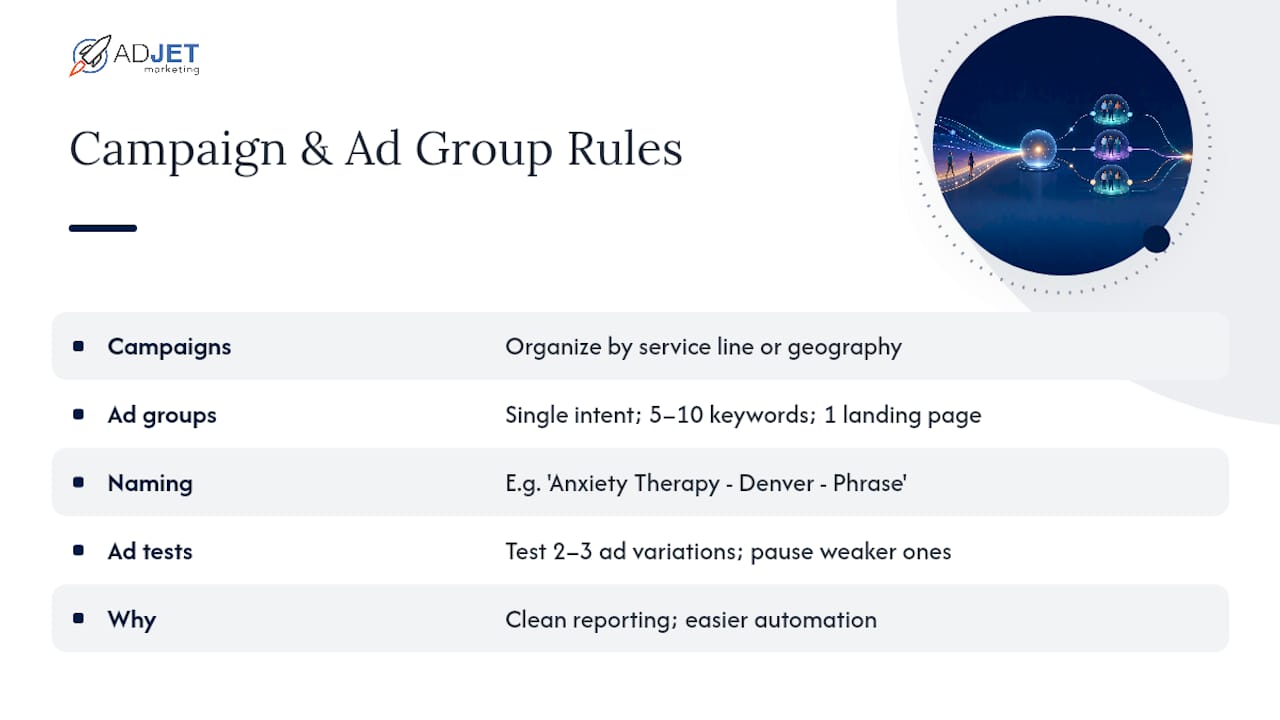
If you offer therapy in three cities, consider separate campaigns per city so you can control budget and bidding independently. If you offer multiple services in one location, structure campaigns by service instead: one campaign for individual therapy, one for couples counseling, one for teen therapy.
Within each campaign, ad groups should follow one rule: single intent, five to ten closely related keywords, and one matched landing page per group. An ad group mixing “couples therapy” and “family therapy” keywords, pointing to a single generic landing page, will underperform two separate ad groups pointing to two specific pages, almost every time.
A naming convention that scales might look like: [Service] - [City] - [Match Type], so you’d see campaigns like “Anxiety Therapy – Denver – Phrase” or “Couples Counseling – Denver – Exact.” This makes reporting and future automation far easier than guessing what “Campaign 3” was supposed to target.
For ad copy, test two to three variations per ad group at a time. Testing more than that dilutes your data too thin to draw conclusions within a reasonable timeframe. Once one variation clearly outperforms, pause the weaker ones and introduce a new challenger.
How Do You Write Therapist Ads That Follow Google’s Healthcare Policies?
Mental health advertising sits inside Google’s healthcare and medicine policy category, which means your ads face more scrutiny than a typical local service business. Google requires healthcare-related advertisers to follow location-specific rules, and some categories require certification, such as LegitScript, before you’re even eligible to run ads.
Sample ad copy that tends to perform without triggering policy flags:
Headline: “Licensed Anxiety Therapist in Denver” Description: “In-person and telehealth sessions. Accepting new clients. Most insurance accepted. Schedule a consultation today.”
Headline: “Couples Counseling, Denver Metro” Description: “Evidence-based approaches for communication and connection. Licensed therapists. Evening appointments available.”
Notice what’s absent: no promises of specific outcomes, no clinical claims about “curing” anxiety or “fixing” relationships, no urgency language that could read as manipulative in a healthcare context.
A policy checklist worth running before every ad goes live:
- Avoid guaranteeing outcomes (“end your anxiety,” “save your marriage”).
- Don’t reference specific diagnoses in ways that could be read as targeting a vulnerable population inappropriately.
- Confirm whether your service category requires certification before running ads at all; Google’s Advertising Policies Help Center lists healthcare subcategories and their requirements.
- Include licensing information (state, credential type) somewhere visible, even if not in the ad copy itself, since it should appear on the landing page.
If an ad gets disapproved, don’t panic and don’t resubmit the same copy hoping it clears the second time. Read the specific policy citation Google provides, adjust the language, and appeal only if you believe the disapproval was made in error. An “Eligible (limited)” label usually means the ad is running but restricted in certain regions or for certain audiences, often tied to the same healthcare certification requirements.
Pro Tip: Mention telehealth availability and licensing state directly in your sitelink extensions rather than cramming it into the headline. It keeps your primary message clean while still surfacing the compliance information Google and prospective clients both want to see.
What Should Your Budget and Timeline Realistically Look Like?
A starting budget of $500 to $600 per month is a reasonable range for gathering enough learning data without overcommitting before you know the account works. That range typically buys a moderate number of clicks per day in a mid-competition market, depending on your city and specialty.
Smart Bidding strategies like Target CPA need consistent conversion volume to function well, generally requiring multiple conversions a month at the campaign level. Below that threshold, manual bidding or Maximize Clicks with a budget cap usually performs more predictably, simply because Google’s algorithm doesn’t have enough signal to optimize confidently.
Expect a learning phase of four to six weeks where cost per lead fluctuates and isn’t a reliable indicator of long-term performance. Treat the 90-day mark as your first real evaluation point for whether the account is stabilizing into a pattern you can plan a budget around.
To know whether a cost per booked intake is acceptable, work backward from client lifetime value. If a client typically stays for several sessions at a standard rate, the lifetime value can be substantial. A cost per booked intake within a reasonable range is easier to justify; excessively high costs may not be economically viable, unless your average client relationship is considerably longer.
Tracking Calls, Forms, and Bookings Without Guessing at ROI
You cannot optimize what you don’t measure, and in therapy specifically, that measurement has to be done carefully because of the sensitive nature of the data involved.
The tracking stack that works reliably:
- Install Google Tag Manager on your website as the container for all tracking tags.
- Set up Google Ads conversion actions for phone calls, form submissions, and booking confirmations.
- Link Google Ads to GA4 so conversion data and behavioral data live in the same reporting environment.
- Verify each conversion action fires correctly using Tag Manager’s preview mode before you launch, not after.
Linking steps in short: connect Ads to Analytics inside the Ads account settings, confirm the link inside Analytics admin, then confirm conversion actions are importing correctly into Ads. Google’s own linking documentation walks through each screen.
For attribution, a 30-day click-through conversion window tends to fit therapy’s decision timeline reasonably well; people often research for a week or two before calling.

Here’s where therapy differs from most industries: standard Google Ads tracking can capture identifiable signals that create PHI exposure risk, particularly with features like enhanced conversions, which are designed to send hashed customer data (email, phone) back to Google for better matching. For a mental health practice, that’s a meaningful compliance concern. Avoid enabling enhanced conversions unless you’ve reviewed exactly what data it transmits, and consider server-side tracking with PHI filtering if you’re working with a compliance-conscious setup. Our conversion tracking walkthrough covers this in more detail.
What Ongoing Optimization Actually Looks Like
Managing a therapy Google Ads account isn’t a “set it up and check back in three months” project, but it also shouldn’t require daily fiddling. A steady weekly and monthly cadence works better than either extreme.
Weekly checks:
- Review the search terms report for irrelevant queries that need to become negative keywords.
- Check budget pacing to confirm you’re not running out of budget by early afternoon.
- Note which keywords are generating conversions versus which are just spending.
Monthly checks:
- Review landing page conversion rate by service and adjust copy or layout where it’s underperforming.
- Introduce one or two new ad variants to test against current winners.
- Reassess bid strategy: if you’ve cleared 15 to 30 monthly conversions consistently, it may be time to test Target CPA.
The KPIs worth watching closely are cost per lead, click-through rate, conversion rate on the landing page, and cost per conversion (which should be distinct from cost per lead if you’re tracking both inquiries and actual booked intakes).
Decision rules that keep the account healthy: pause keywords that have spent noticeably more than your target CPA with zero conversions after a reasonable sample size, expand geography only after your current area is performing predictably, and hold off on testing Performance Max until you have enough conversion history for Google’s automation to work with rather than guess at.
Compliance Essentials Every Therapist Advertiser Needs to Know
Google treats mental health advertising as a healthcare category, which means the standard local-service playbook doesn’t fully apply. Some healthcare-related content can’t be advertised at all, and other categories require advertisers to apply for certification before running ads, sometimes through a third party like LegitScript. Confirm early whether your specific services fall into a restricted category, because finding out after your account gets suspended is a far more expensive lesson.
A practical HIPAA-aware checklist for your Ads account:
- Don’t enable enhanced conversions or any feature that transmits hashed personal data to Google without understanding exactly what’s being sent.
- Avoid building remarketing audiences from pages that reveal a visitor sought mental health treatment; remarketing on sensitive health categories carries real compliance risk, and Google itself restricts personalized advertising based on inferred health conditions.
- Keep intake forms on HIPAA-compliant hosting, separate from your marketing analytics stack where possible.
- Loop in legal counsel or a HIPAA compliance vendor before your first campaign launches if you’re at all uncertain about your tracking setup, not after a patient complaint.
Given these constraints, intent-based search keywords paired with clear, compliant landing pages remain a safer foundation than audience-based remarketing for this category.
Where Most Therapy Google Ads Accounts Actually Go Wrong
The accounts that struggle almost never fail because of bad keywords. In practice, we see the same three problems on repeat: no working conversion tracking, a landing page that doesn’t match what the ad promised, and a budget too small to generate enough data before someone decides the channel “doesn’t work.”
One pattern shows up often enough to be worth naming directly: a practice runs ads for two or three months, sees an inconsistent trickle of leads, and concludes Google Ads isn’t right for therapy. In several of these cases, the actual problem was that conversion tracking had never fired a single event correctly. Google’s algorithm was optimizing blind, essentially guessing which clicks mattered because it had no signal telling it otherwise. Once tracking gets fixed and campaigns get restructured around clean service-specific ad groups, the same budget that produced nothing starts producing bookings within a few weeks. That’s not a fluke of better ad copy. It’s a fluke of the account finally being able to see what’s working.
If you take one thing from this guide, prioritize signal hygiene over bidding sophistication. A perfectly tuned Target CPA strategy built on broken tracking will still fail. A modest budget with airtight conversion data will teach you more in a month than a bigger budget with no visibility ever will.
How Adjetmarketing Helps Therapists Get This Right
There are other paths here: hire a freelancer, manage it yourself with a weekend of YouTube tutorials, or hand it to a generalist agency that treats a therapy practice the same as a plumbing company. Each has real limits, mainly because mental health advertising has policy and privacy requirements that most non-specialist marketers simply haven’t dealt with before.
Adjetmarketing builds Google Ads accounts specifically for therapy and mental health practices, with HIPAA-aware tracking configured from day one instead of retrofitted after a compliance concern surfaces. That means conversion tracking, landing pages, and campaign structure get built together as one system rather than assembled piecemeal, which is usually where accounts run by generalists start leaking budget. We handle the account setup, the landing page build, and the ongoing optimization so you’re not learning Google Ads policy on the fly while also running a caseload.
If you’re deciding whether to build this yourself or bring in help, our practical guide to Google Ads benefits for medical clinics is a reasonable next read, and if you’d rather just talk through your specific situation, reach out and we’ll walk through what a realistic setup looks like for your practice.
Resources Worth Bookmarking Before You Launch
A few official tools and policy pages are worth keeping close while you build and manage your account:
- Google Ads policies explains what’s restricted or prohibited in healthcare advertising, plus how disapprovals and appeals work.
- Google’s healthcare and medicine policy page covers certification requirements like LegitScript for specific categories.
- Google Ads Keyword Planner validates search volume and competition before you commit budget to a keyword list.
Bookmark these now. You’ll likely reference the policy pages again the first time an ad gets disapproved, and that moment tends to arrive sooner than most new advertisers expect.
Sources
- Google Ads is dedicated to following advertising regulations for healthcare and medicine, so ads and destinations are expected to follow appropriate laws and industry standards. Some types of healthcare-related content can’t be advertised at all, while others can only be advertised in certain locations by advertisers who have applied and been approved to advertise those products or services using Google Ads.
- Google Ads policies – Advertising Policies Help
- How to Create a Google Ads Campaign for your Therapy Practice
- Google Ads conversion tracking help
- Google Ads for Mental Health Providers: Therapy and Counseling Campaign Setup — Curve
Recommended
- Google Ads For Therapists: A Step-by-Step Campaign Creation Guide – AdJet Digital Marketing & Google Partner Agency | SEO Development Google Ads Social
- Do Google Ads Work For Counseling Clinics? → Costs, CPL & Real Results – AdJet Digital Marketing & Google Partner Agency | SEO Development Google Ads Social
- Pain Management Google Ads: A 2026 Clinic Strategy Guide
- Is HIPAA-Compliant Marketing Possible With Google Ads? → Yes—Here’s How To Do It Right – AdJet Digital Marketing & Google Partner Agency | SEO Development Google Ads Social