









A compliant landing page is defined as a web page that meets legal privacy requirements, accessibility standards, and advertising platform policies while collecting user data or driving conversions. Building compliant landing pages is not optional for digital marketers and business owners. Regulations like GDPR, standards like WCAG, and platform rules from Google Ads all apply simultaneously. Get any one of them wrong and you risk ad disapprovals, legal exposure, or lost user trust. This guide covers exactly how to create compliant landing pages in 2026, from privacy disclosures and cookie consent to automated monitoring and content alignment.
What legal and privacy requirements must landing pages meet?
Landing page compliance starts with a clear, accessible privacy policy. Under GDPR and similar regulations, any page that collects personal data must link a privacy policy in the footer explaining what data is collected, how it is used, and how users can access or delete it. This is not a formality. It is a legal requirement that also signals trustworthiness to both users and ad platforms.
Beyond the privacy policy, you need a functioning cookie consent mechanism. Cookie consent banners should offer granular opt-in and opt-out options, categorize cookies by type (functional, analytics, marketing), and link to a dedicated cookie policy page. Vague banners that say “We use cookies” without offering real choices do not meet GDPR standards.
Here are the core legal elements every compliant landing page must include:
- Privacy policy link: Placed in the footer, written in plain language, and updated to reflect current data practices.
- Cookie consent banner: Granular controls for each cookie category, not a single accept-all button.
- Opt-in checkboxes: Unchecked by default for any marketing communications. Pre-checked boxes are not valid consent under GDPR.
- Data use transparency: A brief, plain-language statement near your form explaining why you are collecting the data and what you will do with it.
- Opt-out mechanism: A clear way for users to withdraw consent after submitting a form, typically a link to manage preferences or unsubscribe.
For healthcare providers and medical clinics, HIPAA adds another layer. Any form collecting protected health information (PHI) requires additional safeguards. Adjetmarketing covers this in detail for HIPAA-compliant Google Ads campaigns, where the landing page is the point where compliance risk is highest.
Pro Tip: Place your privacy policy link directly below your lead capture form, not just in the footer. Users are more likely to notice it at the moment of data entry, which increases trust and reduces friction.
How to ensure accessibility compliance on landing pages
Accessibility compliance means your landing page meets WCAG (Web Content Accessibility Guidelines) standards so users with disabilities can navigate and use it. WCAG requirements include alt text for all images, high-contrast color schemes, and full keyboard navigation support. Meeting these standards is both a legal protection and a practical improvement to your page’s usability.

The SEO benefit is real and often underestimated. Accessibility improvements like alt text, logical heading structure, and descriptive link text directly improve how search engines crawl and index your page. A page built for screen readers is also a page built for Google’s crawler.
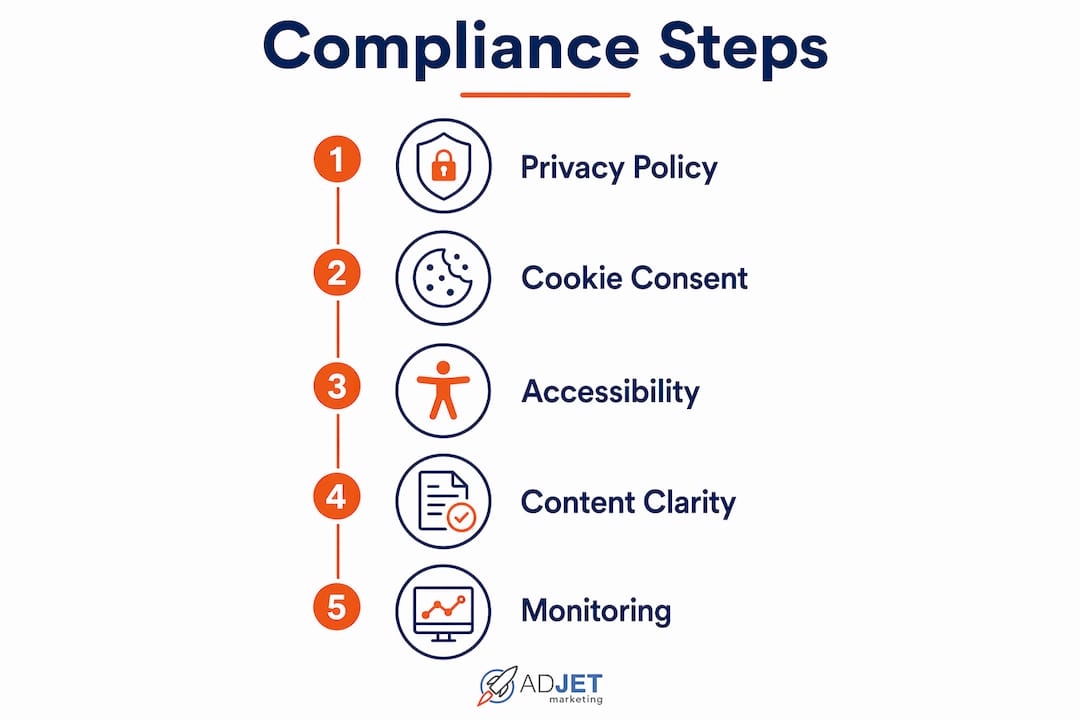
Technical compliance goes beyond visual design. Your page must load quickly on mobile devices, use functional links with descriptive anchor text, and avoid content that flashes or moves in ways that could trigger seizures. Google PageSpeed Insights and Lighthouse are free tools that identify both performance and accessibility failures in one audit.
Common accessibility pitfalls to fix before launch:
- Images without alt text (fails WCAG 1.1.1)
- Color contrast below 4.5:1 ratio for normal text (fails WCAG 1.4.3)
- Form fields without visible labels (fails WCAG 1.3.1)
- Interactive elements unreachable by keyboard tab navigation (fails WCAG 2.1.1)
- Missing or generic page title tags that do not describe the page content
Pro Tip: Run your landing page through the WAVE Web Accessibility Evaluation Tool before launch. It flags errors visually on the page itself, making fixes faster than reading a raw audit report.
What role does content clarity play in landing page compliance?
Google Ads evaluates landing pages as a system of trust signals, not a checklist of individual elements. The evaluation focuses on transparency, relevance, and continuity between your ad and your page. A page that passes every technical check but misleads users about the offer will still fail Google’s review.
Content alignment between your ad and your landing page is the most commonly overlooked compliance factor. If your ad promises a free consultation and your landing page leads with pricing, Google reads that as a trust signal failure. The result is a lower Quality Score, higher cost per click, and potential ad disapproval.
Follow these steps to build content-compliant landing pages:
- Match your headline to your ad copy. The first thing a visitor reads on your page should reflect the exact promise made in the ad. Word-for-word matching is not required, but the core offer must be consistent.
- Explain the offer before asking for action. Structural transparency means the user understands what they are getting before they see the form or CTA button. Do not gate the explanation behind the conversion.
- Avoid superlatives and unverifiable claims. Phrases like “best in the country” or “guaranteed results” trigger both Google’s review process and potential FTC scrutiny. Use specific, verifiable claims instead.
- Include clear business identification. Your page should display your business name, a physical or service area address, and a working phone number or contact method. Anonymous pages fail trust evaluations.
- State terms clearly for any offer. If you are offering a free trial, discount, or consultation, state the conditions plainly. Hidden terms discovered after form submission damage trust and increase complaint rates.
High-performing landing pages combine clear headlines, prominent CTAs, and benefit-driven copy with these compliance elements. The two goals reinforce each other. A transparent page converts better because users trust it.
How to implement automated monitoring for ongoing compliance
Compliance is an ongoing process, not a one-time setup. Automated real-time monitoring combined with periodic manual audits is the only reliable way to maintain landing page compliance as regulations evolve and pages are updated. Manual checks alone miss too much, too often.
Programmatic consent verification is the technical foundation of ongoing compliance. Before you contact any lead, your system should verify consent records by checking for a complete disclosure, a valid signature or checkbox confirmation, a timestamp, an IP address, and the source URL. If any element is missing or the consent has been revoked, the system should block contact automatically.
Here is a comparison of manual versus automated compliance monitoring approaches:
| Factor | Manual monitoring | Automated monitoring |
|---|---|---|
| Frequency | Quarterly or ad hoc | Real-time, continuous |
| Consent verification | Spot checks only | Every lead, every submission |
| DNC list matching | Periodic batch scrub | Checked at point of contact |
| Opt-out processing | Manual queue, delay risk | Immediate, logged automatically |
| Audit trail | Spreadsheet or notes | Immutable system logs |
| Error detection | After the fact | Alert triggered on deviation |
The metrics you track matter as much as the tools you use. Monitor consent verification pass and fail rates, Do Not Call (DNC) match rates, and opt-out processing times. Set alert thresholds so your team is notified immediately when any metric deviates from baseline. Quarterly manual audits should review consent form elements, test the opt-out process end to end, and verify that script adherence is maintained across all contact channels.
Legal and compliance workflows embedded in your CMS, including tracked e-signatures and immutable logs, give you audit-ready documentation without extra manual effort. This matters most when a regulator or platform requests evidence of consent.
Pro Tip: Store consent records with all required metadata (timestamp, IP address, source URL, form version) for a minimum of five years. Regulations in most jurisdictions require you to prove consent was obtained, not just that a form existed.
What are common mistakes when building compliant landing pages?
The most costly compliance mistakes are also the most preventable. They tend to cluster around three areas: missing legal elements, poor consent flows, and no version control.
- Missing privacy policy or cookie banner. Many landing pages built for speed skip these entirely. A page without a privacy policy link is non-compliant from the moment it goes live.
- Pre-checked opt-in boxes. This is invalid consent under GDPR. Every marketing opt-in must be an active, affirmative choice by the user.
- Mismatched ad-to-page messaging. When the ad promises one thing and the page delivers another, you face both Google Ads disapproval risk and user distrust. This is one of the top reasons for Quality Score drops.
- No version control on page content. When you update copy, offers, or consent language, you need a record of what was live and when. Without this, you cannot defend your compliance position if a complaint is filed.
- Ignoring accessibility. Skipping WCAG compliance is a legal risk in the United States under the Americans with Disabilities Act (ADA), not just a best practice.
- No documented approval workflow. For healthcare and legal industries in particular, content changes should require sign-off from a compliance officer or legal reviewer before publishing.
The fix for most of these is process, not technology. Use pre-approved templates for new landing pages. Build a checklist that every page must pass before launch. Assign a named owner for compliance review on each page update. These steps take less time than responding to a complaint or rebuilding a disapproved campaign.
Key takeaways
Compliant landing pages require privacy policies, cookie consent, WCAG accessibility, ad-to-page content alignment, and automated consent monitoring to protect both users and your marketing investment.
| Point | Details |
|---|---|
| Privacy policy is mandatory | Link it in the footer and near your form; explain data use in plain language. |
| Cookie consent must be granular | Offer category-level opt-in and opt-out, not a single accept-all button. |
| Ad and page content must align | Match your headline to your ad promise; explain the offer before the CTA. |
| Accessibility improves SEO and reach | Alt text, contrast ratios, and keyboard navigation benefit all users and search rankings. |
| Automate consent verification | Check every lead for complete, valid consent before contact; log all records with metadata. |
Compliance is a process, not a project
I have worked with enough clinics and marketing teams to know how this usually goes. A landing page gets built fast, the campaign launches, and compliance is treated as something to revisit later. Later rarely comes until there is a problem.
The clients who come to us after a Google Ads disapproval or a HIPAA inquiry almost always have the same gap: the page was built for conversion, not for compliance. The two are not in conflict, but you have to build compliance in from the start, not bolt it on afterward.
What I have found actually works is treating the compliance checklist as part of the design brief, not a post-launch audit. When your designer knows the page needs a cookie banner, a privacy link near the form, and WCAG-compliant contrast ratios before they start, those elements get built correctly the first time. Retrofitting them into a finished page costs more time and often breaks the design.
Regulations will keep evolving. Google’s platform policies update regularly. The only sustainable approach is a documented process with assigned ownership, automated monitoring, and a quarterly review cycle. That is not a burden. It is the foundation that lets you run paid campaigns confidently without worrying about what you might have missed.
— Felix
How Adjetmarketing builds compliant, high-converting landing pages
At Adjetmarketing, we build landing pages and marketing funnels that meet legal and platform requirements without sacrificing conversion performance. Our team handles privacy policy integration, cookie consent setup, WCAG accessibility checks, and ad-to-page content alignment as standard parts of every build. We work with medical clinics, aesthetic practices, and healthcare providers where compliance is not optional. If you want pages that generate quality leads and hold up to regulatory scrutiny, explore our digital marketing strategy services or our web design services to see how we approach compliant page design from the ground up.
FAQ
What must a compliant landing page include?
A compliant landing page must include a privacy policy link, a cookie consent banner with granular controls, unchecked opt-in checkboxes, and clear data use disclosures near any lead capture form.
Does GDPR apply to landing pages outside Europe?
GDPR applies to any page that collects data from users located in the European Union, regardless of where the business is based. If your ads target EU users, your landing pages must meet GDPR requirements.
How does Google Ads evaluate landing page compliance?
Google evaluates landing pages as a system of trust signals, assessing transparency, relevance, and continuity between the ad and the page. Pages that mislead users or hide key information receive lower Quality Scores and risk disapproval.
What is programmatic consent verification?
Programmatic consent verification is an automated process that checks each lead’s consent record for completeness, including disclosure, signature, timestamp, IP address, and source URL, before any contact is made. Leads that fail verification are blocked from outreach automatically.
How often should landing pages be audited for compliance?
Quarterly manual audits combined with continuous automated monitoring represent the current best practice. Manual reviews should test opt-out flows, verify consent form elements, and check for any content changes that may have introduced compliance gaps.
Recommended
- What Landing Pages Do Top Realtors Use? | Convert More Clicks Into Clients – AdJet Digital Marketing & Google Partner Agency | SEO Development Google Ads Social
- Real Estate Website Design That Actually Converts Buyers
- Landing Page Design – AdJet Digital Marketing & Google Partner Agency | SEO Development Google Ads Social
- What’s A Good Landing Page For Therapy Services? → A Copy & Layout You Can Steal – AdJet Digital Marketing & Google Partner Agency | SEO Development Google Ads Social