









Interventional pain marketing is the focused practice of promoting specialized pain procedures, such as epidural steroid injections, nerve blocks, and spinal cord stimulation, through compliant, targeted digital and referral strategies designed to attract and convert the right patients. Unlike broad pain management advertising, this discipline requires you to align your messaging with payer authorization realities, Google Ads healthcare policies, and ethical standards around patient selection. The stakes are higher than in general medical marketing because the procedures are complex, the patient journey is longer, and a single misaligned ad can generate demand your clinic cannot actually convert.
What are the core channels of effective interventional pain marketing?
Interventional pain marketing works best when it combines paid search, organic content, and structured referral programs rather than relying on any single channel. Each channel serves a different stage of the patient decision cycle, and understanding that distinction is what separates high-performing clinics from those burning budget on unqualified leads.

Google Ads is the fastest channel for patient acquisition, but it comes with significant policy constraints. For pain management clinics, compliant campaigns typically receive an “Eligible (limited)” ad status, which means your ads run with location and content restrictions rather than full delivery. This is normal and expected. It does not mean your campaign is failing. What it does mean is that your ad copy, landing pages, and keyword targeting must stay within Google’s healthcare and medicines advertising policies from day one. You can find a detailed breakdown of how to structure these campaigns in this pain management Google Ads guide.
SEO and content marketing build the long-term foundation. Procedure-specific pages targeting searches like “spinal cord stimulation near me” or “epidural steroid injection for back pain” capture patients who are already in research mode. The American Association of Orthopaedic Pain Medicine reports that epidural steroid injections are the most commonly performed interventional pain procedure in the U.S., with over 9 million performed annually. That volume signals real search demand you can capture with well-structured content.
Referral marketing rounds out the strategy. Building a referral flywheel with primary care physicians, orthopedic surgeons, and neurologists produces a consistent stream of pre-qualified patients. These referrals arrive with a baseline level of trust already established, which shortens your conversion cycle considerably.
- Paid search (Google Ads): Best for immediate patient volume; requires strict policy compliance and certified landing pages
- SEO and content: Best for long-term visibility on procedure-specific and condition-specific queries
- Physician referral programs: Best for pre-qualified, high-intent patients with established clinical context
- Social media and educational video: Best for building candidacy awareness and setting realistic expectations before a patient calls
Pro Tip: Create separate landing pages for each procedure rather than sending all Google Ads traffic to your homepage. A page dedicated to spinal cord stimulation candidacy criteria will convert at a significantly higher rate than a generic “pain clinic” page.
How do payer policies shape your marketing messaging?
Payer authorization rules are one of the most underestimated constraints in pain clinic marketing. If your ads generate demand for a procedure that most of your payer mix will not authorize, you end up with a full schedule of appointments that never convert to completed treatments or revenue.
Payer-specific prior authorizations for interventional procedures change frequently, and what was covered last quarter may require new documentation this quarter. Malakos Healthcare Solutions recommends maintaining a payer matrix and conducting quarterly billing audits to stay current. That same discipline needs to extend into your marketing content.
Here is a practical framework for aligning your marketing with payer realities:
- Audit your payer mix before launching campaigns. Identify which procedures your top five payers authorize and under what conditions. This determines which services you can responsibly promote.
- Update your website content quarterly. When payer rules change, your patient-facing content about coverage and access needs to reflect that. Outdated content creates patient frustration and wasted appointments.
- Train your front desk and scheduling team on authorization timelines. If your ads promise fast access but your authorization process takes three weeks, patients drop off. Marketing and operations must tell the same story.
- Avoid coverage guarantees in any ad copy or landing page. Phrases like “most insurance accepted” are fine. Specific coverage claims for individual procedures are not, because payer rules vary too widely.
| Procedure | Typical payer authorization requirement | Marketing implication |
|---|---|---|
| Epidural steroid injection | Conservative care documentation, often 6 weeks | Emphasize candidacy criteria, not speed of access |
| Spinal cord stimulation | Psychological evaluation, trial period required | Set multi-step expectations in content |
| Nerve blocks (diagnostic) | Varies by payer; often less restrictive | Can be positioned as a faster access point |
| Radiofrequency ablation | Prior diagnostic block often required | Market as a follow-on procedure, not a first step |
Pro Tip: Build a one-page payer matrix that your marketing team and billing team both reference. When a payer changes its authorization criteria, update your website content within 30 days. This single habit prevents a significant source of unconvertible patient demand.
What ethical and compliance rules govern pain clinic advertising?
Ethical marketing in interventional pain is not optional. It is a legal and professional requirement that shapes every piece of content you publish.
Google restricts how healthcare marketers can use health-related data for targeting and disapproves ads that reference specific medical conditions without proper certification. Unsubstantiated outcome claims, restricted prescription drug terms, and landing pages that do not match ad copy are the three most common causes of ad disapproval in healthcare campaigns. Each of these is avoidable with proper setup.
HIPAA compliance adds another layer. Patient data collected through contact forms, call tracking, or retargeting pixels must be handled according to HIPAA standards. Using standard Google Analytics without consent mode configuration on a healthcare site is a compliance risk. You can review how to handle this correctly in this guide on HIPAA-compliant Google Ads.
The clinical ethics dimension is equally important. About 30% of patients receiving spinal cord stimulation experience limited or no benefit. Marketing that implies universal success for this procedure is not just misleading. It is a liability. A 2026 Frontiers mini review specifically advocates for ethical marketing focused on candidacy criteria rather than outcome promises.
“Spinal cord stimulation marketing should emphasize candidacy criteria and realistic patient outcomes to maintain ethical standards and avoid misleading patients.” — Frontiers, 2026
Key compliance rules to follow in your pain marketing content:
- Never claim a specific success rate for any procedure unless it is sourced from peer-reviewed literature and properly attributed
- Avoid before-and-after framing that implies guaranteed results
- Do not use condition-specific targeting in Google Ads (e.g., targeting users based on a diagnosed health condition)
- Include appropriate disclaimers on procedure pages noting that outcomes vary and that candidacy is determined during consultation
- Review all ad copy against Google’s healthcare and medicines advertising policy before launch
How can clinics build patient acquisition pathways that actually convert?
Generating patient inquiries is only half the job. The other half is building a pathway from first contact to completed appointment that reflects your actual clinical and operational workflow.
Marketing misaligned with payer authorizations creates unconvertible patient demand. This is one of the most common problems we see when clinics come to Adjetmarketing after working with generalist agencies. The ads were running, the clicks were coming in, but the appointments were not converting because the marketing promised access the clinic could not deliver.
The solution is to map your patient acquisition pathway before you build your campaigns. Start with the clinical intake process and work backward to your ad copy. If spinal cord stimulation requires a psychological evaluation and a trial period before permanent implant, your landing page should explain that process clearly. Patients who understand the journey before they call are far more likely to complete it.
| Marketing approach | Best for | Key consideration |
|---|---|---|
| Insurance-based positioning | High-volume clinics with broad payer contracts | Requires constant payer matrix updates |
| Cash-pay boutique positioning | Independent physicians, regenerative medicine | Higher per-patient revenue, smaller volume |
| Hybrid model | Clinics offering both standard and premium services | Requires clear messaging separation |
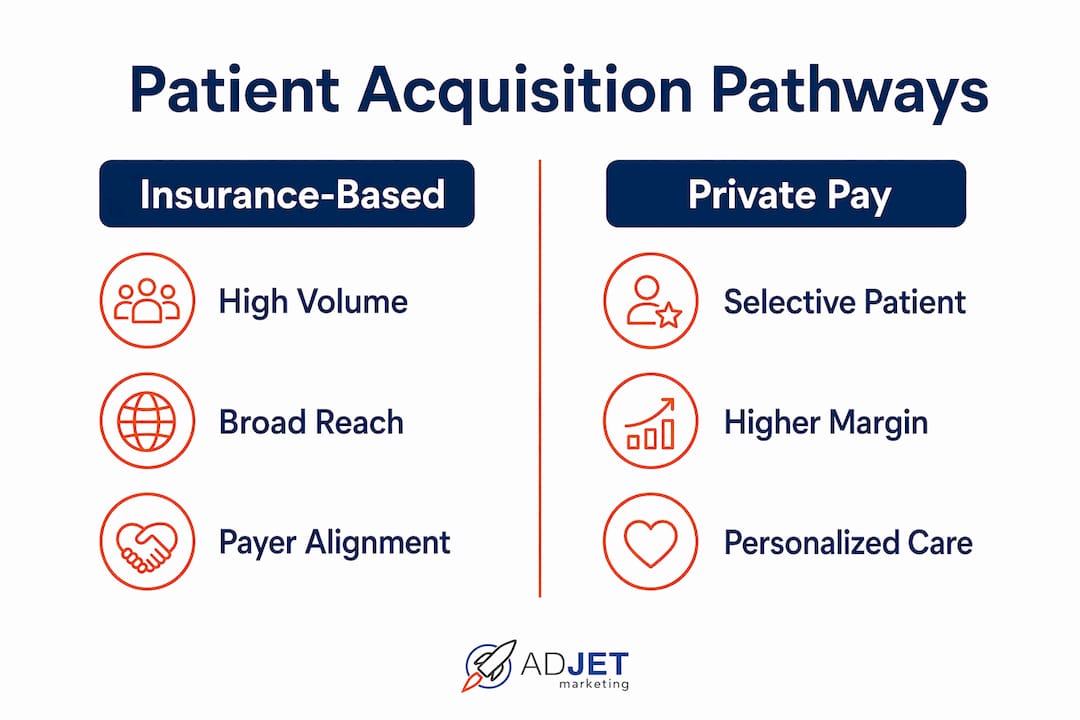
Independent interventional pain physicians are successfully differentiating from private equity chains by emphasizing personalized care, concierge-level service, and specialty procedural expertise. This boutique positioning works particularly well for cash-pay models where you are not constrained by payer authorization timelines.
Pro Tip: Add a candidacy self-assessment tool to your procedure landing pages. A simple five-question form that helps patients determine whether they may be a candidate for a procedure reduces mismatched appointments and increases the quality of every consultation your team handles.
What are the best practices and emerging innovations in pain marketing?
The most forward-looking pain clinics are beginning to incorporate AI-driven patient education into their marketing content. AI and machine learning models can analyze clinical, psychological, and socioeconomic data to predict spinal cord stimulator success rates, reducing failure rates and associated healthcare costs. You cannot use these models in your ads directly, but you can use the underlying concept to shape your patient education content.
Communicating that your clinic uses evidence-based candidacy criteria, rather than offering procedures to every patient who walks in, is itself a differentiator. It signals clinical rigor and builds trust with the patients most likely to benefit and most likely to refer others.
Other best practices gaining traction in 2026:
- Evergreen procedure content: Long-form pages on epidural steroid injections, radiofrequency ablation, and spinal cord stimulation that answer the questions patients actually search for, updated annually to reflect current evidence
- Video patient testimonials: Short, authentic videos where patients describe their experience and outcomes, with appropriate disclaimers, outperform stock imagery and generic copy in conversion testing
- Physician-to-physician referral content: A dedicated section of your website or a downloadable referral guide aimed at primary care physicians, explaining your procedures, candidacy criteria, and referral process
- Local SEO for procedure-specific searches: Optimizing your Google Business Profile and local citations for searches like “pain management specialist [city]” captures high-intent patients in your geographic market
Key takeaways
Effective interventional pain marketing requires aligning compliant digital channels, payer-aware messaging, and ethical patient education to generate demand your clinic can actually convert.
| Point | Details |
|---|---|
| Google Ads compliance | Expect “Eligible (limited)” status; build certified landing pages and avoid condition-specific targeting. |
| Payer matrix discipline | Maintain and update a payer authorization matrix quarterly to keep marketing aligned with what you can deliver. |
| Ethical outcome messaging | Never promise universal results; 30% of spinal cord stimulation patients see limited benefit, so focus on candidacy criteria. |
| Patient pathway mapping | Map the clinical intake process before building campaigns to prevent unconvertible appointment demand. |
| Boutique vs. volume positioning | Independent clinics can compete with PE chains by emphasizing personalized care and cash-pay specialty services. |
Why marketing and clinical operations must be built together
Most of the pain clinic marketing problems I see are not marketing problems at all. They are operations problems wearing a marketing costume. A clinic runs Google Ads, gets 80 inquiries a month, and converts 6 into completed treatments. The instinct is to blame the ads. The real issue is usually a disconnect between what the ads promised and what the intake process delivered.
The clinics that grow sustainably are the ones where the physician or practice manager sat down with the marketing team before a single ad went live and said, “Here is exactly what happens after a patient calls. Here is what we can authorize. Here is what we cannot.” That conversation changes everything about how campaigns are structured.
I have also seen clinics damage their reputation with Google Ads by making claims they could not substantiate. One disapproval for a policy violation does not just pause a campaign. It can trigger a review of your entire account. Building compliant campaigns from the start, even if it means more conservative ad copy, is always the better long-term decision.
The other thing I would push back on is the assumption that more volume is always better. For independent interventional pain physicians, a smaller number of well-matched patients who complete their treatment plan and refer others is worth far more than a high volume of mismatched inquiries. Your marketing should reflect the kind of practice you want to run, not just the maximum number of clicks you can generate.
— Felix
How Adjetmarketing helps pain clinics grow with compliant marketing
Adjetmarketing is a Google Partner agency with direct experience building patient acquisition systems for pain management clinics. We handle Google Ads setup and compliance management, procedure-specific SEO, and high-converting landing page design, all built around the payer and regulatory realities your clinic operates within. We do not run generic healthcare campaigns. Every strategy is built around your specific procedure mix, payer contracts, and patient acquisition goals. If you are ready to build a marketing system that generates qualified patients and converts them reliably, explore our pain clinic digital marketing services or use our marketing profit calculators to estimate your ROI before committing to a budget.
FAQ
What is interventional pain marketing?
Interventional pain marketing is the specialized promotion of procedures like epidural steroid injections, nerve blocks, and spinal cord stimulation through compliant digital and referral strategies. It differs from general pain management advertising by focusing on procedure-specific patient acquisition and payer-aware messaging.
Why do Google Ads for pain clinics show “Eligible (limited)” status?
“Eligible (limited)” is the standard status for compliant healthcare ads on Google, meaning your campaign runs with location and content restrictions rather than full delivery. It is not a disapproval and does not indicate a problem with your account.
How should clinics handle insurance coverage claims in their ads?
Clinics should avoid specific coverage guarantees in ad copy or landing pages because payer authorization rules vary by procedure and change frequently. General statements like “most major insurance accepted” are acceptable; procedure-specific coverage claims are not.
What makes spinal cord stimulation marketing different from other pain procedures?
Spinal cord stimulation requires a psychological evaluation and a trial period before permanent implant, making the patient journey longer and more complex. Marketing for this procedure must set multi-step expectations and emphasize candidacy criteria, since roughly 30% of patients experience limited or no benefit.
How can independent pain clinics compete with large private equity networks?
Independent physicians can differentiate by emphasizing personalized care, specialty procedural expertise, and concierge-level service rather than competing on volume. Cash-pay and boutique positioning for regenerative medicine and advanced neuromodulation procedures is a proven strategy for building a premium patient base without competing directly on price.