









Mobile optimization is the practice of designing and building real estate websites so they load fast, display correctly, and convert visitors on smartphones and tablets. For real estate professionals and investors, this is not a technical nicety. It is the front door to your business. 76% of local mobile searches result in a business visit or contact within 24 hours. That means a buyer searching “homes for sale near me” on their phone is likely to call, email, or visit within the same day. If your site fails them in that moment, you lose the lead permanently. Google’s mobile-first indexing, responsive design standards, and fast-loading inquiry forms are the three pillars every real estate mobile strategy must address.
Why mobile optimization matters in real estate lead generation
Mobile users decide fast. A slow, cluttered property listing page does not get a second chance. Poor mobile usability causes 18.6% of mobile visitors to abandon a site entirely. That abandonment rate translates directly into lost buyer and seller inquiries.
The friction points are predictable and fixable. Real estate sites most often lose mobile visitors because of:
- Tiny tap targets. Buttons and links too small to tap accurately frustrate users and cause errors.
- Slow load times. A listing page heavy with uncompressed photos takes too long to appear on a 4G connection.
- Complex inquiry forms. Multi-field forms designed for desktop feel punishing on a small screen.
- Hard-to-read text. Font sizes that require pinching and zooming signal an outdated site.
Mobile friction signals poor service quality to users. Buyers and sellers do not separate the experience of your website from the experience of working with you. A clunky mobile site reads as a clunky agent. That perception forms in seconds and rarely reverses.
Conversion rate improvements come from removing friction, not adding features. Shortening inquiry forms to three fields (name, phone, and message) consistently increases mobile submissions. Replacing a multi-step contact process with a single tap-to-call button can double the number of inbound calls from mobile visitors.

Pro Tip: Test your own listing pages on a mid-range Android device using a standard mobile data connection, not Wi-Fi. This replicates the real conditions most of your mobile visitors experience, and the results are often sobering.
What does an effective mobile real estate strategy look like?
A strong mobile strategy for real estate sites rests on five practical components. Each one addresses a specific failure point that costs agents and investors leads.
-
Responsive design over separate mobile sites. A responsive site adapts a single codebase to any screen size. Separate mobile sites (m.domain.com) create duplicate content problems, split link equity, and double the maintenance burden. Responsive design is the current industry standard and the approach Google recommends.
-
Compressed images and video. Property photos are the core product of any real estate listing. They are also the primary cause of slow mobile pages. Compress images to WebP format and serve them at the correct display size. For video walkthroughs, host on YouTube or Vimeo and embed rather than self-hosting raw video files. Shaving even one second off load time reduces bounce rates significantly.
-
Mobile navigation built for thumbs. Real estate sites often carry heavy navigation menus built for desktop. On mobile, a hamburger menu with no more than five top-level items keeps navigation clean. Listing search filters should collapse into a single “Filter” button rather than displaying as a full sidebar.
-
Fast, minimal lead capture forms. Every additional field in a contact form reduces completion rates. On mobile, the standard is three fields maximum. Auto-fill support (using HTML autocomplete attributes) removes typing friction and increases form completions on returning visitors.
-
Mobile-optimized email and messaging touchpoints. Mobile engagement must cover the entire customer journey, including follow-up emails and SMS messages. Emails with single-column layouts, large call-to-action buttons, and minimal images perform better on mobile. SMS follow-ups after a form submission have high open rates and keep leads warm between conversations.
The goal across all five components is the same: remove every step between a mobile visitor’s intent and their contact with you.
How does mobile performance affect real estate SEO rankings?
Google uses mobile-first indexing to determine search rankings. This means Google primarily crawls and evaluates the mobile version of your site. Your desktop site’s quality is largely irrelevant if the mobile version is slow, incomplete, or poorly structured.
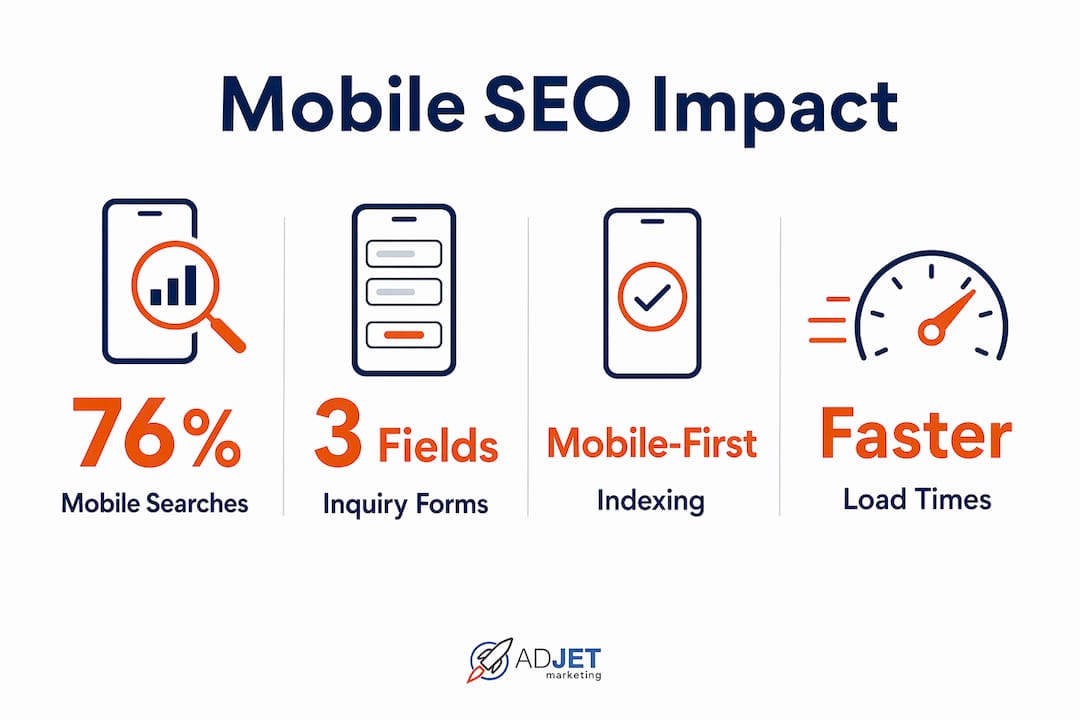
The practical implication is direct. If your mobile site hides property details behind collapsed sections, omits schema markup, or loads slowly, your rankings will drop. That drop affects both organic search visibility and the performance of any Google Ads campaigns pointing to those pages.
| Factor | Desktop behavior | Mobile behavior |
|---|---|---|
| Time on page | Longer sessions, deeper browsing | Shorter sessions, faster decisions |
| Bounce rate | Lower when content is rich | Higher when load time exceeds 3 seconds |
| Form completion | Tolerates multi-field forms | Drops sharply with more than 3 fields |
| Content consumption | Reads full listing descriptions | Scans headlines, photos, and price |
| Ranking signal | Secondary under mobile-first indexing | Primary ranking signal for Google |
Mobile users spend less time per page and browse in shorter, more distracted sessions than desktop users. This behavioral difference means your mobile content must front-load the most critical information: price, location, photos, and a clear contact option. Burying these details below the fold costs you both the user and the ranking signal their engagement would have provided.
Feature parity matters too. Every piece of content visible on your desktop site must also appear on the mobile version. Google’s crawler does not give credit for content it cannot find on mobile. Agents who maintain separate mobile sites often discover that key listing details, agent bios, or neighborhood pages are missing from the mobile version entirely.
Advanced performance tactics that most real estate sites ignore
Excessive third-party scripts cause performance bloat that directly harms conversion rates. Chat widgets, social share buttons, analytics tags, and retargeting pixels each add JavaScript that must load before your page becomes interactive. On mobile, where processing power and connection speed are limited, this bloat can add two to four seconds to your load time.
The fixes that produce the largest gains are often the least glamorous:
- Remove non-essential third-party scripts. Audit every script tag on your site. If a tool is not directly tied to lead generation or core analytics, remove it.
- Implement lazy loading. Lazy loading images and videos means the browser only loads media when it enters the viewport. A listing page with 20 photos loads as fast as a page with 2 photos when lazy loading is correctly implemented.
- Prioritize minimal JavaScript on initial load. Defer non-critical scripts so the page becomes usable before all scripts finish loading. This single change can cut your Time to Interactive metric by half.
- Test under real mobile conditions. Google’s PageSpeed Insights and Lighthouse tools score your site under simulated mobile conditions. A score below 70 on mobile is a direct ranking and conversion liability.
Video content deserves specific attention. Property walkthrough videos increase time on page and improve SEO signals, but self-hosted video files destroy mobile performance. Host video on YouTube or Vimeo, embed it with a lightweight facade (a static thumbnail that loads the player only on click), and you capture the SEO benefit without the performance cost. For mobile-friendly SEO strategies that apply across digital channels, the principle is consistent: speed and simplicity outperform feature density every time.
Pro Tip: Run a Google Lighthouse audit on your three most important listing pages right now. Focus on the “Opportunities” section. The top two or three items on that list will account for the majority of your performance gain, and most are fixable without a full site rebuild.
The “half-distracted” mobile browsing context is real. Your mobile visitors are often commuting, waiting in line, or multitasking. Design for interruption. Clear headings, large photos, and a persistent contact button visible at all times keep distracted users engaged long enough to convert. Conversion rate improvements on mobile come from reducing cognitive load, not from adding more information.
Key Takeaways
A mobile-optimized real estate site directly increases lead volume, search rankings, and client trust by removing friction at every point in the mobile experience.
| Point | Details |
|---|---|
| Mobile searches convert fast | 76% of local mobile searches lead to a contact or visit within 24 hours. |
| Friction kills leads | 18.6% of mobile users abandon sites due to usability problems like slow load times and complex forms. |
| Google ranks mobile first | Google’s mobile-first indexing means your mobile site quality determines your search rankings. |
| Speed is the top priority | Removing third-party scripts and implementing lazy loading produces the largest performance gains. |
| Optimize the full journey | Mobile optimization must extend to emails, SMS, and inquiry forms, not just the website. |
What I’ve learned from auditing real estate mobile sites
Most real estate professionals I work with at Adjetmarketing come to us after noticing a drop in leads, not after proactively thinking about mobile. That timing is the core problem. By the time a performance issue is visible in lead volume, it has already been costing you for months.
The most common mistake I see is treating mobile optimization as a one-time project. You rebuild the site, it scores well on PageSpeed, and then six months later a new plugin, a new chat widget, or a new photo gallery has quietly added 1.5 seconds to your load time. Mobile performance degrades incrementally. It requires the same ongoing attention as your ad spend or your listing inventory.
My honest advice: start with the audit, not the redesign. A full site rebuild is expensive and slow. A targeted audit of your three highest-traffic pages will almost always surface two or three fixes that produce 80% of the available gain. Fix those first. Measure the change in bounce rate and form completions. Then decide whether a broader rebuild is justified by the data.
The agents who see the best results from mobile optimization are not the ones with the most sophisticated sites. They are the ones who check their mobile metrics monthly, fix friction points as they appear, and treat their website as a living lead generation tool rather than a static brochure.
— Felix
How Adjetmarketing helps real estate professionals win on mobile
Real estate agents and investors who work with Adjetmarketing get a team that treats mobile performance as a lead generation issue, not a design issue. We audit existing sites for speed, usability, and content parity, then build or rebuild pages that convert mobile visitors into inquiries. Our approach combines SEO best practices for 2026 with conversion-focused design, so your listings rank well and perform well when buyers land on them. We also manage Google Ads campaigns that send paid traffic to mobile-optimized landing pages, which means every dollar you spend on ads reaches an audience ready to act. If your mobile site is losing you leads, we can show you exactly where and fix it.
FAQ
Why does mobile optimization matter for real estate specifically?
Real estate buyers and sellers search on mobile constantly, often in the moment a decision forms. 76% of local mobile searches lead to a contact within 24 hours, making mobile the highest-intent channel in real estate marketing.
What is mobile-first indexing and how does it affect listings?
Mobile-first indexing means Google evaluates your mobile site to determine search rankings. If your mobile listing pages are slow or missing content, your rankings drop regardless of how good your desktop site looks.
How many form fields should a mobile real estate inquiry form have?
Three fields is the standard: name, phone number, and a short message. Every additional field reduces completion rates on mobile, where typing is slower and patience is shorter.
Does mobile optimization help with Google Ads performance?
Yes. Google Ads Quality Score factors in landing page experience, which includes mobile usability and load speed. A faster, cleaner mobile landing page lowers your cost per click and increases your conversion rate from paid traffic.
How often should a real estate site be audited for mobile performance?
Run a Google Lighthouse or PageSpeed Insights audit monthly on your highest-traffic pages. New plugins, scripts, and media additions degrade performance over time, and monthly checks catch issues before they affect lead volume.