









Telemedicine marketing is defined as the practice of promoting virtual healthcare services through digital channels to attract, engage, and retain patients, while navigating the compliance and trust requirements unique to remote care. Unlike traditional clinic marketing, telemedicine marketing must account for patients who self-triage online, shop across state lines, and make care decisions without ever setting foot in a waiting room. The discipline draws on SEO, paid search, content strategy, and privacy-aware measurement, but applies each through a healthcare-specific lens. Understanding what is telemedicine marketing, and how it differs from generic digital marketing, is the first step toward building campaigns that actually convert.
What is telemedicine marketing and how does it differ from traditional healthcare marketing?
Telemedicine marketing is not simply healthcare marketing moved online. The patient decision process is fundamentally different. A patient searching for a virtual urgent care visit is self-triaging in real time, comparing providers across multiple states, and making a trust judgment based entirely on digital signals. There is no receptionist, no waiting room, and no physical environment to build confidence.
Traditional healthcare marketing relies heavily on local reputation, referral networks, and in-person experience. Telehealth promotion techniques must replace all of those trust signals with digital equivalents. Digital trust signals such as verified provider profiles, secure platform badges, and transparent pricing are not optional features. They are the primary conversion mechanism.

The regulatory environment adds another layer of complexity. Telemedicine providers operate under HIPAA, state licensing rules, and platform advertising policies that restrict how you can target, retarget, and message patients. Treating telehealth like SaaS lead generation misses these critical patient trust and regulatory requirements entirely.
Key differences between telemedicine and traditional healthcare marketing include:
- Patient geography: Patients can cross state lines, which affects licensing claims and ad targeting.
- Trust signals: Provider credentials, security certifications, and pricing transparency replace physical environment cues.
- Compliance scope: HIPAA, platform policies, and state telehealth laws all govern what you can say and how you can track.
- Decision speed: Some telehealth decisions are urgent (same-day care), while others involve longer research cycles (mental health, chronic conditions).
- Intake complexity: Virtual intake must be designed to qualify patients before they consume provider time.
Pro Tip: Before writing a single ad, audit your provider profiles, consent language, and platform security badges. Patients read these before they read your ad copy.
What are the most effective digital marketing tactics for telemedicine patient acquisition?
Condition-specific, symptom-based SEO is the highest-return channel for most telemedicine providers. Targeted, condition-based SEO yields 42% more patient appointments compared to generic SEO approaches. That gap exists because patients search for their symptoms and conditions, not for abstract service categories. A page optimized for “online anxiety therapy Texas” will outperform a generic “telemedicine services” page every time. You can explore healthcare SEO fundamentals to understand how to structure this kind of content architecture.
Paid search works well for high-intent patients who are ready to book. The critical rule is to avoid broad keywords like “online doctor” where national platforms dominate and cost-per-click is prohibitive. Instead, focus on condition-specific and location-aware terms where regional providers can compete efficiently. Google Ads campaigns must be designed within platform policy boundaries from the start, with condition-specific and insurance-aware targeting built in.
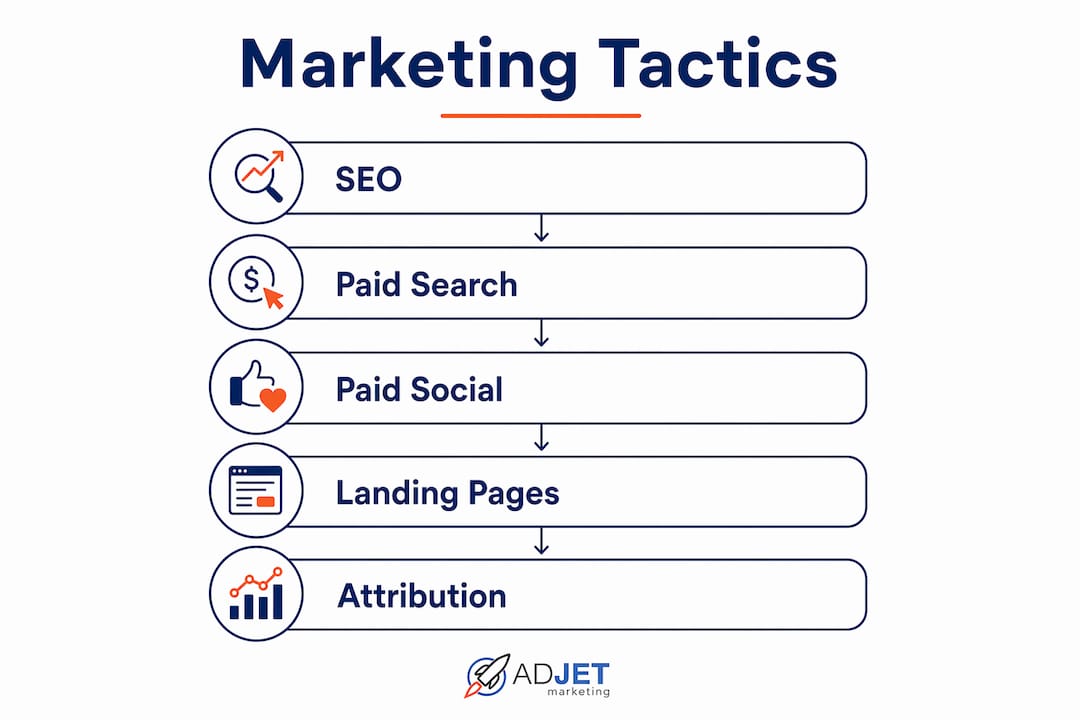
Paid social serves a different function. Facebook and Instagram ads carry a lower average cost-per-click of $1.92 and healthcare conversion rates averaging 11% on those platforms. The tradeoff is intent quality. Paid social surfaces latent demand but risks attracting lower-intent leads, which increases claim risk and operational support burden if intake is not properly designed.
| Channel | Best use case | Key risk |
|---|---|---|
| Condition-specific SEO | Long-term patient acquisition | Slow to build; requires consistent content |
| Google Ads (paid search) | High-intent, ready-to-book patients | Broad keywords dominated by national platforms |
| Facebook and Instagram ads | Awareness and latent demand | Lower intent; higher intake screening burden |
| Content marketing | Trust-building and provider credibility | Long conversion cycle |
Pro Tip: Build separate landing pages for each condition and state you serve. A single generic telemedicine landing page loses patients who need to see their specific condition addressed before they trust you with their care.
Attribution is where most telemedicine marketing programs break down. Last-click attribution misrepresents the patient journey. A patient may see a Facebook ad, read a blog post, search your provider name, and then book. Multi-touch attribution models capture that full path and give you accurate data for budget decisions.
How do you balance marketing scale with operational readiness and compliance?
Scaling telemedicine marketing without operational readiness creates a specific failure pattern. You generate demand, intake breaks down, patients get confused or wait too long, and your support volume spikes. The marketing looks successful in the dashboard while the practice is losing patients in the intake queue.
Intake strategy functions as a quality-control layer between your marketing and your providers. It qualifies patients, sets expectations, and routes care requests to the right provider type. Without it, marketing spend generates noise rather than revenue. Before scaling any campaign, confirm that your intake workflow can handle the volume your ads will produce.
Operational readiness before scaling requires these steps:
- Confirm provider availability. Match your campaign schedule to actual provider hours and capacity. Running ads on weekends when no providers are available wastes budget and frustrates patients.
- Review claim rules. Every headline, landing page, and ad copy claim must be reviewed for accuracy and compliance. Overpromising on wait times or outcomes creates regulatory and reputational risk.
- Set up privacy-aware measurement. Privacy-aware measurement reduces regulatory and reputational risk compared to aggressive pixel tracking. Use consent mode and server-side tagging where possible. You can review HIPAA-compliant Google Ads practices to understand what compliant tracking looks like in practice.
- Align support workflows. Patient questions generated by ads must have a clear answer path. If your support team cannot handle the volume or the question types your campaigns generate, patient experience suffers.
- Define red flags. Identify the metrics that signal operational stress: rising support ticket volume, patient confusion in intake, or a spike in appointment cancellations. These are marketing signals, not just operational ones.
Pro Tip: Run a small-budget test campaign before scaling. Use the intake data from that test to identify workflow gaps before you commit significant spend.
Marketing readiness requires that claim rules, compliance review, provider availability, support workflows, and measurement systems are all in place before you increase budget. Skipping this step is the most common reason telemedicine marketing programs underperform.
What practical steps should healthcare providers take to implement telemedicine marketing?
A clear positioning statement is the foundation of every effective telehealth marketing program. You need to define exactly which conditions you treat, which states you are licensed in, and what makes your care model worth choosing over a national platform. Vague positioning produces vague results.
Channel selection should follow patient intent, not marketing convention. High-intent patients searching for specific conditions belong in paid search and SEO funnels. Patients who do not yet know they need your service belong in paid social awareness campaigns. Mixing these audiences in the same campaign wastes budget and muddies your data.
Key implementation steps for digital marketing for telemedicine:
- Set condition-specific keyword architecture. Build keyword lists around symptoms, diagnoses, and treatment types rather than generic service terms.
- Design trust-first landing pages. Each page should feature provider credentials, platform security information, transparent pricing, and clear next steps. Review healthcare digital marketing strategies for landing page frameworks that convert.
- Measure beyond ad clicks. Track qualified intake completions, appointment bookings, and conversion timing. Ad clicks alone tell you nothing about patient quality.
- Test campaigns within policy boundaries. Run Google Ads within platform healthcare advertising policies from day one. Retroactively fixing policy violations is expensive and disruptive.
- Audit compliance regularly. HIPAA requirements, platform policies, and state telehealth laws change. Build a quarterly compliance review into your marketing calendar.
Measurement discipline separates successful telemedicine marketing programs from expensive experiments. The metrics that matter are qualified intake rate, cost per booked appointment, and patient retention after the first visit. These numbers tell you whether your marketing is attracting the right patients, not just any patients.
Key Takeaways
Telemedicine marketing succeeds when it combines condition-specific targeting, privacy-aware measurement, and operational readiness before scaling spend.
| Point | Details |
|---|---|
| Define telemedicine marketing correctly | It is a specialized discipline requiring trust signals, compliance, and condition-specific targeting. |
| Condition-specific SEO drives appointments | Targeted symptom and condition pages yield significantly more bookings than generic service pages. |
| Paid social requires intake alignment | Lower-intent social leads increase claim risk unless intake screening is properly designed. |
| Operational readiness precedes scale | Confirm provider capacity, claim rules, and support workflows before increasing ad spend. |
| Multi-touch attribution is non-negotiable | Last-click models misrepresent the patient journey and lead to poor budget decisions. |
What I’ve learned about telemedicine marketing after years of working with healthcare providers
The most common mistake I see is treating telemedicine marketing as a standalone function. Clinics run ads, generate leads, and then wonder why conversion rates are low. The answer is almost always operational. The intake process is slow, the landing page makes claims the provider cannot fulfill, or the support team is not equipped to handle the question types the campaign generates.
The second pattern I see regularly is over-reliance on last-click attribution. A practice will cut its Facebook budget because the last-click data shows poor ROI, not realizing that Facebook was the first touch for a large share of its booked patients. Multi-touch attribution changes those decisions entirely.
Condition-specific strategies consistently outperform broad approaches. A mental health practice that builds separate pages and campaigns for anxiety, depression, and ADHD will outperform one that runs a single “online therapy” campaign. The specificity signals relevance to both the patient and the search algorithm.
Privacy-aware measurement is not just a compliance requirement. It is a competitive advantage. Practices that build compliant tracking infrastructure now will have cleaner data and more durable campaigns as platform privacy restrictions tighten. The practices that rely on aggressive pixel tracking are one policy update away from losing their attribution data entirely.
Realistic timelines matter. SEO takes months to build. Paid search requires testing cycles. Expect three to six months before you have enough data to make confident budget decisions. Practices that expect immediate returns from SEO or cut campaigns after two weeks never give the strategy enough time to work.
— Felix
How Adjetmarketing helps telemedicine providers build compliant, high-performing campaigns
Adjetmarketing works with medical clinics and private healthcare providers to build marketing programs that generate qualified patient leads without cutting corners on compliance. For telemedicine providers specifically, that means condition-specific SEO, Google Ads campaigns built within platform policy boundaries, and landing pages designed to convert high-intent patients. The team integrates medical marketing strategy with operational readiness reviews so that the demand your campaigns generate matches what your intake and providers can actually handle. If you want campaigns that produce booked appointments rather than raw clicks, Adjetmarketing builds the full system, from keyword architecture to privacy-compliant tracking.
FAQ
What is telemedicine marketing in simple terms?
Telemedicine marketing is the practice of promoting virtual healthcare services through digital channels, including SEO, paid search, and content, while meeting HIPAA and platform compliance requirements.
How does condition-specific SEO help telemedicine providers?
Condition-specific SEO targets the exact symptoms and diagnoses patients search for, which produces significantly more booked appointments than generic service-level pages.
Why is multi-touch attribution important for telehealth campaigns?
Patients rarely convert on the first touchpoint. Multi-touch attribution captures the full decision path, giving you accurate data to allocate budget across channels effectively.
What compliance rules apply to telemedicine advertising?
HIPAA governs patient data handling, Google and Meta enforce healthcare advertising policies, and state telehealth licensing laws restrict geographic targeting and clinical claims.
How do you market telemedicine services without violating HIPAA?
Use privacy-aware measurement tools such as consent mode and server-side tagging, avoid pixel-based retargeting that captures protected health information, and review all ad claims for accuracy before launch.