









Effective SEO strategies for pain clinics combine a fully optimized Google Business Profile, symptom-focused content, and structured E-E-A-T schema to increase search rankings and drive patient bookings. Search engine optimization (SEO) for healthcare, specifically for pain management, is a discipline governed by Google’s Your Money or Your Life (YMYL) standards, which demand clinical credibility at every level of your website. Clinics that implement this framework correctly achieve top 3 rankings within 6–12 months and begin generating appointment bookings within 90 days. That timeline is realistic, not a guarantee, and it depends on consistent execution across local SEO, content architecture, and technical structure. This guide gives you a practical blueprint for 2026.
What are the essential components of a pain clinic SEO strategy?
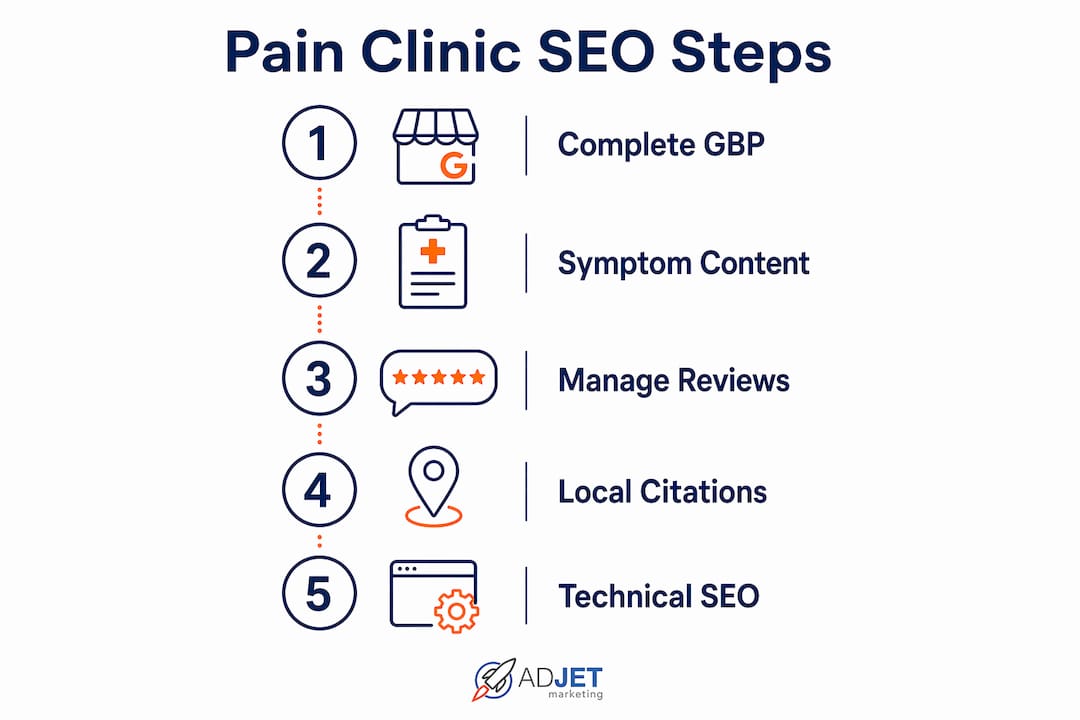
A pain clinic’s SEO foundation rests on three pillars: a complete Google Business Profile (GBP), symptom-class content, and properly implemented E-E-A-T structured data. Each pillar works independently, but the compounding effect happens when all three are active at the same time.
Google Business Profile setup
Your GBP is the single most visible local asset you control. Accurate GBP categories and detailed service menus directly influence your Map Pack ranking. Set your primary category to “Pain Management Physician” or the closest accurate match, add secondary categories for related services, and write a description that names your service areas explicitly.
- Add correct primary and secondary GBP categories
- Write a service-area description using neighborhood and city names
- Upload 100 or more photos (clinics with this volume receive significantly more calls)
- Publish weekly posts covering treatments, patient education, and clinic news
- Populate the Q&A section with questions patients actually ask
Pro Tip: Pre-populate your GBP Q&A with your 10 most common intake questions. Google surfaces these answers in search results, which reduces friction before a patient even visits your website.
E-E-A-T schema and structured data
E-E-A-T stands for Experience, Expertise, Authoritativeness, and Trustworthiness. For YMYL medical content, Google evaluates it structurally, not just editorially. Chained schema markup linking Physician, MedicalCondition, and FAQPage schemas signals clinical credibility far more effectively than author bios alone. A bio tells a reader who wrote the page. Chained schema tells Google what the page is about, who is responsible for it, and what conditions it addresses.

Review management and local citations
Reviews are a direct prominence signal in Google’s local ranking algorithm. A steady flow of 5-star reviews, combined with consistent GBP activity, builds local prominence that generic directory listings cannot replicate. Aim for a review acquisition process built into your post-visit workflow, not a one-time ask.
How does local SEO impact pain clinic patient acquisition?
Local SEO for pain management is the discipline of making your clinic appear in geographically relevant searches. When a patient types “back pain doctor near me” or “nerve pain clinic in [city],” Google’s algorithm evaluates relevance, distance, and prominence to decide who appears in the Map Pack. You control relevance and prominence directly.
Here is a step-by-step approach to building local SEO prominence:
- Claim and verify your GBP. An unverified profile cannot rank in the Map Pack regardless of how complete it is.
- Upload photos weekly. Clinics with 100 or more photos on their profile receive significantly more calls than those with fewer than 10.
- Post weekly updates. Google treats GBP post frequency as an activity signal. One post per week covering a treatment or patient tip is sufficient.
- Build local citations. List your clinic on Healthgrades, Zocdoc, Yelp, and your local Chamber of Commerce with identical Name, Address, and Phone (NAP) data across every platform.
- Respond to every review. Responding to reviews signals active management to Google and builds trust with prospective patients reading them.
- Create neighborhood-specific content. A page titled “Chronic Pain Treatment in [Neighborhood Name]” captures hyper-local searches that city-level pages miss entirely.
Google’s local ranking algorithm prioritizes relevance, distance, and prominence. Distance is fixed by your physical address. Relevance and prominence are entirely within your control through content and profile activity.
Why is symptom-focused content more effective for pain clinics?
Patients do not search for treatments first. They search for symptoms. A patient experiencing shooting leg pain types “sciatica symptoms” or “why does my leg go numb” long before they search “pain management clinic near me.” Symptom-class pages consistently outperform generic treatment pages in both rankings and patient engagement because they meet patients at the beginning of their research journey.
The content gap most pain clinics have is significant. A typical clinic website has five to eight service pages and nothing else. That structure captures patients who already know what they need. Symptom-class content captures the much larger pool of patients still figuring it out.
- Map symptoms to services. A page on “lower back pain after sitting” should link directly to your spinal pain management service page.
- Include booking CTAs on every symptom page. Patients who land on a symptom page and find a clear “Schedule a Consultation” button convert at a higher rate than those who have to navigate to find one.
- Chain your schema. Each symptom page should carry MedicalCondition schema linked to the treating Physician schema and a FAQPage schema for common questions about that condition.
- Target 10–20 symptom pages per specialty. Practices that build 10–20 symptom-class pages with properly chained schema and booking CTAs capture significantly more patient search intent than those relying on service pages alone.
Pro Tip: Use Google Search Console to find queries your site already ranks for on page 2 or 3. Those are symptom-class queries you can target with a dedicated page and move to page 1 within 60–90 days.
What technical SEO mistakes do pain clinics commonly make?
Most pain clinic websites have at least three structural problems that limit their ranking potential. Recognizing them is the first step to fixing them.
- Simplistic schema implementation. Adding a single LocalBusiness schema tag is not E-E-A-T. Misuse of schema markup can actively harm rankings on YMYL pages. True E-E-A-T requires chained schema that links treatment content, physician credentials, and FAQs in a coherent structure.
- Keyword overloading on service pages. Putting “back pain,” “neck pain,” “knee pain,” and “nerve pain” on a single service page splits ranking signals. Each condition deserves its own page with a focused keyword target.
- Ignoring GBP activity. A static GBP profile with no posts, few photos, and unanswered reviews signals inactivity to Google. Weekly updates are not optional for competitive local markets.
- Treating SEO as a one-time project. Pain clinic SEO is a compound asset. Rankings built over six months continue to generate patient inquiries without additional ad spend. Clinics that pause SEO activity after an initial push lose ground quickly in competitive markets.
- Misaligning SEO with the patient revenue cycle. Ranking for a symptom query is only valuable if the patient books and shows up. SEO that does not connect to a clear booking path and follow-up process generates traffic without revenue.
For a deeper look at common healthcare marketing errors that reduce SEO effectiveness, the patterns repeat across specialties.
How can pain clinics integrate SEO with broader digital marketing?
SEO and paid advertising are not competing strategies. They serve different parts of the patient acquisition timeline. Google Ads generates calls within days. SEO builds compounding visibility over months. Broad Google Ads campaigns without strict geo-targeting and service-specific landing pages waste budget. SEO insights tell you which services and symptoms drive the most organic interest, and that data should directly inform which ad campaigns you run.
- Use organic ranking data to prioritize ad spend. If your “sciatica treatment” page ranks on page 2 organically, run a targeted Google Ads campaign for that term while the organic ranking climbs.
- Automate patient follow-ups. Automating appointment reminders reduces no-shows by 20–30%. That improvement directly increases the revenue generated from every patient your SEO brings in.
- Build landing pages that match your SEO content. A patient who clicks an ad for “knee pain specialist” and lands on a generic homepage bounces. A page that mirrors the symptom language they searched converts.
- Use SEO to build long-term trust signals. Paid ads stop the moment you stop paying. A library of symptom-class content, positive reviews, and a complete GBP continues attracting patients without ongoing cost.
Pro Tip: For clinics exploring pain management Google Ads alongside SEO, run both simultaneously for the first 90 days. Use ad conversion data to identify which symptom pages to prioritize in your content calendar.
Answer Engine Optimization (AEO) is also worth building into your content plan now. Medical clinics rank in AI search through FAQ schema, structured content, and authoritative credentials. As patients increasingly use AI-powered search tools, clinics with properly structured content will appear in those results alongside traditional Google rankings.
Key takeaways
Pain clinic SEO produces measurable patient growth when it combines a complete Google Business Profile, symptom-class content with chained schema, and consistent local SEO activity maintained over 6–12 months.
| Point | Details |
|---|---|
| GBP is your local foundation | Set accurate categories, upload 100+ photos, and post weekly to build prominence. |
| Symptom pages outperform service pages | Build 10–20 symptom-class pages per specialty with booking CTAs and chained schema. |
| E-E-A-T requires structural implementation | Chain Physician, MedicalCondition, and FAQPage schemas, not just author bios. |
| SEO and ads work together | Use organic ranking data to guide ad targeting and reduce cost-per-acquisition. |
| Automation protects your SEO investment | Automated follow-ups reduce no-shows by 20–30%, converting more SEO traffic into revenue. |
What I’ve learned after years of pain clinic SEO work
Most pain clinics come to us after spending money on a website redesign that did not move their rankings. The site looks good. The problem is structural. There is no symptom-class content, the GBP has 12 photos and no posts, and the schema is a single LocalBusiness tag that tells Google almost nothing about clinical credibility.
The piece of advice I give most often is this: stop treating your website like a brochure and start treating it like a patient acquisition system. Every page should answer a specific question a patient is already asking. Every page should have a clear next step. And every page should carry the structured data that tells Google a qualified physician is responsible for that content.
The clinics that see the fastest results are not the ones with the biggest budgets. They are the ones that commit to weekly GBP activity, publish two symptom-class pages per month, and respond to every review within 24 hours. That consistency compounds. A clinic that does those three things for 12 months will be in a fundamentally different competitive position than one that does them for 30 days and stops.
One more thing worth saying directly: realistic timelines matter. Top 3 rankings in 6–12 months is an accurate benchmark for clinics starting from a weak baseline. Clinics with existing domain authority and some content in place often see meaningful movement in 90 days. Set your expectations accordingly, measure monthly, and do not judge SEO by week-four traffic numbers.
— Felix
How Adjetmarketing helps pain clinics grow through SEO
Adjetmarketing works specifically with pain management clinics and healthcare practices to build the kind of SEO infrastructure that generates consistent patient leads. That means GBP optimization, symptom-class content planning, chained schema implementation, and review management built into a single coordinated strategy. We do not apply generic SEO templates to medical clients. Every clinic gets a plan built around its services, service areas, and patient acquisition goals. If you want to understand why healthcare marketing drives clinic growth at a structural level, that context shapes every decision we make. For clinics ready to build a patient lead system through SEO, Adjetmarketing is a direct next step.
FAQ
How long does SEO take for a pain clinic?
Pain clinics implementing a full SEO strategy typically reach top 3 rankings within 6–12 months, with appointment bookings beginning within 90 days of launch.
What is E-E-A-T and why does it matter for pain clinics?
E-E-A-T stands for Experience, Expertise, Authoritativeness, and Trustworthiness. Google applies it strictly to medical content, and it requires chained schema markup linking physician credentials, conditions treated, and FAQs, not just author bios.
How many pages does a pain clinic website need for SEO?
Practices should build 10–20 symptom-class pages per specialty, each with MedicalCondition, FAQPage, and Physician schema, plus a clear booking call to action.
What is the difference between local SEO and general SEO for pain clinics?
Local SEO targets geographically specific searches through Google Business Profile optimization, local citations, and neighborhood-level content. General SEO targets broader symptom and condition queries that drive organic traffic from a wider area.
Should a pain clinic run Google Ads and SEO at the same time?
Running both simultaneously is the most effective approach. Google Ads generates calls immediately while SEO builds long-term compounding visibility. Use ad conversion data to identify which symptom pages to prioritize in your content plan.