









Your single highest-impact first action is to claim and fully optimize your Google Business Profile (GBP) while confirming your age-gate does not block Googlebot from indexing your site. These two fixes address the most common reasons cannabis clinic sites generate zero organic traffic. Because Google Ads and Meta largely prohibit ads for THC products, organic search is your primary patient acquisition channel. Get the foundation right first, and ranking gains typically appear within 30–90 days for local searches. For a broader overview of what this means for your practice, the SEO benefits for cannabis dispensaries guide is a useful starting point.
Table of Contents
- SEO basics for cannabis websites: your first-week checklist
- How U.S. compliance rules shape every SEO decision you make
- Technical SEO issues that block most cannabis clinic sites from ranking
- How to write patient-focused pages without making medical claims
- Local SEO when platforms restrict cannabis advertising
- How to measure progress and run an AI search audit
- Realistic timeline and budget for cannabis clinic SEO
- Key Takeaways
- What we see at Adjetmarketing — and what to ask any agency
- Adjetmarketing can handle the technical and compliance work for you
- Authoritative sources to verify compliance and best practices
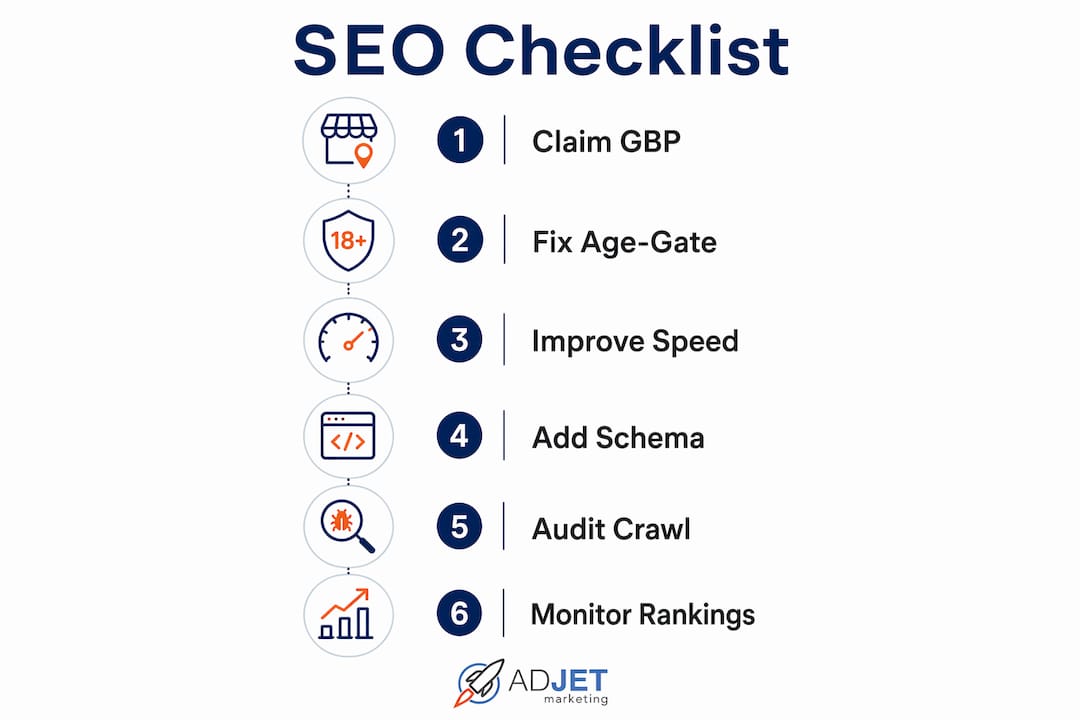
SEO basics for cannabis websites: your first-week checklist
Run these checks before touching content or links. Most can be done in-house; items marked (dev) need a developer.
- Age-gate crawlability — Use Google Search Console’s URL Inspection tool to fetch your homepage. If Googlebot sees a blank page or a redirect loop, your age-gate is blocking indexing (dev).
- Mobile speed — Run your key pages through PageSpeed Insights. Target LCP under 2.5 seconds and CLS under 0.1.
- HTTPS — Confirm every page loads on
https://. Mixed-content warnings erode trust and rankings. - XML sitemap — Submit your sitemap in Google Search Console so new pages get indexed faster.
- NAP consistency — Check that your Name, Address, and Phone number match exactly across your website, GBP, Weedmaps, and Leafly.
- Core schema — Verify you have
LocalBusinessorMedicalOrganizationstructured data on your homepage (dev). - Broken links — Run a crawl with a tool like Screaming Frog or Ahrefs to find and fix 404 errors.
Pro Tip: Test your age-gate by pasting your URL into Google’s URL Inspection tool and clicking “Test Live URL.” If the rendered HTML shows only the gate and no page content, ask your developer to implement a cookie-based gate that serves content to bots while still protecting the user-facing experience.
Technical fixes and GBP optimization can be handled in-house. Schema markup and age-gate restructuring typically require a developer, but they are one-time tasks with lasting impact.
How U.S. compliance rules shape every SEO decision you make
Cannabis marketing in the U.S. operates under a patchwork of state laws. 24 states plus D.C. allow adult-use cannabis, while 26 states do not. That split means content that is perfectly legal in Colorado could create liability in Texas. Verify your state’s specific rules through your state cannabis regulatory authority and NORML’s state law tracker before publishing any service or product page.
The practical rule for content: Describe what patients report, not what your product does. Write “users report feeling relaxed” rather than “treats anxiety.” Avoid any language that implies diagnosis, cure, or guaranteed outcome. This keeps you on the right side of both state regulators and Google’s YMYL (Your Money or Your Life) content scrutiny.
Paid advertising restrictions make this even more consequential. Google Ads and Meta prohibit promotion of THC products, with narrow exceptions only for topical hemp-derived CBD at or below 0.3% THC with platform certification. That means organic search and directory listings carry the full weight of your patient acquisition.
Practical compliance checklist for content:
- Use “reported by users” or “may support” language, never clinical claims.
- Add an age-verification disclaimer on every page.
- Use your exact legal business name on GBP — keyword-stuffing your GBP name risks suspension.
- Create state-specific pages only for states where you are licensed to operate.
- When in doubt, consult a cannabis compliance attorney before publishing health-adjacent claims.
This article is general information, not legal or compliance advice. Confirm current rules with your state regulatory authority or a qualified professional.
Technical SEO issues that block most cannabis clinic sites from ranking
Three technical problems account for the majority of ranking failures we see on cannabis clinic sites.
1. Age-gate crawlability. A poorly built age-gate can hide your entire site from search engines. The fix is a cookie-based implementation that serves full content to Googlebot while still presenting the gate to first-time human visitors. Never use a JavaScript-only gate that renders nothing server-side.

2. Core Web Vitals and page speed. Google’s mobile-first index means your mobile score is your real score. Common Core Web Vitals targets include LCP under 2.5 seconds and CLS under 0.1. Cannabis sites with large product image galleries or iframe-embedded menus frequently fail both thresholds. Compress images, lazy-load below-the-fold assets, and replace iframe menus with crawlable HTML.
3. Schema and crawlable menus. Many dispensary platforms serve menus inside iframes, which Googlebot cannot read. If your product or service menu lives in an iframe, Google sees an empty page. Implement LocalBusiness or MedicalOrganization schema on your homepage, and push for an HTML or JSON-LD menu rendering from your platform vendor.
Pro Tip: Use a website audit checklist to systematically work through crawlability, speed, and schema in one pass rather than fixing issues piecemeal — piecemeal fixes often miss interdependencies.
How to write patient-focused pages without making medical claims
Prioritize service pages and location pages first, then build a small set of educational FAQ pages. A large generic blog without strong service pages is one of the most common mistakes we see.
On E-E-A-T for cannabis clinics: Google applies heightened scrutiny to health-adjacent content. Add author credentials to every educational page, cite published sources (not just your own claims), and include a clear “about this practice” section. These signals tell Google your content comes from a real, accountable source.
Service page structure that works:
- H1 with primary keyword and location (e.g., “Medical Cannabis Consultations in Austin, TX”)
- 200–300 words describing the service in plain language, using reported-effects language
- A brief FAQ section targeting “People Also Ask” queries
- A clear call to action: “Book a consultation” or “Call to schedule”
- Author byline with credentials
For strain or product pages, include the Certificate of Analysis (COA), terpene profile, and effects as reported by users rather than clinical claims. Pages with real lab data and substantive content consistently outperform thin SKU pages in search rankings.
Internal linking matters here. Structure your content so informational pages link to transactional and location pages, guiding patients from education toward booking. A content cluster strategy built around your core services is the most efficient way to build topical authority without a massive content volume.
Local SEO when platforms restrict cannabis advertising
GBP is the single most important ranking factor for local pack visibility. Treat it as a first-class platform, not an afterthought.
- GBP optimization: Set your category to “Cannabis store,” upload 10+ real photos, keep hours accurate, and post updates every 1–2 weeks.
- Legal business name only: Never add keywords to your GBP name. Use the name exactly as it appears on your license.
- Weedmaps and Leafly: These directories dominate the first page of local cannabis searches in most markets. Claim and fully complete both profiles.
- NAP consistency: Any mismatch across your website, GBP, Weedmaps, Leafly, and Yelp creates conflicting trust signals that suppress local rankings.
- Location pages: Boilerplate pages that simply swap the city name are filtered by Google. Each location page needs unique content: parking instructions, nearby landmarks, and location-specific patient information.
For more on local cannabis SEO tactics and how they connect to patient lead generation, that resource covers the strategic case in depth.
Pro Tip: When responding to patient reviews, keep replies factual and brief. Thank the reviewer, address any concern without discussing specific treatments, and avoid any language that could be read as a medical claim. Consistent, compliant responses build local pack prominence over time.
How to measure progress and run an AI search audit
Set up baseline tracking before making any changes. Without a baseline, you cannot attribute improvements to specific fixes.
Measurement checklist:
- Connect GA4 and Google Search Console to your site in week one.
- Set up conversion events: form submissions, phone calls (use a call tracking number), and appointment bookings.
- Record your current keyword rankings for 20–30 target terms.
- If you use a third-party booking platform, configure cross-domain tracking so conversions are not lost.
AI audit method: Before investing in content or PR, test your target patient questions in ChatGPT and Perplexity. Note which sources those systems cite. Then compare those citations against your Google Search Console data. The sources AI trusts are the ones worth targeting for backlinks, guest content, or press mentions. Marketing professionals recommend this reconnaissance step before heavy optimization to avoid building authority in the wrong places.
Pro Tip: After fixing technical issues, use GSC’s URL Inspection tool to request re-indexing of your key pages. Then submit an updated XML sitemap. This shortens the lag between your fix and Google recognizing it.
Realistic timeline and budget for cannabis clinic SEO
| Scope | Typical Timeline | Approximate Budget Range |
|---|---|---|
| Technical audit + critical fixes | 2–4 weeks | — |
| GBP optimization + NAP cleanup | 2–4 weeks | — |
| Location page rollout (per location) | 4 weeks | — |
| Content cluster build (5–10 pages) | 2–4 months | — |
| Ongoing managed SEO retainer | Monthly | — |
Local fixes typically show ranking movement within 30–90 days. On-page and content work takes 3–6 months to produce measurable traffic gains. Authority and link growth is a 6–12+ month effort.
When to hire an agency: multi-location rollout, compliance complexity, poor lead quality despite traffic, or no internal capacity to manage technical fixes and content simultaneously. When to DIY: single location, limited budget, and a staff member who can dedicate 5–10 hours per week to implementation.
Key Takeaways
Cannabis clinic SEO is an organic-first discipline because paid ad restrictions make Google Business Profile and on-page optimization your primary patient acquisition tools.
| Point | Details |
|---|---|
| Fix crawlability first | An age-gate that blocks Googlebot makes all other SEO work pointless — test with URL Inspection before anything else. |
| GBP is your local anchor | Use your exact legal business name, set the correct category, and post updates regularly to maintain local pack visibility. |
| Compliance shapes every page | Use reported-effects language, avoid medical claims, and verify state rules before publishing any health-adjacent content. |
| Measure before you optimize | Set up GA4, call tracking, and rank baselines in week one so you can attribute improvements to specific fixes. |
| Adjetmarketing as next step | Adjetmarketing handles site audits, age-gate fixes, location page builds, and GA4 setup for cannabis clinics seeking managed SEO. |
What we see at Adjetmarketing — and what to ask any agency
Most cannabis clinic sites that come to us share the same short list of problems: an age-gate that silently blocks indexing, an iframe menu Google cannot read, location pages that are identical except for the city name, and GA4 connected but no conversion events configured. Traffic exists; leads do not. That gap almost always traces back to one of those four issues.
Quick fixes often fail because they address symptoms rather than causes. A clinic adds blog posts but never fixes the iframe menu, so Google still cannot index the product catalog. Another clinic optimizes GBP but has three different phone numbers across directories, so the local pack ranking never stabilizes. The pattern is consistent: technical debt blocks content investment from paying off.
When you evaluate any agency for cannabis SEO, ask these specific questions:
- Can you show a case study where you improved lead volume, not just rankings?
- How do you handle age-gate implementation to preserve Googlebot access?
- Are you a Google Partner, and how does that affect your access to platform guidance?
- How do you track HIPAA-adjacent data handling in GA4 and call tracking setups?
- What does your audit process look like before you recommend a content strategy?
Realistic timelines matter here. An agency promising first-page rankings in 30 days for a new cannabis clinic site is not being straight with you. Local fixes can move the needle in 30–90 days. Meaningful organic traffic from content takes 3–6 months minimum.
Adjetmarketing can handle the technical and compliance work for you
Cannabis clinic SEO requires more than keyword research. It requires an agency that understands age-gate implementation, HIPAA-aware tracking, compliant content language, and the specific directories that drive local patient leads. Adjetmarketing is a Google Partner agency that works with medical clinics, aesthetic practices, and cannabis-adjacent healthcare providers to build exactly this kind of foundation.
A typical engagement starts with a full site audit covering crawlability, speed, schema, and GBP status. From there, the team handles technical fixes, location page builds, GA4 and call tracking configuration, and a content plan built around patient search intent. Every step is documented and measured.
If you are ready to stop guessing at what is blocking your rankings, request a medical marketing consultation to see what a structured audit and rollout plan looks like for your practice.
Authoritative sources to verify compliance and best practices
- NORML State Laws — Verify current adult-use and medical cannabis legal status by state before publishing location-specific content.
- Google Business Profile Help Center — Official guidance on GBP categories, suspension policies, and name requirements for cannabis businesses.
- Google Search Console — Free tool for indexing checks, URL Inspection, and keyword performance baselines.
- PageSpeed Insights — Google’s tool for Core Web Vitals scores and specific remediation recommendations.
- ReviewTrackers Cannabis SEO Guide — Practical overview of review strategy, GBP optimization, and content best practices for cannabis businesses.
- Dutchie Dispensary SEO Tips — Covers technical SEO basics including indexability, mobile optimization, and title tag structure specific to dispensary sites.
Recommended
- SEO Benefits For Cannabis Dispensaries: 2026 Guide
- On-page SEO Essentials: Optimizing Your Cannabis Site For Success – AdJet Digital Marketing & Google Partner Agency | SEO Development Google Ads Social
- Best Cannabis SEO Strategies For 2025 – AdJet Digital Marketing & Google Partner Agency | SEO Development Google Ads Social
- Designing For Success: Creating User-Friendly Cannabis Websites – AdJet Digital Marketing & Google Partner Agency | SEO Development Google Ads Social