









Having a real estate website is not enough to generate consistent leads. Most agents build a site, add a few listings, and wait for the phone to ring. It never does. That’s because simply existing online and being found online are two completely different things. Real estate SEO is the practice of optimizing your website, content, and online profiles so you rank in Google for the local, high-intent searches your future clients are already making. This guide breaks down what real estate SEO actually means, which elements drive results, and how you can build a strategy that turns search rankings into signed clients.
Table of Contents
- Defining real estate SEO: What it is and why it matters
- Key elements that make or break real estate SEO success
- How to build a lead-generating real estate SEO strategy
- Common pitfalls and misconceptions in real estate SEO
- The uncomfortable truth about real estate SEO most agents ignore
- Get expert help to grow your real estate leads
- Frequently asked questions
Key Takeaways
| Point | Details |
|---|---|
| SEO drives quality leads | Agents who invest in SEO capture more motivated home buyers and sellers through organic search. |
| Google Business Profile is key | Maintaining and optimizing your GBP listing is the fastest path to more calls and map pack visibility. |
| Strategy beats shortcuts | Long-term results come from consistent, high-value SEO—not one-off tricks. |
| Local content wins | Neighborhood-focused pages and reviews help you outrank national sites for local intent. |
Defining real estate SEO: What it is and why it matters
Most agents hear “SEO” and think it means stuffing keywords into a web page. That’s not what moves the needle in real estate. Real estate SEO is a targeted, location-focused practice that puts your business in front of buyers and sellers at the exact moment they’re searching for an agent.
“Real estate SEO is the practice of optimizing websites, content, and online profiles for real estate agents and brokers to rank higher in search engines like Google for location-specific, high-intent queries such as ‘real estate agent [city]’ or ‘homes for sale [neighborhood]’ to attract organic traffic and generate qualified leads.”
That definition matters because it highlights something critical: the goal isn’t just traffic, it’s qualified traffic. Someone typing “homes for sale in Austin” is actively looking to buy. Someone typing “best neighborhoods in Austin” is in early research mode. Both are valuable, but they require different content approaches. SEO helps you show up for both, guiding prospects through their journey until they contact you.
Here’s why a basic website without SEO falls short for agents:
- No local signals: Google needs clear signals that you serve a specific location. Without them, your site is invisible in local searches.
- No keyword targeting: Without researching what your clients actually type into Google, your content misses their intent entirely.
- No authority: Google ranks sites it trusts. Trust is built through reviews, backlinks, and content consistency over time.
- No technical foundation: Slow load times, broken links, or poor mobile performance all hurt rankings regardless of how good your content is.
Understanding the effective SEO basics that drive rankings helps you see SEO not as a technical task but as a business growth system. When done right, it supports not just new client acquisition but also reinforces your credibility with referral partners who check your online presence before sending clients your way.
One more thing worth noting: Google Business Profile influences 70% of local calls to agents. That single data point tells you where the phone calls actually come from. It’s not your website homepage. It’s your Google profile showing up in the map pack directly beneath the search bar. SEO powers that placement.
Key elements that make or break real estate SEO success
Knowing SEO matters is one thing. Knowing which elements to prioritize is what separates agents who see results within months from those who spin their wheels for years. Let’s break down the core components.
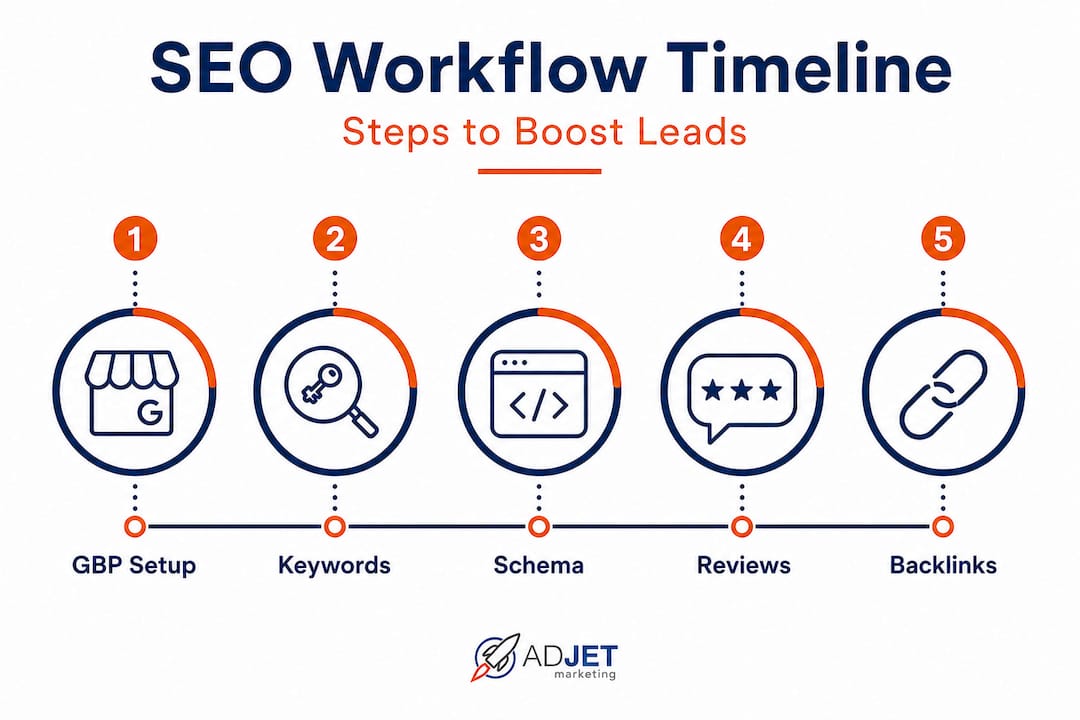
1. Google Business Profile (GBP)
This is the single most important local SEO asset you control. Your GBP listing appears in the map pack, shows your phone number, hours, reviews, and photos. Google Business Profile tips show that fully optimized profiles with complete information, regular posts, and consistent photo updates consistently outperform incomplete ones in map pack rankings.

2. High-value local keywords
These are the search phrases your ideal clients use. Think “real estate agent [city name],” “condos for sale [neighborhood],” or “how to sell my home in [zip code].” Long-tail keywords (phrases with three or more words) often have less competition and higher intent.
3. Local schema markup
Schema is code added to your website that tells Google exactly what your business is, where it operates, and what services it offers. For real estate agents, local business schema and real estate listing schema can enhance how your pages appear in search results.
4. Online reviews
Google weighs the quantity, quality, and recency of your reviews when deciding where to rank you locally. Reviews on your GBP profile are especially powerful. Agents with 50 or more recent, detailed reviews consistently outrank competitors with fewer reviews.
5. Mobile optimization
Over 60% of real estate searches happen on mobile devices. Google uses mobile-first indexing, which means it ranks your mobile site first. A site that loads slowly or displays poorly on phones will lose rankings regardless of its desktop experience.
6. Backlinks from relevant sites
Backlinks are links from other websites pointing to yours. They signal authority to Google. Quality matters far more than quantity. One link from a local news outlet or a respected real estate association beats 50 links from irrelevant directories.
Here’s a quick comparison of how each element impacts your local SEO performance:
| SEO Element | Impact on local rankings | Difficulty to implement | Time to see results |
|---|---|---|---|
| Google Business Profile | Very high | Low | 1 to 3 months |
| Local keywords | High | Medium | 3 to 6 months |
| Online reviews | High | Low | 1 to 3 months |
| Mobile optimization | High | Medium | Immediate |
| Local schema markup | Medium | Medium | 2 to 4 months |
| Backlinks | High | High | 4 to 8 months |
Map pack dominance comes from combining a strong GBP with schema and a steady stream of recent reviews. These three elements working together create a compounding effect on your local visibility.
Pro Tip: Search Google for “real estate agent [your city]” right now and look at the agents filling the top three map pack spots. Study their GBP profiles, count their reviews, and check how recently those reviews were posted. That competitive snapshot tells you exactly what benchmark you need to hit.
You can also explore advanced SEO tactics to understand how layering these elements together creates rankings that are far more durable than any paid ad campaign.
How to build a lead-generating real estate SEO strategy
With the key elements identified, the next step is putting them into a structured, repeatable workflow. Real estate SEO is not a single project. It’s an ongoing process that compounds over time.
Here is a step-by-step strategy framework designed specifically for agents and brokers:
-
Conduct keyword research. Use free tools like Google’s “People Also Ask” feature or paid tools to identify the top 20 to 30 keywords your ideal buyers and sellers use. Group them by intent: buying, selling, and neighborhood research.
-
Audit your current website. Check your site speed using Google PageSpeed Insights. Identify any broken links, missing meta descriptions (the short text descriptions Google shows beneath your page title in search results), or duplicate content issues.
-
Optimize your Google Business Profile. Fill out every field. Add high-quality photos of your listings, your office, and yourself. Select the most accurate primary and secondary categories. Post updates at least twice per month.
-
Create neighborhood-focused content. Write dedicated pages or blog posts for each neighborhood or zip code you serve. Include local statistics, school information, commute details, and lifestyle highlights. This signals deep local relevance to Google.
-
Build a review generation system. After every closing, send a direct link to your GBP review page. Make it effortless for clients. Target at least five new reviews per month.
-
Earn local backlinks. Partner with local businesses, contribute to community publications, or sponsor local events to earn citations and links from locally relevant sites.
-
Track and iterate. Use Google Search Console (a free tool from Google that shows which searches bring people to your site) to monitor which keywords drive traffic. Adjust your content based on what’s gaining traction.
Local SEO strategies confirm that agents who follow a structured workflow like this outperform those who treat SEO as a series of disconnected tasks.
Here’s a realistic performance benchmark for agents implementing this strategy consistently:
| Timeframe | Expected outcome |
|---|---|
| Month 1 to 2 | GBP profile optimized, technical issues resolved |
| Month 3 to 4 | First keyword rankings appearing, map pack visibility improving |
| Month 5 to 6 | 20 to 40% increase in organic website traffic |
| Month 7 to 12 | Consistent lead inquiries from organic search, 3 to 5 quality leads per month |
| Year 2 and beyond | Established local authority, reduced need for paid ads |
These numbers are not guaranteed. They reflect what agents commonly experience when organic SEO is executed with consistency and proper technique.
Pro Tip: Publishing content about a specific neighborhood, such as “The top 5 reasons families are moving to [neighborhood name] in 2026,” consistently outperforms generic “tips for buyers” posts because it targets people already searching for that area. Pair it with fresh client reviews mentioning that neighborhood for maximum impact.
Dig deeper into what’s working right now by reviewing real SEO case studies that show how consistent strategy execution drives measurable growth.
Common pitfalls and misconceptions in real estate SEO
Even agents who commit to SEO often derail their own progress by following outdated advice or buying into myths that waste their time and budget. Let’s clear up the most damaging ones.
Myth 1: “SEO is a one-time setup.”
Many agents optimize their site once, then leave it unchanged for years. Google rewards freshness and ongoing activity. Your competitors are publishing content and earning reviews every month. A static site loses ground by default.
Myth 2: “More pages equals better rankings.”
Creating hundreds of thin, low-quality pages does not improve rankings. It often hurts them. Google penalizes sites with duplicate or low-quality content. Focus on fewer, genuinely helpful pages rather than quantity.
Myth 3: “Buying backlinks is a fast track to page one.”
Paid link schemes violate Google’s guidelines and can result in manual penalties that drop your site from search results entirely. One penalty can take twelve or more months to recover from. The risk is not worth it.
Myth 4: “Reviews don’t affect search rankings.”
This one is costly. Google Business Profile drives local ranking signals heavily influenced by review volume, recency, and response rate. Ignoring your reviews is the same as ignoring a major ranking factor.
Myth 5: “My IDX listings will rank automatically.”
Most IDX (Internet Data Exchange) feeds that pull listings onto your site create duplicate content because the same listing data appears on dozens of other agent sites. Without unique content layered on top, those pages offer little SEO value.
The agents who avoid these mistakes and follow proven SEO best practices are the ones who build durable first-page rankings while competitors chase shortcuts.
Real talk: What actually drives local rankings, according to consistent Google guidance, is relevance (does your content match what the searcher wants?), proximity (how close is your business to the searcher?), and prominence (how well-known and trusted is your business online?). Focus on those three pillars and you will outperform agents who chase algorithm tricks.
The uncomfortable truth about real estate SEO most agents ignore
Here’s what most SEO guides won’t tell you: the majority of agents who fail at SEO don’t fail because they chose the wrong keywords. They fail because they treat SEO as a task to complete rather than a commitment to maintain.
We’ve seen this pattern repeatedly. An agent invests in an initial SEO setup, gets some early ranking movement, then stops creating content, stops soliciting reviews, and stops updating their GBP. Within six months, competitors who stayed consistent have moved ahead. The agent concludes that “SEO doesn’t work” and moves on to the next tactic.
The uncomfortable reality is that SEO rewards business discipline. It rewards agents who genuinely know their neighborhoods and write about them in specific, useful ways. It rewards agents who stay in front of past clients well enough that those clients leave detailed, enthusiastic reviews. It rewards consistency over shortcuts, every single time.
There’s another pattern worth naming: too many agents copy generic SEO templates from national real estate portals. They create the same “top 10 tips for first-time buyers” post that thousands of other sites already have. Google has no reason to rank that content because it adds nothing new.
The agents who win local search are the ones who serve their neighborhoods with genuine depth. They write about specific streets, school rezoning news, new restaurant openings, and local commute changes. That hyperlocal specificity is something no national platform can replicate. It’s your competitive advantage, and no amount of technical SEO can substitute for it.
This same principle applies to drawing in qualified leads across any service-based business: authentic, locally-rooted content outperforms generic content over the long run. Start there, stay there, and your rankings will follow.
Get expert help to grow your real estate leads
Building a strong real estate SEO strategy takes time, expertise, and consistent execution. If you’re serious about generating high-quality leads through organic search, working with a performance-driven digital marketing team can significantly accelerate your results. At AdJet Marketing, we help real estate agents build and manage complete SEO implementation strategies that drive local visibility, qualified traffic, and real inquiries. From Google Business Profile optimization to neighborhood-focused content and technical site improvements, our team provides measurable, data-backed growth. You focus on closing deals. We focus on making sure the right clients find you first.
Frequently asked questions
How does real estate SEO attract more buyers and sellers?
By ranking for high-intent local searches, you put yourself directly in front of motivated buyers and sellers the moment they begin their property search, before they ever contact another agent.
How long does it take to see results from real estate SEO?
Results like map pack placements and increased inquiries typically appear within three to six months of consistent, well-executed SEO effort, with stronger gains building through the first year.
Is Google Business Profile really that important for local real estate SEO?
Yes. Google Business Profile influences 70% of local calls to agents, making it the single most impactful asset for appearing in the map pack and generating direct inquiries.
Can paid ads replace real estate SEO for lead generation?
Paid ads can supplement your visibility, but they stop the moment you stop spending. Real estate SEO generates long-term organic leads that continue without ongoing ad spend, making it a far more cost-efficient foundation for lead generation.
Recommended
- Real Estate Agent SEO – AdJet Digital Marketing & Google Partner Agency | SEO Development Google Ads Social
- What’s The Best Way To Get Real Estate Leads? | 10 Scalable Lead Gen Hacks – AdJet Digital Marketing & Google Partner Agency | SEO Development Google Ads Social
- How Do Top Realtors Rank On Google? | The SEO Playbook For Agents – AdJet Digital Marketing & Google Partner Agency | SEO Development Google Ads Social
- Real Estate Agent Marketing – AdJet Digital Marketing & Google Partner Agency | SEO Development Google Ads Social