









Private practice marketing services are specialized patient acquisition strategies designed for independent healthcare providers, combining local SEO, paid advertising, Google Business Profile optimization, and HIPAA-compliant content marketing to generate consistent client inquiries. Unlike general business marketing, these services account for the unique ethical, legal, and trust-based dynamics of healthcare. A therapist in Austin competing against Psychology Today listings, a pain clinic trying to rank above hospital directories, or a counselor launching a new specialty all face the same core challenge: being found by the right people at the right moment. The tactics that work in retail or real estate do not transfer cleanly to healthcare. What does work is a connected system of digital visibility built specifically for the clinical context.
What private practice marketing services actually include
The term “private practice marketing services” is the common shorthand used by practice owners searching for help. The recognized industry term for this work is healthcare marketing, and it covers a defined set of channels and compliance requirements that general digital marketing agencies rarely understand. The core components are SEO, Google Business Profile management, Google Ads, directory optimization, and ethical content marketing, all operating within HIPAA boundaries.
A connected local visibility system of your website, SEO, Google Business Profile, and active reviews consistently outperforms directory listings like Psychology Today for attracting higher-intent clients. That matters because a client who finds your website directly is already further along in their decision process than one browsing a directory of fifty therapists.

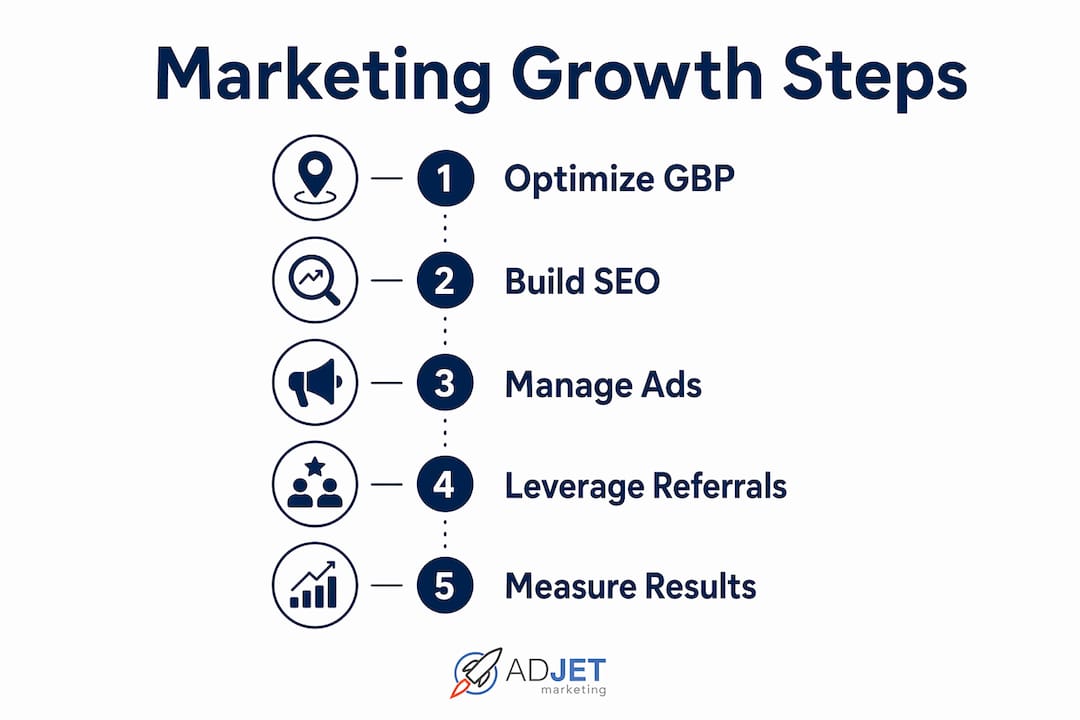
The most effective healthcare marketing solutions treat these channels as a system, not a checklist. SEO builds long-term authority. Google Business Profile captures local searches today. Paid ads fill gaps immediately. Content marketing builds trust over time. Each channel reinforces the others.
How do SEO and Google Business Profile work together for visibility?
SEO and Google Business Profile serve two distinct but complementary functions in private practice advertising. SEO targets specialty-specific and long-tail keywords, such as “EMDR therapist in Denver” or “anxiety counselor accepting Aetna,” through your website’s content and authority. Google Business Profile targets the local map pack that appears when someone searches “therapist near me” or “counselor in [city].”
The timing difference between these two channels is significant. Google Business Profile changes often show results in days to weeks, while SEO typically requires three to six months before meaningful client inquiries arrive. This means you can get quick wins from your Google Business Profile while your SEO investment compounds in the background.
Here is what a well-optimized local visibility setup looks like in practice:
- Create individual specialty pages on your website (e.g., a dedicated page for trauma therapy, a separate page for couples counseling) to capture long-tail searches
- Claim and fully complete your Google Business Profile with accurate hours, service categories, and a practice description that includes your city and specialty
- Actively collect Google reviews from current and past clients, since review volume and recency are direct local ranking signals
- Keep your name, address, and phone number consistent across every directory listing to avoid confusing Google’s local algorithm
- Link your Google Business Profile to your website’s most relevant specialty page, not just your homepage
Pro Tip: Ask satisfied clients to mention your specialty in their review, such as “helped me with PTSD” or “great for couples therapy.” These keyword-rich reviews strengthen your local relevance signals without any additional SEO work on your end.
Your own website, when properly optimized, will outrank Psychology Today for your specific name and specialty in most markets. That is the goal: own your own search real estate instead of renting visibility on someone else’s platform.
What are the essentials of HIPAA-compliant digital marketing?
HIPAA does not prohibit advertising. It restricts the use of protected health information, or PHI, in marketing without explicit patient authorization. The practical implication for digital marketing for therapists is that you cannot send patient data, including names, email addresses tied to health conditions, or appointment history, to ad platforms like Google or Meta.
The HIPAA Privacy Rule permits healthcare advertising but requires patient authorization before using PHI. Major ad platforms do not sign Business Associate Agreements, which means PHI cannot legally flow to them for marketing purposes. This is not a technicality. It is the reason standard website analytics and pixel-based tracking require a compliance layer before you use them in a healthcare context.
Practical HIPAA-compliant marketing requires these protections:
- Use a PHI-stripping compliance layer between your website and ad platforms so that conversion data reaches Google or Meta without any identifiable patient information attached
- Track conversions at the campaign level, counting appointment requests or phone calls, rather than tracking individual user journeys through your site
- Avoid retargeting audiences built from pages that reveal health conditions, such as a “depression therapy” service page
- Audit your website’s existing tracking tags and remove any pixels that collect and transmit user-level data without a compliant consent mechanism
- Use platforms like Consentify to manage digital consent and reduce compliance risk at the point of data collection
Pro Tip: Design your conversion events to capture the fact of a contact form submission or phone call without passing the page URL or referral source to the ad platform. The URL “yourpractice.com/depression-therapy/contact” reveals a health condition. Strip it before it leaves your server.
HIPAA-conscious conversion tracking uses conversion APIs and compliance layers to protect PHI while still giving you the performance data you need to optimize campaigns. You can run effective, measurable advertising without putting your practice at legal risk. The two goals are not in conflict. They just require the right setup from the start.
How can Google Ads generate leads for a private practice?
Google Ads is the fastest patient acquisition strategy available to private practices. When set up correctly, a campaign can generate consultation requests within days. The key phrase is “set up correctly,” because the default Google experience pushes most advertisers toward Smart Campaigns, which are automated, low-control setups that waste budget on irrelevant searches.
Follow these steps to build a Google Ads campaign that actually performs:
- Use Expert Mode. Switch out of Smart Campaigns immediately. Expert Mode gives you control over match types, bidding strategy, ad scheduling, and keyword selection.
- Target your local service area only. Set geographic targeting to your city or a defined radius around your practice. Paying for clicks from people two states away is pure waste.
- Build tightly themed ad groups. Group keywords by specific intent: one ad group for “anxiety therapist,” another for “couples counseling,” another for “EMDR.” Each group gets its own ad copy and landing page.
- Create specialty-specific landing pages. Send each ad group to a page built for that exact search intent. A person searching “teen therapist near me” should land on a page about your adolescent therapy services, not your homepage.
- Set up HIPAA-compliant conversion tracking before you spend a dollar. Measure appointment requests and phone calls without sending PHI to Google.
- Start with a realistic budget. Typical keyword CPCs for therapy-related searches range from $4 to $8, with effective monthly budgets starting between $500 and $2,000 depending on your market and specialty.
Pro Tip: Write ad copy that sounds like a person, not a billboard. “Accepting new clients in Chicago. Specializing in trauma and PTSD. Same-week appointments available.” That specificity converts better than “Top-Rated Therapy Services. Call Today.”
Paid ads produce immediate results, but they stop the moment you stop spending. SEO for therapists takes three to six months to deliver meaningful inquiries but compounds over time. The most effective approach runs both in parallel, using Google Ads to generate leads now while SEO builds a durable foundation. For a deeper walkthrough, Adjetmarketing’s Google Ads campaign guide covers the full setup process for therapy practices.
What budget levels fit different private practice marketing needs?
Most therapists spend less than $100 a month on marketing. Focused spending of $150 to $500 monthly on high-impact tactics produces consistent growth. The gap between those two numbers is not about resources. It is about knowing where to spend first.
The table below maps budget levels to realistic service options and expected timelines:
| Budget Level | Services Covered | Time Investment | Timeline to Results |
|---|---|---|---|
| DIY ($0 to $150/month) | Google Business Profile setup, directory cleanup, basic content | High (10+ hours/month) | 4 to 12 weeks for local visibility |
| Targeted ($150 to $700/month) | Psychology Today optimization, SEO content, GBP management | Medium (3 to 5 hours/month) | 6 to 16 weeks |
| Managed growth ($800+/month) | Google Ads, full SEO, website optimization, conversion tracking | Low (review and approve) | 2 to 8 weeks for paid leads |
The ROI framing matters here. A single private-pay client attending weekly sessions at $150 per session over several months generates enough revenue to cover most marketing investments many times over. One new client justifies the cost of a Psychology Today profile optimization or a Google Business Profile overhaul. The question is not whether marketing is worth it. It is which channel to fund first.
Diagnose your gaps before purchasing a full-service package. If you have no Google Business Profile, fix that before running Google Ads. If your website has no specialty pages, build those before investing in SEO link building. The highest-ROI marketing moves come from strategic allocation to high-signal channels, not from spreading budget thin across every platform simultaneously.
Pro Tip: Start with your Google Business Profile and one specialty page on your website. These two assets cost almost nothing and produce compounding returns. Add paid ads only after your organic foundation is in place.
Which complementary strategies support ethical practice growth?
Referral networks, directory selection, and educational content are the three most underused channels in effective marketing for clinics and private practices. They also align most naturally with the values most practitioners bring to their work.
Building referral relationships within your specialty and adjacent fields, such as connecting with primary care physicians, psychiatrists, school counselors, and community health organizations, remains one of the most trusted client sources for private practices. These relationships take time but produce high-quality referrals from people who already trust the referring provider.
Directory selection deserves more scrutiny than most practices give it. Psychology Today is the default, but it is not always the best fit. Specialty directories, insurance-specific directories, and community health platforms often deliver better-matched clients at lower cost. Evaluate directories based on your specialty, your client population, and the quality of inquiries, not just name recognition.
Educational content that explains your therapy approach, addresses common client fears, and answers the questions people type into Google before they ever call a therapist builds trust without being promotional. A blog post titled “What to expect in your first EMDR session” serves both SEO and client education simultaneously. It attracts people who are already researching your specialty and positions you as a credible, approachable provider before they ever contact you.
Community involvement, speaking at local organizations, and participating in professional peer groups also generate visibility and referrals without any advertising spend. This kind of presence builds the reputation that sustains a practice over years, not just quarters. For guidance on content that supports this kind of trust-building, Adjetmarketing’s resource on therapy practice content covers the practical side of what to create and how often.
Key takeaways
Private practice marketing services work best when SEO, Google Business Profile, paid ads, and referral strategies operate as a connected system rather than isolated tactics.
| Point | Details |
|---|---|
| Start with Google Business Profile | GBP optimization produces local visibility results in days to weeks at minimal cost. |
| Layer paid ads over an organic foundation | Google Ads generate immediate leads but require HIPAA-compliant tracking before launch. |
| Budget to client value ratio | One new private-pay client typically covers the cost of most monthly marketing investments. |
| HIPAA compliance is non-negotiable | Strip PHI before it reaches ad platforms using compliance layers and conversion APIs. |
| Referrals and content compound over time | Educational content and referral networks build durable client pipelines that paid ads cannot replace. |
What I’ve learned from working with private practices on marketing
The most common pattern we see at Adjetmarketing is a practice owner who has been paying for a Psychology Today listing for two years, has a website that has not been updated since 2021, and wonders why their caseload is inconsistent. The problem is not effort. It is sequence.
The practices that grow steadily are the ones that build in stages. They fix their Google Business Profile first, then build out specialty pages on their website, then add Google Ads once the conversion infrastructure is in place. They do not try to do everything at once, and they do not skip the compliance work because it feels complicated.
The HIPAA piece is where I see the most anxiety, and honestly, the most avoidance. Practices either ignore compliance entirely and run campaigns that expose them to real risk, or they decide marketing is too complicated and do nothing. Neither is the right answer. Compliant tracking is achievable. It requires the right setup, not a law degree.
What I find most interesting about this space is that the practices with the best marketing outcomes are rarely the ones spending the most. They are the ones who understand their client’s search behavior, build content that matches it, and show up consistently in the right places. That is a skill, not a budget line.
If you are comparing channels and trying to decide where to start, Adjetmarketing’s channel comparison guide lays out the tradeoffs between PPC, SEO, and social in plain terms.
— Felix
Grow your practice with marketing built for healthcare
Adjetmarketing works exclusively with healthcare providers, including therapists, pain clinics, med spas, and private practices, to build marketing systems that generate real patient inquiries. As a Google Partner agency, we design SEO strategies, Google Ads campaigns, and high-converting websites that are built for HIPAA compliance from the ground up. We do not apply generic digital marketing templates to healthcare. Every strategy is built around your specialty, your market, and your growth goals. If you want to understand why healthcare marketing requires a different approach than standard business promotion, that resource is a good place to start. When you are ready to talk through your specific situation, we are here.
FAQ
What do private practice marketing services typically include?
Private practice marketing services include SEO, Google Business Profile management, Google Ads, directory optimization, and HIPAA-compliant content marketing. These channels work together to increase local visibility and generate consistent client inquiries.
How long does it take to see results from private practice marketing?
Google Business Profile changes produce results in days to weeks, while SEO typically takes three to six months. Google Ads can generate consultation requests within days when properly configured.
Do I need HIPAA compliance for digital advertising?
Yes. The HIPAA Privacy Rule restricts sending PHI to ad platforms, which do not sign Business Associate Agreements. Compliant campaigns use PHI-stripping layers and conversion APIs to track performance without exposing patient data.
How much should a private practice spend on marketing?
Focused spending of $150 to $500 monthly on high-impact tactics produces consistent growth for most practices. Larger budgets of $800 or more per month support managed Google Ads and full SEO programs with faster results.
Is Google Ads or SEO better for a private practice?
Google Ads produces immediate leads but requires ongoing spend. SEO builds durable visibility over months and compounds over time. Running both in parallel, with Google Ads funding short-term growth while SEO builds long-term authority, is the most effective approach for most practices.
Recommended
- How Do We Scale From Solo To Group Practice? Marketing Steps By Headcount – AdJet Digital Marketing & Google Partner Agency | SEO Development Google Ads Social
- Boost Your Practice: Top Digital Marketing Strategies For Therapists – AdJet Digital Marketing & Google Partner Agency | SEO Development Google Ads Social
- Top Medspa Marketing Trends To Watch In 2024 – AdJet Digital Marketing & Google Partner Agency | SEO Development Google Ads Social
- What’s The Best Marketing Channel For Therapists Right Now? → PPC Vs SEO Vs Social – AdJet Digital Marketing & Google Partner Agency | SEO Development Google Ads Social