









Performance Max works for healthcare when you have clean, non-PHI conversion signals and enough monthly conversions to train the algorithm, typically appointment-driven services like med spas, dental practices, or multi-location clinics. Avoid it, or lock down its automated features, when your intake forms or landing pages touch protected health information. The rest of this guide walks through exactly which settings to change and why.
TL;DR:
- Performance Max requires at least 15 to 20 conversions per month to effectively train the algorithm and produce stable results for healthcare practices.
- To avoid HIPAA violations, disable Final URL Expansion, use server-side tracking to sanitize data, and ensure all pixels and tags are fully audited before launching campaigns.
- Creating dedicated asset groups per service line and linking them to relevant landing pages enhances ad relevance and campaign performance in healthcare settings.
- Optimizing towards booked appointments, not just form submissions, provides a more accurate measure of campaign success and return on investment.
- For practices lacking technical infrastructure, partnering with an experienced agency like Adjet Marketing helps ensure compliance and campaign effectiveness.
Table of Contents
- What Is Performance Max, and Is It Right for Healthcare Marketers?
- How Performance Max Works and What You Actually Control
- Compliance and PHI Risk: What Actually Triggers Exposure
- Your Compliant Performance Max Setup Checklist
- Measuring What Matters: KPIs, Bidding, and Training the Algorithm
- AdJet’s Playbook for Healthcare Performance Max Campaigns
- Connecting Performance Max to Your EHR and Practice Management Systems
- What Successful Healthcare Performance Max Campaigns Look Like
- Common Pitfalls That Sink Healthcare Performance Max Campaigns
- Perspective: In-House vs. Agency, How to Decide
- How AdJet Marketing Builds Compliant Performance Max Campaigns for Healthcare
- Sources
- FAQ
What Is Performance Max, and Is It Right for Healthcare Marketers?
Performance Max (PMax) is Google’s automated campaign type that runs ads across Search, Display, YouTube, Gmail, and Discover from a single campaign, letting Google’s machine learning decide where and when to spend your budget. For healthcare advertisers, that automation is a double-edged sword. It can extend reach efficiently, but it also removes a layer of manual control that healthcare marketing has historically relied on to stay compliant.
We see this question constantly from clinic owners: “Should we just turn on PMax and let Google handle it?” The honest answer depends on what your funnel looks like.
Good fits for Performance Max:
- Appointment-driven practices with steady monthly lead volume (med spas, dental, physical therapy, mental health practices with multiple clinicians)
- Multi-location healthcare brands that need broad reach across Search, YouTube, and Display without building separate campaigns for each channel
- Practices with a well-instrumented funnel already tracking phone calls, form fills, and booking confirmations as distinct conversion events
Situations where PMax is the wrong tool, or needs heavy guardrails:
- Practices whose intake forms collect symptoms, diagnoses, or insurance details directly on the landing page Google might auto-detect
- Specialties requiring tight keyword control, like addiction treatment or reproductive health, where broad automated targeting can waste spend or attract the wrong audience
- Clinics with fewer than 15 to 20 conversions a month. PMax needs volume to train its bidding model, and thin data usually produces erratic, expensive results before it produces good ones
If your funnel is clean and your volume supports it, PMax can genuinely expand reach. If either condition is missing, a tightly built Search campaign will usually outperform it.
How Performance Max Works and What You Actually Control
PMax automates far more than a standard Search campaign. You feed it “asset groups,” essentially bundles of headlines, descriptions, images, videos, and logos, and Google’s algorithm assembles and tests combinations across every channel it has access to. You don’t pick placements. You don’t write individual ads for each network. You supply raw materials and targeting signals, and the system builds from there.
That trade-off unsettles a lot of marketers used to granular Search campaign control, and for good reason. But you’re not entirely hands-off. Several levers still shape performance meaningfully:
- Conversion goals: PMax optimizes toward whatever conversion action you designate as primary, so a poorly defined goal (say, “page view” instead of “booking confirmed”) sends the algorithm chasing the wrong outcome.
- Audience signals: These are starting hints, not hard targeting rules, but they meaningfully speed up early learning when you feed in a real customer list or a well-built in-market audience.
- Search themes: The closest thing to keywords in PMax. Vague search themes (“healthcare near me”) produce vague traffic; specific ones (“post-surgical lymphatic drainage massage”) produce qualified traffic.
- Asset group structure: One asset group per service line (not one for the whole practice) lets creative stay relevant to what someone actually searched for.
- Negative keywords: Historically unavailable in PMax, though Google has expanded limited negative keyword controls at the account level. Don’t assume you have the same exclusion power you had in Search campaigns.
The practical takeaway: PMax isn’t “set and forget.” It’s “set the guardrails correctly, then let the algorithm work inside them.”
Compliance and PHI Risk: What Actually Triggers Exposure
Here’s where healthcare advertisers need to slow down before flipping the switch. The Office for Civil Rights (OCR) has made website tracking technology an enforcement priority in recent years, and the penalties are not theoretical. HIPAA violations tied to tracking tech can carry fines up to $50,000 per incident, and enforcement actions have specifically targeted pixels and analytics scripts that transmitted patient data without proper safeguards.
Performance Max introduces three specific mechanisms that can create that exposure:
- Final URL Expansion, which lets Google send your ad traffic to any page it decides converts well, including patient portal pages or condition-specific pages you never approved for paid traffic.
- Enhanced Conversions and auto-detected form fields, where Google’s tag can scrape form data (name, email, sometimes symptom descriptions) to improve conversion matching, without you explicitly authorizing which fields get sent.
- Customer-list uploads, where uploading a patient contact list for audience targeting, if not properly hashed and handled under a signed agreement, can itself constitute a PHI disclosure.
Curve’s audit framework for healthcare PMax campaigns lays out the mechanics of how these features surface protected data, and the mitigation pattern it recommends lines up with what we implement for clients: disable the risky automation by default, then rebuild tracking on a server-side foundation that never lets raw patient data reach Google’s servers in the first place.
Mitigation patterns that work:
- Disable Final URL Expansion so Google can only send traffic to pages you’ve explicitly vetted.
- Route conversions through a server-side pipeline that strips identifying data and forwards only sanitized signals (a GCLID, an event name, a conversion value) to Google Ads.
- Sign a Business Associate Agreement with any vendor touching patient data, including your analytics and tag management providers.
- Run a full tag inventory across every page that receives paid traffic, checking for auto-fired pixels you didn’t explicitly configure.
Statistic Callout: Enforcement penalties for HIPAA violations tied to tracking technology can reach up to $50,000 per incident, a figure that makes “we’ll deal with compliance later” a genuinely expensive bet.
Pro Tip: Run Google’s Tag Assistant on every landing page in your PMax rotation before launch, not after. Auto-fired conversion pixels on a symptom-intake form are the single most common compliance gap we find during client audits.
Your Compliant Performance Max Setup Checklist
Launching PMax for a healthcare client isn’t a one-afternoon task, and treating it that way is how practices end up with either a compliance problem or a campaign that never learns properly. Here’s the sequence we follow.
Phase 1: Audit (before you touch campaign settings)
- Inventory every tag firing on pages that will receive paid traffic, including third-party pixels you may have forgotten about.
- Map your current conversion actions and confirm which ones actually indicate a booked patient versus a form submission that never converted.
- Confirm whether any existing customer-list audiences were built from unhashed or improperly handled patient data.
Phase 2: Build a sanitized conversion flow
- Route form submissions and call conversions through a server-side endpoint before they reach Google Ads.
- Forward only the GCLID, a generic event name, and a conversion value. Server-side routing preserves the optimization signal Google’s algorithm needs without exposing what the patient actually submitted.
Phase 3: Lock down campaign settings
- Disable Final URL Expansion in campaign settings before launch.
- Turn off auto-enhanced conversions unless you’ve confirmed the specific fields it captures are non-PHI.
- Set your primary conversion goal to a verified booking, not a raw form submit.
Phase 4: Assets and budget
- Build at least one dedicated asset group per service line, each with 5 or more headlines, 5 descriptions, and both image and video assets.
- Start with a budget that supports a minimum volume of conversions in the first 30 days; below that, the algorithm won’t have enough data to optimize meaningfully.
Pro Tip: Give PMax a distinct landing page per asset group instead of routing everything to your homepage. Google’s algorithm rewards relevance between ad creative and destination, and a homepage rarely matches a specific search theme.
Measuring What Matters: KPIs, Bidding, and Training the Algorithm
Raw lead volume is a misleading metric in healthcare marketing. A campaign generating 50 form fills a month means nothing if 40 of them are unqualified. The KPIs that actually tell you whether PMax is working:
- Booked appointment rate, not form submission rate. Tying “conversion” to a downstream verification step, like an office confirmation or booking ID, gives you a far more honest picture than counting raw submits.
- Qualified lead rate, the share of leads that pass your front-desk screening.
- Call duration, a strong proxy for call quality when phone conversions matter more than form fills.
On bidding strategy, most healthcare accounts start with Maximize Conversions while the campaign accumulates data, then graduate to Target CPA once you have a reliable cost benchmark, usually after 30 to 50 conversions. Switching to Target CPA too early, before the algorithm has a real baseline, tends to throttle spend and stall growth.
Give a new PMax campaign a 60 to 90 day learning window before making major structural changes. We’ve watched clients panic at week two and rebuild the whole campaign, resetting the learning phase and losing the progress the algorithm had already made.
Statistic Callout: Strong analytics infrastructure correlates with meaningfully better marketing ROI, one reason platforms built around integrated performance analytics have become standard in serious healthcare marketing operations.
Review PMax performance weekly for the first two months, then move to a biweekly cadence once spend and conversion patterns stabilize.
AdJet’s Playbook for Healthcare Performance Max Campaigns
We’ve run this exact sequence across med spas, pain clinics, and therapy practices enough times to know the pattern. Most clients come to us after a DIY PMax launch produced a spike in cheap, unqualified leads, or worse, a compliance scare from an auto-detected pixel nobody remembered enabling.
Our standard rollout:
- Week 1 to 2: Full tag and funnel audit, conversion mapping, BAA review with existing vendors.
- Week 3 to 4: Server-side tracking build, campaign settings locked (Final URL Expansion off, conversion goals set to verified bookings).
- Week 5 onward: Phased launch starting with one or two service lines, not the entire practice at once.
- Ongoing: Weekly reporting for the first 60 days, then biweekly dashboards tracking booked appointment rate, not just lead count.
Realistic timeline to stability: 60 to 90 days before you have enough data to trust the trends. That’s not a sales pitch, it’s how the algorithm actually learns, and any agency promising faster stabilization is glossing over how PMax’s bidding model works.
Connecting Performance Max to Your EHR and Practice Management Systems
The gap between what Google Ads reports and what actually happened in your practice is where most healthcare marketing measurement breaks down. A form submission in Google Ads isn’t the same thing as a patient who showed up, and closing that gap usually means connecting your ad platform data to your EHR or practice management system.
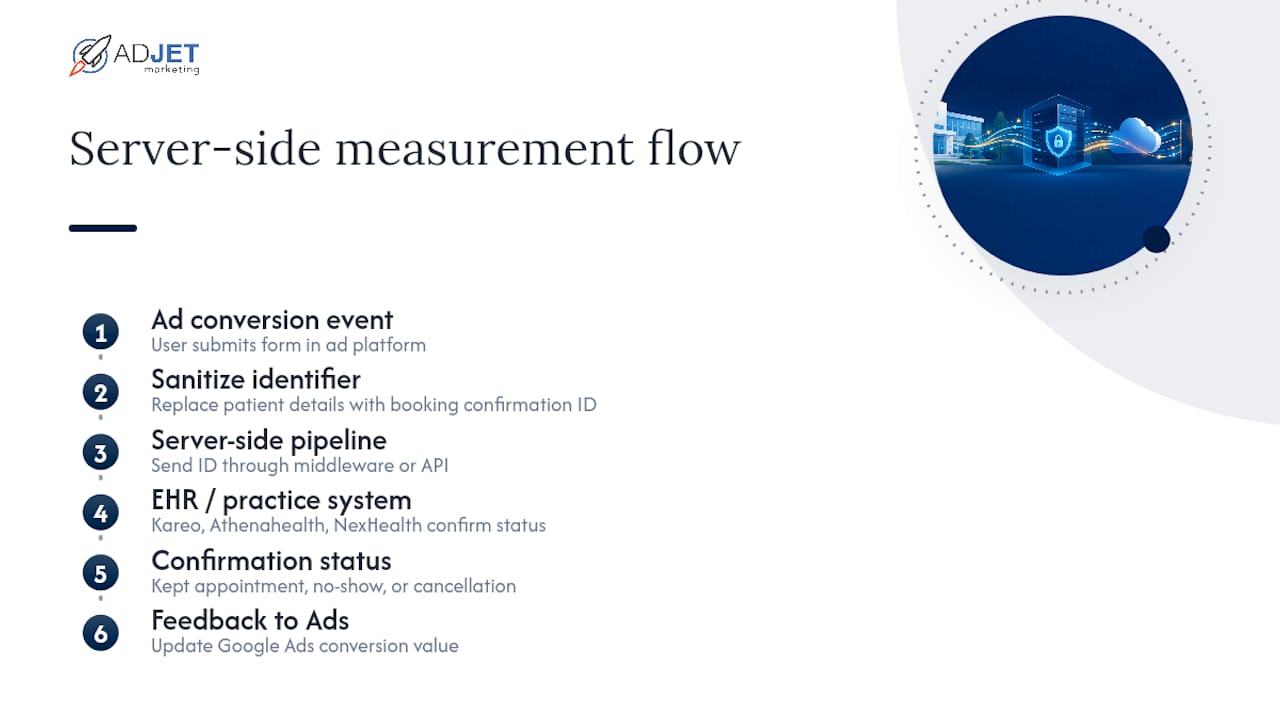
The practical approach: instead of sending patient details to Google, you send a sanitized identifier, like a booking confirmation ID, back through your server-side pipeline. Your practice management system (systems like Kareo, Athenahealth, or NexHealth are common in outpatient settings) confirms whether that booking ID resulted in a kept appointment, a no-show, or a cancellation. That confirmation status feeds back into your conversion value in Google Ads, so the algorithm starts optimizing toward patients who actually show up, not just people who filled out a form.
This integration takes real engineering work. It usually requires either a middleware layer or API access between your EHR/EMR and your ad platform, something most solo practitioners don’t have in-house. But the payoff is substantial: campaigns that optimize toward kept appointments consistently outperform campaigns optimizing toward raw form fills, because the algorithm stops rewarding low-intent traffic that never converts into revenue.
If your EHR vendor doesn’t support this kind of API connection, a simpler interim step works too: manually tag lead quality weekly (booked, no-show, unqualified) and feed that back into your conversion values by adjusting bid strategies based on the pattern you see, rather than automating the feedback loop entirely.
What Successful Healthcare Performance Max Campaigns Look Like
The healthcare practices that get real results from PMax share a specific pattern, and it has less to do with budget size than with preparation. A multi-location dental group with clean call tracking and separate asset groups per service line (implants, orthodontics, general checkups) can scale PMax spend confidently because each asset group has enough conversion volume to train independently.
Med spas tend to see the strongest early wins, largely because their conversion events (a booked consultation) are naturally non-PHI and their services (Botox, laser treatments, body contouring) map cleanly onto distinct asset groups with strong visual creative. Video assets showing before-and-after results or a walkthrough of a treatment room consistently outperform static images in PMax’s automated placements.
Mental health and therapy practices face a tougher setup because intake forms often ask sensitive questions upfront. The practices that succeed here are the ones that moved intake questions off the initial landing page, using a simple “request a consultation” form that collects only name and contact info, with clinical intake happening later in a secure patient portal. That single structural change often makes the difference between a compliant PMax campaign and one carrying real PHI exposure risk.
The common thread across every successful case: conversion tracking that measures something real (a kept appointment, a qualified consultation), not a vanity metric like form submissions or click volume.
Common Pitfalls That Sink Healthcare Performance Max Campaigns
Most healthcare PMax failures trace back to a handful of repeated mistakes, and recognizing them early saves months of wasted spend.
Launching without conversion volume. Practices that launch PMax on 5 to 8 monthly conversions almost always see erratic performance because the algorithm doesn’t have enough data to identify a pattern. The fix is either building volume first through Search campaigns or accepting a longer, rockier learning phase.
Leaving Final URL Expansion enabled by default. This is the single most common technical oversight we find in existing client accounts. Google’s default setting sends traffic wherever it predicts conversions, which can mean an unnetted page nobody reviewed for compliance.
Treating all conversions as equal. A campaign optimizing toward “any form submission” will fill your pipeline with unqualified leads faster than one optimizing toward “verified booking,” even though the raw lead count looks identical on a report.
Panicking during the learning phase. Rebuilding campaign structure inside the first 30 days resets the algorithm’s learning progress, which is often the real reason performance looks stuck rather than any flaw in the original setup.
Ignoring asset group relevance. One generic asset group covering an entire multi-service practice dilutes creative relevance and typically underperforms compared to service-line-specific groups, even with identical budgets.
Perspective: In-House vs. Agency, How to Decide
Running compliant PMax in-house requires real technical infrastructure: engineering resources for server-side tracking, someone running regular tag audits, and often legal review of vendor agreements. BCG’s research on healthcare AI adoption makes a point worth applying here too: the value comes from workflow redesign and governance, not just flipping a feature on.
If you have that infrastructure, in-house works. If you don’t, an agency is usually the faster, safer path, particularly for multi-location practices needing to scale quickly. When evaluating one, ask for a signed BAA, real healthcare case studies, and dashboard access you control directly.
— Felix
How AdJet Marketing Builds Compliant Performance Max Campaigns for Healthcare
If you’d rather not build server-side tracking infrastructure and tag audits from scratch, that’s the exact gap Adjetmarketing fills for clinics and therapy practices. As a Google Partner agency, we handle the technical build, the Google Ads campaign setup and management, and the landing page architecture that keeps PHI off pages Google’s automation can crawl into.
Many clients come to us after a self-managed PMax launch produced a flood of unqualified leads or a compliance scare nobody caught until it was live. We start with a funnel audit, then build conversion-focused landing pages designed to keep intake data separate from your ad-facing pages. From there, we structure campaigns around verified bookings, not raw form fills, and report on the metrics that actually predict revenue.
If you’re weighing whether to launch PMax yourself or want a second set of eyes on an existing campaign, start with a conversation about your current setup at Adjetmarketing.
Sources
- HHS applies inflation increase penalties for HIPAA violations – HIPAA Journal
- Healthcare Performance Max Campaigns: PHI Risks and the 2026 Audit Framework – Curve
- Transforming to an AI-first health-care provider – BCG (2026)
FAQ
Is Performance Max Worth It for Healthcare Practices?
It’s worth it when you have clean conversion tracking and enough monthly volume, typically 15 to 20 conversions, to train the algorithm properly. For practices with sensitive intake forms or low lead volume, a tightly controlled Search campaign is often the safer, more predictable choice.
What Does Performance Max Do Differently From Regular Search Campaigns?
PMax automatically distributes your budget across Search, Display, YouTube, Gmail, and Discover from one campaign, using Google’s machine learning to decide placement and audience rather than requiring manual targeting for each channel. You supply asset groups and conversion goals; Google’s algorithm handles the rest.
What Are Two Benefits of Performance Max for Healthcare Marketers?
It extends reach across multiple Google-owned channels without building separate campaigns for each one, and it can identify converting audiences faster than manual targeting once it has sufficient conversion data. The trade-off is reduced manual control, which matters more in healthcare than in most other industries.
What Is the Main Compliance Risk With Performance Max in Healthcare?
The biggest risk is PHI exposure through features like Final URL Expansion and auto-detected form fields, which can send patient data to Google without explicit authorization. Disabling these features and routing conversions through a server-side tracking setup is the standard mitigation.
Does AdJet Marketing Offer Performance Max Setup for Healthcare Clients?
Yes, Adjetmarketing provides Google Ads campaign setup and management for healthcare and therapy practices, including compliant tracking architecture and landing page design. Current pricing details are available directly on the site.