









Med spa Google Ads cost has two parts: the ad spend you pay Google, and the fee you pay whoever builds and manages the account. Both vary a lot by city, treatment and competition, so no honest single number exists. What you can do is build the budget from the bottom up, starting with what a booked patient is worth to you. This guide shows how.
TL;DR
- Google charges per click, and your price per click depends on the treatment, your market and the quality of your ads and landing page. Treatments like fillers and body contouring are not priced like facials.
- Plan three line items: ad spend, management fees, and the landing page or website that turns clicks into consultations.
- The number that matters is cost per booked patient, not cost per click. Work backward from lifetime value.
- Expect a few months of testing before the data is trustworthy. Anyone who guarantees a result in week one is selling you hype.
- Many med spas get a better return by starting with a few high-value treatments instead of spreading a small budget across the whole menu.
Table of Contents
- How Google Ads charges a med spa
- What med spas typically spend on marketing overall
- The three costs behind a med spa Google Ads program
- Cost per lead is not cost per patient
- A worked budget example
- Why a small budget needs a narrow focus
- Policy limits that affect cost
- Google Ads or SEO first?
- How long before you know if it works
- Our perspective
- Where AdJet fits
- A checklist before you commit a dollar
- FAQ
- Sources
How Google Ads charges a med spa
Most med spa campaigns run on cost-per-click bidding. According to Google’s own explanation, with this model you are charged only when someone clicks your ad and goes to your website. You set the most you’re willing to pay for a click, and the actual price is decided in an auction.
That auction runs every time someone searches. Google lists several factors that decide which ads show and in what position, and your bid is only one of them. Ad relevance and the experience on your landing page count too. In practice, this means two med spas bidding the same amount can pay different prices for the same click.
For you, the practical consequences are:
- Competitive treatments cost more per click. If five clinics within ten miles want the person searching for a specific injectable, the price rises.
- Broad, low-intent searches are cheaper but convert worse. Someone researching a procedure is not the same as someone ready to book.
- Quality helps. A relevant ad pointing to a focused page usually lowers what you pay for the same position.
How the daily budget really works
You set an average daily budget, not a hard daily cap. Google’s budgets documentation explains that on busy days Google may spend up to twice your daily budget, but you won’t be charged more than 30.4 times your average daily budget in a month. So a $100 daily budget means a monthly ceiling of about $3,040, and any single day can look higher than $100.
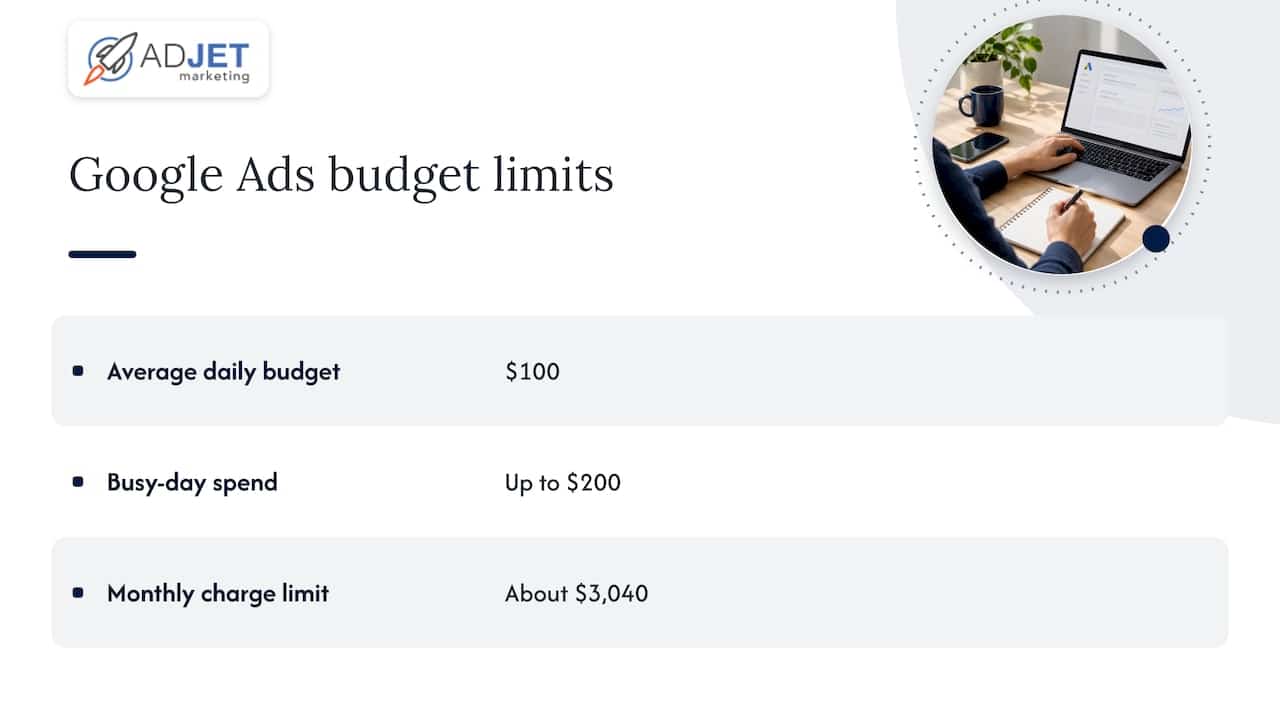
This surprises many owners who see a $190 day and assume something is broken. It usually isn’t. Check the monthly total, not one day.
What med spas typically spend on marketing overall
Google Ads is one slice of the marketing budget. The American Med Spa Association reports that, based on its 2024 State of the Industry report, the average med spa invests about 7% of revenue in marketing. Its 2025 write-up also notes that budgets range widely, from roughly 2% to 15% of revenue, with many clinics spending between $1,600 and $15,000 per month across online and offline channels.
Use that as a sanity check, not a target. A newer practice trying to fill a calendar often spends a higher share than an established one that gets most of its bookings from referrals and repeat clients.
A quick way to frame it:
| Practice situation | Reasonable approach to paid search |
|---|---|
| Newly opened, little brand awareness | Higher share of revenue to marketing; Google Ads for fast visibility while SEO builds |
| Established, strong repeat clients | Smaller, targeted campaigns for high-value treatments and new-patient acquisition |
| Adding a new device or service line | Dedicated campaign and landing page for that service only |
| Multiple locations | Separate budgets and campaigns per location, since markets differ |
The three costs behind a med spa Google Ads program
1. Ad spend
This is what goes to Google. It is the most variable part and the one you control most directly. You can raise or lower it at any time, and it should follow performance, not the other way around.
2. Management fees
Agencies price management differently: a flat monthly retainer, a percentage of ad spend, or a hybrid. Each has trade-offs. A percentage model can reward an agency for simply spending more, while a flat fee tied to scope keeps incentives cleaner. Ask for the model in writing, along with what the fee includes: reporting, call tracking setup, landing page testing and strategy calls.
We do not publish a management price for Google Ads because scope depends on the number of locations, treatments and the state of your existing account. You can read how we approach it on our Google Ads services page and our medical spa Google Ads page.
3. The landing page
This is the line item most owners skip, and the one that quietly decides whether the first two are wasted. Sending paid traffic to a general homepage with twenty menu items and a slow-loading slider is one of the most common reasons clinics tell us their ads “don’t work.” A page built for one treatment, with clear pricing context, proof, a short form and a click-to-call button, converts better than a page built for everything.
Cost per lead is not cost per patient
Clicks are cheap compared with what they lead to. The chain looks like this:
- Click
- Lead (form, call or chat)
- Booked consultation
- Patient who shows up
- Patient who buys, and perhaps returns
Every step loses people. If you measure only clicks or even leads, you can feel successful while the front desk is chasing unqualified inquiries. Many clinics come to us after exactly this pattern: plenty of form fills, few bookings, and no way to tell which campaigns produced the good ones.
To fix that, track phone calls and form submissions as separate conversions, record which ones became appointments, and feed that back into your reporting. A lead that never answers the phone is not worth the same as one who books.
A worked budget example
The numbers below are illustrative, chosen to show the logic. They are not benchmarks, and your figures will differ. Replace them with your own.
Say your average first-year value of a new injectables patient is $1,200 in revenue, and your contribution margin after product, provider time and overhead is about 40%. That’s $480 of profit per new patient.
| Step | Illustrative figure |
|---|---|
| Monthly ad spend | $3,000 |
| Average cost per click | $10 |
| Clicks per month | 300 |
| Click-to-lead rate | 8% |
| Leads per month | 24 |
| Lead-to-consultation-to-patient rate | 30% |
| New patients per month | about 7 |
| Ad spend per new patient | about $417 |
At $480 profit per patient, this account roughly breaks even on the first treatment and makes money if patients return. If the landing page lifts the click-to-lead rate from 8% to 12%, the same spend produces 36 leads and about 11 patients, and cost per patient drops to about $273. Nothing about the ad changed. The page did the work.
This is why we push owners to look at conversion rate before raising budget. Doubling spend on a leaky funnel doubles the leak.
Why a small budget needs a narrow focus
With a limited budget, Google needs enough clicks to learn which searches and ads lead to conversions. Google’s bidding guidance describes different bidding goals, such as clicks or conversions, and automated strategies depend on data to improve. Spread $1,000 across ten treatments and none gets enough volume to learn.
A more workable approach for a smaller budget:
- Pick two or three treatments with the best margin and repeat-visit potential.
- Target searches with local intent, such as the treatment plus your city or “near me.”
- Build one landing page per treatment.
- Exclude irrelevant searches, such as job seekers, DIY queries and training courses.
- Limit the geography to areas patients will actually drive from.
What about $10 a day?
It is possible to run a campaign at $10 a day, which is about $304 a month at Google’s 30.4 multiplier. In a competitive metro, though, that may buy very few clicks for injectable or laser terms. It can work as a short test for a narrow, local service. It rarely supports a full launch in a crowded market. Treat it as a learning budget, not a growth plan.
Policy limits that affect cost
Med spa advertisers face restrictions that general businesses do not. Certain treatments and claims can trigger limited serving or disapproval under Google’s healthcare policies, which reduces how often some ads appear. Before you budget around a treatment, confirm in your account whether ads for it are eligible, limited or disapproved. Account suspensions and rewrites cost time, and time is money when you are paying for traffic that can’t convert.
Compliance also applies to what happens after the click. If you collect health information through forms or tracking, talk to your attorney or compliance advisor about privacy rules before you launch retargeting or advanced tracking. We build with that in mind, but legal advice for your practice should come from counsel who knows your state.
Google Ads or SEO first?
This is not either-or, but the timing differs.
| Google Ads | SEO | |
|---|---|---|
| Speed to first leads | Days to weeks, once approved | Usually months |
| Cost structure | Pay per click, stops when you stop | Upfront and ongoing effort, compounds |
| Control | High: budget, keywords, geography | Lower: depends on search rankings |
| Best for | New launches, new services, short-term demand | Long-term visibility, lower cost per lead over time |
A balanced plan often uses ads for early bookings while SEO matures. If you want to explore the organic side, see our medical spa SEO page and our comparison, SEO vs. PPC. And if you are weighing social platforms against search, our breakdown of Google Ads vs. Meta Ads for med spas covers the trade-offs.
How long before you know if it works
Be skeptical of promises of immediate results. A realistic path looks like this:
- Weeks 1 to 2: Account setup, conversion tracking, landing pages and first ads. Spend is low-signal.
- Weeks 3 to 8: Search term data accumulates. You cut wasteful queries and test ad variations.
- Months 2 to 4: Patterns emerge. You can judge cost per lead and, with front desk feedback, cost per booked patient.
- Month 4 onward: You scale what works and stop what doesn’t.
The pace depends on volume. A high-spend account in a large city learns faster than a small one in a small town. We can’t promise a particular result, and neither should anyone else.
Our perspective
The question we hear most is, “How much should I spend?” We answer with a question: what is a new patient worth to you, and how many can your team handle well?
In our experience, the clinics that get the most from Google Ads share a few habits. They track calls as carefully as forms. They tell us which leads turned into appointments. They give us a narrow list of treatments to start with, and they let the data run long enough to mean something. The ones who struggle usually have a good campaign pointing at a weak page, or a front desk that can’t respond to leads within minutes.
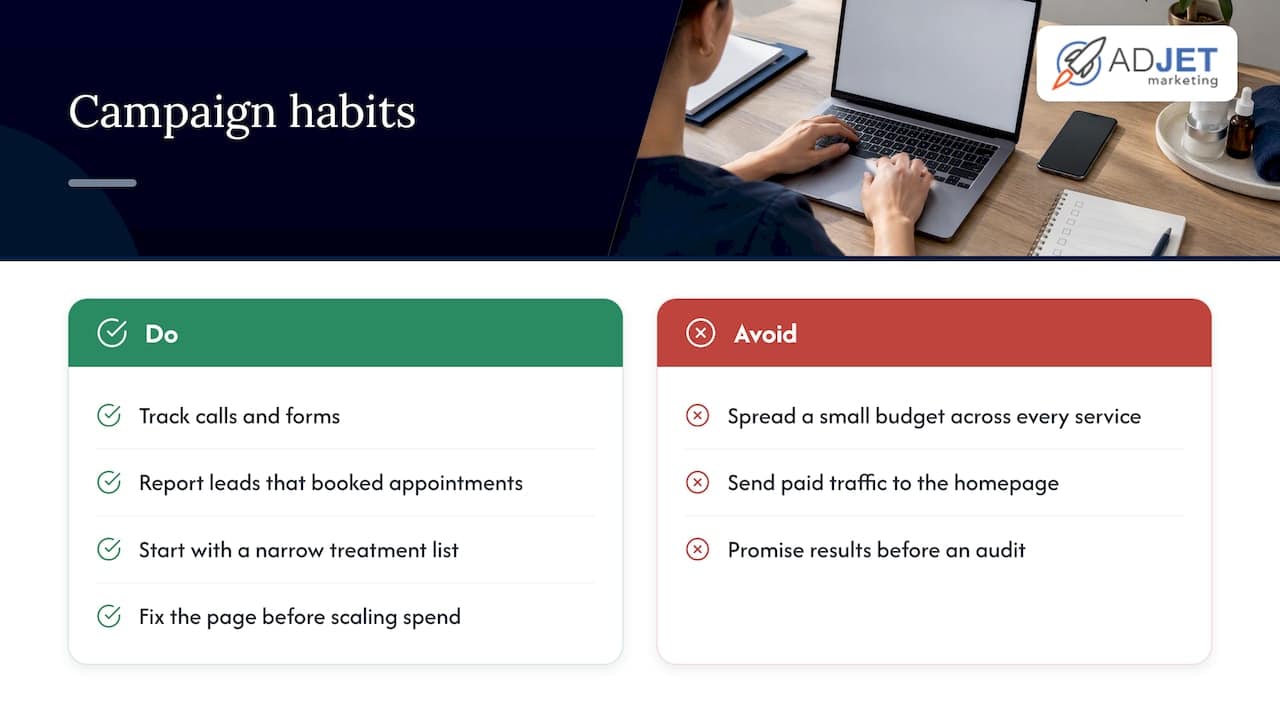
We also avoid a few things on purpose. We don’t recommend spreading a small budget thin across every service. We don’t recommend sending paid traffic to a homepage. And we don’t promise numbers before we’ve seen your market, because a promise made before an audit is a guess.
If your budget is modest, start small and focused, and fix the page before you scale spend. If it is larger, be ready to segment by treatment and by location.
— Felix
Where AdJet fits
We are a Google Partner agency based in Texas, and we build the ads and the pages they point to. Our Google Ads services cover campaign structure, tracking and reporting. If your landing page is the weak link, our landing page design plans are published with prices: a Starter Plan at 299 USD per month, a Premium Plan at 1500 USD per month, and a single custom landing page at 2000 USD one-off. Management fees for ads are quoted after we look at your account and market.
For more on campaign structure, read proven Google Ads strategies to increase med spa bookings.
A checklist before you commit a dollar
- Know your average new-patient value and margin for each treatment you plan to advertise.
- Set a target cost per booked patient, not just per lead.
- Confirm call tracking and form tracking work before launch.
- Build a dedicated page for each priority treatment.
- Decide who answers leads and how fast.
- Agree on how long you will run before judging results.
- Ask any agency how it charges and what the fee covers.
FAQ
How much does advertising on Google cost for a med spa?
There is no fixed price. You pay per click, and the price depends on your treatment, your city and the competition. Add management fees and landing page costs for the full picture. The best way to budget is to start with what a new patient is worth to you and work backward.
Is $10 a day enough for Google Ads?
It works as a small test for a narrow local service, but it often buys too few clicks in a competitive market to give reliable data. Google may also spend up to twice your daily budget on some days, within a monthly limit of 30.4 times the daily figure. Treat $10 a day as learning money, not a launch budget.
How much should a med spa spend on marketing in total?
The American Med Spa Association reports an average of about 7% of revenue, with a wide range from roughly 2% to 15%. Newer practices tend to spend a higher share. Google Ads is one part of that, alongside SEO, social and your website.
Are Google Ads worth it for a med spa?
They can be, when the page converts, tracking is accurate and the treatments advertised have enough margin. They are a poor fit when the front desk can’t follow up quickly or the site is not built for paid traffic. Give the campaign enough months to produce meaningful data before you decide.
Sources
- American Med Spa Association: how much should I spend on med spa marketing
- Google Ads Help: budgets overview
- Google Ads Help: using Google Ads for online marketing
- Google Ads Help: how the Google Ads auction works
- Google Ads Help: understanding bidding basics