









Local Service Ads (LSAs) are Google’s pay-per-lead ads for local service businesses. They sit at the top of the results page, show your name, star rating and review count, and you pay when a customer contacts you, not when they click. For contractors, that makes them one of the most direct ways to get phone calls from people already looking for help. They also come with a screening process, a ranking system you cannot simply outbid, and some operational demands that catch many owners off guard.
This guide covers how LSAs work, what verification involves, how placement is decided, how to set a budget, and when regular Google Ads or SEO should sit beside them.
TL;DR
- LSAs charge per valid lead, not per click, and you set an average weekly budget based on the number of leads you want.
- Verification is required and varies by business category and location. Plan for roughly 3 to 4 weeks before ads can run.
- A higher bid does not guarantee top placement. Reviews, responsiveness, proximity and verification status all count.
- LSAs work best alongside a strong Google Business Profile and, for many contractors, a regular Google Ads campaign.
- Healthcare-adjacent businesses need extra care with privacy rules. Do not assume an ad platform is HIPAA compliant.
Table of Contents
- What Local Service Ads Are, and How They Differ From Regular Google Ads
- Screening and Verification: The Part That Takes Time
- How Google Decides Who Appears First
- Budgets, Bids and What a Lead Costs
- Setting Realistic Expectations
- LSAs, Regular Google Ads and SEO: How They Fit Together
- What to Do After the Lead Comes In
- A Caution for Healthcare and Wellness Advertisers
- Our Perspective: Treat LSAs as an Operations Channel
- How AdJet Can Help
- FAQ
- Sources
What Local Service Ads Are, and How They Differ From Regular Google Ads
Regular Google Ads are search ads. You choose keywords, write the ad text, send people to a page, and pay when someone clicks. LSAs work differently. You pick your job types and service area, complete screening, and Google shows your business in a unit with your name, rating, and review count. Customers call or message you straight from the ad.
The placement is the main attraction. According to one contractor-marketing guide, LSAs appear above regular Google Ads and above the map pack. For a homeowner with a burst pipe or a failed furnace, that top position is the first thing they see.
The payment model is the second difference. As Google explains, with LSAs you pay for valid leads. A lead is typically a phone call or message request from a customer interested in your service. You do not choose keywords, and you do not write headlines. The tradeoff is less control: Google decides which searches your business appears for, based on the job types you select.
| Local Service Ads | Regular Google Ads (search) | |
|---|---|---|
| You pay for | Valid leads | Clicks |
| You control | Job types, service area, budget, hours | Keywords, ad copy, landing pages, bids |
| Placement | Top of results, above the map pack | Below LSAs, above organic results |
| Entry requirement | Screening and verification | Account and policy compliance |
| Where customers land | Call or message to you directly | Your website or landing page |
Screening and Verification: The Part That Takes Time
No contractor can skip screening. Google states that all businesses must pass its screening and verification process, and that the process varies by business category and location. It may include background checks, business registration, insurance, and license checks.
For most contractors, the practical checklist looks like this:
- Confirm your trade category is available in your market. Availability is specific to the category and the local area, so check inside the Local Services dashboard before you commit any budget.
- Gather your business registration, your state or local license, and your proof of insurance. Requirements differ by trade and state, so look at Google’s qualification rules for your category.
- Prepare for background checks on owners and, where required, field workers.
- Keep a verified Google Business Profile. Google’s verification documentation notes that the process typically takes 3 to 4 weeks.
That timeline matters for planning. If your busy season begins in April, start the process in February, not the week you want leads. Delays usually come from missing documents or a mismatch between the business name on your license and the name on your profile.
We see a pattern here with new clients. Owners assume eligibility is automatic, then discover their category is not offered in their market, or that one worker’s paperwork is incomplete. Check first, then build the plan around what you find.
How Google Decides Who Appears First
This is the point that surprises people who come from regular Google Ads. You cannot simply buy the top spot. Ranking draws on a combination of factors: review score, number of reviews, responsiveness to leads, proximity to the searcher, and verification status. Google’s bidding documentation describes a bid as the most you would pay for a lead, and when similar businesses bid on the same lead, those bids determine how much that lead is worth. A bid is one input, not the whole decision.
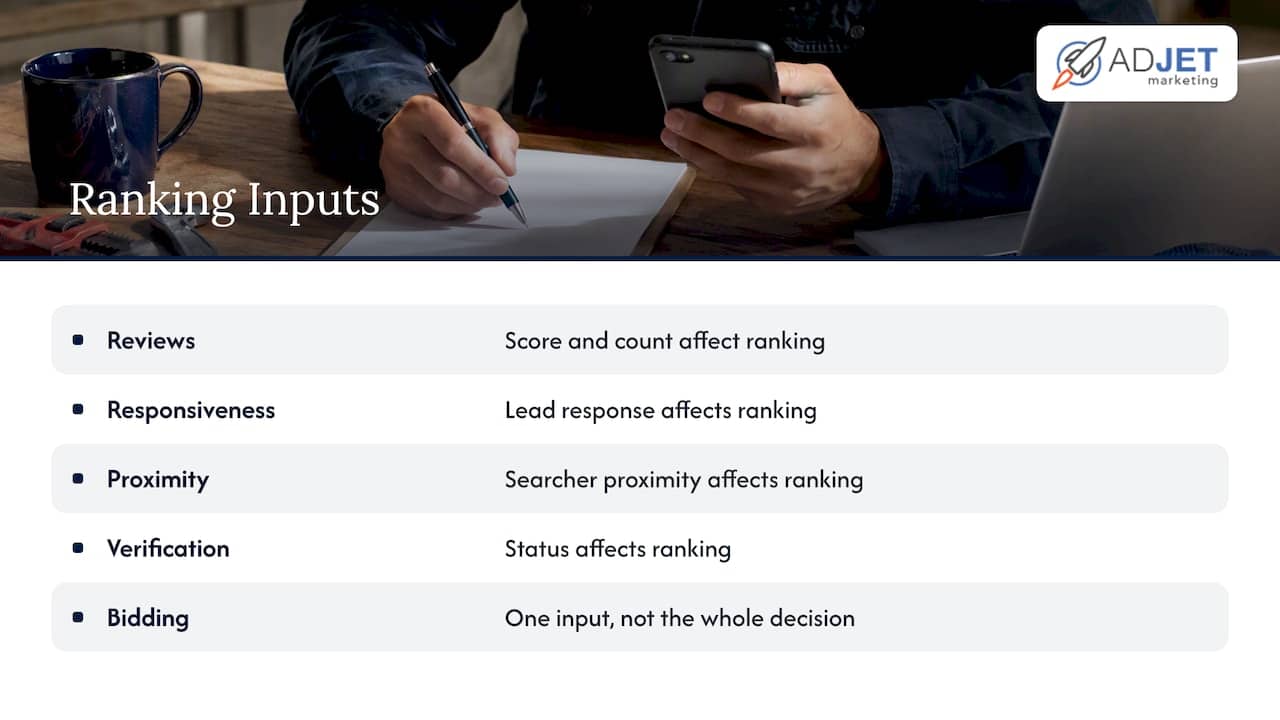
Reviews
Stars and review count are visible in the ad itself, so they work twice: they help you rank and they persuade the customer. One roofing guide cites that 97% of consumers read reviews before choosing a local business. Treat that figure as a vendor claim rather than an audited statistic, but the direction is hard to argue with. Ask every satisfied customer for a review while the job is fresh, and reply to each one.
Responsiveness
Missed calls hurt you. If leads come in and nobody answers, your responsiveness suffers, and your placement can suffer with it. Practically, that means:
- Set LSA business hours to hours when someone really picks up.
- Route calls to a number that rings your office or a dedicated answering line, not a voicemail box nobody checks.
- Reply to message requests quickly, ideally within minutes.
- Mark leads as booked, or not booked, so the system learns what a good lead looks like for you.
Proximity and service area
You cannot change where a customer is standing, but you can set the service area honestly. Selecting zip codes you cannot reach in a reasonable drive produces leads you will decline, which wastes budget and lowers responsiveness.
Budgets, Bids and What a Lead Costs
Google’s guidance is to set an average weekly budget based on the number of leads you want in a given week. Spend can vary from week to week around that average. Bidding options include automated bidding to maximize leads, or a target cost per lead.
What will a lead cost you? It depends on your trade, your city and your competition, and no honest source can name a universal number. Roofing in a large metro costs far more per lead than a small handyman job in a rural county. Published case figures you may see online, such as a monthly spend turning into several times that in profit, come from specific businesses and should not be used as a forecast for yours.
Here is how we suggest thinking about budget instead:
- Work out your average job value and your realistic close rate on leads.
- Decide the most you could pay for a lead and still profit after labor and materials.
- Start with a conservative weekly budget for the first month. Watch lead quality and your cost per booked job, not just cost per lead.
- Raise the budget only when you can answer every call.
A valid lead is not the same as a booked job. Some will be price shoppers, wrong-area requests or duplicates. Google has a dispute process for leads that should not count, so review your lead list weekly and flag the ones that do not meet the criteria.
Setting Realistic Expectations
LSAs can produce calls within days of going live, which is faster than SEO. But “fast” does not mean “easy.” Expect an early period where your ranking is still building, because you have few reviews or your responsiveness data is thin. The businesses that do well over time treat reviews and call handling as the engine, and the ad budget as the fuel.
We do not promise lead volumes or returns, and you should be wary of anyone who does. Your market, season and capacity decide results more than any setting.
LSAs, Regular Google Ads and SEO: How They Fit Together
Contractors often ask which channel to pick. The balanced answer is that each one catches a different kind of customer.
| Channel | Best for | Main limit |
|---|---|---|
| Local Service Ads | Urgent, high-intent calls from people ready to hire | Less control over targeting and messaging; screening required |
| Regular Google Ads | Specific services, higher-value projects, tailored landing pages | Click costs, and you pay even when a click does not convert |
| Local SEO and Google Business Profile | Steady long-term visibility and trust | Takes months, and results are slower to measure |
Some examples of how contractors split their effort:
- An emergency-focused plumber or HVAC company leans on LSAs for calls and keeps a lean regular campaign for specific services.
- A remodeler selling large projects often needs a landing page that explains the process, shows past work and captures a quote request. A phone call from an LSA is a thin way to sell a kitchen renovation, so regular ads sent to a strong page can do more.
- A new company with few reviews may start with regular ads and local SEO while it builds its review base, then add LSAs.
Your Google Business Profile supports all three channels, because LSAs require a verified profile and the map pack draws from it. Our guides on this are written for clinics, but the profile mechanics (accurate categories, hours, photos, and review handling) apply to any local business. For longer-term visibility, a local SEO program builds the organic side.
What to Do After the Lead Comes In
Many contractors lose money after the ad, not in it. A lead that goes to voicemail, or a caller who gets a vague quote, is gone. A simple process helps:
- Answer within a few rings, or return the call within minutes.
- Ask the same three or four qualifying questions every time: location, type of job, timeline, and whether they own the property.
- Book an estimate on the call when possible.
- Mark the lead outcome in the dashboard.
- Ask for a review after the job.
If you also run regular ads, the page they land on matters just as much. A page with one clear offer, a visible phone number, proof of past work and a short form converts better than a homepage with ten competing links. Our landing page design offering and our guide to high-converting landing pages go deeper on this.
A Caution for Healthcare and Wellness Advertisers
This article is about contractors, but many of our readers also run clinics or med spas, so a note on privacy. If your business handles patient information, do not treat an advertising platform as a compliant partner by default. The FTC’s guidance says HIPAA, the FTC Act and the Health Breach Notification Rule can all apply to those who collect or share consumer health information. The agency has acted on this: in a 2023 case, GoodRx agreed to a $1.5 million civil penalty and a ban on sharing health data for advertising.
Also check Google’s healthcare advertising policies for your service. Eligibility for Local Services Ads differs by category, so confirm that your category is offered in the dashboard before spending time on screening. Home-service features such as call handling may not work the same way for healthcare. For tracking and consent questions, speak with a qualified healthcare compliance attorney, and read our piece on HIPAA-compliant marketing with Google Ads.
Our Perspective: Treat LSAs as an Operations Channel
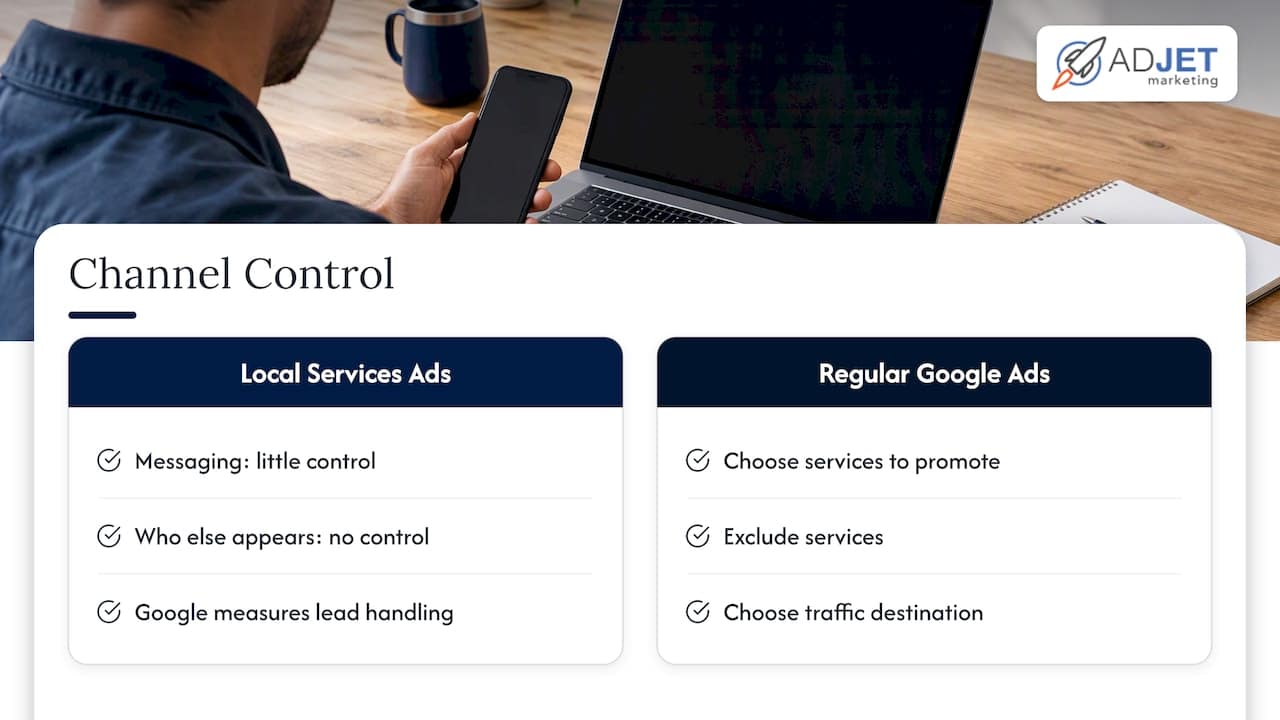
Many businesses come to us after a channel produced poor lead quality. The pattern is rarely the platform. It is usually one of three things: an unclear service area, calls going unanswered, or an ad sending people to a page that does not match the job. LSAs expose all three quickly, because Google measures how you handle leads.
Our view is that LSAs are worth testing for contractors in categories where they are available, but they should not be the only channel. They give you little control over messaging and no control over who else shows up. A regular Google Ads account lets you decide which services to push, which to exclude, and where to send traffic. Structuring that account around separate services, with its own landing page for each, is how you avoid paying for the wrong clicks.
We also push for realistic timelines. Verification takes weeks. Ranking builds as reviews and responsiveness build. SEO takes months. A budget plan that assumes full results in week one will disappoint, and we would rather say so before you sign anything.
If you want to compare channels before committing, start with the numbers: your average job value, your close rate, and the most you can pay for a booked job. Everything else follows from those.
— Felix
How AdJet Can Help
We are a Google Partner agency that manages Google Ads campaigns, local SEO, and conversion-focused web pages for local businesses, including home services. If you want regular ads to run alongside your LSA activity, or landing pages that turn clicks into calls, we can scope that with you. Our published landing page pricing starts with a Starter Plan at 299 USD per month, and the full plan details are here. Google Ads and SEO services are quoted on request.
FAQ
Do Local Service Ads work for every type of contractor?
No. Availability depends on the business category and the local market. Screening requirements also vary by category and location. Check your trade and service area in the Local Services dashboard before you plan a budget around it.
How long does it take to get approved?
Google’s documentation says verification typically takes 3 to 4 weeks. Missing licenses, insurance papers or background check steps can add time. Start before your busy season.
Can I pay more to rank first?
Not on bid alone. Placement depends on factors including review score, number of reviews, responsiveness, proximity and verification status. A bid affects what a lead is worth, but poor responsiveness or few reviews can hold you back even with a high bid.
Should I use Local Service Ads or regular Google Ads?
Many contractors use both. LSAs suit urgent, call-driven work, while regular ads suit specific services or larger projects that need a tailored landing page. Start from your job values and close rates, then decide the split.
Are Local Service Ads safe for medical practices?
Only with care. Ad platforms generally are not HIPAA compliant by default, and the FTC has enforced against sharing sensitive health data for advertising. Confirm your category’s eligibility and talk with a healthcare compliance attorney about tracking and lead handling.
Sources
- How leads work, Local Services Help
- Understand the screening and verification process, Local Services Help
- How providers qualify for Local Services Ads, Local Services Help
- Business screening and verification requirements, United States
- How bidding works for Local Services Ads
- Google Local Services Ads for Roofers: The 2026 Guide
- Collecting, Using, or Sharing Consumer Health Information, FTC
- FTC enforcement action against GoodRx
- Healthcare and medicines, Advertising Policies Help