








Internet marketing incorporated is a single, measurable program that aligns owned, paid, and earned media into a predictable lead-and-revenue engine. The American Marketing Association defines digital marketing strategy as a deliberate set of channel decisions tied to conversion outcomes, not a collection of disconnected tactics. Organizations like Salesforce frame it as a high-level roadmap where every channel serves a specific business goal. Adjetmarketing builds exactly this kind of integrated program for clinics, home services businesses, and real estate professionals across the U.S.
Before you read further, here are your immediate next steps:
- Audit your current owned, paid, and earned assets (30–60 minutes, checklist below).
- Pick three workhorse channels — Search, Email, and one social platform that matches your buyer.
- Set one revenue KPI before you launch anything: cost per lead, booked appointments, or customer acquisition cost (CAC).
- Assign a 90-day milestone so you have a concrete checkpoint, not an open-ended experiment.
Table of Contents
- What does an integrated internet marketing strategy actually mean?
- Which three channels should you prioritize first?
- What components does your program need to include?
- Run this audit before you spend another dollar
- What should your 90, 180, and 365-day roadmap look like?
- When should you hire an agency instead of running it in-house?
- Key Takeaways
- What we see in client work, and what actually fixes it
- Adjetmarketing builds integrated programs that produce measurable results
- Useful sources and further reading
What does an integrated internet marketing strategy actually mean?
An integrated strategy means your SEO, paid ads, email, and social channels share a single measurement framework and consistent messaging, rather than operating as separate campaigns with separate goals. Salesforce describes it as aligning owned, paid, and earned media to create predictable lead and revenue outcomes.
The three media types each play a distinct role. Owned media is everything you control: your website, landing pages, email list, and content. Paid media is ad spend on Google, Meta, or other platforms. Earned media is third-party validation: reviews, press mentions, and organic shares. Integration means a prospect can move from a Google search (paid) to a landing page (owned) to a follow-up email sequence (owned), and every step is tracked back to revenue.
What integration is not: posting on Instagram while running Google Ads and sending a monthly newsletter with no shared audience data, no consistent offer, and no unified reporting. The AMA’s framework is direct on this point: strategy is a set of deliberate decisions that connect to conversion, not a posting schedule.
Which three channels should you prioritize first?
Start with Search, Email, and one social platform. Each serves a different stage of the buyer journey, and together they cover intent, retention, and awareness without spreading your budget too thin.
| Pillar | Primary Objective | Key KPI | Best Use Case |
|---|---|---|---|
| Search (SEO + PPC) | Capture in-market intent | Cost per lead, conversion rate | High-intent queries: “pain clinic near me,” “medspa Botox” |
| Nurture and convert leads | Open rate, revenue per email | Follow-up sequences, re-engagement, appointment reminders | |
| Social (paid + organic) | Build awareness, retarget | CPM, click-through rate | Brand visibility, lookalike audiences, demand creation |
Pro Tip: For B2B businesses, replace the social pillar with LinkedIn and content syndication. For local service businesses and clinics, Meta retargeting often outperforms organic social for direct lead generation.
Mailchimp’s multi-channel platform is a practical example of how email, SMS, and paid ads can share audience data in one place, which simplifies segmentation and cuts the time you spend exporting lists between tools.
When to shift budget between Search and paid: if your SEO rankings are generating consistent traffic, you can reduce branded paid search spend and redirect it to top-of-funnel social. If you are in a new market or launching a new service, paid search delivers results faster than organic.
What components does your program need to include?
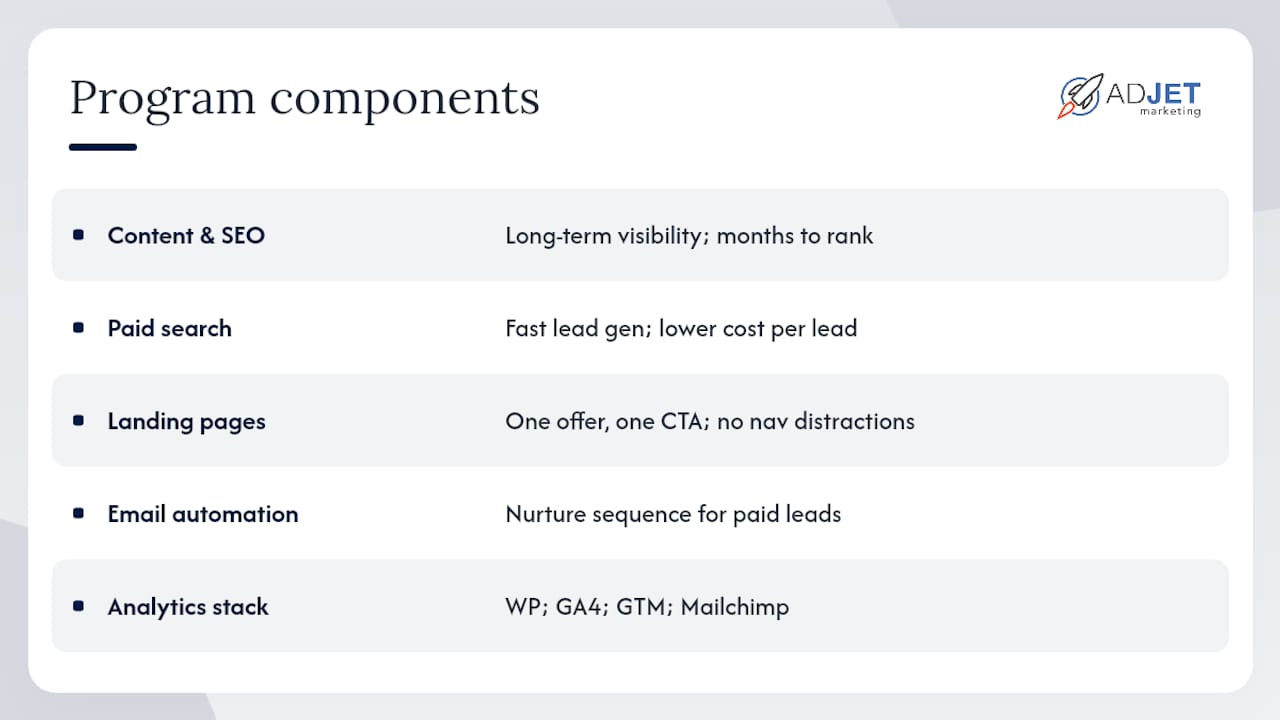
A complete internet marketing program requires content and SEO, paid search and social, conversion-optimized landing pages, email automation, and an analytics stack that connects all of them to revenue.
Content and SEO build long-term visibility for high-intent queries. Results take months, but the compounding return on a well-ranked page outpaces paid traffic over time.
Paid search and social provide speed. A well-structured Google Ads campaign can quickly generate booked appointments after launch. The structure matters: ad groups organized by service and intent, not by budget, produce far better quality scores and lower cost per lead.
Conversion-optimized landing pages are where most programs leak revenue. A generic homepage is not a landing page. Each campaign needs a dedicated page with one offer, one call to action, and no navigation distractions. Read more on landing pages in healthcare marketing to see how this applies to appointment-driven businesses.
Email automation handles the leads your paid campaigns generate. Without a nurture sequence, most leads lose interest quickly.
Analytics and tech stack: WordPress as your CMS, Google Analytics 4 for behavior data, Google Tag Manager for tracking, and a platform like Mailchimp for email. These four tools cover the majority of small-to-mid-market needs without unnecessary complexity.
Pro Tip: If resources are limited, start with landing pages and Search before anything else. A high-converting landing page paired with a tightly structured Google Ads campaign will generate measurable leads faster than any other combination.
Run this audit before you spend another dollar
This checklist surfaces your highest-impact fixes before you allocate any new budget.
Owned media:
- Does every service page have a clear, single call to action?
- Are your landing pages separate from your main site navigation? (High impact, low effort)
- Is your site loading in under three seconds on mobile? (High impact, medium effort)
- Is your Google Business Profile complete with photos, hours, and recent reviews?
Paid media:
- Are conversion tracking tags firing correctly in Google Tag Manager? (High impact, low effort)
- Are your ad groups organized by intent, not by budget? (High impact, medium effort)
- Are you sending paid traffic to a dedicated landing page or to your homepage? (High impact, low effort)
Earned media:
- Do you have a process for requesting reviews after each appointment or job? (Medium impact, low effort)
- Are your NAP (name, address, phone) citations consistent across Google, Yelp, and industry directories? (Medium impact, medium effort)
Log every “no” answer as a fix item. In the first 30 days, address all high-impact, low-effort items first. Those typically include conversion tracking, landing page separation, and review request processes.
What should your 90, 180, and 365-day roadmap look like?
Days 1–90: Complete the audit. Launch high-intent Search campaigns with dedicated landing pages. Set up conversion tracking. Establish your baseline KPIs. This phase is about getting clean data, not scaling.
Days 90–180: Scale content production and SEO. Build email nurture sequences for leads generated in phase one. Expand paid campaigns to include retargeting. Review CAC and adjust channel mix based on real data.
Days 180–365: You should have a measured, multi-channel funnel with attribution in place. This is when you optimize for efficiency: reduce CPL, improve lead-to-appointment rates, and test new audience segments.
Budget shapes vary by business size. Small businesses typically start with a focused paid search and landing page budget. Mid-market businesses add content, SEO, and email automation. Enterprise programs layer in programmatic, advanced attribution, and dedicated CRO resources. These are directional shapes, not guarantees. Your actual numbers depend on market, competition, and conversion rates.
One realistic expectation: SEO takes months to produce ranking results. Paid search can generate leads within days. A program that relies entirely on SEO will not produce pipeline in 90 days. One that relies entirely on paid search will not build durable visibility. The Salesforce strategy guide and the 2026 This Is LD framework both emphasize balancing both for resilience.
When should you hire an agency instead of running it in-house?
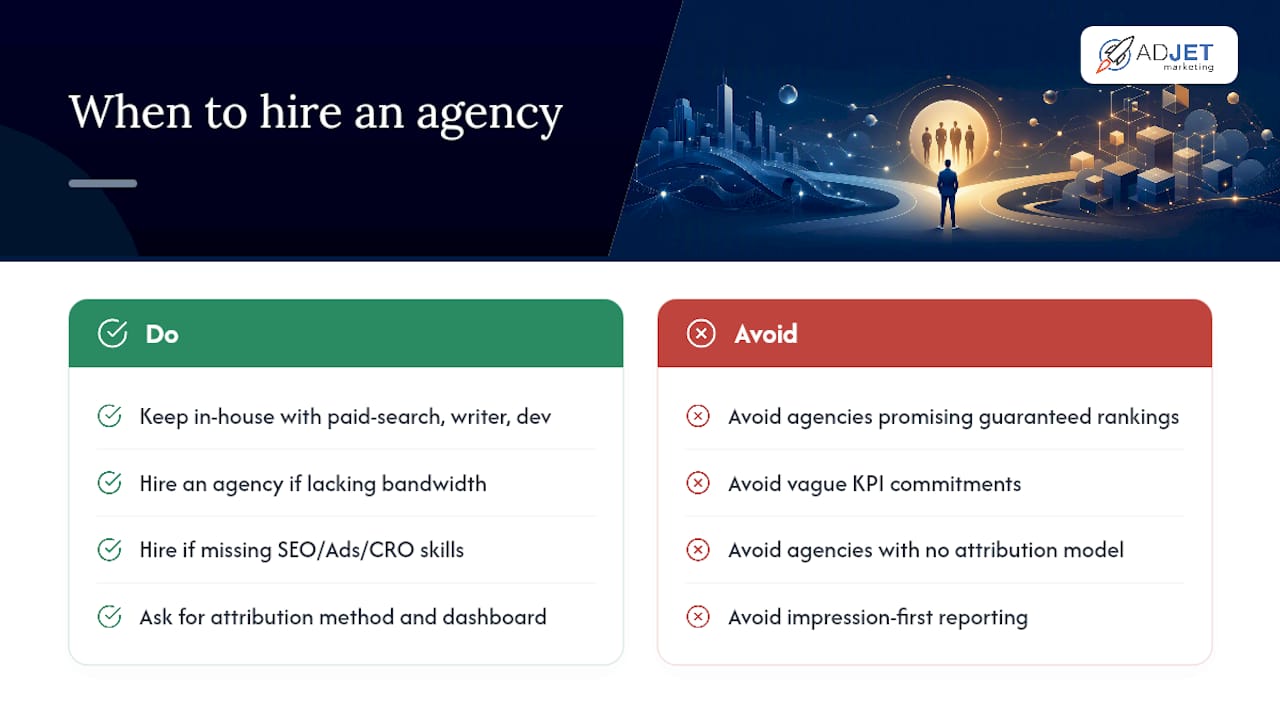
Hire when you lack internal bandwidth, consistent performance data, or the specialized skills required for technical SEO, Google Ads structure, or conversion rate optimization. Those three areas have steep learning curves and direct revenue consequences when done poorly.
Internal teams handle integrated marketing well when they have a dedicated person with paid search experience, a content writer, and a developer who can implement tracking. If any of those are missing, the program will stall.
When evaluating agencies, ask these questions directly:
On measurement: “How do you attribute leads to revenue, and what does your reporting dashboard look like?” An agency that cannot show you a clear path from ad spend to booked appointments is not measuring what matters.
On structure: “Can you walk me through how you would structure our Google Ads campaigns?” Vague answers about “targeting the right audience” are a red flag. Specific answers about match types, negative keyword lists, and ad group organization by intent signal real expertise.
On references: “Can you share a client in our industry and what results they saw in the first 90 days?” Agencies with real results share them. Agencies without them deflect.
Red flags: guaranteed rankings, vague KPI commitments, no attribution model, and reporting that leads with impressions rather than leads or revenue.
Adjetmarketing is a Google Partner agency that builds and manages SEO, Google Ads, and conversion-optimized WordPress landing pages for medical clinics, home services businesses, and real estate professionals. The Google Partner credential signals that the agency meets Google’s standards for campaign management and performance. For a clinic owner who has tried running ads internally and is seeing high CPL with poor lead quality, that combination of paid search structure and landing page expertise is typically where the fastest improvement comes from. You can also review clinic-specific digital marketing strategies to see how the approach applies to appointment-driven businesses.
Key Takeaways
An integrated internet marketing program built on Search, Email, and Social, measured by CAC and conversion rate, and reviewed on a weekly-monthly-quarterly cadence is the most direct path from marketing spend to predictable revenue.
| Point | Details |
|---|---|
| Start with an audit | Run the owned/paid/earned checklist before spending any new budget to find your highest-impact fixes. |
| Three workhorse channels | Prioritize Search, Email, and one social platform; add channels only after these are producing measurable results. |
| Revenue KPIs only | Track CAC, cost per lead, and conversion rate; drop vanity metrics from your reporting entirely. |
| Realistic timelines | Paid search produces leads within days; SEO builds durable visibility over months. Plan for both. |
| Adjetmarketing as your agency partner | Adjetmarketing delivers SEO, Google Ads management, and conversion-optimized landing pages for clinics and local businesses with a Google Partner credential. |
What we see in client work, and what actually fixes it
We see the same pattern regularly. A clinic or home services business has been running Google Ads for six to twelve months, spending a meaningful budget, and the leads are either low quality or not converting to booked appointments. When we dig in, the issue is almost never the ad copy. It is the landing page, the conversion tracking, or both.
Three pitfalls come up most often. First, sending paid traffic to a homepage instead of a dedicated landing page. A homepage has too many exits and no single offer. Second, measuring clicks and impressions instead of booked appointments. If your reporting does not show you cost per booked appointment, you cannot make a rational budget decision. Third, treating SEO and paid as separate programs with separate goals. When they share audience data and messaging, both perform better.
The fastest wins we see: fix conversion tracking first, then build a dedicated landing page for your top service, then tighten ad group structure by intent. Those three changes, done in sequence, typically reduce CPL and improve lead quality within 60 days.
Realistic expectations matter. A well-run integrated program does not produce a flood of leads in week one. It produces a measurable improvement in lead quality and conversion rate over 90 days, and a compounding return over 12 months. That is what we plan for with every client.
Adjetmarketing builds integrated programs that produce measurable results
If you are running paid search without a conversion-optimized landing page, or investing in SEO without a measurement framework tied to revenue, Adjetmarketing can close those gaps. As a Google Partner agency, we manage Google Ads campaigns and build WordPress landing pages designed to convert traffic into booked appointments, not just clicks.
A starter engagement typically includes a full audit of your owned, paid, and earned assets, a 90-day plan with specific KPI targets, and a reporting dashboard that shows pipeline and CAC, not impressions. We work with medical clinics, aesthetic practices, home services businesses, and real estate professionals across the U.S.
If your current program is not producing the lead quality or volume you need, request a conversion audit and we will show you exactly where the gaps are and what fixing them is worth.
Useful sources and further reading
- How to Create a Digital Marketing Strategy | Salesforce
- Digital Marketing Strategy: What You Need to Know
- Digital Marketing Strategy: The Ultimate Guide
- Digital Marketing Strategy in 2026: Framework & Examples | This Is LD
- Mailchimp marketing platform
Recommended
- IV Clinic Marketing – AdJet Digital Marketing & Google Partner Agency | SEO Development Google Ads Social
- Website Optimization Guide For Marketing Pros In 2026
- Maximize Your Franchise Success: Proven Marketing Strategies From Top Agencies – AdJet Digital Marketing & Google Partner Agency | SEO Development Google Ads Social
- How Do We Measure Marketing ROI Beyond CPL? → LTV, CAC & Payback – AdJet Digital Marketing & Google Partner Agency | SEO Development Google Ads Social