









If your practice runs call-only ads, you have a deadline. Google stopped allowing new call-only ads in February 2026, and existing ones stop serving in February 2027. The replacement is a responsive search ad with a call asset. You can still build campaigns whose goal is a ringing phone. The format is what changes.
This guide explains what call-only ads were, why they worked for clinics, what takes their place, and how to move over without losing the calls that fill your schedule. It also covers the privacy and policy questions that matter more in healthcare than in most industries.
TL;DR
- Call-only ads can no longer be created, and every existing one stops serving in February 2027. Plan the move well before then.
- The replacement is the responsive search ad (RSA) with a call asset. Phone-first campaigns remain possible, but you have less control over exact wording.
- Count calls that turn into booked appointments, not raw call volume. Set a minimum call length and import booked appointments where you can.
- Healthcare adds constraints: HIPAA rules on using patient information for marketing, FTC rules on claims, and call recording that is off by default for sensitive industries.
- Phones win only when someone answers. Staffing and a form fallback matter as much as the ad.
Table of Contents
- What call-only ads were, and why clinics liked them
- What is happening to call-only ads
- What replaces them
- An example of a call-focused ad for a medical practice
- How to move your account before February 2027
- Measure calls that become appointments
- Compliance: HIPAA, FTC claims and call recording
- Phone, form or both?
- Perspective: what we tell clinics about this change
- Should you use ads or SEO for calls?
- Where we can help
- FAQ
- Sources
What call-only ads were, and why clinics liked them
Google introduced call-only campaigns in 2015 as mobile search ads that show a business name, a short description, a phone number and a call button. The campaign was optimized for phone calls rather than website visits. Google’s reasoning was simple: some businesses create their value in a conversation, so every click should start a call.
That fits a lot of medical practices. A person with back pain, a toddler with an ear infection or someone who wants a same-week consultation often wants to talk to a human. They do not want to fill out a form and wait.
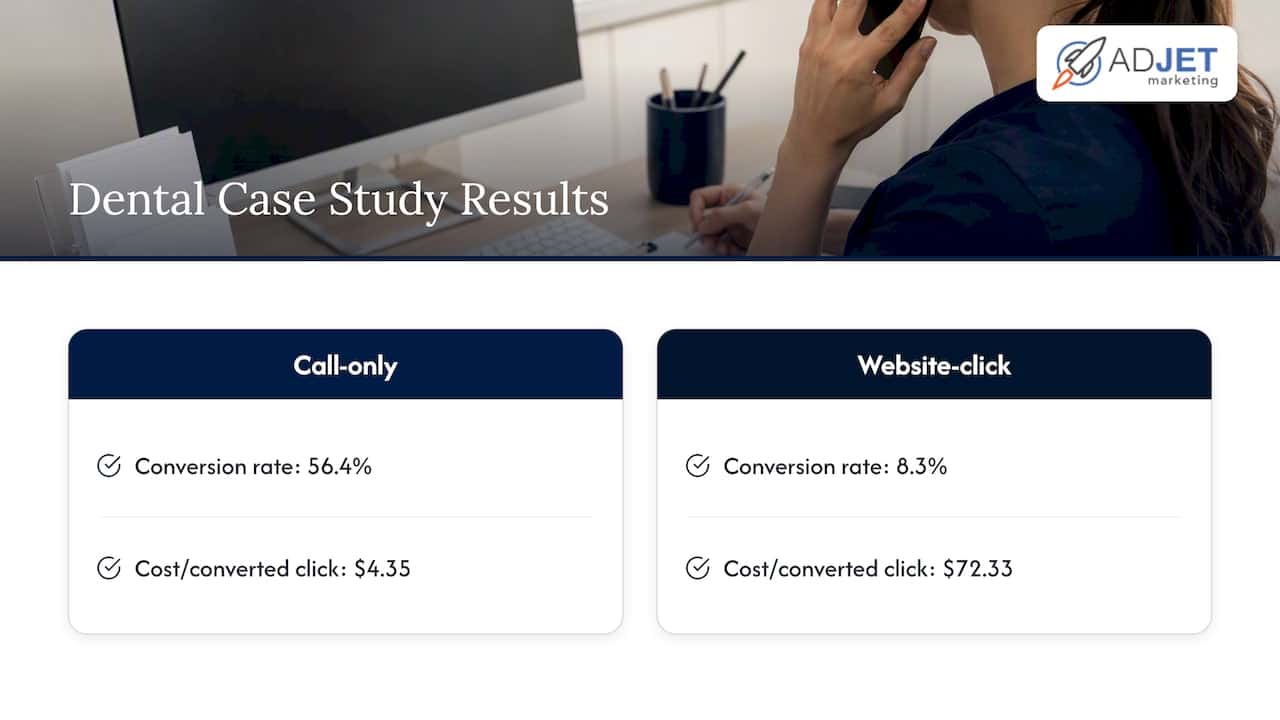
Early results looked strong. A 2015 case study from a U.S. dental practice reported that a call-only campaign converted at 56.4% versus 8.3% for a comparable campaign sending clicks to a website. Cost per converted click was $4.35 versus $72.33. Treat that as one agency’s account from a decade ago, not a benchmark. It does show why the format appealed: it removed the landing page between the searcher and your front desk.
The format had real downsides, which we come back to below. Clicks on the headline could trigger a charge even if the caller hung up, and you could not send people to a page that explained your services, insurance or locations.
What is happening to call-only ads
The timeline is short and fixed:
- February 2026: the option to create new call-only ads was removed.
- February 2027: all existing call-only ads stop receiving impressions.
Google announced the change in October 2025 and gave advertisers a 16-month transition period to move to responsive search ads with call assets. One third-party source reports that Google had already folded call-focused functionality into responsive search ads by mid-2025. That is why many accounts now look different from older tutorials.
If a guide still tells you to pick “Call-only ad” from the ad type menu, it is out of date. Check your own account to see which of your ads are still the old format.
What replaces them
Responsive search ads with call assets
Google’s guidance is that advertisers add their phone numbers to responsive search ads as call assets to keep generating phone leads. An RSA lets you supply multiple headlines and descriptions. Google tests combinations of them to find the ones most likely to perform for each search.
The practical differences for a clinic:
| Call-only ad | RSA with call asset | |
|---|---|---|
| Main action | Call button only | Website click or call |
| Ad copy control | You write fixed headlines and descriptions | You supply options, Google assembles them |
| Landing page | None | Yes, so you can explain services, insurance, locations |
| Who sees the call button | Mobile devices that can call | Devices that can call, when the asset shows |
| Measurement | Calls only | Calls plus form fills and page behavior |
The trade is control for flexibility. You lose the guarantee that every click is a call. You gain a page that can answer questions before the person dials, which often improves call quality.
Local Services Ads
For some specialties, a different product is worth testing alongside search. Google’s U.S. page says eligible healthcare providers can appear in local search with a call or message button, and advertisers pay when a potential customer contacts them instead of for ordinary clicks. Listed categories include dentists, dermatologists, ophthalmologists, optometrists, physical therapists, podiatrists and primary-care providers. If you are in one of those categories, it is a legitimate second channel. If you are not, search with call assets is your route.
An example of a call-focused ad for a medical practice
Below is an illustrative example of the structure, not a real campaign. It is for a fictional physical therapy clinic.
- Headlines (you supply several): “Physical Therapy in Plano”, “Call to Book a Visit”, “Same-Week Appointments”, “Most Insurance Accepted”
- Descriptions: “Evaluation with a licensed therapist. Call our front desk or request a time online.”
- Call asset: the clinic’s tracked local number, with call reporting enabled
- Landing page: a service page with the phone number at the top, hours, accepted insurance and a short form
Two things to notice. Every headline can stand alone, because Google will mix them. And nothing in the copy makes a medical promise, which matters for policy reasons covered below.
Only claim “same-week appointments” or “most insurance accepted” if your schedule and contracts support it. Ad copy that overpromises burns trust at the front desk.
How to move your account before February 2027
Do this in order, and do not pause the old ads until the new ones are collecting data.
- Inventory. List every campaign that still uses call-only ads, with its last 90 days of calls, cost and booked appointments.
- Build RSAs in the same ad groups. Use the keywords that already produced calls. Write at least a dozen distinct headlines, since the system needs variety to test.
- Attach call assets. Use a tracking number, and link your Google Business Profile so the ad has location context. This matches Google’s own recommendations: enable call reporting, set call conversions as a primary goal, use smart bidding and link a business profile.
- Fix the landing page. The old format had none. Put the phone number high on mobile, make it tap-to-call, and add a short form for people who cannot call now.
- Run old and new side by side for a few weeks if you can, then compare cost per booked appointment, not cost per click.
- Retire the old ads once the new setup is stable, and well before the cutoff.
Expect a learning period. Smart bidding needs conversion data, and a clinic with a small number of calls per month will see more volatility. That is a reason to start now, not in January.
Measure calls that become appointments
A call is not a patient. Many clinics come to us with campaigns that report plenty of calls and a front desk that says the leads are poor. The cause is usually that every call, including wrong numbers, existing patients and sales calls, is counted as a win.
Google Ads offers two ways to filter this. You can have Google use AI to analyze call recordings, or set a minimum call duration so that very short calls do not count. For most practices, a minimum duration is the simple first step. A 60-second threshold is a common starting point, but adjust it to how long a real scheduling call lasts at your clinic.
Beyond that:
- Track form fills and calls as separate conversion actions so you can see which one books patients.
- Have the front desk tag calls in your scheduling system by source: new patient, existing patient, insurance question, other.
- Where your systems allow it, send booked appointments back into Google Ads as the conversion that bidding optimizes for.
We cover the setup in detail in our guide to fixing phone call conversion tracking for clinics.
Compliance: HIPAA, FTC claims and call recording
Healthcare advertising has rules that general advice ignores. None of the following is legal advice. Your compliance officer or healthcare attorney should review your setup.
HIPAA and marketing
Under the Privacy Rule, a covered entity generally needs a patient’s written authorization before sharing protected health information (PHI) with a telemarketer for marketing. HHS defines marketing as a communication about a product or service that encourages the recipient to buy or use it. Authorization is generally required unless an exception applies.
The practical rule for ads: do not feed patient lists, appointment details or diagnoses into ad platforms or tracking tools without your compliance team’s sign-off. Conversion tracking that records only that a call of a certain length happened is very different from a tool that ties a call to a named patient and a condition.
Ad claims
The FTC says advertising a medical product or service as preventing, treating or curing disease requires competent and reliable scientific evidence. Keep call ad copy factual: what you offer, where, and how to book.
Call recording
This is where call-only ads and call assets differ from what many clinics assume. For advertisers identified as operating in sensitive industries such as healthcare, Google Ads call recording is disabled automatically unless you accept the Call Ads Supplemental Terms. When it is on, callers hear a short automated message that the call may be recorded. Recording also requires verified domain ownership, a US-based number and call reporting.
Our view: leave recording off unless you have a clear quality-assurance purpose, your compliance review has approved it, and you have confirmed how recordings are stored and who can listen. Duration-based filtering gets you most of the benefit with far less exposure.
Policy limits on health targeting
Health-related keywords can be restricted under Google’s personalized advertising policies. A physical therapy clinic has reported service keywords being disapproved under that policy. That is one practice’s report, not a rule for every account, but it is a reason to avoid remarketing lists built on sensitive conditions and to keep a record of how each campaign is configured.
Phone, form or both?
The phone usually wins in healthcare because patients want an answer now, and high-value procedures often need a conversation. But a phone-only strategy has holes. Calls outside business hours, long hold times and voicemail all lose patients. Some people simply will not call.
Offer both, then make sure both get answered. Practice-management guidance from Physicians Practice recommends that when a website inquiry includes a phone number, especially for higher-value procedures, staff call first, follow up by text, and try again if the patient does not pick up. The same logic applies to ad leads. A well-tuned campaign does nothing if the call goes to voicemail.
A simple operating standard we suggest:
- Answer calls within a few rings during business hours, or route them to a live answering service.
- Respond to every form lead the same day, by phone first.
- Review missed calls weekly. They are leads you paid for.
Perspective: what we tell clinics about this change
We do not see the end of call-only ads as a loss for most practices. The old format was easy to launch and easy to misread. It produced calls, and calls felt like proof. But a campaign that sends every click straight to a phone, with no page, gives you very little to learn from.
The move to RSAs with call assets asks for a bit more work: a landing page that earns trust, conversion tracking that separates real new-patient calls from noise, and a front desk that treats ad calls as the most valuable ones of the day. Clinics that already do those things will barely notice the switch.
We would also be careful about expectations. Smart bidding takes time to learn, results vary by specialty and market, and no one can promise a number of calls or patients. We would rather set a realistic timeline with you, test, and report on booked appointments, with compliance in view from the start.
— Felix
Should you use ads or SEO for calls?
Paid search gives you speed and control. You can show up this month for “urgent care near me” or “botox consultation.” The cost is that calls stop when budget stops. SEO and a strong Google Business Profile take months to build but keep producing calls without a per-click charge. Most practices do best with both, and the right mix depends on budget, competition and how quickly you need new patients. For a broader view, see our healthcare PPC strategy and SEO vs. PPC comparison.
Where we can help
If your account still runs call-only ads and you want a second pair of eyes on the transition, our team manages Google Ads for medical practices, including RSA builds, call tracking and landing pages. We start with an audit of what you have now. Our Google Ads audit checklist for healthcare shows what we look at, and you can run through it yourself first.
FAQ
Are call-only ads still available?
No, not for new campaigns. Google removed the option to create them in February 2026, and existing ones stop serving in February 2027. Check your account for any ads still using the old format.
What is replacing call-only ads?
Responsive search ads with call assets. You supply headlines and descriptions, add your phone number as a call asset, and Google tests combinations. People can then call or visit your site from the same ad.
Can a medical practice still run ads focused only on phone calls?
Yes, in practice. You can set call conversions as your primary goal, use a tracked number and design the landing page around calling. You will not have a pure call-button-only format, so the page and the ad copy need to push toward the phone.
Is it safe to record calls from Google Ads in healthcare?
Recording is off by default for sensitive industries, and you must accept additional terms to turn it on. Callers hear a notice when it is active. Talk to your compliance officer or healthcare attorney before enabling it.
Sources
- Google Ads Help: About call ads
- Google Ads Help: Transition from call ads to call assets
- Google Ads Help: Measure calls from ads
- Google Ads Help: Manage your call recording settings and eligibility
- Google Ads Help: Set up call recording
- Google Ads Help community: physical therapy keywords disapproved
- Inside AdWords: Charge up your phones with call-only campaigns
- Google Local Services Ads for U.S. businesses
- Search Engine Land: Google to phase out call-only ads by 2027
- Case study: call-only PPC ad optimization
- ClickGUARD: call-only ads in responsive format
- HHS: HIPAA marketing FAQ
- HHS: HIPAA guidance on contacting former patients
- FTC letter on unsubstantiated health claims
- Physicians Practice: the five minutes that decide whether a new patient books